Kenya Flower and Ornamental Plants Market Summary
The kenya flower and ornamental plants market was estimated at USD 1029 Million in 2025 and is projected to reach USD 1497 Million by 2032, growing at a CAGR of 6.5% from 2026 to 2032.
Kenya Flower and Ornamental Plants Market Year-wise Growth Rate and Key Drivers
This graph highlights how the Kenya Flower and Ornamental Plants Market has steadily grown over the years, supported by major growth factors.
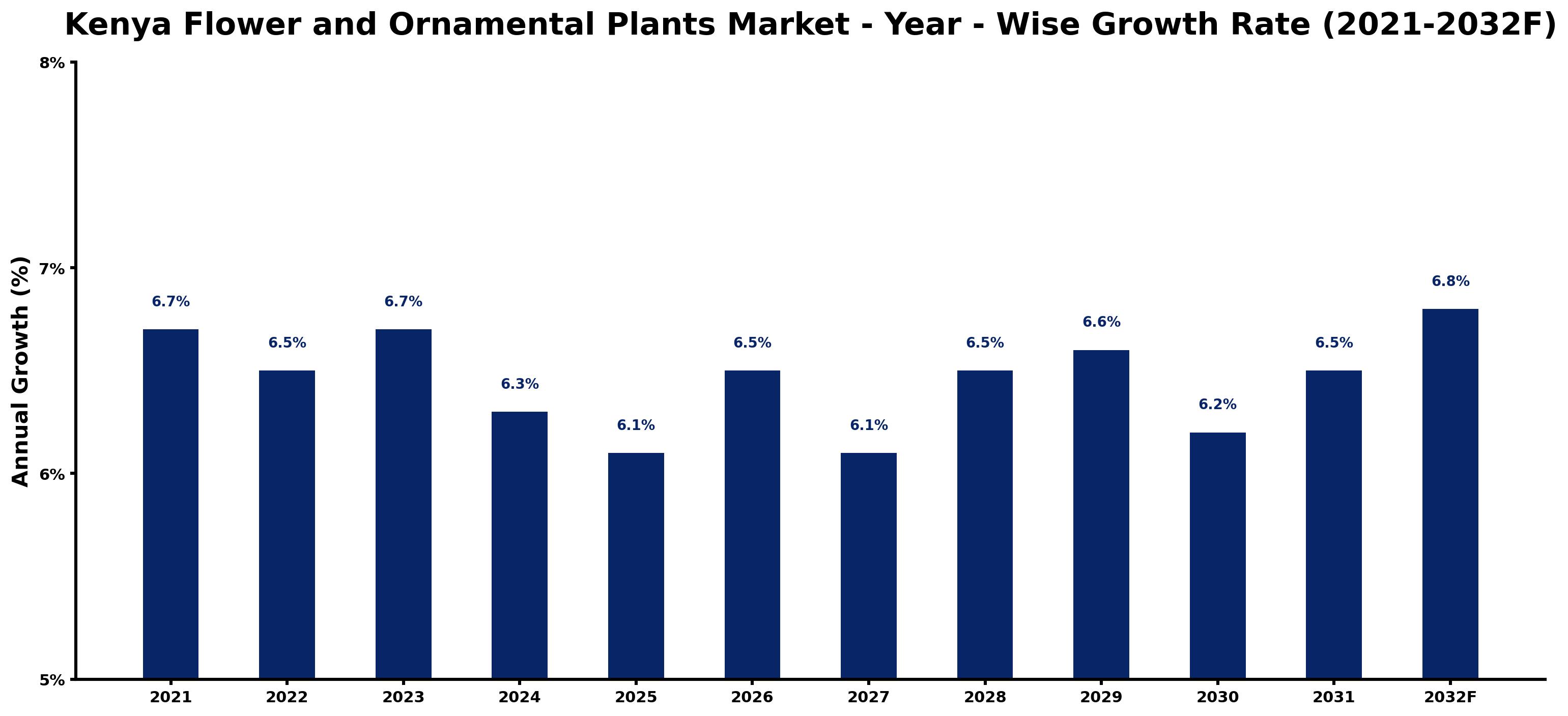
The table below presents the year wise growth rates along with the key drivers influencing the market
| Year | Growth Rate | Major Drivers |
| 2021 | 6.7% | The local horticulture sector saw a significant uptick as events resumed post-pandemic. |
| 2022 | 6.5% | Investment in sustainable farming practices attracted foreign interest in Kenya's floriculture. |
| 2023 | 6.7% | E-commerce platforms emerged, transforming how consumers purchase flowers and plants. |
| 2024 | 6.3% | Consumer preference shifted towards locally sourced and sustainable ornamental plants. |
| 2025 | 6.1% | Export channels expanded, facilitating access to international markets for Kenyan florists. |
| 2026 | 6.5% | Urbanization trends prompted increased demand for ornamental plants in residential spaces. |
| 2027 | 6.1% | Agro-tourism initiatives began integrating flower farms, boosting local economy and visibility. |
| 2028 | 6.5% | Technological innovations streamlined supply chains, improving efficiency in flower distribution. |
| 2029 | 6.6% | Consumer education on plant care grew, positively impacting sales and customer loyalty. |
| 2030 | 6.2% | Luxury events showcasing Kenyan flowers highlighted the nation's competitive advantage globally. |
| 2031 | 6.5% | Collaborations between farmers and designers created unique products for upscale markets. |
| 2032 | 6.8% | Sustainable branding became essential as consumers prioritized eco-friendly purchasing choices. |
Note - Market size estimations and growth projections presented in this report are based on 6Wresearch's advanced forecasting approach, validated with industry datasets as of June 2026.
Kenya Flower and Ornamental Plants Market Synopsis
The Kenya Flower and Ornamental Plants Market is projected to reach 6.5% and witness significant growth during the forecast period (2026-2032). As the leading producer of ornamental plants in Africa, Kenya boasts an impressive export volume, generating over $20 million annually in floral exports to European markets. This substantial revenue underscores the country's dominance in the global floral market and its strategic importance in supplying high-quality varieties that cater to evolving consumer preferences.
Kenya Flower and Ornamental Plants Market Growth Drivers
The robust growth of the Kenya Flower and Ornamental Plants Market can be primarily attributed to several key drivers:
- Increasing demand from European countries is a significant catalyst for market expansion. These regions are characterized by high purchasing power, which enables consumers to invest in premium quality floral and ornamental products, thereby boosting exports from Kenya.
- Technological advancements, including the adoption of automated greenhouse systems, have resulted in improved production efficiency. These innovations not only enhance crop yields but also provide farmers with the flexibility to diversify their floral offerings, catering to a wider array of tastes and preferences.
- Government initiatives have played a crucial role in facilitating market growth. The implementation of free trade agreements within the African continent has expanded export channels and allowed for increased market penetration, thus benefiting local growers.
- The rising trend of sustainable farming practices is gaining traction in the industry. As consumers become more environmentally conscious, growers are continuously seeking methods to produce flowers and ornamental plants with minimal environmental impact, which could further support market expansion.
- An increase in the popularity of online floral retailing offers new avenues for market growth. E-commerce platforms provide consumers with easy access to a broader selection of floral products, thus enhancing the potential for sales and market reach.
Kenya Flower and Ornamental Plants Market Challenges and Restraints
While the Kenya Flower and Ornamental Plants Market exhibits significant growth potential, several challenges continue to impede its progress:
- Price volatility remains a primary concern, as unstable weather patterns can lead to fluctuations in supply. This unpredictability can result in both shortages and oversupply, subsequently impacting profit margins for local growers.
- Climate change poses an ongoing threat to the agricultural sector, as changing weather conditions may affect crop quality and yield. Growers must adapt to these shifts to ensure sustainability and profitability.
- Access to funding and credit facilities for small-scale farmers can be limited, restricting their ability to invest in advanced technologies and quality improvements necessary for remaining competitive in the global marketplace.
- The increasing competition from both local and international suppliers may pressure prices and challenge market share. Local growers must enhance their offerings to differentiate themselves amidst a crowded market.
- Regulatory hurdles surrounding plant exports, including compliance with international standards, can complicate trade and introduce additional costs for growers. This bureaucracy may deter some businesses from engaging fully in international markets.
Kenya Flower and Ornamental Plants Market Government Investment and Initiatives
The Kenyan government has undertaken various initiatives aimed at bolstering the flower and ornamental plants sector. Investments in research and development are being prioritized to enhance agricultural productivity, focusing on sustainable practices that can withstand climate variability. Additionally, government support through training programs for farmers is instrumental in equipping them with the necessary skills to adopt advanced agricultural techniques.
Public spending on infrastructure development, such as improving transport links to major export markets, is also a critical area of focus. Enhanced logistics capabilities not only facilitate timely deliveries but also reduce costs associated with exports. Moreover, the promotion of trade agreements with other African nations encourages collaborative growth opportunities and strengthens market access.
Furthermore, the government fosters collaborations with private-sector stakeholders to create a more robust floral industry capable of meeting international standards. Such partnerships are essential in driving innovation and competitiveness within the sector, contributing to long-term sustainability and growth.
Kenya Flower and Ornamental Plants Market Latest Developments (May 2025 - June 2026)
Between May 2025 and June 2026, the Kenya Flower and Ornamental Plants Market has seen notable developments reflecting its dynamic nature. There has been a marked increase in the integration of technology in farming practices, with more growers investing in hydroponic systems. This shift allows for better climate control and increased yields, even under adverse weather conditions, aligning production capabilities with market demand.
Additionally, there is an observable trend towards diversifying product portfolios. Many growers are introducing new flower varieties and ornamental plants that have been enhanced for durability and aesthetic appeal, catering to evolving consumer preferences, particularly in export markets.
Sustainability efforts have gained momentum, with more entities committing to environmentally responsible practices. These initiatives not only contribute to climate resilience but also enhance brand reputation among consumers who increasingly favor eco-friendly products.
Lastly, the landscape of flower retailing has also undergone transformation. The rise of e-commerce platforms has enabled farmers to access a broader customer base, revolutionizing sales strategies and increasing overall market competitiveness.
Kenya Flower and Ornamental Plants Market - Key Attractiveness of the Report
- 10 Years of Market Numbers
- Historical Data Starting from 2022 to 2025
- Base Year: 2025
- Forecast Data until 2032
- Key Performance Indicators Impacting the Market
- Major Upcoming Developments and Projects
Key Highlights of the Report:
- Kenya Flower and Ornamental Plants Market Outlook
- Market Size of Kenya Flower and Ornamental Plants Market, 2025
- Forecast of Kenya Flower and Ornamental Plants Market, 2032F
- Historical Data and Forecast of Kenya Flower and Ornamental Plants Revenues & Volume for the Period 2022-2032F
- Kenya Flower and Ornamental Plants Market Trend Evolution
- Kenya Flower and Ornamental Plants Market Drivers and Challenges
- Kenya Flower and Ornamental Plants Price Trends
- Kenya Flower and Ornamental Plants Porter's Five Forces
- Kenya Flower and Ornamental Plants Industry Life Cycle
- Historical Data and Forecast of Kenya Flower and Ornamental Plants Market Revenues & Volume By Product Type for the Period 2022-2032F
- Historical Data and Forecast of Kenya Flower and Ornamental Plants Market Revenues & Volume By Potted Plants for the Period 2022-2032F
- Historical Data and Forecast of Kenya Flower and Ornamental Plants Market Revenues & Volume By Cut Flowers for the Period 2022-2032F
- Historical Data and Forecast of Kenya Flower and Ornamental Plants Market Revenues & Volume By Application for the Period 2022-2032F
- Historical Data and Forecast of Kenya Flower and Ornamental Plants Market Revenues & Volume By Home for the Period 2022-2032F
- Historical Data and Forecast of Kenya Flower and Ornamental Plants Market Revenues & Volume By Commercial for the Period 2022-2032F
- Kenya Flower and Ornamental Plants Import Export Trade Statistics
- Market Opportunity Assessment By Product Type
- Market Opportunity Assessment By Application
- Kenya Flower and Ornamental Plants Top Companies Market Share
- Kenya Flower and Ornamental Plants Competitive Benchmarking By Technical and Operational Parameters
- Kenya Flower and Ornamental Plants Company Profiles
- Kenya Flower and Ornamental Plants Key Strategic Recommendations






































