Kenya Food Processing & Handling Equipment Market Summary
The kenya food processing & handling equipment market was estimated at USD 483 Million in 2025 and is projected to reach USD 679 Million by 2032, growing at a CAGR of 5.9% from 2026 to 2032.
Kenya Food Processing & Handling Equipment Market Year-wise Growth Rate and Key Drivers
This graph highlights how the Kenya Food Processing & Handling Equipment Market has steadily grown over the past five years, supported by major growth factors.
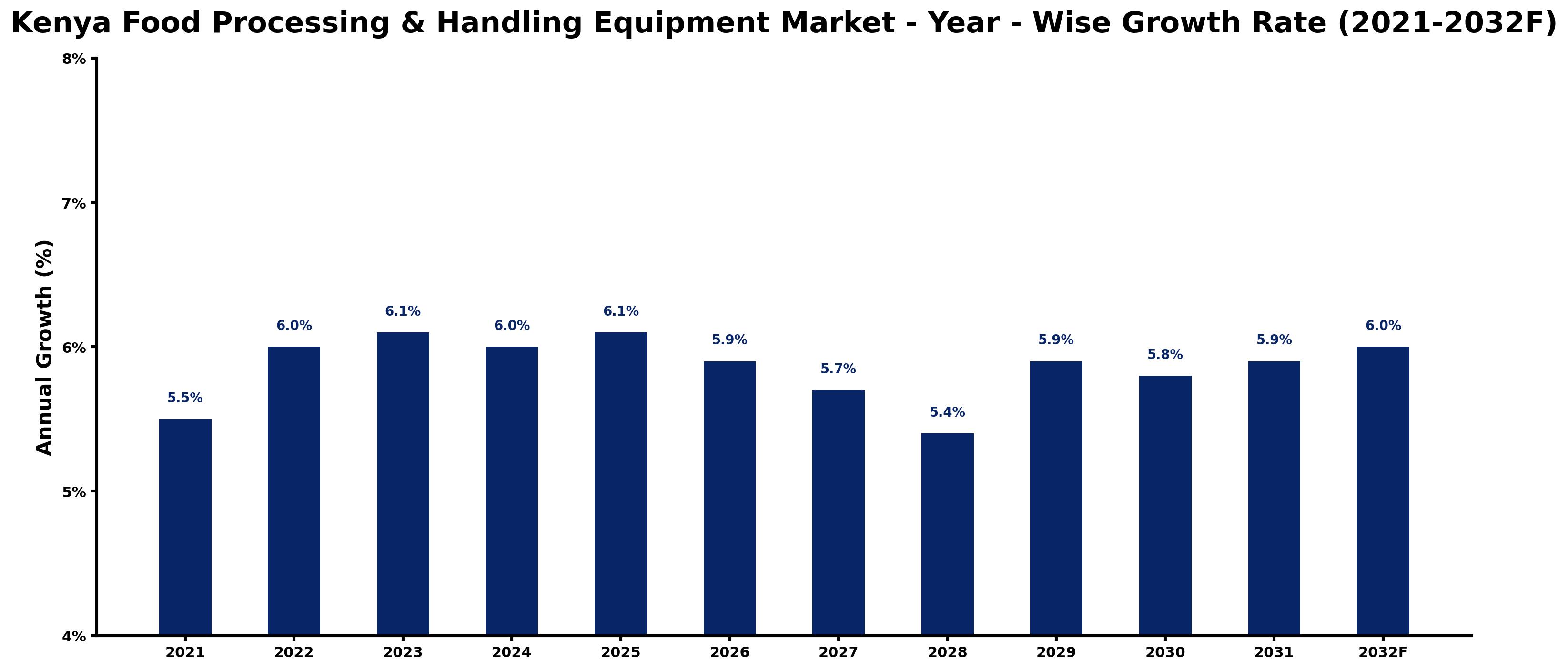
The table below presents the year wise growth rates along with the key drivers influencing the market
| Year | Growth Rate | Major Drivers |
| 2021 | 5.5% | Local manufacturers began focusing on quality improvements to meet international standards. |
| 2022 | 6.0% | Urbanization prompted changes in consumer preferences for processed food options. |
| 2023 | 6.1% | Investment in logistics infrastructure enhanced distribution channels across major cities. |
| 2024 | 6.0% | Emerging food tech startups introduced innovative processing solutions to traditional markets. |
| 2025 | 6.1% | Export opportunities to regional markets encouraged local firms to enhance production capabilities. |
| 2026 | 5.9% | Consumer awareness of food safety standards increased demand for advanced handling equipment. |
| 2027 | 5.7% | Agricultural partnerships grew, integrating processing facilities closer to production sites. |
| 2028 | 5.4% | E-commerce platforms facilitated direct sales, leading to higher demand for efficient processing. |
| 2029 | 5.9% | Sustainability trends influenced manufacturers to adopt eco-friendly processing technologies. |
| 2030 | 5.8% | Expansion of the middle-class created a larger customer base for processed foods. |
| 2031 | 5.9% | Technological collaborations emerged, fostering knowledge transfer and equipment modernization. |
| 2032 | 6.0% | Global food trends drove local processors to innovate and diversify product offerings. |
Note - Market size estimations and growth projections presented in this report are based on 6Wresearch's advanced forecasting approach, validated with industry datasets as of June 2026.
Kenya Food Processing & Handling Equipment Market Synopsis
The Kenya Food Processing Handling Equipment Market is projected to reach 5.9% and witness significant growth during the forecast period (2026-2032). This growth can be attributed to factors such as increasing urbanization, a rise in disposable incomes, and a growing consumer appetite for processed food products. As technological advancements continue to evolve, the focus on enhancing efficiency and safety in food processing operations is becoming paramount. The market encompasses a diverse range of equipment, including mixers, grinders, slicers, packaging machinery, and refrigeration systems, all of which are essential for modern food processing. Additionally, government initiatives aimed at promoting food processing and sector investments are stimulating market expansion.
Kenya Food Processing & Handling Equipment Market Growth Drivers
The factors fueling the growth of the Kenya Food Processing & Handling Equipment Market are multifaceted. Key growth drivers include:
- Urbanization is rapidly reshaping consumer lifestyles, leading to an increased demand for processed and packaged food products as city dwellers seek convenience.
- Rising disposable incomes create opportunities for consumers to invest in higher-quality food products, further driving the demand for efficient food processing equipment.
- Technological advancements in food processing machinery, including automation and robotics, enhance operational efficiency and reduce production costs.
- The growing emphasis on food safety and quality standards is propelling businesses to invest in advanced processing equipment that complies with regulatory requirements.
- Government support through various initiatives aimed at promoting food security and agribusiness is fostering a conducive environment for investments in food processing technology.
Kenya Food Processing & Handling Equipment Market Trends and Opportunities
The Kenya Food Processing & Handling Equipment Market is witnessing several notable trends that present opportunities for growth:
- There is a marked shift towards sustainable practices within the food processing sector, where companies are increasingly investing in environmentally friendly machinery to align with consumer preferences.
- The adoption of digital solutions and smart technologies is becoming commonplace, offering manufacturers tools to optimize production processes and enhance inventory management.
- With the growing popularity of indigenous foods, there is an increasing interest in machinery specifically designed for processing local crops and traditional food products.
- Food safety and compliance with international standards are prompting businesses to upgrade their equipment to incorporate features that monitor and ensure food quality.
- Collaboration between public and private sectors is strengthening, paving the way for innovation and improved infrastructure in the food processing landscape.
Kenya Food Processing & Handling Equipment Market Challenges and Restraints
Despite its growth prospects, the Kenya Food Processing & Handling Equipment Market faces several challenges that could hinder its development:
- Access to affordable financing remains a critical barrier for small and medium-sized enterprises (SMEs), which often lack the capital to invest in modern, technologically advanced equipment.
- The skill gap in the labor market presents challenges, as many workers are not adequately trained to operate sophisticated food processing machinery.
- Inconsistent power supply leads to disruptions in production processes, affecting overall operational efficiency for food processing facilities.
- Inadequate transportation and storage infrastructure for processed food products increases logistical challenges and operational costs.
- Competition from imported equipment poses a threat, as international players often provide more advanced and cost-effective solutions.
Kenya Food Processing & Handling Equipment Market Investment Opportunities
Investment opportunities in the Kenya Food Processing & Handling Equipment Market are abundant, driven by the following factors:
- The demand for industrial ovens, packaging machines, refrigeration systems, and food processing machinery is on the rise, fueled by changing consumer preferences and urbanization.
- The government's pro-agribusiness stance and initiatives to enhance food security create a fertile ground for investment in modern food processing technologies.
- Developing local partnerships can open doors for companies to expand their distribution networks and penetrate untapped market segments effectively.
- The growing middle-class population in Kenya is increasing the demand for convenience foods, necessitating investments in equipment that can cater to this market trend.
- Investing in local manufacturing capabilities for food processing equipment may reduce dependence on imports and enhance the resilience of the local industry.
Kenya Food Processing & Handling Equipment Market Government Investment and Initiatives
The Kenyan government has instituted various policies to bolster the food processing and handling equipment market. Key initiatives include:
- The Food, Drugs, and Chemical Substances Act regulates the quality and safety of food products, ensuring that manufacturers adhere to stringent standards.
- The Agriculture Sector Transformation and Growth Strategy aims to enhance the efficiency and competitiveness of the food processing industry by promoting advanced technologies and best practices.
- The Kenya Bureau of Standards (KEBS) plays a critical role in setting standards for food processing equipment, ensuring that products meet quality and safety expectations.
- Incentives such as tax breaks and investment opportunities are designed to attract both domestic and foreign investors to the food processing sector.
- Public spending on infrastructure development is integral to improving the overall supply chain for processed food products, enhancing distribution capabilities.
Kenya Food Processing & Handling Equipment Market Latest Developments (May 2025 - June 2026)
In the period from May 2025 to June 2026, significant developments within the Kenya Food Processing & Handling Equipment Market indicate a shift towards modernization and increased investment. The focus has been on enhancing efficiency through automation solutions and upgrading to environmentally sustainable equipment. Industry stakeholders are increasingly adapting to consumer demands for quality and safety, pushing for compliance with international standards. Initiatives to improve infrastructure have also gained momentum, positioning local manufacturers to better compete with imported counterparts. Overall, the direction of the industry reflects a commitment to innovation, sustainability, and responsiveness to market needs.
Kenya Food Processing & Handling Equipment Market - Key Attractiveness of the Report
- 10 Years of Market Numbers
- Historical Data Starting from 2022 to 2025
- Base Year: 2025
- Forecast Data until 2032
- Key Performance Indicators Impacting the Market
- Major Upcoming Developments and Projects
Key Highlights of the Report:
- Kenya Food Processing & Handling Equipment Market Outlook
- Market Size of Kenya Food Processing & Handling Equipment Market, 2025
- Forecast of Kenya Food Processing & Handling Equipment Market, 2032F
- Historical Data and Forecast of Kenya Food Processing & Handling Equipment Revenues & Volume for the Period 2022-2032F
- Kenya Food Processing & Handling Equipment Market Trend Evolution
- Kenya Food Processing & Handling Equipment Market Drivers and Challenges
- Kenya Food Processing & Handling Equipment Price Trends
- Kenya Food Processing & Handling Equipment Porter's Five Forces
- Kenya Food Processing & Handling Equipment Industry Life Cycle
- Historical Data and Forecast of Kenya Food Processing & Handling Equipment Market Revenues & Volume By Equipment Type for the Period 2022-2032F
- Historical Data and Forecast of Kenya Food Processing & Handling Equipment Market Revenues & Volume By Food Processing equipment for the Period 2022-2032F
- Historical Data and Forecast of Kenya Food Processing & Handling Equipment Market Revenues & Volume By Foodservice equipment for the Period 2022-2032F
- Historical Data and Forecast of Kenya Food Processing & Handling Equipment Market Revenues & Volume By Food Packaging equipment for the Period 2022-2032F
- Historical Data and Forecast of Kenya Food Processing & Handling Equipment Market Revenues & Volume By Application for the Period 2022-2032F
- Historical Data and Forecast of Kenya Food Processing & Handling Equipment Market Revenues & Volume By Bakery & confectionery products for the Period 2022-2032F
- Historical Data and Forecast of Kenya Food Processing & Handling Equipment Market Revenues & Volume By Meat & poultry products for the Period 2022-2032F
- Historical Data and Forecast of Kenya Food Processing & Handling Equipment Market Revenues & Volume By Dairy products for the Period 2022-2032F
- Historical Data and Forecast of Kenya Food Processing & Handling Equipment Market Revenues & Volume By Alcoholic beverages for the Period 2022-2032F
- Historical Data and Forecast of Kenya Food Processing & Handling Equipment Market Revenues & Volume By Non-alcoholic beverages for the Period 2022-2032F
- Historical Data and Forecast of Kenya Food Processing & Handling Equipment Market Revenues & Volume By Fish & seafood products for the Period 2022-2032F
- Historical Data and Forecast of Kenya Food Processing & Handling Equipment Market Revenues & Volume By Others? for the Period 2022-2032F
- Historical Data and Forecast of Kenya Food Processing & Handling Equipment Market Revenues & Volume By Form for the Period 2022-2032F
- Historical Data and Forecast of Kenya Food Processing & Handling Equipment Market Revenues & Volume By Solid for the Period 2022-2032F
- Historical Data and Forecast of Kenya Food Processing & Handling Equipment Market Revenues & Volume By Liquid for the Period 2022-2032F
- Historical Data and Forecast of Kenya Food Processing & Handling Equipment Market Revenues & Volume By Semi-solid for the Period 2022-2032F
- Kenya Food Processing & Handling Equipment Import Export Trade Statistics
- Market Opportunity Assessment By Equipment Type
- Market Opportunity Assessment By Application
- Market Opportunity Assessment By Form
- Kenya Food Processing & Handling Equipment Top Companies Market Share
- Kenya Food Processing & Handling Equipment Competitive Benchmarking By Technical and Operational Parameters
- Kenya Food Processing & Handling Equipment Company Profiles
- Kenya Food Processing & Handling Equipment Key Strategic Recommendations






































