Kenya Home Appliances Market Summary
The kenya home appliances market was estimated at USD 576 Million in 2025 and is projected to reach USD 834 Million by 2032, growing at a CAGR of 6.4% from 2026 to 2032.
Kenya Home Appliances Market Year-wise Growth Rate and Key Drivers
This graph highlights how the Kenya Home Appliances Market has steadily grown over the past five years, supported by major growth factors.
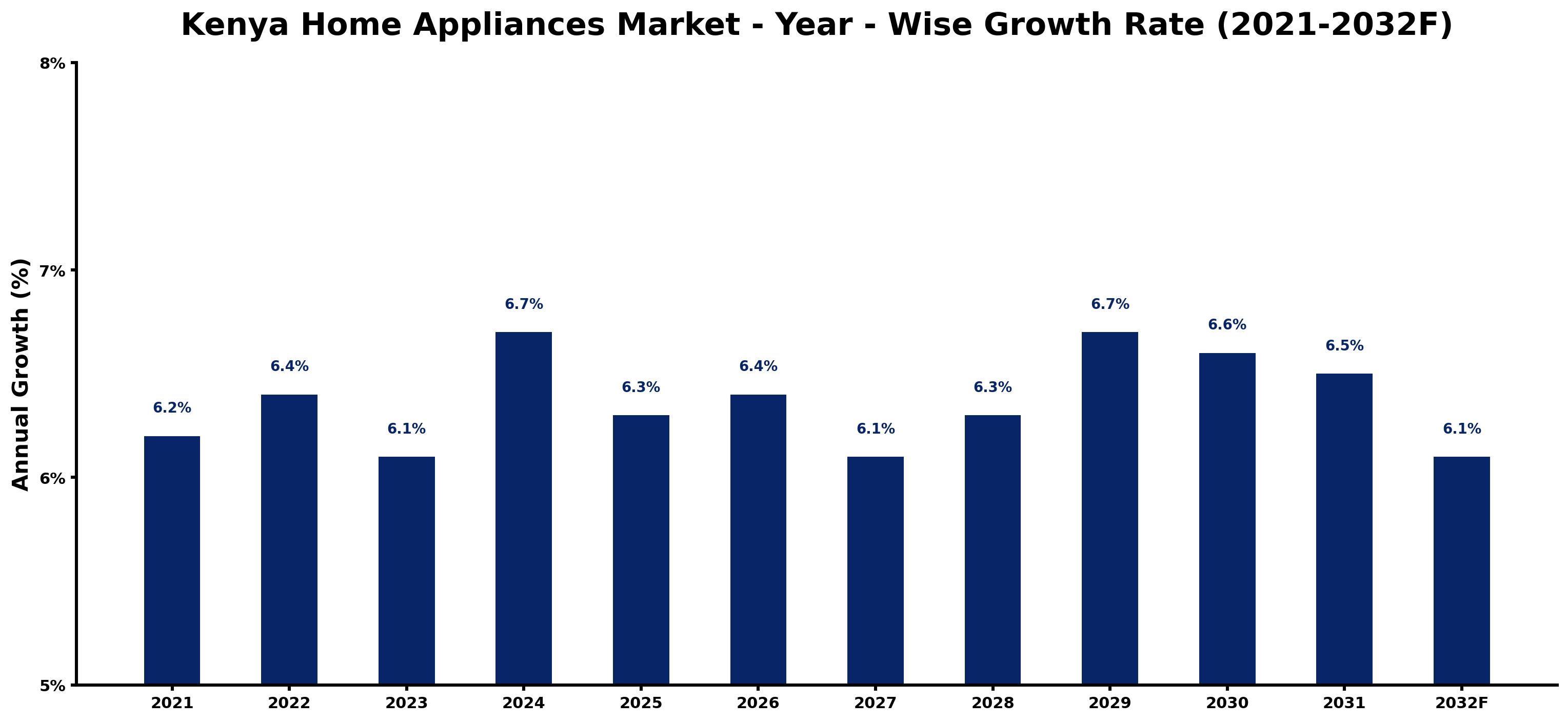
The table below presents the year wise growth rates along with the key drivers influencing the market
| Year | Growth Rate | Major Drivers |
| 2021 | 6.2% | Shifts in consumer priorities highlight energy-efficient appliances as essential purchases. |
| 2022 | 6.4% | Urbanization continues to accelerate, driving demand for modern kitchen technologies. |
| 2023 | 6.1% | Supply chain disruptions prompt local manufacturers to explore sustainable production methods. |
| 2024 | 6.7% | Rising disposable incomes enable households to invest in premium home appliance brands. |
| 2025 | 6.3% | Innovative financing options make high-end appliances more accessible to average consumers. |
| 2026 | 6.4% | The tech-savvy youth are increasingly prioritizing smart home integration in appliances. |
| 2027 | 6.1% | Local manufacturers enhance product quality, fostering consumer trust and brand loyalty. |
| 2028 | 6.3% | The rise of e-commerce platforms transforms traditional retail dynamics for home appliances. |
| 2029 | 6.7% | Environmental awareness shifts consumer preferences toward eco-friendly appliance options. |
| 2030 | 6.6% | Increased competition drives continuous innovation among both local and international brands. |
| 2031 | 6.5% | Energy tariffs stabilize, making energy-efficient appliances a financially wise choice. |
| 2032 | 6.1% | Integration of Internet of Things technology enhances appliance functionality and convenience. |
Note - Market size estimations and growth projections presented in this report are based on 6Wresearch's advanced forecasting approach, validated with industry datasets as of June 2026.
Kenya Home Appliances Market Synopsis
The Kenya Home Appliances Market is projected to reach 6.4% and witness significant growth during the forecast period (2026-2032). This dynamic market is characterized by the increasing urbanization, which is driving a rapid shift in consumer lifestyles and preferences. The rising disposable incomes among Kenyan households are leading to higher demand for modern home appliances that enhance convenience and efficiency in daily living.
Kenya Home Appliances Market Growth Drivers
Several key factors are contributing to the growth trajectory of the Kenya Home Appliances Market. Urbanization is at the forefront, with more people migrating to urban centers, necessitating the need for essential household appliances. Additionally, the gradual increase in disposable income is empowering consumers to invest in quality appliances, leading to a significant shift in purchasing behavior.
- The ongoing urbanization process is encouraging the development of new housing projects, which are often equipped with modern home appliances to meet the expectations of urban dwellers.
- As Kenyans experience rising disposable incomes, they are also increasingly discerning, seeking out energy-efficient and advanced appliances that promote sustainability.
- The growing emphasis on enhanced lifestyles is evident, as appliances that facilitate quick meal preparation, laundry, and home comfort are becoming standard in many households.
- Product innovations in smart technologies are inspiring consumers to upgrade their appliances to improve energy efficiency and usability, which is a growing trend in urban areas.
- Finally, the competitive landscape with both local and international brands is encouraging price reductions and improved product offerings, further stimulating market demand.
Kenya Home Appliances Market Challenges and Restraints
Despite the promising growth, the Kenya Home Appliances Market faces notable challenges. Affordability remains a significant barrier for many consumers, particularly in lower-income brackets. Additionally, the market must navigate issues related to energy efficiency and product reliability, as consumers increasingly demand high-quality, durable products.
- Many households are still grappling with the financial implications of investing in multiple home appliances, often delaying purchases or opting for lower-quality products.
- There are also technical hurdles associated with developing products that cater to the diverse preferences and needs of the local population while ensuring competitive pricing.
- Inconsistencies in energy supply may deter consumers from investing in energy-intensive appliances, prompting businesses to adjust their offerings accordingly.
- Market players need to focus on educating consumers about the long-term savings associated with energy-efficient appliances to combat short-term price concerns.
- In addition, the importation of appliances may be affected by fluctuations in tariffs and regulatory frameworks, impacting the availability and pricing of these products.
Kenya Home Appliances Market Government Investment and Initiatives
The Kenyan government has taken significant steps to bolster the home appliances market through various investment initiatives. These efforts are predominantly focused on enhancing living standards nationwide and promoting energy-efficient technologies. The government aims to improve access to essential amenities, which includes facilitating the financing of home appliances.
- Policies promoting energy efficiency and the adoption of sustainable technologies are becoming increasingly favorable, creating a conducive environment for market growth.
- Government incentives for manufacturers producing energy-saving appliances are likely to enhance local production capabilities, thereby boosting the domestic market.
- Investment in infrastructure development directly impacts the home appliances market by ensuring reliable energy supply, further encouraging consumer confidence in electric appliances.
- Public spending on urban housing projects also aligns with market growth, as these developments typically incorporate modern appliances in their designs.
- Moreover, government initiatives aimed at consumer education about the benefits of smart appliances are crucial in fostering increased adoption among the populace.
Kenya Home Appliances Market Latest Developments (May 2025 - June 2026)
In the period between May 2025 and June 2026, the Kenya Home Appliances Market has undergone several notable developments. A rise in consumer interest in smart appliances has led to an influx of products featuring advanced technology aimed at enhancing energy efficiency. This has coincided with increased public awareness campaigns by government and private entities emphasizing the importance of energy conservation.
- New entrants into the market have begun offering innovative home appliances at competitive prices, which has intensified market competition and benefited consumers.
- There has been a notable increase in partnerships between appliance manufacturers and local suppliers to streamline distribution channels and improve accessibility to urban and rural consumers.
- Additionally, the government has rolled out initiatives to support financing options for first-time appliance buyers, helping to alleviate affordability issues.
- Consumer preferences have shifted towards more eco-friendly options, resulting in an uptick in demand for energy-efficient models across various appliance categories.
- Amid these developments, market participants have also increased their focus on after-sales services and warranty offerings to enhance customer satisfaction and build brand loyalty.
Kenya Home Appliances Market - Key Attractiveness of the Report
- 10 Years of Market Numbers
- Historical Data Starting from 2022 to 2025
- Base Year: 2025
- Forecast Data until 2032
- Key Performance Indicators Impacting the Market
- Major Upcoming Developments and Projects
Key Highlights of the Report:
- Kenya Home Appliances Market Outlook
- Market Size of Kenya Home Appliances Market, 2025
- Forecast of Kenya Home Appliances Market, 2032
- Historical Data and Forecast of Kenya Home Appliances Revenues & Volume for the Period 2022-2032F
- Kenya Home Appliances Market Trend Evolution
- Kenya Home Appliances Market Drivers and Challenges
- Kenya Home Appliances Price Trends
- Kenya Home Appliances Porter's Five Forces
- Kenya Home Appliances Industry Life Cycle
- Historical Data and Forecast of Kenya Home Appliances Market Revenues & Volume By Product Types for the Period 2022-2032F
- Historical Data and Forecast of Kenya Home Appliances Market Revenues & Volume By Kitchen Appliances for the Period 2022-2032F
- Historical Data and Forecast of Kenya Home Appliances Market Revenues & Volume By Washing Appliances for the Period 2022-2032F
- Historical Data and Forecast of Kenya Home Appliances Market Revenues & Volume By Entertainment Appliances for the Period 2022-2032F
- Historical Data and Forecast of Kenya Home Appliances Market Revenues & Volume By Air Conditioner for the Period 2022-2032F
- Historical Data and Forecast of Kenya Home Appliances Market Revenues & Volume By Others for the Period 2022-2032F
- Historical Data and Forecast of Kenya Home Appliances Market Revenues & Volume By Technology for the Period 2022-2032F
- Historical Data and Forecast of Kenya Home Appliances Market Revenues & Volume By Wi-Fi for the Period 2022-2032F
- Historical Data and Forecast of Kenya Home Appliances Market Revenues & Volume By Bluetooth for the Period 2022-2032F
- Historical Data and Forecast of Kenya Home Appliances Market Revenues & Volume By ZigBee for the Period 2022-2032F
- Historical Data and Forecast of Kenya Home Appliances Market Revenues & Volume By Radio Frequency Identification for the Period 2022-2032F
- Historical Data and Forecast of Kenya Home Appliances Market Revenues & Volume By Cellular Technology for the Period 2022-2032F
- Historical Data and Forecast of Kenya Home Appliances Market Revenues & Volume By IoT for the Period 2022-2032F
- Historical Data and Forecast of Kenya Home Appliances Market Revenues & Volume By Distribution Channel for the Period 2022-2032F
- Historical Data and Forecast of Kenya Home Appliances Market Revenues & Volume By Retail for the Period 2022-2032F
- Historical Data and Forecast of Kenya Home Appliances Market Revenues & Volume By E-commerce for the Period 2022-2032F
- Historical Data and Forecast of Kenya Home Appliances Market Revenues & Volume By Others for the Period 2022-2032F
- Kenya Home Appliances Import Export Trade Statistics
- Market Opportunity Assessment By Product Types
- Market Opportunity Assessment By Technology
- Market Opportunity Assessment By Distribution Channel
- Kenya Home Appliances Top Companies Market Share
- Kenya Home Appliances Competitive Benchmarking By Technical and Operational Parameters
- Kenya Home Appliances Company Profiles
- Kenya Home Appliances Key Strategic Recommendations






































