Algeria Home Appliances Market Summary
The algeria home appliances market was estimated at USD 204 Million in 2025 and is projected to reach USD 270 Million by 2032, growing at a CAGR of 4.9% from 2026 to 2032.
Algeria Home Appliances Market Year-wise Growth Rate and Key Drivers
This graph highlights how the Algeria Home Appliances Market has steadily grown over the past five years, supported by major growth factors.
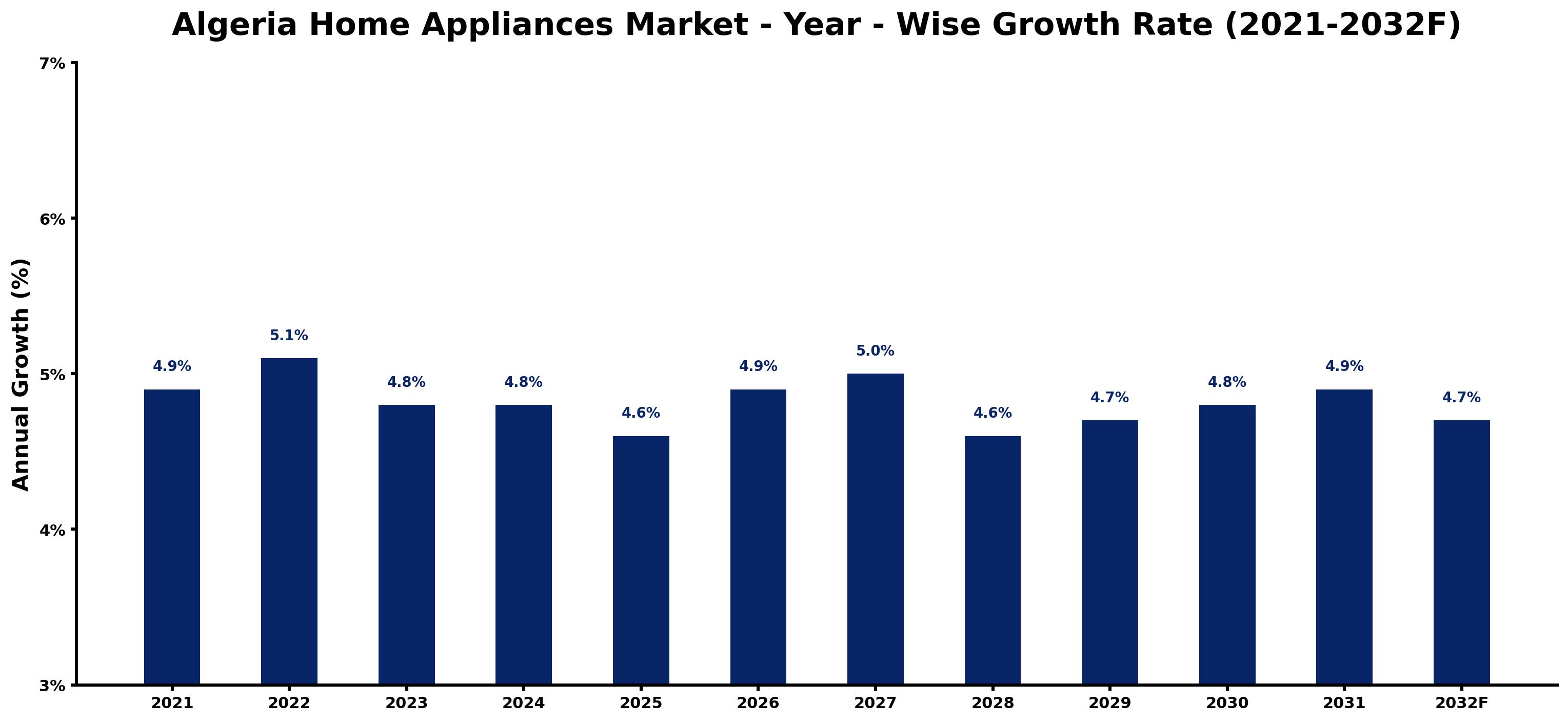
The table below presents the year wise growth rates along with the key drivers influencing the market
| Year | Growth Rate | Major Drivers |
| 2021 | 4.9% | Household income levels gradually improved, boosting spending on essential home appliances. |
| 2022 | 5.1% | Increased availability of foreign brands enhanced competition and product variety in Algeria. |
| 2023 | 4.8% | Urbanization trends led to heightened demand for modern kitchen and laundry appliances. |
| 2024 | 4.8% | Technological integration in appliances appealed to tech-savvy younger consumers, increasing sales. |
| 2025 | 4.6% | Consumer awareness about energy efficiency began influencing appliance purchasing decisions significantly. |
| 2026 | 4.9% | Enhanced distribution networks allowed for better product accessibility across rural and urban areas. |
| 2027 | 5.0% | Local manufacturers gained traction, promoting home-grown products and stimulating market growth. |
| 2028 | 4.6% | E-commerce platforms emerged as primary sales channels, reshaping consumer purchase behaviors. |
| 2029 | 4.7% | Sustainability trends encouraged manufacturers to innovate, aligning with eco-conscious consumer preferences. |
| 2030 | 4.8% | Continued infrastructure improvements facilitated better logistics and delivery for home appliances. |
| 2031 | 4.9% | Rising expatriate populations introduced diverse preferences, driving demand for niche appliances. |
| 2032 | 4.7% | Shift in lifestyle habits post-pandemic cemented the importance of home appliances in daily life. |
Note - Market size estimations and growth projections presented in this report are based on 6Wresearch's advanced forecasting approach, validated with industry datasets as of June 2026.
Algeria Home Appliances Market Synopsis
The Algeria Home Appliances Market is projected to reach 4.9% and witness significant growth during the forecast period (2026-2032). This market encompasses a diverse range of consumer electronics and household appliances essential for cooking, cleaning, and enhancing overall comfort in residential settings. Major product categories include refrigerators, washing machines, air conditioners, and various kitchen appliances, all tailored to meet the evolving needs and preferences of Algerian consumers who seek modern living solutions.
Algeria Home Appliances Market Growth Drivers
Several key factors are driving the growth of the Algeria Home Appliances Market. One of the primary drivers is the increase in disposable incomes among the population, which enables consumers to invest in modern appliances that offer convenience and improved quality of life. Urbanization is also playing a pivotal role, as more individuals migrate to urban centers where demand for household conveniences skyrockets.
- The rising inclination towards energy-efficient appliances is notable, as consumers are becoming increasingly aware of both environmental impacts and cost savings associated with such products. This shift is further accelerated by government initiatives promoting energy conservation.
- Smart home technology adoption is another factor contributing to market momentum, with a noticeable uptick in consumer interest in appliances that offer connectivity and enhanced functionality.
- Additionally, the growing availability of credit and financing options is lowering the entry barrier for consumers hesitant to make significant upfront investments in household technologies.
- Improvements in local manufacturing capabilities are making appliances more accessible and affordable, further fostering market expansion.
- Finally, increased consumer awareness regarding the benefits of modern appliances, including time savings and ease of use, is driving purchasing decisions across various demographics.
Algeria Home Appliances Market Challenges and Restraints
While the Algeria Home Appliances Market presents promising opportunities, it is not without its challenges. One significant barrier is affordability; many consumers may find modern appliances beyond their budget, limiting market penetration.
- Electricity availability remains a concern, particularly in remote areas where access can be unreliable, affecting the usability of electric appliances.
- Consumer preferences are leaning towards energy-efficient products, which, while beneficial for the environment, may lead to increased upfront costs that deter some buyers.
- Moreover, competition from lower-cost imported appliances could pose threats to local manufacturers striving to enhance their market share.
- Understanding regional variations in consumer preferences and needs is critical, as a one-size-fits-all approach may not resonate in diverse cultural settings across Algeria.
- Lastly, political and economic fluctuations can impact consumer confidence and spending behavior, adding an element of unpredictability to market dynamics.
Algeria Home Appliances Market Government Investment and Initiatives
The Algerian government recognizes the critical role of the home appliances market in enhancing the quality of life for its citizens and bolstering domestic productivity. In light of this, several policies and initiatives have been introduced to facilitate market growth.
- Incentives for investment in local appliance manufacturing have been established, aiming to reduce reliance on imports and create jobs within the sector.
- Regulatory frameworks focusing on energy efficiency and product safety standards are being developed to ensure that appliances available in the market meet international quality benchmarks.
- Public awareness campaigns are underway to educate consumers about the advantages of energy-efficient products, encouraging adoption and driving demand.
- The government is also investing in infrastructure improvements to ensure that electricity supply is stable, thereby enhancing the functionality of home appliances across the nation.
- Collaboration with private sectors to promote financing options has been initiated, ensuring that consumers have access to affordable credit facilities for significant appliance purchases.
Algeria Home Appliances Market Latest Developments (May 2025 - June 2026)
Recent developments in the Algeria Home Appliances Market from May 2025 to June 2026 indicate a dynamic shift towards the integration of smart technologies in household appliances. The market is witnessing a notable increase in products featuring advanced connectivity options and smart home integration capabilities.
- Consumer interest in energy-efficient models continues to rise, spurred on by government initiatives aimed at promoting sustainability.
- Local manufacturers are adapting to changing consumer demands by innovating their product lines and enhancing energy efficiency across their offerings.
- The introduction of financing schemes by certain stakeholders has made it easier for average consumers to access modern appliances without significant financial strain.
- Collaboration among manufacturers, suppliers, and retailers is increasing to streamline distribution channels, ensuring better availability of products across various retail outlets.
- In consumer interactions, a shift is noted as preferences favor appliances that not only provide functionality but also incorporate aesthetic design features.
Algeria Home Appliances Market - Key Attractiveness of the Report
- 10 Years of Market Numbers
- Historical Data Starting from 2022 to 2025
- Base Year: 2025
- Forecast Data until 2032
- Key Performance Indicators Impacting the Market
- Major Upcoming Developments and Projects
Key Highlights of the Report:
- Algeria Home Appliances Market Outlook
- Market Size of Algeria Home Appliances Market, 2025
- Forecast of Algeria Home Appliances Market, 2032
- Historical Data and Forecast of Algeria Home Appliances Revenues & Volume for the Period 2022-2032F
- Algeria Home Appliances Market Trend Evolution
- Algeria Home Appliances Market Drivers and Challenges
- Algeria Home Appliances Price Trends
- Algeria Home Appliances Porter's Five Forces
- Algeria Home Appliances Industry Life Cycle
- Historical Data and Forecast of Algeria Home Appliances Market Revenues & Volume By Product Types for the Period 2022-2032F
- Historical Data and Forecast of Algeria Home Appliances Market Revenues & Volume By Kitchen Appliances for the Period 2022-2032F
- Historical Data and Forecast of Algeria Home Appliances Market Revenues & Volume By Washing Appliances for the Period 2022-2032F
- Historical Data and Forecast of Algeria Home Appliances Market Revenues & Volume By Entertainment Appliances for the Period 2022-2032F
- Historical Data and Forecast of Algeria Home Appliances Market Revenues & Volume By Air Conditioner for the Period 2022-2032F
- Historical Data and Forecast of Algeria Home Appliances Market Revenues & Volume By Others for the Period 2022-2032F
- Historical Data and Forecast of Algeria Home Appliances Market Revenues & Volume By Technology for the Period 2022-2032F
- Historical Data and Forecast of Algeria Home Appliances Market Revenues & Volume By Wi-Fi for the Period 2022-2032F
- Historical Data and Forecast of Algeria Home Appliances Market Revenues & Volume By Bluetooth for the Period 2022-2032F
- Historical Data and Forecast of Algeria Home Appliances Market Revenues & Volume By ZigBee for the Period 2022-2032F
- Historical Data and Forecast of Algeria Home Appliances Market Revenues & Volume By Radio Frequency Identification for the Period 2022-2032F
- Historical Data and Forecast of Algeria Home Appliances Market Revenues & Volume By Cellular Technology for the Period 2022-2032F
- Historical Data and Forecast of Algeria Home Appliances Market Revenues & Volume By IoT for the Period 2022-2032F
- Historical Data and Forecast of Algeria Home Appliances Market Revenues & Volume By Distribution Channel for the Period 2022-2032F
- Historical Data and Forecast of Algeria Home Appliances Market Revenues & Volume By Retail for the Period 2022-2032F
- Historical Data and Forecast of Algeria Home Appliances Market Revenues & Volume By E-commerce for the Period 2022-2032F
- Historical Data and Forecast of Algeria Home Appliances Market Revenues & Volume By Others for the Period 2022-2032F
- Algeria Home Appliances Import Export Trade Statistics
- Market Opportunity Assessment By Product Types
- Market Opportunity Assessment By Technology
- Market Opportunity Assessment By Distribution Channel
- Algeria Home Appliances Top Companies Market Share
- Algeria Home Appliances Competitive Benchmarking By Technical and Operational Parameters
- Algeria Home Appliances Company Profiles
- Algeria Home Appliances Key Strategic Recommendations






































