Kenya Household Appliance Market Growth Rate Analysis (2025 - 2031)
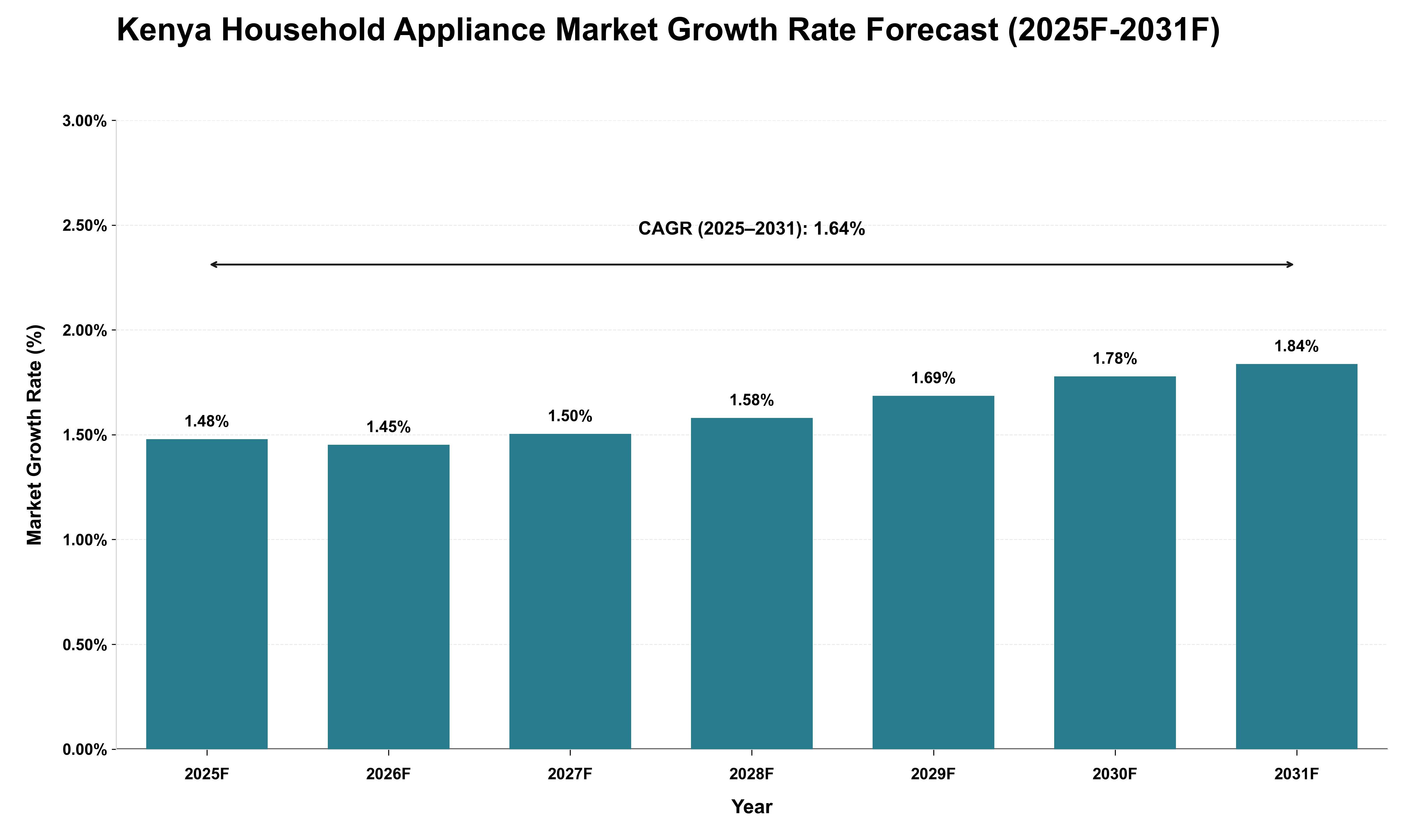
The outlook for the Kenya household appliance market will be shaped by several macroeconomic factors, including rising urbanization, increasing disposable incomes, and a growing middle class that drives demand for modern conveniences. As the economy expands, consumer preferences will shift towards energy-efficient and technologically advanced appliances, reflecting a broader global trend. The forecasted CAGR of 1.64% from 2025 to 2031 indicates a gradual increase in demand, with annual growth rates projected to rise from 1.48% in 2025 to 1.84% by 2031. This incremental growth suggests that while the market will experience steady expansion, it may also face challenges such as import dependencies on foreign manufacturers and potential fluctuations in currency exchange rates impacting pricing strategies. Overall, the anticipated growth trajectory will likely reflect both cyclical trends in consumer spending and structural shifts towards sustainable living solutions within Kenyan households.
Key Highlights of the Report:
- Kenya Household Appliance Market Outlook
- Market Size of Kenya Household Appliance Market,2024
- Forecast of Kenya Household Appliance Market, 2031
- Historical Data and Forecast of Kenya Household Appliance Revenues & Volume for the Period 2021-2031
- Kenya Household Appliance Market Trend Evolution
- Kenya Household Appliance Market Drivers and Challenges
- Kenya Household Appliance Price Trends
- Kenya Household Appliance Porter's Five Forces
- Kenya Household Appliance Industry Life Cycle
- Historical Data and Forecast of Kenya Household Appliance Market Revenues & Volume By Type for the Period 2021-2031
- Historical Data and Forecast of Kenya Household Appliance Market Revenues & Volume By Kitchen for the Period 2021-2031
- Historical Data and Forecast of Kenya Household Appliance Market Revenues & Volume By Cleaning for the Period 2021-2031
- Historical Data and Forecast of Kenya Household Appliance Market Revenues & Volume By Entertainment for the Period 2021-2031
- Historical Data and Forecast of Kenya Household Appliance Market Revenues & Volume By Others for the Period 2021-2031
- Historical Data and Forecast of Kenya Household Appliance Market Revenues & Volume By Size for the Period 2021-2031
- Historical Data and Forecast of Kenya Household Appliance Market Revenues & Volume By Small for the Period 2021-2031
- Historical Data and Forecast of Kenya Household Appliance Market Revenues & Volume By Medium for the Period 2021-2031
- Historical Data and Forecast of Kenya Household Appliance Market Revenues & Volume By Large for the Period 2021-2031
- Historical Data and Forecast of Kenya Household Appliance Market Revenues & Volume By Others for the Period 2021-2031
- Historical Data and Forecast of Kenya Household Appliance Market Revenues & Volume By Application for the Period 2021-2031
- Historical Data and Forecast of Kenya Household Appliance Market Revenues & Volume By Residential for the Period 2021-2031
- Historical Data and Forecast of Kenya Household Appliance Market Revenues & Volume By Commercial for the Period 2021-2031
- Historical Data and Forecast of Kenya Household Appliance Market Revenues & Volume By Industrial for the Period 2021-2031
- Historical Data and Forecast of Kenya Household Appliance Market Revenues & Volume By Others for the Period 2021-2031
- Historical Data and Forecast of Kenya Household Appliance Market Revenues & Volume By Distribution Channel for the Period 2021-2031
- Historical Data and Forecast of Kenya Household Appliance Market Revenues & Volume By Online for the Period 2021-2031
- Historical Data and Forecast of Kenya Household Appliance Market Revenues & Volume By Offline for the Period 2021-2031
- Historical Data and Forecast of Kenya Household Appliance Market Revenues & Volume By Supermarkets for the Period 2021-2031
- Historical Data and Forecast of Kenya Household Appliance Market Revenues & Volume By Others for the Period 2021-2031
- Kenya Household Appliance Import Export Trade Statistics
- Market Opportunity Assessment By Type
- Market Opportunity Assessment By Size
- Market Opportunity Assessment By Application
- Market Opportunity Assessment By Distribution Channel
- Kenya Household Appliance Top Companies Market Share
- Kenya Household Appliance Competitive Benchmarking By Technical and Operational Parameters
- Kenya Household Appliance Company Profiles
- Kenya Household Appliance Key Strategic Recommendations






































