Kenya Insulated Glass Market Size, Share & Growth Rate
The Kenya Insulated Glass Market was estimated at USD 257 Million in 2025 and is projected to reach USD 353 Million by 2032, growing at a CAGR of 4.6% from 2026 to 2032. This growth trajectory is primarily fueled by the burgeoning construction sector in urban hubs, where energy efficiency and sustainability are no longer optional but essential components of building design. As developers increasingly seek to enhance thermal insulation and soundproofing in their projects, the demand for insulated glass solutions is steadily climbing.
Kenya Insulated Glass Market Year-wise Growth Rate and Key Drivers
This graph highlights how the Kenya Insulated Glass Market has steadily grown over the years, supported by major growth factors.
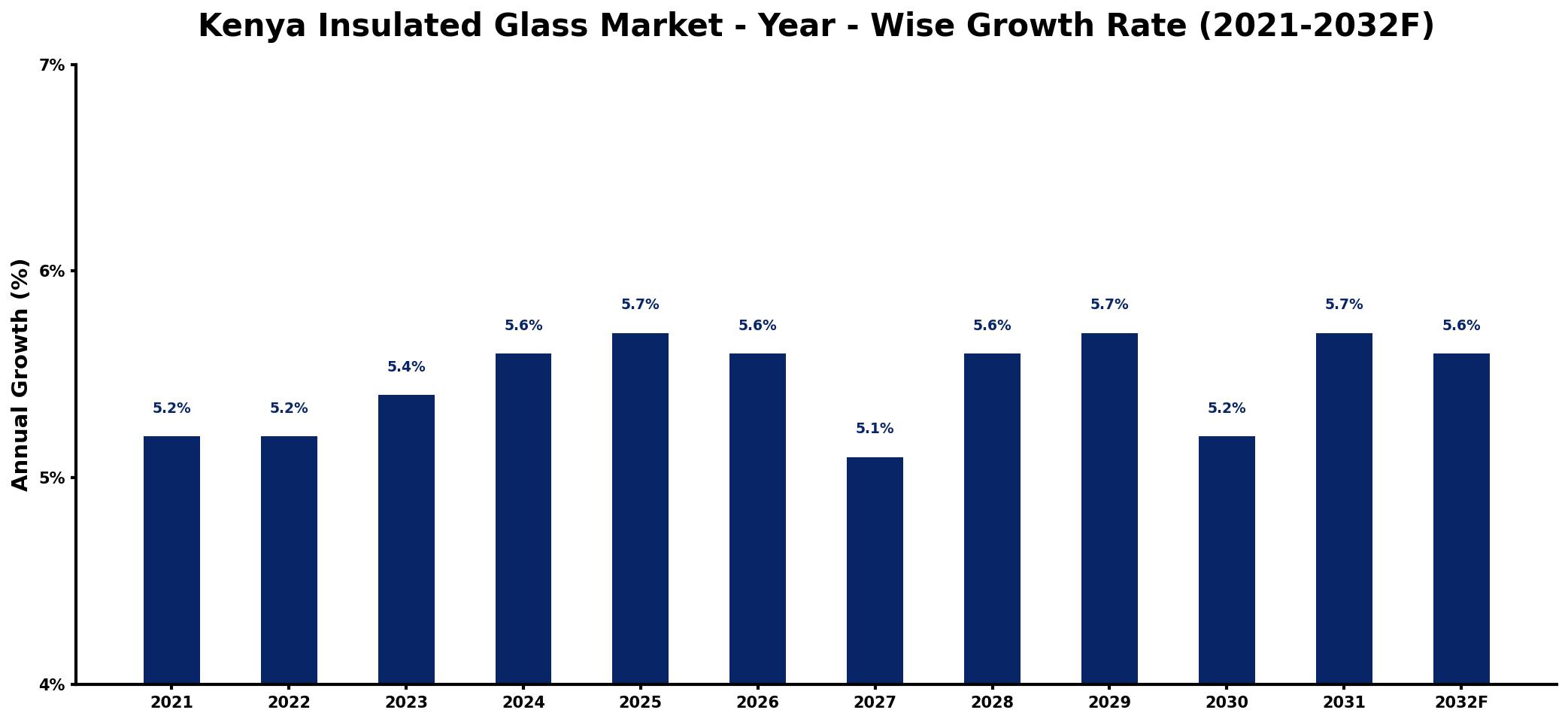
The table below presents the year‑wise growth rates along with the key drivers influencing the market
| Year | Growth Rate | Major Drivers |
| 2021 | 5.2% | Rising construction sector investments |
| 2022 | 5.2% | Growing demand from hospitality industry |
| 2023 | 5.4% | Increased focus on energy efficiency |
| 2024 | 5.6% | Expansion of commercial real estate |
| 2025 | 5.7% | Emerging residential construction projects |
| 2026 | 5.6% | Government incentives for energy efficiency |
| 2027 | 5.1% | Surge in renovation activities nationwide |
| 2028 | 5.6% | Technological advancements in building materials |
| 2029 | 5.7% | Growing interest in sustainable architecture |
| 2030 | 5.2% | Increased urbanization and population growth |
| 2031 | 5.7% | Rising consumer awareness on insulation |
| 2032 | 5.6% | Strengthening infrastructure development initiatives |
Note: Market size estimations and growth projections presented in this report are based on 6Wresearch's proprietary forecasting methodology, utilizing the latest available industry data, government publications, and primary research inputs.
Kenya Insulated Glass Market Synopsis
In recent years, the Kenya insulated glass market has seen a notable increase in interest due to a shift toward energy-efficient building practices. Insulated glass units, known for their dual or multi-pane designs filled with insulating gas, are becoming a staple in modern construction, offering superior thermal performance compared to traditional glass.
This market transformation is particularly evident in major cities like Nairobi, where real estate developers and homeowners alike are prioritizing sustainability. Awareness of insulated glass benefits, such as reduced energy costs and increased comfort, is encouraging consumers to invest in these advanced solutions.
Kenya Insulated Glass Market Key Takeaways
- The market is driven by increasing construction activities, especially in urban areas.
- Growing consumer awareness regarding energy-efficient solutions propels demand for insulated glass.
- Technological advancements have led to the emergence of innovative products, including self-cleaning and smart glass.
- Government regulations supporting sustainability are creating favorable market conditions.
- Investment opportunities are abundant, particularly in manufacturing and distribution sectors.
Evaluation of Restraints in Kenya Insulated Glass Market
Despite the positive growth outlook, the Kenya insulated glass market faces several constraints. A significant challenge is the competition posed by lower-cost alternatives, such as traditional single-pane glass, which can hinder consumer adoption of insulated solutions. Additionally, limited public awareness regarding the long-term benefits of insulated glass creates barriers to market penetration. Furthermore, fluctuations in raw material costs and import duties can complicate pricing strategies for manufacturers, affecting overall market competitiveness.
Kenya Insulated Glass Market Trends
The drive for energy-efficient buildings is reshaping the landscape of the Kenya insulated glass market. Current trends indicate a strong preference for double-glazing solutions that provide thermal insulation and soundproofing. Moreover, technological advancements are paving the way for innovative products tailored to specific consumer needs, such as energy management systems integrated into insulated glass. As the construction sector evolves, so too does the demand for multifunctional glass products that blend aesthetics with performance.
Kenya Insulated Glass Market Opportunities
With the ongoing urbanization and infrastructure development in Kenya, the insulated glass market is poised for lucrative investment opportunities. Stakeholders can benefit by focusing on the manufacturing and distribution of energy-efficient solutions tailored for residential, commercial, and industrial projects. Collaborations with architects and developers can further enhance market penetration, as these partnerships facilitate the integration of insulated glass in upcoming building designs. Additionally, raising consumer awareness about the cost benefits associated with energy-efficient solutions will likely yield significant market growth.
Government Initiatives in the Kenya Insulated Glass Market
Government policies in Kenya increasingly favor sustainable construction practices, which directly impact the insulated glass market. Regulations promoting energy efficiency, such as the Energy (Solar Water Heating) Regulations 2012 and the Energy Act of 2019, provide a supportive framework for the adoption of energy-efficient materials. These initiatives create a conducive environment for insulated glass manufacturers and encourage investments in sustainable technologies.
Future Insights of the Kenya Insulated Glass Market
Looking ahead, the Kenya insulated glass market is set for robust growth as construction activities escalate and the push for energy-efficient solutions intensifies. Expectations of increased infrastructure development, along with greater public awareness of sustainability issues, are likely to bolster demand for insulated glass products. Furthermore, continuous advancements in technology, such as smart glass applications, will pave the way for innovative solutions that meet modern building demands.
Kenya Insulated Glass Market Latest Developments (2025 - 2026)
Recent trends in the Kenya insulated glass market indicate a shift towards integrating smart technology into glass products, enabling functionalities like automated climate control and energy monitoring. As local manufacturers ramp up production capabilities, they are increasingly focusing on quality enhancement to compete with international standards. Notably, public awareness campaigns regarding the benefits of insulated glass are being amplified, significantly aiding market penetration.
Kenya Insulated Glass Market - Key Attractiveness of the Report
- 10 Years of Market Numbers
- Historical Data Starting from 2022 to 2025
- Base Year: 2025
- Forecast Data until 2032
- Key Performance Indicators Impacting the Market
- Major Upcoming Developments and Projects
Key Highlights of the Report:
- Kenya Insulated Glass Market Outlook
- Market Size of Kenya Insulated Glass Market, 2025
- Forecast of Kenya Insulated Glass Market, 2032
- Historical Data and Forecast of Kenya Insulated Glass Revenues & Volume for the Period 2022-2032F
- Kenya Insulated Glass Market Trend Evolution
- Kenya Insulated Glass Market Drivers and Challenges
- Kenya Insulated Glass Price Trends
- Kenya Insulated Glass Porter's Five Forces
- Kenya Insulated Glass Industry Life Cycle
- Historical Data and Forecast of Kenya Insulated Glass Market Revenues & Volume By Type for the Period 2022-2032F
- Historical Data and Forecast of Kenya Insulated Glass Market Revenues & Volume By Heated Insulating Glass for the Period 2022-2032F
- Historical Data and Forecast of Kenya Insulated Glass Market Revenues & Volume By Tempering Insulating Glass for the Period 2022-2032F
- Historical Data and Forecast of Kenya Insulated Glass Market Revenues & Volume By Custom Insulated Glass for the Period 2022-2032F
- Historical Data and Forecast of Kenya Insulated Glass Market Revenues & Volume By Other Glasses for the Period 2022-2032F
- Historical Data and Forecast of Kenya Insulated Glass Market Revenues & Volume By Application for the Period 2022-2032F
- Historical Data and Forecast of Kenya Insulated Glass Market Revenues & Volume By Doors & Partitions for the Period 2022-2032F
- Historical Data and Forecast of Kenya Insulated Glass Market Revenues & Volume By Kitchen Appliances & Cabinets for the Period 2022-2032F
- Historical Data and Forecast of Kenya Insulated Glass Market Revenues & Volume By Floors & Ceilings for the Period 2022-2032F
- Historical Data and Forecast of Kenya Insulated Glass Market Revenues & Volume By Furniture & Curtain Walls for the Period 2022-2032F
- Historical Data and Forecast of Kenya Insulated Glass Market Revenues & Volume By Railings & Bolted Structures for the Period 2022-2032F
- Historical Data and Forecast of Kenya Insulated Glass Market Revenues & Volume By Automotive Glasses for the Period 2022-2032F
- Historical Data and Forecast of Kenya Insulated Glass Market Revenues & Volume By End User for the Period 2022-2032F
- Historical Data and Forecast of Kenya Insulated Glass Market Revenues & Volume By Residential Buildings for the Period 2022-2032F
- Historical Data and Forecast of Kenya Insulated Glass Market Revenues & Volume By Commercial & Institutional Buildings for the Period 2022-2032F
- Historical Data and Forecast of Kenya Insulated Glass Market Revenues & Volume By Industrial Users for the Period 2022-2032F
- Kenya Insulated Glass Import Export Trade Statistics
- Market Opportunity Assessment By Type
- Market Opportunity Assessment By Application
- Market Opportunity Assessment By End User
- Kenya Insulated Glass Top Companies Market Share
- Kenya Insulated Glass Competitive Benchmarking By Technical and Operational Parameters
- Kenya Insulated Glass Company Profiles
- Kenya Insulated Glass Key Strategic Recommendations






































