Kenya Managed Services Market Size & Growth Rate (2026-2032)
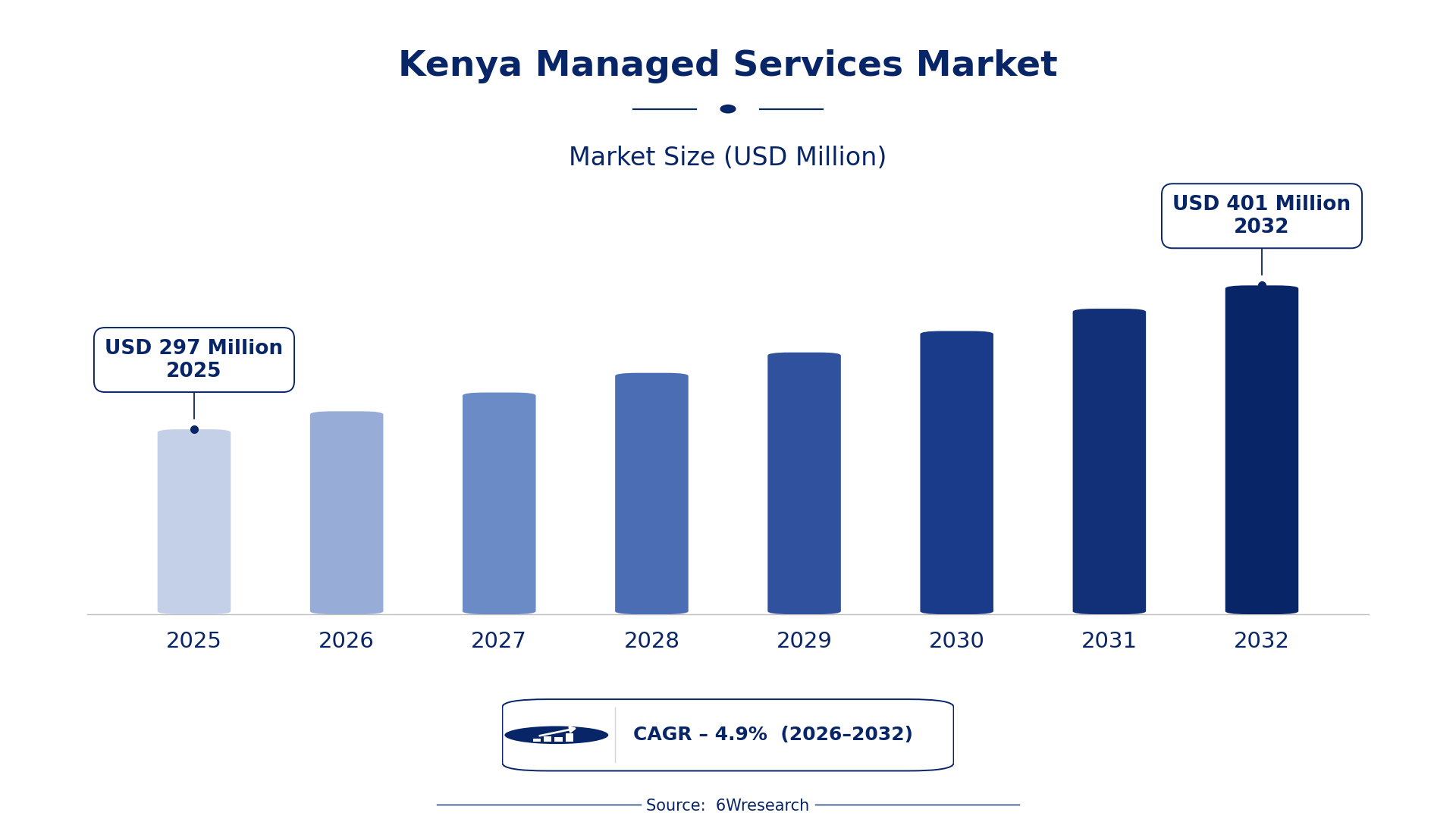
The Kenya Managed Services Market was estimated at USD 297 Million in 2025 and is projected to reach USD 401 Million by 2032, growing at a CAGR of 4.9% from 2026 to 2032.
Kenya Managed Services Market Synopsis
The primary force driving the Kenya Managed Services Market is the increasing demand for IT outsourcing, particularly among small and medium-sized enterprises (SMEs). This shift enables businesses to focus on core operations while accessing advanced technologies and skilled professionals without hefty investments.
Telecommunication companies, financial institutions, and government sectors are leading the charge for managed services. As digital transformation accelerates, organizations are keen to adopt solutions that enhance efficiency and reduce operational costs, positioning managed services as a vital component of their strategies.
Kenya Managed Services Market Year-wise Growth Rate and Key Drivers
This graph illustrates the annual growth rates of the Kenya Managed Services Market from 2021 to 2032, highlighting a steady upward trajectory and projected expansion over the forecast period.
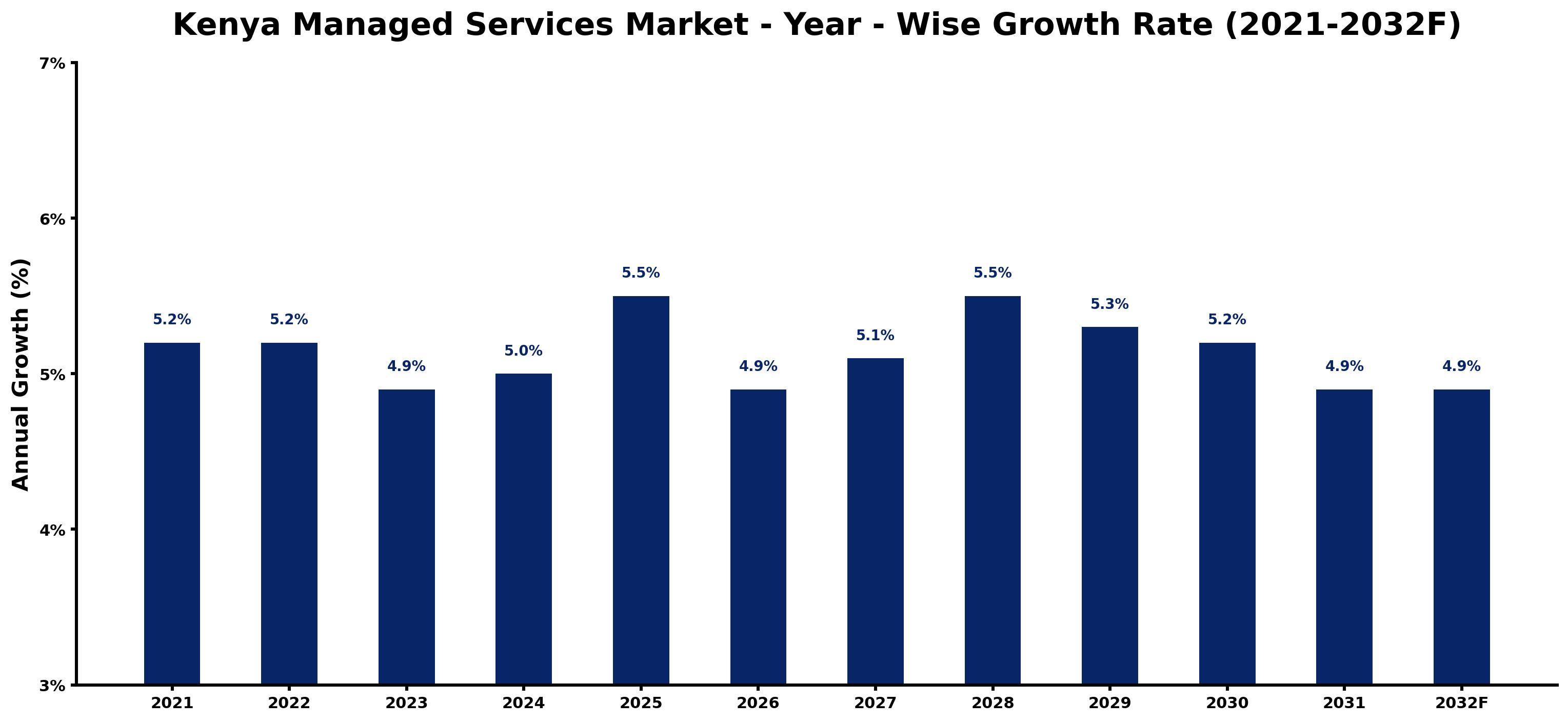
The table below presents the year‑wise growth rates along with the key drivers influencing the market
| Year | Growth Rate | Major Drivers |
| 2021 | 5.2% | Increased mobile internet penetration enhancing service accessibility. |
| 2022 | 5.2% | Emerging startups demanding scalable IT support services. |
| 2023 | 4.9% | National Cyber Security Strategy boosting managed security services. |
| 2024 | 5.0% | Growth in fintech firms increasing cloud service requirements. |
| 2025 | 5.5% | Government's digital tax incentive attracting IT investments. |
| 2026 | 4.9% | Rising awareness of IT service benefits among SMEs. |
| 2027 | 5.1% | Adoption of IoT technologies creating service management needs. |
| 2028 | 5.5% | Regional tech hubs fostering innovation in managed services. |
| 2029 | 5.3% | Digital health initiatives driving demand for IT management. |
| 2030 | 5.2% | Increased data privacy regulations necessitating compliance services. |
| 2031 | 4.9% | Enhancements in local telecom infrastructures improving service delivery. |
| 2032 | 4.9% | Diverse industry needs prompting tailored managed service solutions. |
Note: Market size estimations and growth projections presented in this report are based on 6Wresearch's proprietary forecasting methodology, utilizing the latest available industry data, government publications, and primary research inputs.
Kenya Managed Services Market Key Takeaways
Below are some of the specific key takeaways from the market, including:
- Cloud services are gaining traction as businesses recognize their scalability and cost-effectiveness.
- There’s a notable increase in demand for managed security services to combat rising cyber threats.
- SMEs are increasingly outsourcing IT operations to specialized providers for improved operational efficiency.
- Government policies are actively fostering an environment conducive to managed services growth.
- Investment opportunities are abundant, particularly in cybersecurity and data analytics sectors.
Evaluation of Restraints in Kenya Managed Services Market
Several restraints limit the growth of the Kenya Managed Services Market. High costs associated with implementing advanced technology infrastructure remain a significant barrier for many businesses. The scarcity of skilled professionals with expertise in managed services exacerbates this issue, as companies struggle to find qualified personnel to support their IT needs. on top of that, ongoing concerns regarding data security and regulatory compliance can deter potential clients from outsourcing their IT operations, leading to a cautious approach in adopting managed services.
Kenya Managed Services Market Trends
The shift towards cloud-based managed services is a defining trend, as organizations embrace the flexibility and efficiency these solutions offer. Businesses of all sizes are increasingly recognizing the advantages of cloud computing, leading to a surge in demand for cloud-managed services.
on top of that, the rising need for enhanced cybersecurity measures is propelling the popularity of managed security services. As cyber threats evolve, organizations are prioritizing their cybersecurity posture, driving investments in managed services that offer advanced protection solutions.
Kenya Managed Services Market Opportunities
Investment opportunities in the Kenya Managed Services Market are substantial, particularly in areas like cloud services, cybersecurity, and data analytics. The increasing digitization of businesses across various industries creates a growing demand for reliable and efficient IT solutions.
With the Kenyan government actively promoting digital transformation initiatives, companies that provide tailored managed services are well-positioned to capitalize on this demand. By focusing on innovative solutions that cater to the specific needs of Kenyan businesses, providers can unlock significant growth potential in this dynamic market.
Government Initiatives in the Kenya Managed Services Market
The Kenyan government plays a critical role in shaping the Managed Services Market through various policies and initiatives aimed at promoting ICT growth. Regulatory frameworks have been established to facilitate investment in digital infrastructure, while ongoing efforts to enhance cybersecurity measures create a safer environment for businesses to operate.
- A national digital infrastructure upgrade programme launched in 2023 aims to improve ICT accessibility across the country.
- Current initiatives include the rollout of the National Broadband Strategy, which seeks to expand internet access in underserved regions.
- Recent policies have been implemented to encourage public-private partnerships in ICT development.
- Upcoming regulations are set to mandate data protection standards for managed service providers, enhancing client trust.
Future Insights of the Kenya Managed Services Market
Looking ahead to 2026-2032, the Kenya Managed Services Market is on a growth trajectory driven by the acceleration of cloud adoption and the need for specialized IT support. As businesses increasingly rely on complex IT systems, managed service providers will be essential in delivering efficient solutions.
The burgeoning Internet of Things (IoT) and mobile device proliferation will further create opportunities for managed services focused on managing and securing these technologies. Companies that adapt to these evolving demands will find themselves at the forefront of the market.
Kenya Managed Services Market Latest Developments
In the last year, activity within the Kenya Managed Services Market has intensified as organizations seek to enhance their IT capabilities. The focus has been on adopting innovative solutions and improving service delivery to meet rising client expectations.
- A major technology vendor announced an upgrade to its cybersecurity offerings, with implementation completed in early 2025.
- A leading regional operator is currently expanding its cloud services portfolio, with this initiative expected to conclude by mid-2026.
- A new partnership between IT firms aimed at developing advanced data analytics solutions has been initiated and remains underway.
- An initiative to enhance training for IT professionals in managed services is planned to launch in late 2025.
Kenya Managed Services Market - Key Attractiveness of the Report
- 10 Years of Market Numbers
- Historical Data Starting from 2022 to 2025
- Base Year: 2025
- Forecast Data until 2032
- Key Performance Indicators Impacting the Market
- Major Upcoming Developments and Projects
Key Highlights of the Report:
- Kenya Managed Services Market Outlook
- Market Size of Kenya Managed Services Market, 2025
- Forecast of Kenya Managed Services Market, 2032
- Historical Data and Forecast of Kenya Managed Services Revenues & Volume for the Period 2022-2032F
- Kenya Managed Services Market Trend Evolution
- Kenya Managed Services Market Drivers and Challenges
- Kenya Managed Services Price Trends
- Kenya Managed Services Porter's Five Forces
- Kenya Managed Services Industry Life Cycle
- Historical Data and Forecast of Kenya Managed Services Market Revenues & Volume By Service Type for the Period 2022-2032F
- Historical Data and Forecast of Kenya Managed Services Market Revenues & Volume By Managed Security Services for the Period 2022-2032F
- Historical Data and Forecast of Kenya Managed Services Market Revenues & Volume By Managed Network Services for the Period 2022-2032F
- Historical Data and Forecast of Kenya Managed Services Market Revenues & Volume By Managed Data Center and IT Infrastructure Services for the Period 2022-2032F
- Historical Data and Forecast of Kenya Managed Services Market Revenues & Volume By Managed Communication and Collaboration Services for the Period 2022-2032F
- Historical Data and Forecast of Kenya Managed Services Market Revenues & Volume By Managed Mobility Services for the Period 2022-2032F
- Historical Data and Forecast of Kenya Managed Services Market Revenues & Volume By Managed Information Services for the Period 2022-2032F
- Historical Data and Forecast of Kenya Managed Services Market Revenues & Volume By Deployment Type for the Period 2022-2032F
- Historical Data and Forecast of Kenya Managed Services Market Revenues & Volume By Cloud for the Period 2022-2032F
- Historical Data and Forecast of Kenya Managed Services Market Revenues & Volume By On-Premises for the Period 2022-2032F
- Historical Data and Forecast of Kenya Managed Services Market Revenues & Volume By Organization Size for the Period 2022-2032F
- Historical Data and Forecast of Kenya Managed Services Market Revenues & Volume By Small and Medium-sized Enterprises (SMEs) for the Period 2022-2032F
- Historical Data and Forecast of Kenya Managed Services Market Revenues & Volume By Large Enterprises for the Period 2022-2032F
- Historical Data and Forecast of Kenya Managed Services Market Revenues & Volume By Vertical for the Period 2022-2032F
- Historical Data and Forecast of Kenya Managed Services Market Revenues & Volume By BFSI for the Period 2022-2032F
- Historical Data and Forecast of Kenya Managed Services Market Revenues & Volume By IT and Telecom for the Period 2022-2032F
- Historical Data and Forecast of Kenya Managed Services Market Revenues & Volume By Retail and Consumer Goods for the Period 2022-2032F
- Historical Data and Forecast of Kenya Managed Services Market Revenues & Volume By Manufacturing for the Period 2022-2032F
- Historical Data and Forecast of Kenya Managed Services Market Revenues & Volume By Government for the Period 2022-2032F
- Historical Data and Forecast of Kenya Managed Services Market Revenues & Volume By Healthcare and Life Sciences for the Period 2022-2032F
- Historical Data and Forecast of Kenya Managed Services Market Revenues & Volume By Energy and Utilities for the Period 2022-2032F
- Historical Data and Forecast of Kenya Managed Services Market Revenues & Volume By Media and Entertainment for the Period 2022-2032F
- Kenya Managed Services Import Export Trade Statistics
- Market Opportunity Assessment By Service Type
- Market Opportunity Assessment By Deployment Type
- Market Opportunity Assessment By Organization Size
- Market Opportunity Assessment By Vertical
- Kenya Managed Services Top Companies Market Share
- Kenya Managed Services Competitive Benchmarking By Technical and Operational Parameters
- Kenya Managed Services Company Profiles
- Kenya Managed Services Key Strategic Recommendations






































