Kenya Medical Tubing Market Size, Share & Growth Rate
The Kenya Medical Tubing Market was estimated at USD 384 Million in 2025 and is projected to reach USD 503 Million by 2032, growing at a CAGR of 3.9% from 2026 to 2032. This growth trajectory is primarily driven by the ongoing expansion of healthcare infrastructure, alongside an increasing demand for sophisticated medical devices. Coupled with heightened awareness around infection control practices, the market is poised for significant advancement as healthcare providers seek to enhance patient safety and treatment efficacy.
Kenya Medical Tubing Market Year-wise Growth Rate and Key Drivers
This graph highlights how the Kenya Medical Tubing Market has steadily grown over the years, supported by major growth factors.
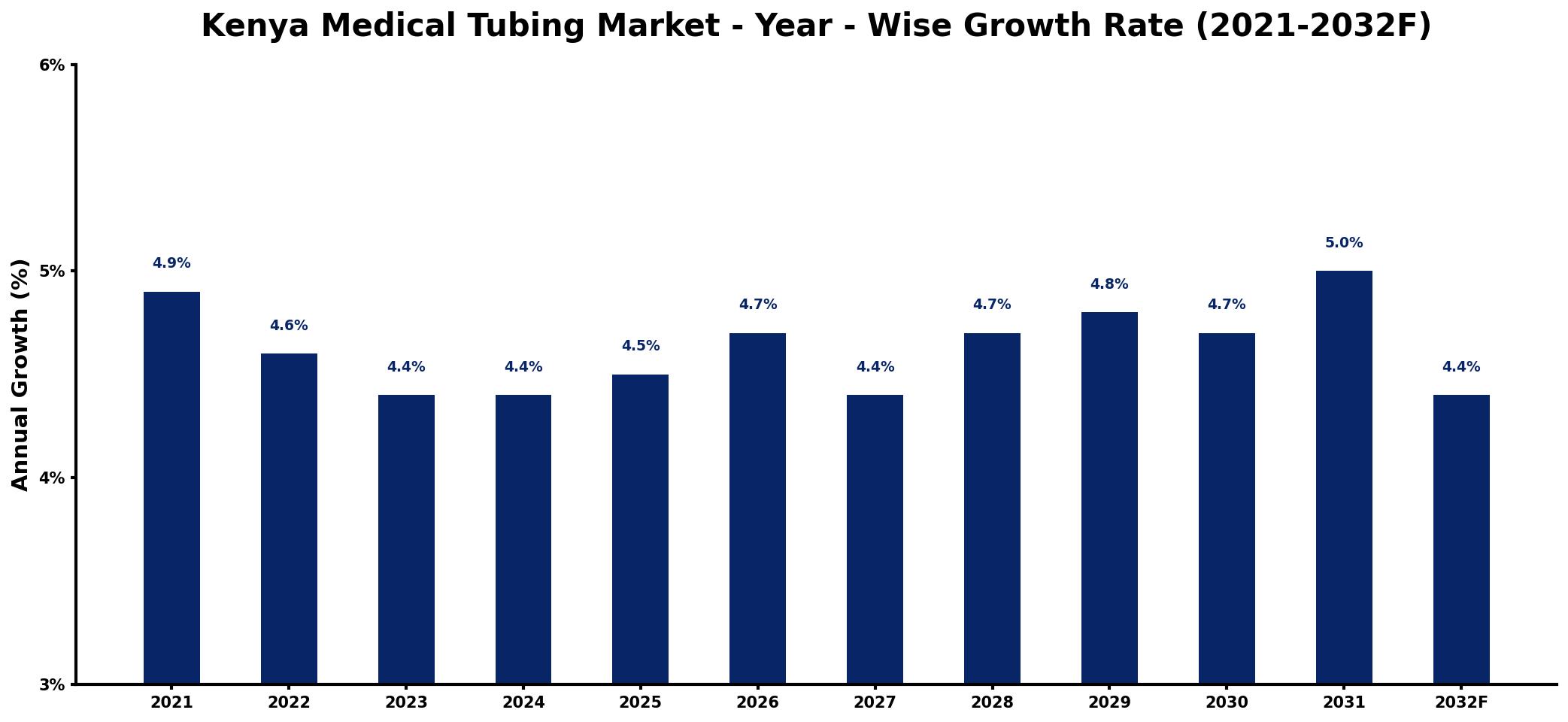
The table below presents the year‑wise growth rates along with the key drivers influencing the market
| Year | Growth Rate | Major Drivers |
| 2021 | 4.9% | Increased healthcare infrastructure investments |
| 2022 | 4.6% | Rising demand for healthcare services |
| 2023 | 4.4% | Growing adoption of advanced technologies |
| 2024 | 4.4% | Expansion of healthcare facilities network |
| 2025 | 4.5% | Increased focus on preventative care |
| 2026 | 4.7% | Rising patient population projections |
| 2027 | 4.4% | Growth in telemedicine applications |
| 2028 | 4.7% | Surge in health awareness campaigns |
| 2029 | 4.8% | Increased government healthcare funding |
| 2030 | 4.7% | Growing partnerships with private sector |
| 2031 | 5.0% | growing regional consumption patterns |
| 2032 | 4.4% | Emergence of innovative healthcare solutions |
Note: Market size estimations and growth projections presented in this report are based on 6Wresearch's proprietary forecasting methodology, utilizing the latest available industry data, government publications, and primary research inputs.
Kenya Medical Tubing Market Synopsis
In recent years, the Kenya Medical Tubing Market has exhibited robust growth, fueled by a shift towards advanced medical technologies and a rise in healthcare investments. As healthcare systems evolve, the market is increasingly leaning towards high-quality medical tubing solutions that cater to diverse applications, from catheters to IV tubes.
Looking ahead, the momentum is expected to continue with government initiatives aimed at improving healthcare access in rural areas and addressing chronic health issues. As these advancements unfold, manufacturers will need to innovate and comply with stringent regulatory standards to maintain their competitive edge in this burgeoning market.
Kenya Medical Tubing Market Key Takeaways
- The market is characterized by a diverse range of products, including catheters, cannulas, and IV tubes.
- Government initiatives are catalyzing improvements in healthcare infrastructure and access.
- Infection control measures are driving the demand for high-quality and single-use medical tubing.
- Investment in innovative manufacturing technologies is becoming increasingly vital for market players.
- Sustainability is emerging as a significant trend, with manufacturers focusing on eco-friendly materials.
Evaluation of Restraints in Kenya Medical Tubing Market
Despite the positive outlook, several constraints hinder the Kenya Medical Tubing Market's growth. One major restraint is the limited access to advanced materials and technologies that are crucial for developing high-quality products. Fluctuating raw material prices can further complicate production logistics, impacting both cost and availability. Additionally, compliance with stringent regulatory requirements can pose challenges for manufacturers, especially local players competing against imported products that may have different standards.
Kenya Medical Tubing Market Trends
Key trends are emerging in the Kenya Medical Tubing Market that are reshaping both demand and technology. A significant shift is the move towards high-performance materials that enhance flexibility and durability, catering to the increasing needs of medical procedures. Furthermore, manufacturers are adopting innovative production techniques, including advanced polymers and extrusion technologies, to enhance patient safety and product reliability.
The trend towards single-use medical tubing is gaining momentum, primarily as a means to minimize infection risks and promote efficient healthcare practices. Lastly, there is a growing commitment to sustainability in manufacturing processes, with a heightened emphasis on recyclable and biodegradable materials.
Kenya Medical Tubing Market Opportunities
Opportunities within the Kenya Medical Tubing Market are ripe for exploration, particularly for investors looking to tap into the expanding healthcare sector. The increasing demand for specialized medical tubing materials such as silicone, PVC, and polyethylene creates a favorable environment for new entrants and existing players alike. Moreover, innovative applications in surgery, diagnostics, and patient monitoring can yield significant returns.
Collaborative ventures with local healthcare providers to develop tailored solutions will be essential for capturing market share in this evolving landscape. As patient care standards continue to rise, those positioned to supply high-quality medical tubing solutions stand to benefit from long-term growth prospects.
Government Initiatives in the Kenya Medical Tubing Market
The Kenyan government is actively implementing policies aimed at enhancing the medical tubing sector by ensuring product safety and quality. The Kenya Bureau of Standards (KEBS) plays a critical role in establishing regulations for medical tubing products, which must adhere to specified performance standards. Manufacturers and importers are required to secure mandatory certifications for their products, promoting the availability of reliable medical tubing solutions that contribute to better healthcare outcomes.
Future Insights of the Kenya Medical Tubing Market
Looking ahead to 2026-2032, the Kenya Medical Tubing Market is set to experience sustained growth, driven by continued healthcare infrastructure development and advancements in medical technology. A rising geriatric population and increasing prevalence of chronic diseases will further propel the demand for medical tubing. Additionally, as healthcare providers intensify their focus on infection control and patient safety, high-quality medical tubing products will become increasingly sought after.
Research and development efforts are expected to expand, with manufacturers striving to introduce innovative products that enhance performance and safety features. Overall, this market is well-positioned for robust growth, presenting numerous opportunities for expansion and product innovation.
Kenya Medical Tubing Market Latest Developments (2025 - 2026)
In recent months, the Kenya Medical Tubing Market has seen a flurry of activity focused on enhancing product offerings and compliance with new regulatory standards. Several manufacturers are investing in advanced production technologies to improve the quality and safety of their medical tubing products. Furthermore, there has been an increase in partnerships between local healthcare providers and tubing manufacturers aimed at developing tailored solutions for specific medical applications, signaling a trend toward customized healthcare solutions.
Kenya Medical Tubing Market - Key Attractiveness of the Report
- 10 Years of Market Numbers
- Historical Data Starting from 2022 to 2025
- Base Year: 2025
- Forecast Data until 2032
- Key Performance Indicators Impacting the Market
- Major Upcoming Developments and Projects
Key Highlights of the Report:
- Kenya Medical Tubing Market Outlook
- Market Size of Kenya Medical Tubing Market, 2025
- Forecast of Kenya Medical Tubing Market, 2032
- Historical Data and Forecast of Kenya Medical Tubing Revenues & Volume for the Period 2022-2032F
- Kenya Medical Tubing Market Trend Evolution
- Kenya Medical Tubing Market Drivers and Challenges
- Kenya Medical Tubing Price Trends
- Kenya Medical Tubing Porter's Five Forces
- Kenya Medical Tubing Industry Life Cycle
- Historical Data and Forecast of Kenya Medical Tubing Market Revenues & Volume By Material for the Period 2022-2032F
- Historical Data and Forecast of Kenya Medical Tubing Market Revenues & Volume By Plastics for the Period 2022-2032F
- Historical Data and Forecast of Kenya Medical Tubing Market Revenues & Volume By Rubbers for the Period 2022-2032F
- Historical Data and Forecast of Kenya Medical Tubing Market Revenues & Volume By Specialty Polymers for the Period 2022-2032F
- Historical Data and Forecast of Kenya Medical Tubing Market Revenues & Volume By Structure for the Period 2022-2032F
- Historical Data and Forecast of Kenya Medical Tubing Market Revenues & Volume By Single-lumen for the Period 2022-2032F
- Historical Data and Forecast of Kenya Medical Tubing Market Revenues & Volume By Co-extruded for the Period 2022-2032F
- Historical Data and Forecast of Kenya Medical Tubing Market Revenues & Volume By Multi-lumen for the Period 2022-2032F
- Historical Data and Forecast of Kenya Medical Tubing Market Revenues & Volume By Tapered Or Bump Tubing for the Period 2022-2032F
- Historical Data and Forecast of Kenya Medical Tubing Market Revenues & Volume By Braided Tubing for the Period 2022-2032F
- Historical Data and Forecast of Kenya Medical Tubing Market Revenues & Volume By Application for the Period 2022-2032F
- Historical Data and Forecast of Kenya Medical Tubing Market Revenues & Volume By Bulk Disposable Tubing for the Period 2022-2032F
- Historical Data and Forecast of Kenya Medical Tubing Market Revenues & Volume By Catheters & Cannulas for the Period 2022-2032F
- Historical Data and Forecast of Kenya Medical Tubing Market Revenues & Volume By Drug Delivery System for the Period 2022-2032F
- Historical Data and Forecast of Kenya Medical Tubing Market Revenues & Volume By Special Applications for the Period 2022-2032F
- Kenya Medical Tubing Import Export Trade Statistics
- Market Opportunity Assessment By Material
- Market Opportunity Assessment By Structure
- Market Opportunity Assessment By Application
- Kenya Medical Tubing Top Companies Market Share
- Kenya Medical Tubing Competitive Benchmarking By Technical and Operational Parameters
- Kenya Medical Tubing Company Profiles
- Kenya Medical Tubing Key Strategic Recommendations






































