Algeria Medical Tubing Market Size, Share & Growth Rate
The Algeria Medical Tubing Market was estimated at USD 156 Million in 2025 and is projected to reach USD 220 Million by 2032, growing at a CAGR of 5.0% from 2026 to 2032. This growth trajectory is underpinned by an expanding healthcare infrastructure, a rising elderly population, and an increasing preference for minimally invasive medical procedures. As healthcare providers focus more on patient-centered care, the demand for high-quality medical tubing products is expected to surge, providing a robust foundation for market expansion.
Algeria Medical Tubing Market Year-wise Growth Rate and Key Drivers
This graph highlights how the Algeria Medical Tubing Market has steadily grown over the years, supported by major growth factors.
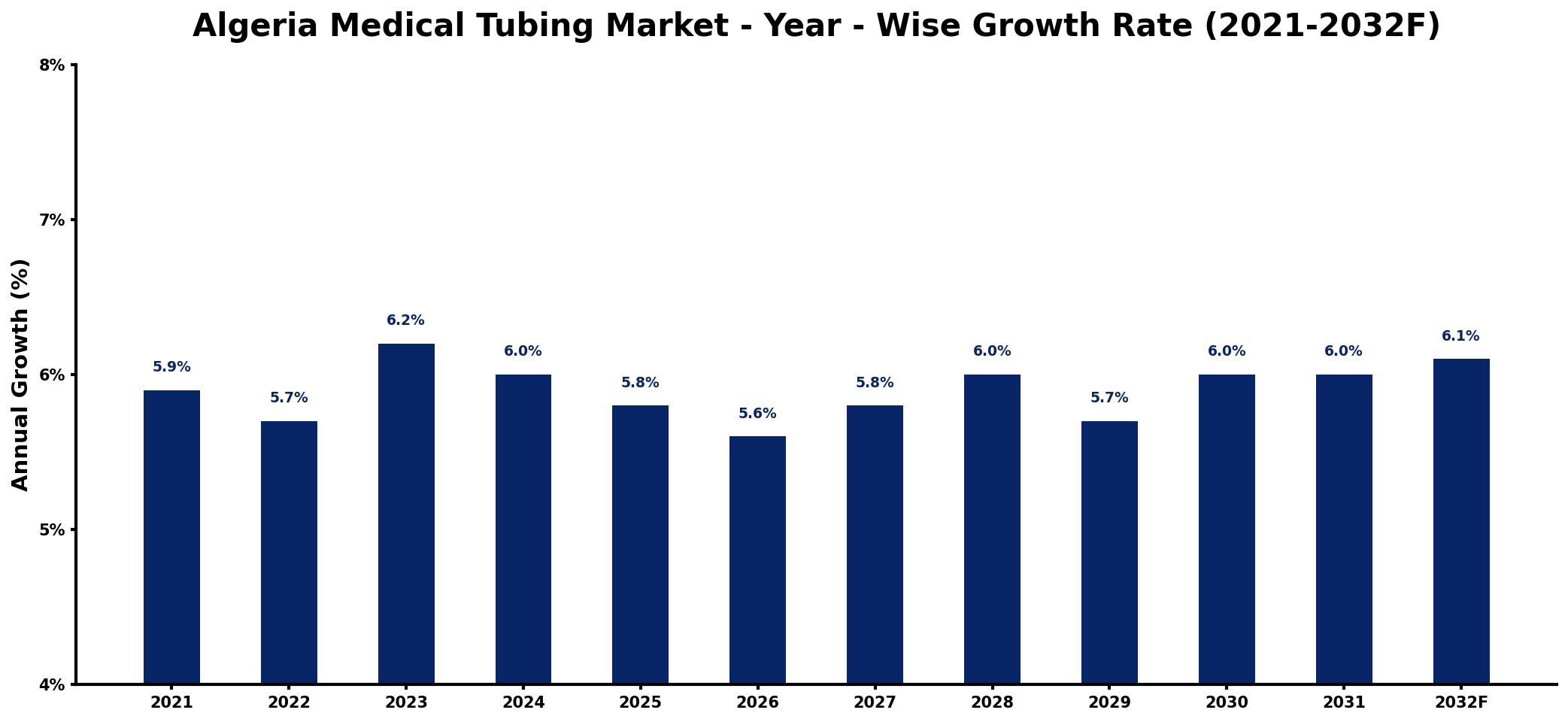
The table below presents the year‑wise growth rates along with the key drivers influencing the market
| Year | Growth Rate | Major Drivers |
| 2021 | 5.9% | Rising healthcare infrastructure investments |
| 2022 | 5.7% | Increased demand for surgical procedures |
| 2023 | 6.2% | Growth in biotechnology applications |
| 2024 | 6.0% | Expansion of pharmaceutical production capacities |
| 2025 | 5.8% | Higher prevalence of chronic diseases |
| 2026 | 5.6% | Advancements in healthcare technologies |
| 2027 | 5.8% | stronger distribution network expansion |
| 2028 | 6.0% | Surge in outpatient care services |
| 2029 | 5.7% | increased production capacity utilization |
| 2030 | 6.0% | Increase in health awareness campaigns |
| 2031 | 6.0% | Development of innovative healthcare solutions |
| 2032 | 6.1% | increased domestic production output |
Note: Market size estimations and growth projections presented in this report are based on 6Wresearch's proprietary forecasting methodology, utilizing the latest available industry data, government publications, and primary research inputs.
Algeria Medical Tubing Market Synopsis
The Algeria Medical Tubing Market has experienced a notable momentum recently, driven by an enhanced focus on healthcare advancements. As the sector progresses, a variety of medical tubing products, including catheters and respiratory tubes, are gaining prominence, addressing the diverse needs of healthcare providers and patients alike.
Looking ahead, the market is set to continue its upward trajectory. Innovations in manufacturing processes and materials are expected to further elevate product standards, enhancing patient safety and comfort. Simultaneously, regulatory frameworks are evolving to ensure compliance and quality assurance across the medical tubing landscape in Algeria.
Algeria Medical Tubing Market Key Takeaways
- The market is witnessing a shift towards single-use medical tubing to mitigate infection risks.
- Advancements in technology are fostering the development of biocompatible and flexible materials.
- Investment in local manufacturing capabilities is crucial to reduce dependency on imports.
- The regulatory environment is increasingly stringent, ensuring product safety and efficacy.
- Rising healthcare expenditures are amplifying the demand for high-quality medical tubing solutions.
Evaluation of Restraints in Algeria Medical Tubing Market
Despite the positive market outlook, several restraints are holding back growth potential in the Algeria Medical Tubing Market. A significant barrier is the country's reliance on imports due to insufficient local manufacturing infrastructure. This dependence can lead to vulnerabilities in supply chains and increased costs for healthcare providers. Additionally, navigating the complex regulatory landscape can create hurdles for market entrants, hampering innovation and time-to-market for new products. Companies must also contend with limited access to advanced technologies, which can stifle product development and competitiveness in an increasingly dynamic sector.
Algeria Medical Tubing Market Trends
The Algeria Medical Tubing Market is currently characterized by several key trends that shape its landscape. There is a growing adoption of flexible and biocompatible materials aimed at enhancing patient comfort and safety. Concurrently, the push towards single-use medical devices is gaining momentum to reduce risks of infections and cross-contamination. Furthermore, technological advancements are leading to the development of antimicrobial coatings for medical tubing, which not only improve infection control but also align with global health trends emphasizing patient safety.
Algeria Medical Tubing Market Opportunities
Investment opportunities within the Algeria Medical Tubing Market are abundant, particularly as the healthcare sector continues to expand. The need for high-quality medical tubing products is expected to rise in tandem with increased healthcare spending and infrastructure enhancements. Innovators focusing on creating specialized products tailored to local medical needs will find a receptive market. Moreover, strategic partnerships aimed at advancing manufacturing capabilities and technology adoption present lucrative avenues for growth and differentiation in this competitive landscape.
Government Initiatives in the Algeria Medical Tubing Market
The Algerian government has made significant strides in regulating the Medical Tubing Market through comprehensive policies aimed at ensuring quality and safety. Regulatory bodies, including the Ministry of Health, play a pivotal role in overseeing the manufacturing, importation, and distribution of medical tubing products. By instituting stringent guidelines for registration and certification, the government seeks to promote transparency and consumer protection. These efforts are designed to build a reliable market environment that fosters confidence among healthcare providers and patients alike.
Future Insights of the Algeria Medical Tubing Market
As we look toward 2026-2032, the Algeria Medical Tubing Market is on a promising path toward sustained growth. Factors contributing to this outlook include the continuous development of healthcare infrastructure and an increasing focus on advanced medical technologies. The rising prevalence of chronic diseases further underscores the need for effective medical tubing solutions. Nonetheless, companies will need to navigate the challenges posed by international competition and regulatory requirements to fully leverage market opportunities.
Algeria Medical Tubing Market Latest Developments (2025 - 2026)
Recent developments within the Algeria Medical Tubing Market indicate a significant push toward modernization and quality improvement. Industry stakeholders are increasingly investing in R&D to innovate and enhance product offerings, focusing on materials that provide greater safety and patient comfort. Additionally, partnerships between local and international firms are emerging to bolster manufacturing capabilities, ultimately aiming to reduce reliance on imports while meeting domestic demand for high-quality medical tubing products.
Algeria Medical Tubing Market - Key Attractiveness of the Report
- 10 Years of Market Numbers
- Historical Data Starting from 2022 to 2025
- Base Year: 2025
- Forecast Data until 2032
- Key Performance Indicators Impacting the Market
- Major Upcoming Developments and Projects
Key Highlights of the Report:
- Algeria Medical Tubing Market Outlook
- Market Size of Algeria Medical Tubing Market, 2025
- Forecast of Algeria Medical Tubing Market, 2032
- Historical Data and Forecast of Algeria Medical Tubing Revenues & Volume for the Period 2022-2032F
- Algeria Medical Tubing Market Trend Evolution
- Algeria Medical Tubing Market Drivers and Challenges
- Algeria Medical Tubing Price Trends
- Algeria Medical Tubing Porter's Five Forces
- Algeria Medical Tubing Industry Life Cycle
- Historical Data and Forecast of Algeria Medical Tubing Market Revenues & Volume By Material for the Period 2022-2032F
- Historical Data and Forecast of Algeria Medical Tubing Market Revenues & Volume By Plastics for the Period 2022-2032F
- Historical Data and Forecast of Algeria Medical Tubing Market Revenues & Volume By Rubbers for the Period 2022-2032F
- Historical Data and Forecast of Algeria Medical Tubing Market Revenues & Volume By Specialty Polymers for the Period 2022-2032F
- Historical Data and Forecast of Algeria Medical Tubing Market Revenues & Volume By Structure for the Period 2022-2032F
- Historical Data and Forecast of Algeria Medical Tubing Market Revenues & Volume By Single-lumen for the Period 2022-2032F
- Historical Data and Forecast of Algeria Medical Tubing Market Revenues & Volume By Co-extruded for the Period 2022-2032F
- Historical Data and Forecast of Algeria Medical Tubing Market Revenues & Volume By Multi-lumen for the Period 2022-2032F
- Historical Data and Forecast of Algeria Medical Tubing Market Revenues & Volume By Tapered Or Bump Tubing for the Period 2022-2032F
- Historical Data and Forecast of Algeria Medical Tubing Market Revenues & Volume By Braided Tubing for the Period 2022-2032F
- Historical Data and Forecast of Algeria Medical Tubing Market Revenues & Volume By Application for the Period 2022-2032F
- Historical Data and Forecast of Algeria Medical Tubing Market Revenues & Volume By Bulk Disposable Tubing for the Period 2022-2032F
- Historical Data and Forecast of Algeria Medical Tubing Market Revenues & Volume By Catheters & Cannulas for the Period 2022-2032F
- Historical Data and Forecast of Algeria Medical Tubing Market Revenues & Volume By Drug Delivery System for the Period 2022-2032F
- Historical Data and Forecast of Algeria Medical Tubing Market Revenues & Volume By Special Applications for the Period 2022-2032F
- Algeria Medical Tubing Import Export Trade Statistics
- Market Opportunity Assessment By Material
- Market Opportunity Assessment By Structure
- Market Opportunity Assessment By Application
- Algeria Medical Tubing Top Companies Market Share
- Algeria Medical Tubing Competitive Benchmarking By Technical and Operational Parameters
- Algeria Medical Tubing Company Profiles
- Algeria Medical Tubing Key Strategic Recommendations






































