Kenya Men Personal Care Market Summary
The kenya men personal care market was estimated at USD 308 Million in 2025 and is projected to reach USD 418 Million by 2032, growing at a CAGR of 5.2% from 2026 to 2032.
Kenya Men Personal Care Market Year-wise Growth Rate and Key Drivers
This graph highlights how the Kenya Men Personal Care Market has steadily grown over the past five years, supported by major growth factors.
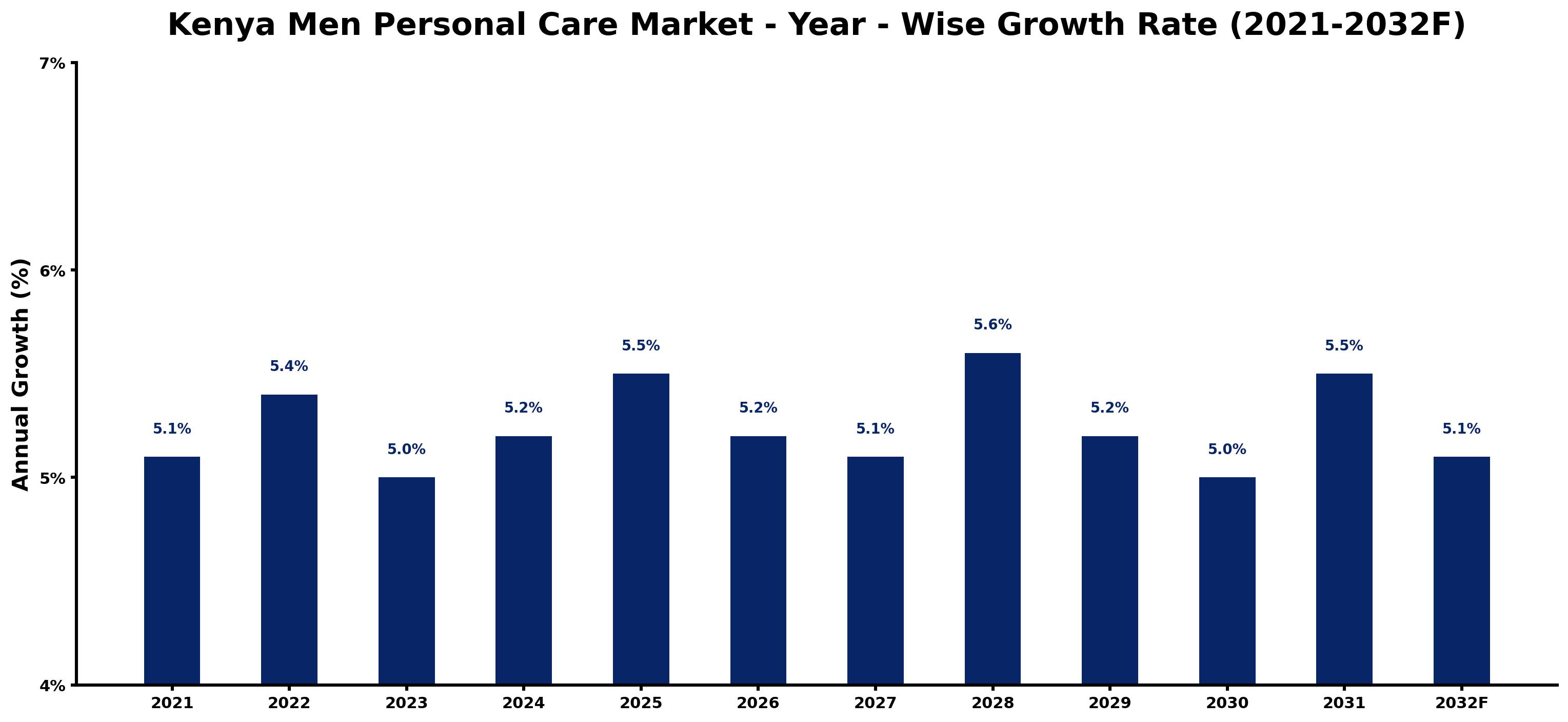
The table below presents the year wise growth rates along with the key drivers influencing the market
| Year | Growth Rate | Major Drivers |
| 2021 | 5.1% | An emerging middle class influences men's spending on personal grooming products. |
| 2022 | 5.4% | Social media campaigns challenge traditional notions of masculinity and self-care. |
| 2023 | 5.0% | Local brands emphasize natural ingredients, appealing to environmentally conscious consumers. |
| 2024 | 5.2% | Urbanization trends lead to higher disposable income among Kenyan men. |
| 2025 | 5.5% | E-commerce growth transforms purchasing habits, making products more accessible. |
| 2026 | 5.2% | Increased awareness of skincare benefits encourages men to invest in personal care. |
| 2027 | 5.1% | Partnerships between brands and influencers create targeted marketing strategies. |
| 2028 | 5.6% | Innovative product lines cater to diverse skin types and grooming needs. |
| 2029 | 5.2% | Shifts in lifestyle towards health and wellness drive demand for organic options. |
| 2030 | 5.0% | Retail expansions focus on urban centers, providing convenience for consumers. |
| 2031 | 5.5% | Collaborations with local artisans highlight cultural relevance in personal care products. |
| 2032 | 5.1% | Sustainable practices resonate with younger generations, shaping their buying decisions. |
Note - Market size estimations and growth projections presented in this report are based on 6Wresearch's advanced forecasting approach, validated with industry datasets as of June 2026.
Kenya Men Personal Care Market Synopsis
The Kenya Men Personal Care Market is projected to reach 5.2% and witness significant growth during the forecast period (2026-2032). This market growth is largely attributed to evolving societal norms and an increasing awareness among male consumers regarding grooming and personal care. The product spectrum encompasses a diverse range of offerings, including skincare, haircare, and grooming solutions specifically designed for men. As men become more conscious of their personal grooming routines, the demand for tailored products continues to rise, reflecting a broader cultural shift that embraces self-care among males.
Kenya Men Personal Care Market Growth Drivers
Several key factors are propelling the growth of the Kenya Men Personal Care Market. First, changing societal attitudes towards male grooming are influencing consumer behavior, fostering a greater acceptance of personal care among men. Second, the rising disposable income in urban areas allows more men to invest in grooming products, moving beyond basic hygiene to include luxury and premium offerings. Additionally, the proliferation of e-commerce platforms is providing men with increased access to a wider array of personal care products, enabling better shopping experiences. Furthermore, health and wellness trends are pushing consumers towards natural and organic products, aligning with a global shift towards sustainable consumption.
Kenya Men Personal Care Market Trends and Opportunities
The Kenya Men Personal Care Market is witnessing notable trends that present significant opportunities for growth. There is a marked shift towards natural and organic formulations, driven by rising health consciousness among consumers. Men are increasingly prioritizing products devoid of harmful chemicals, opting for skin, hair, and grooming solutions that align with their lifestyle choices. The market is also seeing increased interest in specialized products that address specific grooming needs such as anti-aging solutions, acne treatment, and beard care products. As brands respond to these evolving preferences, there is an opportunity to introduce innovative offerings that resonate with the male demographic.
Kenya Men Personal Care Market Challenges and Restraints
Despite its growth potential, the Kenya Men Personal Care Market faces several challenges. Traditional gender norms still present significant barriers, often overshadowing the importance of personal grooming among men. Many men perceive grooming products as feminine, which hampers acceptance and market penetration. Moreover, limited availability of specialized men's grooming products in physical stores presents a challenge for consumers seeking tailored solutions. Economic factors, including price sensitivity and budget constraints, further impact purchasing decisions. To overcome these challenges, targeted education campaigns are essential to reshape perceptions and promote the benefits of personal grooming among men.
Kenya Men Personal Care Market Investment Opportunities
The Kenya Men Personal Care Market offers numerous investment opportunities as awareness and demand for grooming products continue to rise. Investment can be directed towards the development of innovative skincare, haircare, and grooming products that cater specifically to men's unique needs. The burgeoning demand for natural and organic men's personal care products represents a prime opportunity for brands looking to align with consumer preferences for sustainable offerings. Furthermore, leveraging digital marketing strategies and influencer partnerships can facilitate effective outreach to target the male demographic, capitalizing on the increasing market potential.
Kenya Men Personal Care Market Government Investment and Initiatives
While the Kenyan government has not established specific policies exclusively for the men's personal care market, several broader regulatory frameworks govern the personal care sector. The Kenya Bureau of Standards (KEBS) sets quality and safety standards for personal care products, ensuring that consumer health is protected. Additionally, the Competition Authority of Kenya regulates market practices, promoting fair competition and preventing monopolistic behaviors. Initiatives aimed at boosting local manufacturing, such as "Buy Kenya, Build Kenya," may indirectly enhance the men's personal care segment by supporting local producers and fostering entrepreneurship in this growing market.
Kenya Men Personal Care Market Latest Developments (May 2025 - June 2026)
Recent developments in the Kenya Men Personal Care Market indicate a stronger market direction focused on sustainability and innovation. Brands are increasingly investing in product lines that emphasize natural ingredients, tapping into a growing consumer preference for eco-friendly options. Additionally, there is a notable rise in the promotion of grooming education targeted at men, aimed at overcoming traditional perceptions surrounding personal care. The integration of digital marketing strategies is becoming more pronounced, allowing brands to engage directly with male consumers through social media and online campaigns. These trends highlight a dynamic shift in the market that aligns with global grooming trends.
Kenya Men Personal Care Market - Key Attractiveness of the Report
- 10 Years of Market Numbers
- Historical Data Starting from 2022 to 2025
- Base Year: 2025
- Forecast Data until 2032
- Key Performance Indicators Impacting the Market
- Major Upcoming Developments and Projects
Key Highlights of the Report:
- Kenya Men Personal Care Market Outlook
- Market Size of Kenya Men Personal Care Market, 2025
- Forecast of Kenya Men Personal Care Market, 2032F
- Historical Data and Forecast of Kenya Men Personal Care Revenues & Volume for the Period 2022-2032F
- Kenya Men Personal Care Market Trend Evolution
- Kenya Men Personal Care Market Drivers and Challenges
- Kenya Men Personal Care Price Trends
- Kenya Men Personal Care Porter's Five Forces
- Kenya Men Personal Care Industry Life Cycle
- Historical Data and Forecast of Kenya Men Personal Care Market Revenues & Volume By Types for the Period 2022-2032F
- Historical Data and Forecast of Kenya Men Personal Care Market Revenues & Volume By Hair Care for the Period 2022-2032F
- Historical Data and Forecast of Kenya Men Personal Care Market Revenues & Volume By Shaving for the Period 2022-2032F
- Historical Data and Forecast of Kenya Men Personal Care Market Revenues & Volume By Oral Care for the Period 2022-2032F
- Historical Data and Forecast of Kenya Men Personal Care Market Revenues & Volume By Personal Cleanliness for the Period 2022-2032F
- Historical Data and Forecast of Kenya Men Personal Care Market Revenues & Volume By Skin Care for the Period 2022-2032F
- Historical Data and Forecast of Kenya Men Personal Care Market Revenues & Volume By Others for the Period 2022-2032F
- Historical Data and Forecast of Kenya Men Personal Care Market Revenues & Volume By Distribution Channel for the Period 2022-2032F
- Historical Data and Forecast of Kenya Men Personal Care Market Revenues & Volume By Online for the Period 2022-2032F
- Historical Data and Forecast of Kenya Men Personal Care Market Revenues & Volume By Offline for the Period 2022-2032F
- Kenya Men Personal Care Import Export Trade Statistics
- Market Opportunity Assessment By Types
- Market Opportunity Assessment By Distribution Channel
- Kenya Men Personal Care Top Companies Market Share
- Kenya Men Personal Care Competitive Benchmarking By Technical and Operational Parameters
- Kenya Men Personal Care Company Profiles
- Kenya Men Personal Care Key Strategic Recommendations






































