Kenya Natural Fragrance Market Size, Share & Growth Rate
The Kenya Natural Fragrance Market was estimated at USD 224 Million in 2025 and is projected to reach USD 312 Million by 2032, growing at a CAGR of 4.8% from 2026 to 2032. This impressive growth trajectory is primarily fueled by rising consumer preferences for eco-friendly and health-conscious products, resulting in increased demand for natural fragrances derived from essential oils and botanical extracts. As awareness of the health and environmental benefits of these products grows, so too does the market's potential.
Kenya Natural Fragrance Market Year-wise Growth Rate and Key Drivers
This graph highlights how the Kenya Natural Fragrance Market has steadily grown over the years, supported by major growth factors.
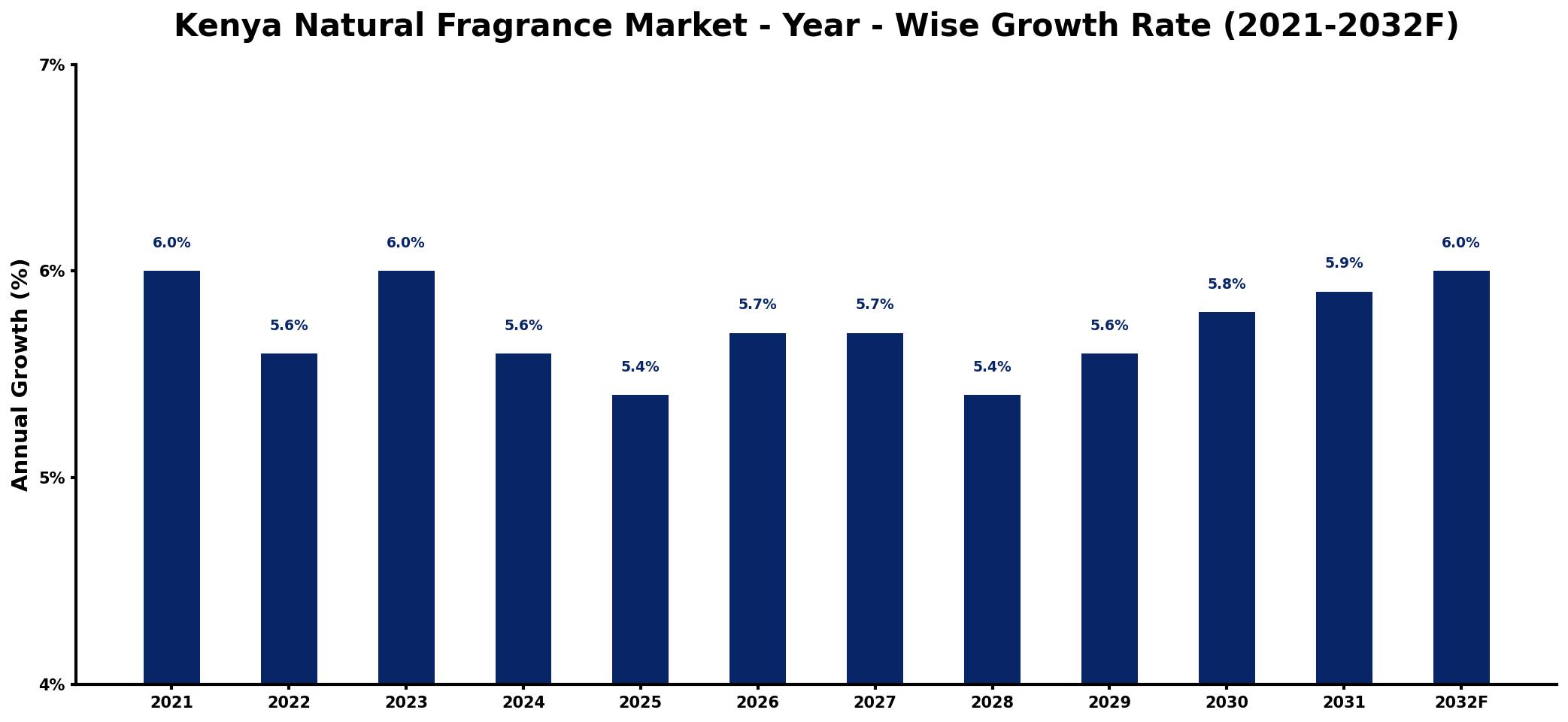
The table below presents the year‑wise growth rates along with the key drivers influencing the market
| Year | Growth Rate | Major Drivers |
| 2021 | 6.0% | increased consumer interest in wellness |
| 2022 | 5.6% | rising popularity of artisanal products |
| 2023 | 6.0% | expansion of online retail channels |
| 2024 | 5.6% | growing demand for eco-friendly options |
| 2025 | 5.4% | investment in local production facilities |
| 2026 | 5.7% | increased focus on sustainable sourcing |
| 2027 | 5.7% | heightened awareness of ingredient transparency |
| 2028 | 5.4% | emergence of innovative scent technologies |
| 2029 | 5.6% | enhanced product quality standards |
| 2030 | 5.8% | improved processing technologies adoption |
| 2031 | 5.9% | rising collaborations with influencers |
| 2032 | 6.0% | development of personalized scent experiences |
Note: Market size estimations and growth projections presented in this report are based on 6Wresearch's proprietary forecasting methodology, utilizing the latest available industry data, government publications, and primary research inputs.
Kenya Natural Fragrance Market Synopsis
The rising popularity of essential oils in personal care products is significantly influencing the Kenya Natural Fragrance Market. Consumers are increasingly gravitating towards fragrances that not only delight the senses but also promote well-being and sustainability. This shift is bolstered by local producers harnessing indigenous plants like lavender and eucalyptus to create unique and authentic fragrances.
As demand for natural ingredients swells, the landscape of the fragrance market is evolving. Notably, the clean beauty movement is reshaping consumer choices, prompting brands to innovate their product lines and ensure transparency regarding ingredient sourcing and sustainability practices.
Kenya Natural Fragrance Market Key Takeaways
- Consumer demand for sustainable and non-toxic personal care products is driving the market.
- Local production of essential oils from indigenous flora enhances market viability.
- Challenges such as high ingredient costs and supply chain limitations persist.
- Government policies affecting ingredient sourcing impact brand growth and trust.
- There is a significant opportunity for investment in local manufacturing capabilities.
Evaluation of Restraints in Kenya Natural Fragrance Market
The Kenya Natural Fragrance Market is currently facing several restraints that hinder its full potential. A key limitation is the high cost of natural fragrance ingredients, which can deter smaller brands from entering the market. Furthermore, the lack of awareness regarding the benefits of natural fragrances among consumers presents an educational hurdle. Additionally, existing supply chain inefficiencies and reliance on imports complicate the landscape, making consistency in product quality and availability an ongoing concern for manufacturers and brands.
Kenya Natural Fragrance Market Trends
The natural fragrance market is witnessing an exciting evolution, spurred on by the rise of clean beauty trends that prioritize safety and environmental consciousness. Emerging consumer preferences are shifting towards brands that offer transparency in their ingredient sourcing while emphasizing the therapeutic benefits of natural fragrances. Moreover, the integration of technology in formulation processes is opening new avenues for innovation, allowing for improved scent consistency and unique blends that cater to diverse consumer tastes.
Kenya Natural Fragrance Market Opportunities
Significant growth and investment opportunities lie in the establishment of local manufacturing facilities to produce natural fragrance components. As consumer demand continues to climb, companies that invest in sustainable and efficient production methods are poised to capture market share. Additionally, there is a pressing need for educational initiatives to enhance consumer understanding of natural fragrances, which presents brands with an opportunity to strengthen their positioning and foster loyalty among environmentally conscious consumers.
Government Initiatives in the Kenya Natural Fragrance Market
The Kenyan government is increasingly recognizing the importance of sustainable practices within various industries, including natural fragrances. Initiatives aimed at promoting the use of indigenous plants and supporting local farmers are paving the way for a more robust supply chain. Public programs focused on eco-friendly practices and investments in agricultural development further encourage the growth of this market, aligning with global sustainability goals.
Future Insights of the Kenya Natural Fragrance Market
Looking ahead to 2026-2032, the Kenya Natural Fragrance Market is set to witness continued expansion as consumers increasingly prioritize wellness and sustainability. Enhanced local production capabilities coupled with an influx of innovative, eco-friendly products will drive market growth. The rising global demand for natural ingredients will also create avenues for Kenyan producers to establish a stronger presence in the international market, particularly as they capitalize on the unique properties of local botanicals.
Kenya Natural Fragrance Market Latest Developments (2025 - 2026)
In recent months, the natural fragrance sector has seen a surge in product launches that emphasize sustainability and the use of indigenous ingredients. Collaborations between local farmers and fragrance producers have become more common, enhancing both product quality and community support. Additionally, there has been an uptick in consumer workshops aimed at promoting awareness about the benefits of natural fragrances, which is likely to increase market penetration and consumer loyalty.
Kenya Natural Fragrance Market - Key Attractiveness of the Report
- 10 Years of Market Numbers
- Historical Data Starting from 2022 to 2025
- Base Year: 2025
- Forecast Data until 2032
- Key Performance Indicators Impacting the Market
- Major Upcoming Developments and Projects
Key Highlights of the Report:
- Kenya Natural Fragrance Market Outlook
- Market Size of Kenya Natural Fragrance Market, 2025
- Forecast of Kenya Natural Fragrance Market, 2032
- Historical Data and Forecast of Kenya Natural Fragrance Revenues & Volume for the Period 2022-2032F
- Kenya Natural Fragrance Market Trend Evolution
- Kenya Natural Fragrance Market Drivers and Challenges
- Kenya Natural Fragrance Price Trends
- Kenya Natural Fragrance Porter's Five Forces
- Kenya Natural Fragrance Industry Life Cycle
- Historical Data and Forecast of Kenya Natural Fragrance Market Revenues & Volume By Ingredient for the Period 2022-2032F
- Historical Data and Forecast of Kenya Natural Fragrance Market Revenues & Volume By Essential Oils for the Period 2022-2032F
- Historical Data and Forecast of Kenya Natural Fragrance Market Revenues & Volume By Natural Extracts for the Period 2022-2032F
- Historical Data and Forecast of Kenya Natural Fragrance Market Revenues & Volume By Type for the Period 2022-2032F
- Historical Data and Forecast of Kenya Natural Fragrance Market Revenues & Volume By Top note for the Period 2022-2032F
- Historical Data and Forecast of Kenya Natural Fragrance Market Revenues & Volume By Middle Note for the Period 2022-2032F
- Historical Data and Forecast of Kenya Natural Fragrance Market Revenues & Volume By Base Note for the Period 2022-2032F
- Historical Data and Forecast of Kenya Natural Fragrance Market Revenues & Volume By Application for the Period 2022-2032F
- Historical Data and Forecast of Kenya Natural Fragrance Market Revenues & Volume By Fine Fragrances for the Period 2022-2032F
- Historical Data and Forecast of Kenya Natural Fragrance Market Revenues & Volume By Personal Care & Cosmetics for the Period 2022-2032F
- Historical Data and Forecast of Kenya Natural Fragrance Market Revenues & Volume By Household Care for the Period 2022-2032F
- Kenya Natural Fragrance Import Export Trade Statistics
- Market Opportunity Assessment By Ingredient
- Market Opportunity Assessment By Type
- Market Opportunity Assessment By Application
- Kenya Natural Fragrance Top Companies Market Share
- Kenya Natural Fragrance Competitive Benchmarking By Technical and Operational Parameters
- Kenya Natural Fragrance Company Profiles
- Kenya Natural Fragrance Key Strategic Recommendations






































