Kenya Online Grocery Market Size, Share & Growth Rate
The Kenya Online Grocery Market was estimated at USD 439 Million in 2025 and is projected to reach USD 597 Million by 2032, growing at a CAGR of 4.5% from 2026 to 2032. This growth trajectory is fueled by increasing internet penetration, a burgeoning middle class, and evolving consumer lifestyles that prioritize convenience and efficiency. As urbanization continues to shape shopping habits, the demand for accessible and reliable online grocery services is set to rise sharply in the coming years.
Kenya Online Grocery Market Year-wise Growth Rate and Key Drivers
This graph highlights how the Kenya Online Grocery Market has steadily grown over the years, supported by major growth factors.
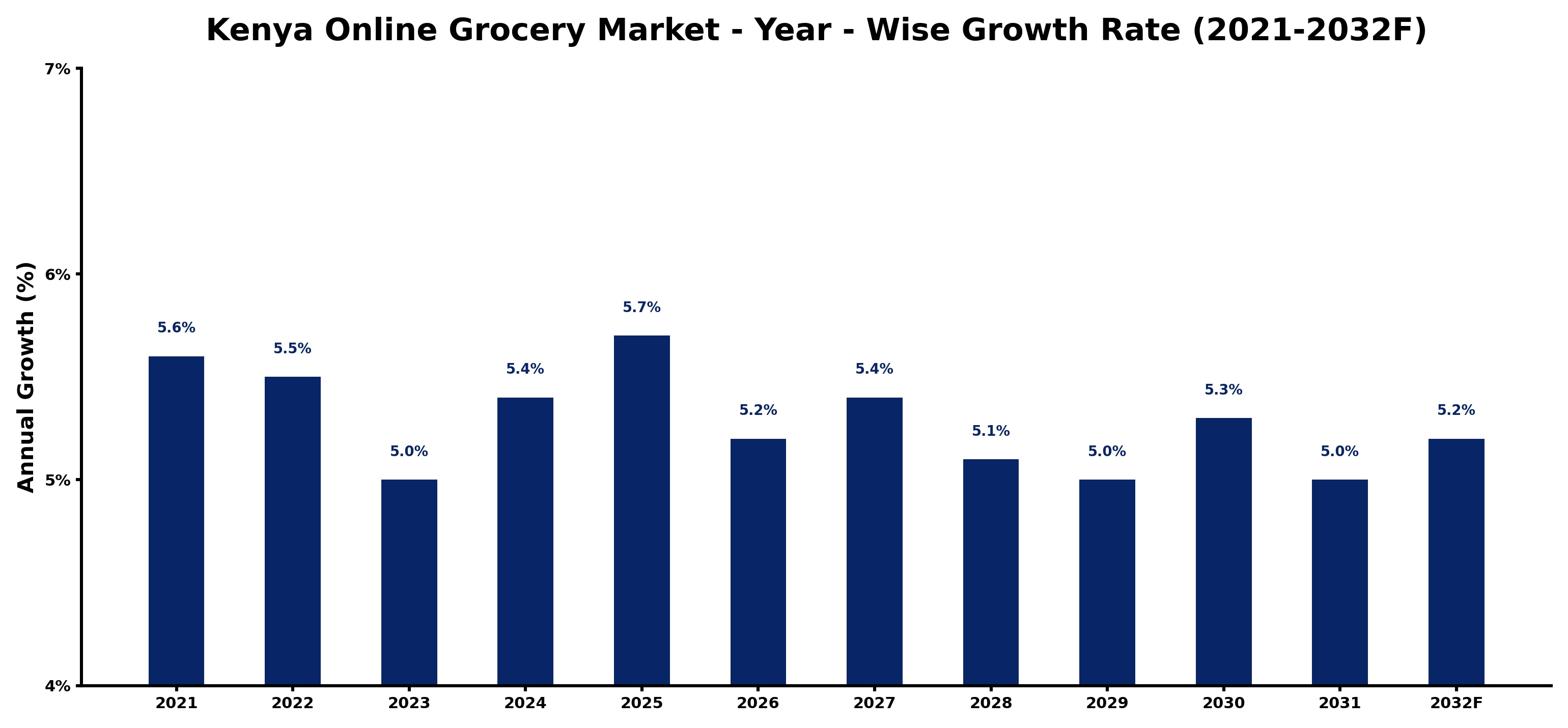
The table below presents the year‑wise growth rates along with the key drivers influencing the market
| Year | Growth Rate | Major Drivers |
| 2021 | 5.6% | Mobile payment adoption increased convenience |
| 2022 | 5.5% | Urbanization drove online shopping growth |
| 2023 | 5.0% | Delivery service improvements enhanced efficiency |
| 2024 | 5.4% | Industrial activity supported growth |
| 2025 | 5.7% | Product variety attracted new customers |
| 2026 | 5.2% | Sustainability trends influenced purchasing behavior |
| 2027 | 5.4% | Market expansion drove consumption |
| 2028 | 5.1% | Promotions and discounts attracted shoppers |
| 2029 | 5.0% | Health-conscious products gained popularity |
| 2030 | 5.3% | Technological innovations improved user experience |
| 2031 | 5.0% | Social media marketing expanded reach |
| 2032 | 5.2% | Subscription services enhanced customer loyalty |
Note - Market size estimations and growth projections presented in this report are based on 6Wresearch’s advanced forecasting approach, validated with industry datasets as of June 2026.
Kenya Online Grocery Market Synopsis
Recent momentum in the Kenya Online Grocery Market reflects a significant shift towards digital shopping, particularly following the pandemic, which accelerated the adoption of e-commerce. However, the market is poised to enter a new phase characterized by enhanced competition, technological innovations, and evolving consumer expectations.
Looking ahead, the potential for growth appears expansive, with both established retailers and new entrants striving to capture market share. The focus on improved logistics, user experience, and a diverse product range will be critical as companies position themselves to meet the needs of a tech-savvy consumer base.
Kenya Online Grocery Market Key Takeaways
- Rapid growth driven by increased internet access and changing consumer preferences.
- Emergence of competitive delivery services and innovative payment solutions enhances market appeal.
- A strong emphasis on improving logistics and operational efficiency is essential for market players.
- Investment opportunities abound in technology that supports last-mile delivery and inventory management.
- The regulatory environment is supportive, with frameworks in place for e-commerce growth.
Evaluation of Restraints in Kenya Online Grocery Market
Despite the promising outlook, the Kenya Online Grocery Market faces notable restraints that could impede growth. Limited internet access in rural areas hampers reach, while unreliable delivery infrastructure raises concerns over service quality and product freshness. Furthermore, the traditional preference for in-person shopping remains prevalent, as many consumers harbor skepticism regarding the reliability of online transactions. Trust issues surrounding security and privacy can also deter potential users from embracing online grocery shopping. Finally, competition from established brick-and-mortar stores poses a challenge, as they continue to maintain loyal customer bases through personalized experiences.
Kenya Online Grocery Market Trends
The online grocery landscape in Kenya is evolving rapidly, with several key trends shaping the market. The proliferation of e-commerce platforms is enabling consumers to access an extensive range of products, while mobile payment solutions are becoming increasingly popular, further simplifying the online shopping experience. The COVID-19 pandemic has played a significant role in transforming consumer behavior, leading to a surge in demand for online grocery delivery services. As consumers prioritize convenience, the trend toward quick, same-day delivery is likely to continue growing, enhancing competition among market players.
Kenya Online Grocery Market Opportunities
The potential for investment in the Kenya Online Grocery Market is significant. With a growing middle class and a shift in consumer preferences towards online shopping, there is a robust demand for platforms that prioritize user-friendly interfaces, diverse product offerings, and efficient delivery systems. Additionally, emerging technologies such as data analytics and advanced logistics solutions present lucrative opportunities for enhancing operational efficiency. By addressing the needs of modern consumers, businesses can effectively capture a share of the expanding market.
Government Initiatives in the Kenya Online Grocery Market
While there are no specific policies targeting the online grocery market, the Kenyan government has established a framework for e-commerce through the E-commerce Act of 2019. This legislation offers guidelines for online business operations, consumer protection, and data privacy, which collectively enhance the market's operational landscape. Additionally, the government's initiatives to improve digital infrastructure and promote entrepreneurship, such as the Ajira Digital Program, contribute positively to the online grocery sector, fostering smoother transactions and broader internet access for consumers.
Future Insights of the Kenya Online Grocery Market
The future of the Kenya Online Grocery Market looks exceptionally bright, with continued expansion expected from 2026 to 2032. Key drivers include ongoing increases in internet penetration and smartphone usage, coupled with a strong consumer demand for convenience and digital shopping experiences. As competition intensifies, market players will likely prioritize enhancing their digital platforms, diversifying product assortments, and refining delivery capabilities. This proactive approach will be vital for capturing a growing share of the market as consumer behaviors evolve.
Kenya Online Grocery Market Latest Developments (May 2025 - June 2026)
Recent developments in the Kenya Online Grocery Market indicate a push towards greater innovation and improved customer experiences. Companies are increasingly adopting advanced technologies to streamline logistics and enhance inventory management. The focus on sustainable practices is also gaining traction, with several platforms exploring partnerships with local suppliers to promote fresh and organic produce. Moreover, the market is witnessing a rise in collaborations aimed at expanding product offerings and boosting service efficiency.
Kenya Online Grocery Market - Key Attractiveness of the Report
- 10 Years of Market Numbers
- Historical Data Starting from 2022 to 2025
- Base Year: 2025
- Forecast Data until 2032
- Key Performance Indicators Impacting the Market
- Major Upcoming Developments and Projects
Key Highlights of the Report:
- Kenya Online Grocery Market Outlook
- Market Size of Kenya Online Grocery Market, 2025
- Forecast of Kenya Online Grocery Market, 2032
- Historical Data and Forecast of Kenya Online Grocery Revenues & Volume for the Period 2022-2032F
- Kenya Online Grocery Market Trend Evolution
- Kenya Online Grocery Market Drivers and Challenges
- Kenya Online Grocery Price Trends
- Kenya Online Grocery Porter's Five Forces
- Kenya Online Grocery Industry Life Cycle
- Historical Data and Forecast of Kenya Online Grocery Market Revenues & Volume By Product Type for the Period 2022-2032F
- Historical Data and Forecast of Kenya Online Grocery Market Revenues & Volume By Food Grains for the Period 2022-2032F
- Historical Data and Forecast of Kenya Online Grocery Market Revenues & Volume By Bread, Bakery and Dairy Products for the Period 2022-2032F
- Historical Data and Forecast of Kenya Online Grocery Market Revenues & Volume By Fruits and Vegetables for the Period 2022-2032F
- Historical Data and Forecast of Kenya Online Grocery Market Revenues & Volume By Personal Care for the Period 2022-2032F
- Historical Data and Forecast of Kenya Online Grocery Market Revenues & Volume By Dry and Baking Products for the Period 2022-2032F
- Historical Data and Forecast of Kenya Online Grocery Market Revenues & Volume By Household Products for the Period 2022-2032F
- Historical Data and Forecast of Kenya Online Grocery Market Revenues & Volume By Meat and Meat Products for the Period 2022-2032F
- Historical Data and Forecast of Kenya Food Grains Online Grocery Market Revenues & Volume By Others for the Period 2022-2032F
- Historical Data and Forecast of Kenya Online Grocery Market Revenues & Volume By Platform for the Period 2022-2032F
- Historical Data and Forecast of Kenya Online Grocery Market Revenues & Volume By App-based for the Period 2022-2032F
- Historical Data and Forecast of Kenya Online Grocery Market Revenues & Volume By Web-based for the Period 2022-2032F
- Kenya Online Grocery Import Export Trade Statistics
- Market Opportunity Assessment By Product Type
- Market Opportunity Assessment By Platform
- Kenya Online Grocery Top Companies Market Share
- Kenya Online Grocery Competitive Benchmarking By Technical and Operational Parameters
- Kenya Online Grocery Company Profiles
- Kenya Online Grocery Key Strategic Recommendations






































