Kenya Paints & varnishes Market Summary
The kenya paints & varnishes market was estimated at USD 721 Million in 2025 and is projected to reach USD 1305 Million by 2032, growing at a CAGR of 10.2% from 2026 to 2032.
Kenya Paints & varnishes Market Year-wise Growth Rate and Key Drivers
This graph highlights how the Kenya Paints & varnishes Market has steadily grown over the past five years, supported by major growth factors.
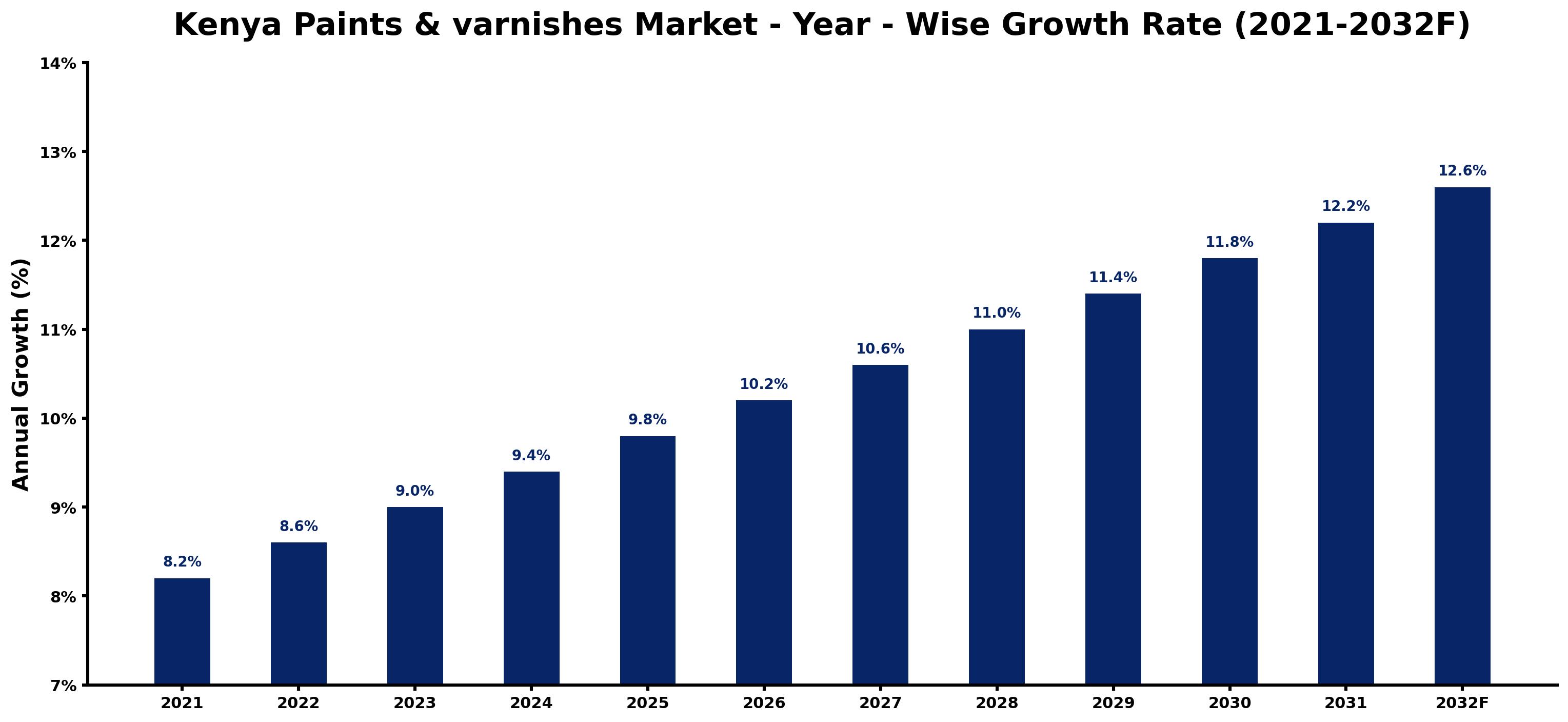
The table below presents the year wise growth rates along with the key drivers influencing the market
| Year | Growth Rate | Major Drivers |
| 2021 | 8.2% | Consumers increasingly favor eco-friendly paints, impacting purchasing decisions across the sector. |
| 2022 | 8.6% | An uptick in urbanization trends leads to higher residential painting demands in cities. |
| 2023 | 9.0% | Innovative distribution channels emerge, allowing easier access to diverse paint options. |
| 2024 | 9.4% | Home improvement projects gain momentum, with households investing in aesthetic enhancements. |
| 2025 | 9.8% | The construction sector's expansion boosts demand for specialized industrial coatings and varnishes. |
| 2026 | 10.2% | International brands enter the market, amplifying competition and driving quality improvements. |
| 2027 | 10.6% | Local manufacturing initiatives enhance supply chain resilience amid global logistical challenges. |
| 2028 | 11.0% | Digital marketing strategies effectively target younger demographics, increasing brand engagement online. |
| 2029 | 11.4% | Sustainable raw material sourcing becomes a focal point for environmentally-conscious consumers. |
| 2030 | 11.8% | Corporate social responsibility initiatives gain traction, influencing brand loyalty among buyers. |
| 2031 | 12.2% | Technological advancements in paint formulations enhance durability and application efficiency. |
| 2032 | 12.6% | Overall consumer spending power improves, supporting discretionary spending on home aesthetics. |
Note - Market size estimations and growth projections presented in this report are based on 6Wresearch's advanced forecasting approach, validated with industry datasets as of June 2026.
Kenya Paints & varnishes Market Synopsis
The Kenya Paints varnishes Market is projected to reach USD 380.3 million and witness significant growth during the forecast period (2026-2032). This anticipated growth is reflective of several socio-economic factors that are shaping the industry landscape. As urbanization rates continue to rise, a corresponding demand for decorative and functional paints has emerged, particularly in the booming construction sector. Coupled with increasing disposable incomes, consumers are more inclined to invest in home renovation and improvements that enhance aesthetic appeal.
Kenya Paints & varnishes Market Growth Drivers
A number of factors are contributing to the expansion of the Kenya Paints & varnishes Market:
- Urbanization is driving the growth of residential and commercial buildings, leading to a greater demand for both decorative and protective coatings.
- The increasing trend toward home renovations, spurred by a growing middle class, is resulting in heightened demand for high-quality paints and finishes.
- Environmental regulations are increasingly prohibiting the use of harmful substances, such as lead, which is pushing manufacturers to innovate with safer and more eco-friendly products.
- Technological advancements in production processes are enhancing product durability and quality, allowing firms to offer competitive prices that appeal to cost-conscious consumers.
- A rebound in economic activities post-pandemic is prompting consumers to renew spending on home décor and improvement projects after a period of restraint.
Kenya Paints & varnishes Market Trends and Opportunities
The current landscape of the Kenya Paints & varnishes Market is marked by several notable trends:
- Growing health consciousness among consumers is driving demand for low-VOC and non-toxic paint products that are safer for both inhabitants and the environment.
- There is a rising preference for customized paint solutions that cater to specific aesthetic preferences and unique application needs, providing opportunities for brands that focus on personalization.
- The increasing penetration of e-commerce platforms is facilitating easier access to paint products, allowing consumers to explore a wider range and make purchases from the convenience of their homes.
- Sustainability is becoming a key differentiator in product offerings, with manufacturers focusing on producing paints that minimize environmental impact through sustainable sourcing and production methods.
- The influence of design trends on consumer preferences is prompting paint manufacturers to develop color palettes and finishes that align with contemporary styles and aesthetics.
Kenya Paints & varnishes Market Challenges and Restraints
Despite its growth potential, the Kenya Paints & varnishes Market faces several challenges:
- Supply chain disruptions, exacerbated by the global pandemic, have impacted the availability of raw materials, leading to potential delays in production schedules and project timelines.
- Fluctuations in raw material prices can significantly affect pricing strategies and profit margins for manufacturers operating in this competitive market.
- The presence of unregulated and counterfeit products poses a challenge to consumer safety and product integrity, necessitating stronger regulatory frameworks.
- Consumer price sensitivity can restrain market growth, particularly in economically challenging times, limiting the potential for premium product offerings.
- The dependency on traditional distribution methods may limit market reach, particularly in rural areas where access to modern retail formats is limited.
Kenya Paints & varnishes Market Government Investment and Initiatives
The Kenyan government has implemented various initiatives aimed at stimulating growth in the paints and varnishes sector. These include investment in infrastructure projects which indirectly boost demand for paints, as well as policies promoting sustainable building practices. Public spending on housing and urban development is on the rise, with an emphasis on creating livable urban environments that adhere to modern design standards. Additionally, regulatory frameworks are evolving to support the adoption of environmentally friendly materials, providing incentives for manufacturers to innovate and adhere to new standards.
Kenya Paints & varnishes Market Latest Developments (May 2025 - June 2026)
The Kenya Paints & varnishes Market has seen several significant developments between May 2025 and June 2026. As consumer demand gradually recovers from the impacts of the pandemic, companies are adapting by enhancing their product portfolios with eco-friendly options. There has been a noticeable shift towards online retail, allowing manufacturers to reach a broader audience amid evolving purchasing behaviors. Furthermore, collaboration between local and international firms has been observed, aimed at leveraging technological advancements to improve product offerings. The focus on sustainability continues to gain traction, with more companies investing in R&D to create innovative solutions that align with market expectations for environmentally conscious products.
Kenya Paints & varnishes Market - Key Attractiveness of the Report
- 10 Years of Market Numbers
- Historical Data Starting from 2022 to 2025
- Base Year: 2025
- Forecast Data until 2032
- Key Performance Indicators Impacting the Market
- Major Upcoming Developments and Projects
The growth is primarily driven by urbanization, rising disposable incomes, increased demand for decorative paints, and renovations.
Environmental regulations are pushing manufacturers towards eco-friendly products, enhancing product safety and reducing health risks for consumers.
Key challenges include supply chain disruptions, price fluctuations of raw materials, and competition from unregulated products.
Recent trends include a shift towards e-commerce, demand for personalized products, and a focus on sustainability in product development.
Key Highlights of the Report:
- Kenya Paints & varnishes Market Outlook
- Market Size of Kenya Paints & varnishes Market, 2025
- Forecast of Kenya Paints & varnishes Market, 2032F
- Historical Data and Forecast of Kenya Paints & varnishes Revenues & Volume for the Period 2022-2032F
- Kenya Paints & varnishes Market Trend Evolution
- Kenya Paints & varnishes Market Drivers and Challenges
- Kenya Paints & varnishes Price Trends
- Kenya Paints & varnishes Porter's Five Forces
- Kenya Paints & varnishes Industry Life Cycle
- Historical Data and Forecast of Kenya Paints & varnishes Market Revenues & Volume By Type for the Period 2022-2032F
- Historical Data and Forecast of Kenya Paints & varnishes Market Revenues & Volume By Water-borne paints and varnishes for the Period 2022-2032F
- Historical Data and Forecast of Kenya Paints & varnishes Market Revenues & Volume By Solvent-borne paints and varnishes for the Period 2022-2032F
- Historical Data and Forecast of Kenya Paints & varnishes Market Revenues & Volume By Others for the Period 2022-2032F
- Historical Data and Forecast of Kenya Paints & varnishes Market Revenues & Volume By Applications for the Period 2022-2032F
- Historical Data and Forecast of Kenya Paints & varnishes Market Revenues & Volume By Transportations paints and varnishes for the Period 2022-2032F
- Historical Data and Forecast of Kenya Paints & varnishes Market Revenues & Volume By Industrial paints and varnishes for the Period 2022-2032F
- Historical Data and Forecast of Kenya Paints & varnishes Market Revenues & Volume By Construction paints and varnishes for the Period 2022-2032F
- Kenya Paints & varnishes Import Export Trade Statistics
- Market Opportunity Assessment By Type
- Market Opportunity Assessment By Applications
- Kenya Paints & varnishes Top Companies Market Share
- Kenya Paints & varnishes Competitive Benchmarking By Technical and Operational Parameters
- Kenya Paints & varnishes Company Profiles
- Kenya Paints & varnishes Key Strategic Recommendations






































