Kenya Plastic Film Market Summary
The kenya plastic film market was estimated at USD 402 Million in 2025 and is projected to reach USD 547 Million by 2032, growing at a CAGR of 5.6% from 2026 to 2032.
Kenya Plastic Film Market Year-wise Growth Rate and Key Drivers
This graph highlights how the Kenya Plastic Film Market has steadily grown over the past five years, supported by major growth factors.
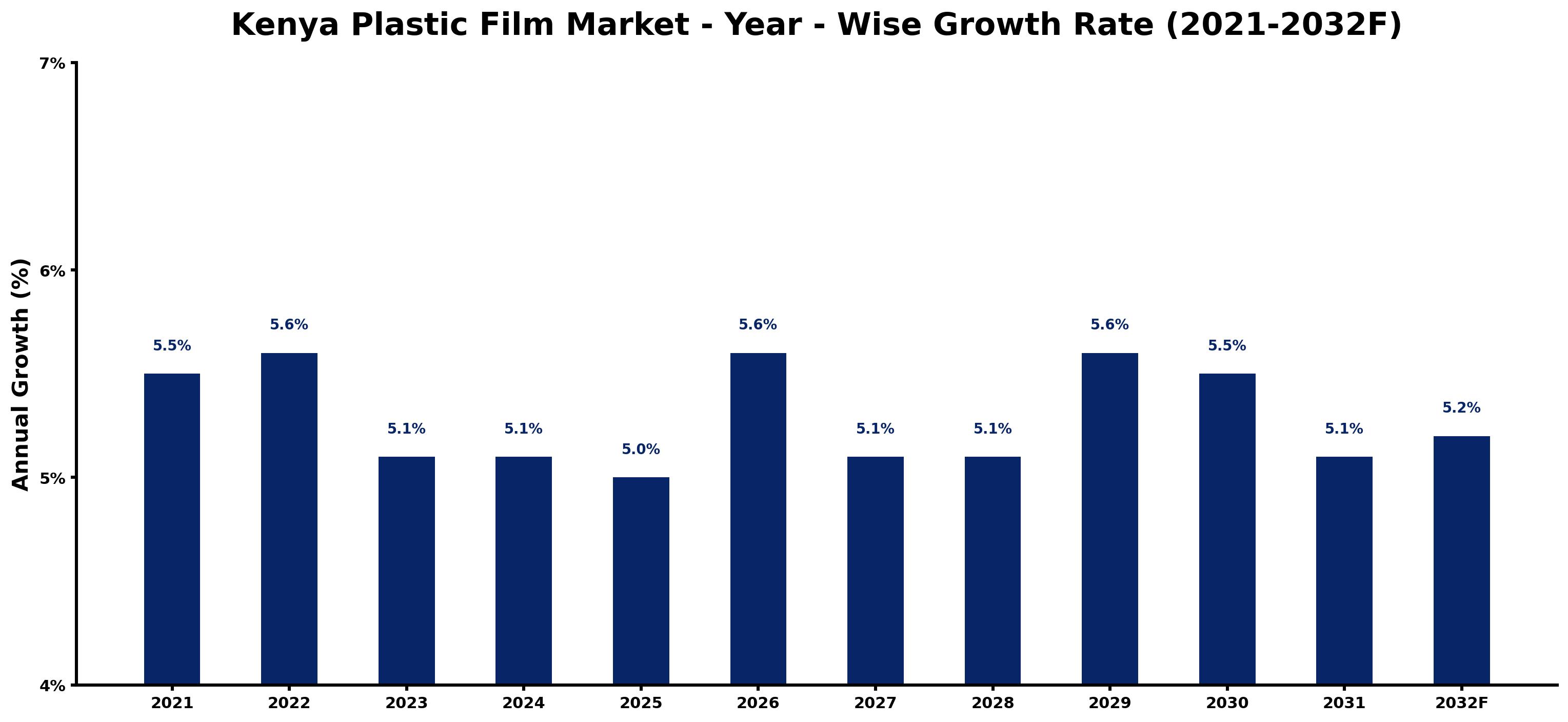
The table below presents the year wise growth rates along with the key drivers influencing the market
| Year | Growth Rate | Major Drivers |
| 2021 | 5.5% | Emerging agricultural practices stimulate demand for enhanced crop protection solutions. |
| 2022 | 5.6% | Manufacturers pivot towards eco-friendly materials amid shifting consumer preferences. |
| 2023 | 5.1% | Investment in logistics infrastructure boosts distribution efficiency for plastic film products. |
| 2024 | 5.1% | Urbanization trends increase packaging needs across multiple sectors in Kenya. |
| 2025 | 5.0% | Local production capabilities are strengthened by rising foreign direct investments. |
| 2026 | 5.6% | Retail sector expansion necessitates innovative packaging solutions for diverse products. |
| 2027 | 5.1% | Sustainability initiatives encourage businesses to explore biodegradable film alternatives. |
| 2028 | 5.1% | Technological innovations facilitate the production of thinner, more durable films. |
| 2029 | 5.6% | E-commerce growth drives the need for protective packaging solutions in logistics. |
| 2030 | 5.5% | Increased agricultural exports amplify the demand for reliable plastic film applications. |
| 2031 | 5.1% | Consumer awareness around waste management influences packaging design strategies. |
| 2032 | 5.2% | Collaboration between manufacturers and retailers promotes sustainability in supply chains. |
Note - Market size estimations and growth projections presented in this report are based on 6Wresearch's advanced forecasting approach, validated with industry datasets as of June 2026.
Kenya Plastic Film Market Synopsis
The Kenya Plastic Film Market is projected to reach 5.6% and witness significant growth during the forecast period (2026-2032). This growth is driven by diverse applications across crucial industries including packaging, agriculture, and construction. The flexibility, durability, and cost-effectiveness of plastic films make them an essential component in various production processes, catering to the evolving demands of these sectors.
Kenya Plastic Film Market Growth Drivers
Several factors are propelling the growth of the Kenya Plastic Film Market. The increasing demand for efficient packaging solutions continues to be a major driver, particularly in the food and beverage sector, where the emphasis on product longevity and safety is paramount. In agriculture, the use of plastic films for mulching, greenhouse covering, and silage wrapping enhances crop yields and improves farming efficiency. Furthermore, the construction industry utilizes plastic films for insulation and moisture barriers, indicating a diverse range of application areas.
- High demand for flexible and durable packaging in food and beverage applications, enhancing product shelf life and safety.
- Growing agricultural practices utilizing plastic films to improve productivity and protection against pests and weather conditions.
- Increased construction activity leading to a higher consumption of plastic films for building insulation and waterproofing.
- Innovation in the production of biodegradable plastic films, responding to environmental concerns and consumer preferences for sustainable options.
- Government regulations promoting recycling and the use of eco-friendly materials, opening new avenues for market growth.
Kenya Plastic Film Market Trends and Opportunities
The Kenya Plastic Film Market is experiencing a pronounced shift towards sustainable practices. There is a burgeoning demand for biodegradable and eco-friendly alternatives, prompted by heightened awareness of plastic pollution and regulatory pressures. Manufacturers are increasingly investing in research and development to create innovative solutions that align with consumer preferences for environmentally responsible packaging.
- Emergence of biodegradable plastic films, which are made from plant-based materials, to meet the rising demand for sustainable alternatives.
- Increased investment in recycling technologies to reduce waste and improve resource efficiency in plastic film production.
- Adoption of recycled plastics in film manufacturing, creating a circular economy and minimizing environmental impact.
- Growth in e-commerce necessitating specialized packaging solutions, prompting new product development tailored to this expanding market segment.
- Integration of advanced manufacturing technologies to enhance the performance characteristics of plastic films, ensuring they meet stringent market requirements.
Kenya Plastic Film Market Challenges and Restraints
Despite the positive outlook, the Kenya Plastic Film Market faces several challenges. Environmental issues stemming from plastic pollution pose significant risks for the industry, prompting calls for more stringent regulations. Additionally, competition from biodegradable alternatives and other packaging materials such as paper presents a challenge to traditional plastic film products.
- Environmental concerns related to plastic waste, leading to a demand for more responsible production and disposal practices.
- Competition from alternative packaging materials such as biodegradable films and paper products, which could divert market share from plastic films.
- Fluctuations in raw material prices, which can affect production costs and profitability for manufacturers.
- Inadequate recycling infrastructure, limiting the potential for sustainability and responsible end-of-life management of plastic films.
- Lack of consumer awareness regarding sustainable plastic usage, which can hinder the acceptance of eco-friendly products in the market.
Kenya Plastic Film Market Investment Opportunities
Investment opportunities in the Kenya Plastic Film Market are vibrant, particularly in the context of rising urbanization and evolving consumer preferences. Industries such as food and beverage, healthcare, and agriculture present a growing demand for innovative packaging solutions, making this an attractive landscape for investments.
- Opportunity to manufacture high-quality, eco-friendly plastic films to meet the increasing demand for sustainable packaging.
- Investment in technological advancements aimed at enhancing production efficiency and reducing environmental footprints.
- Potential for partnerships with various stakeholders across the value chain to expand market access and product offerings.
- Research and development focused on recyclable and biodegradable film solutions, capitalizing on the trend towards environmental sustainability.
- Development of niche markets requiring specialized film products, such as those catering to the e-commerce sector.
Kenya Plastic Film Market Government Investment and Initiatives
The Kenyan government has implemented significant initiatives to regulate the plastic film market, aimed at promoting sustainability and mitigating environmental impacts. Key policies include the ban on single-use plastic bags, which has effectively reduced plastic waste. Furthermore, government programs designed to enhance recycling capabilities and promote biodegradable materials are paving the way for a more environmentally conscious industry.
- Implementation of a ban on the use and import of single-use plastic bags, which has significantly impacted plastic waste management.
- Establishment of recycling plants to facilitate proper disposal and recycling of plastic film products.
- Promotion of biodegradable alternatives through incentives for manufacturers adapting eco-friendly practices.
- Public awareness campaigns aimed at educating consumers about sustainable plastic usage and disposal methods.
- Support for innovation and research into alternative materials and sustainable manufacturing processes.
Kenya Plastic Film Market Latest Developments (May 2025 - June 2026)
In the period from May 2025 to June 2026, the Kenya Plastic Film Market has witnessed notable developments focused on enhancing sustainability and efficiency. Several initiatives have emerged, aimed at promoting the use of biodegradable materials and improving recycling infrastructure. The trend towards sustainable packaging has led to an increase in eco-friendly product offerings in various industries, aligning with consumer preferences for environmental responsibility.
Kenya Plastic Film Market - Key Attractiveness of the Report
- 10 Years of Market Numbers
- Historical Data Starting from 2022 to 2025
- Base Year: 2025
- Forecast Data until 2032
- Key Performance Indicators Impacting the Market
- Major Upcoming Developments and Projects
Key Highlights of the Report:
- Kenya Plastic Film Market Outlook
- Market Size of Kenya Plastic Film Market, 2025
- Forecast of Kenya Plastic Film Market, 2032F
- Historical Data and Forecast of Kenya Plastic Film Revenues & Volume for the Period 2022-2032F
- Kenya Plastic Film Market Trend Evolution
- Kenya Plastic Film Market Drivers and Challenges
- Kenya Plastic Film Price Trends
- Kenya Plastic Film Porter's Five Forces
- Kenya Plastic Film Industry Life Cycle
- Historical Data and Forecast of Kenya Plastic Film Market Revenues & Volume By Product Types for the Period 2022-2032F
- Historical Data and Forecast of Kenya Plastic Film Market Revenues & Volume By Polyethylene (PE) for the Period 2022-2032F
- Historical Data and Forecast of Kenya Plastic Film Market Revenues & Volume By Polypropylene (PP) for the Period 2022-2032F
- Historical Data and Forecast of Kenya Plastic Film Market Revenues & Volume By Polyvinyl chloride (PVC) for the Period 2022-2032F
- Historical Data and Forecast of Kenya Plastic Film Market Revenues & Volume By Polyethylene terephthalate (PET) for the Period 2022-2032F
- Historical Data and Forecast of Kenya Plastic Film Market Revenues & Volume By Others for the Period 2022-2032F
- Historical Data and Forecast of Kenya Plastic Film Market Revenues & Volume By Applications for the Period 2022-2032F
- Historical Data and Forecast of Kenya Plastic Film Market Revenues & Volume By Packaging for the Period 2022-2032F
- Historical Data and Forecast of Kenya Plastic Film Market Revenues & Volume By Construction for the Period 2022-2032F
- Historical Data and Forecast of Kenya Plastic Film Market Revenues & Volume By Electricals & Electronics for the Period 2022-2032F
- Historical Data and Forecast of Kenya Plastic Film Market Revenues & Volume By Automotive for the Period 2022-2032F
- Historical Data and Forecast of Kenya Plastic Film Market Revenues & Volume By Pharmaceutical for the Period 2022-2032F
- Historical Data and Forecast of Kenya Plastic Film Market Revenues & Volume By Agriculture for the Period 2022-2032F
- Historical Data and Forecast of Kenya Plastic Film Market Revenues & Volume By Consumer Goods for the Period 2022-2032F
- Historical Data and Forecast of Kenya Plastic Film Market Revenues & Volume By Utility for the Period 2022-2032F
- Kenya Plastic Film Import Export Trade Statistics
- Market Opportunity Assessment By Product Types
- Market Opportunity Assessment By Applications
- Kenya Plastic Film Top Companies Market Share
- Kenya Plastic Film Competitive Benchmarking By Technical and Operational Parameters
- Kenya Plastic Film Company Profiles
- Kenya Plastic Film Key Strategic Recommendations






































