Kenya Plastic Processing Equipment Market Size, Share & Growth Rate
The Kenya Plastic Processing Equipment Market was estimated at USD 338 Million in 2025 and is projected to reach USD 464 Million by 2032, growing at a CAGR of 4.6% from 2026 to 2032. This positive growth trajectory is fueled by increased demand for plastic products in diverse sectors such as packaging, automotive, and construction, driven by urbanization and the rise of the middle-class population. Moreover, advancements in technology and government policies promoting sustainable practices are reshaping the landscape, opening avenues for innovative solutions in plastic processing.
Kenya Plastic Processing Equipment Market Year-wise Growth Rate and Key Drivers
This graph highlights how the Kenya Plastic Processing Equipment Market has steadily grown over the years, supported by major growth factors.
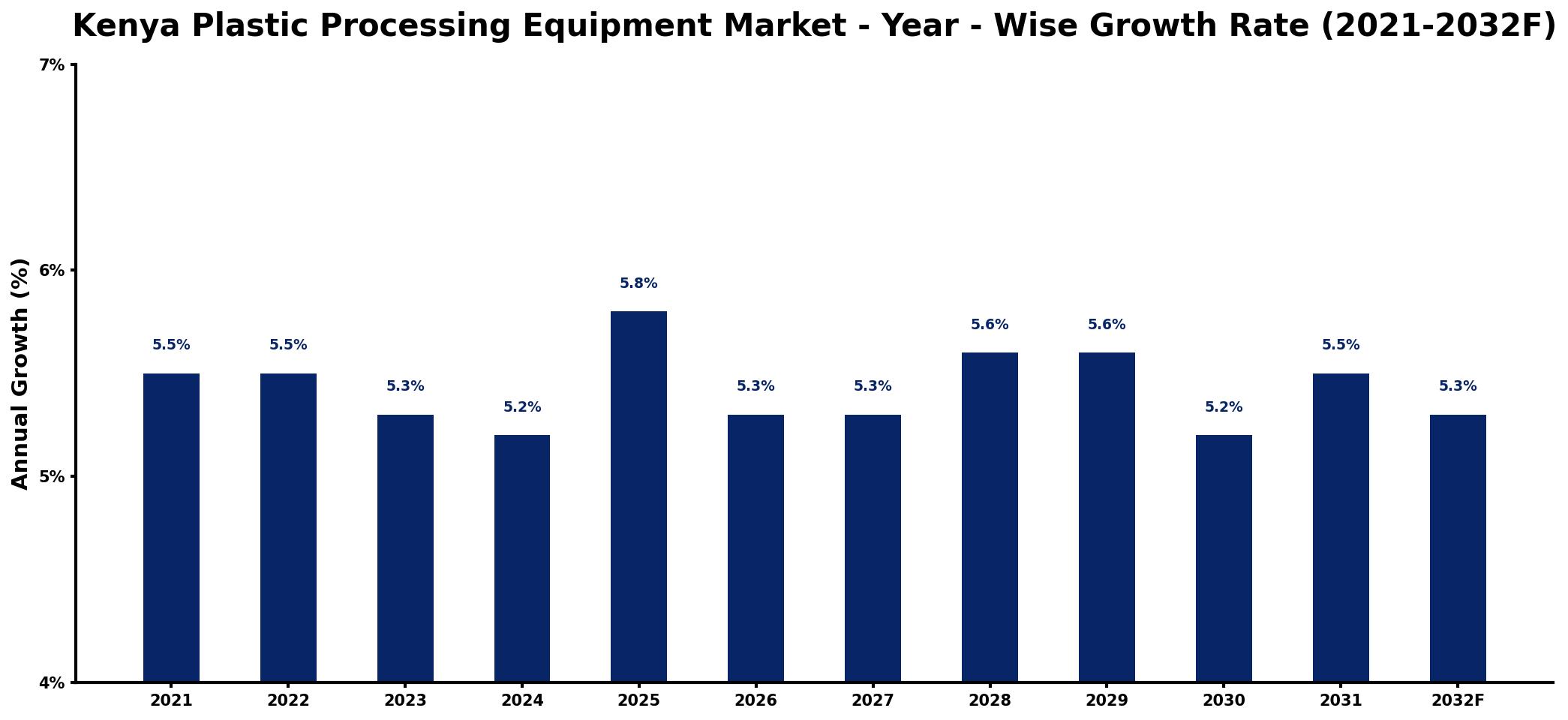
The table below presents the year‑wise growth rates along with the key drivers influencing the market
| Year | Growth Rate | Major Drivers |
| 2021 | 5.5% | Rising demand from packaging sector |
| 2022 | 5.5% | Increased investments in manufacturing |
| 2023 | 5.3% | Growth in construction industry applications |
| 2024 | 5.2% | Expansion of recycling initiatives |
| 2025 | 5.8% | Emerging markets driving consumption |
| 2026 | 5.3% | Technological advancements boosting efficiency |
| 2027 | 5.3% | Surge in consumer goods production |
| 2028 | 5.6% | Growing focus on sustainability practices |
| 2029 | 5.6% | Diversification in end-use industries |
| 2030 | 5.2% | Strengthening regional trade agreements |
| 2031 | 5.5% | Enhancements in supply chain logistics |
| 2032 | 5.3% | Innovation in material alternatives |
Note: Market size estimations and growth projections presented in this report are based on 6Wresearch's proprietary forecasting methodology, utilizing the latest available industry data, government publications, and primary research inputs.
Kenya Plastic Processing Equipment Market Synopsis
In Kenya, the demand for plastic processing equipment is surging, spurred by the growing plastic production industry. This sector is especially vibrant in packaging, where the need for high-quality, efficient machinery is critical to meet consumer demand.
Local manufacturers are increasingly investing in advanced machinery, such as extrusion and injection molding equipment, to enhance production capabilities. The shift toward eco-friendly practices is further influencing equipment choices, as manufacturers align with sustainability goals and government regulations.
Kenya Plastic Processing Equipment Market Key Takeaways
- The market is driven by rising urbanization and industrial growth.
- There is a notable focus on sustainability, influencing machinery development.
- Technological advancements, including automation, are enhancing production efficiency.
- Government regulations are increasingly impacting market dynamics and equipment standards.
- Investment opportunities exist for local and international equipment suppliers targeting modern manufacturing needs.
Evaluation of Restraints in Kenya Plastic Processing Equipment Market
Despite the growth prospects, the Kenya Plastic Processing Equipment Market faces significant challenges. High initial costs associated with advanced machinery create barriers, particularly for small and medium-sized enterprises. Furthermore, limited access to financing options can hinder local players from upgrading their operations. A lack of skilled labor proficient in operating sophisticated machinery complicates matters, preventing manufacturers from fully capitalizing on technological advancements. Additionally, competition from cheaper imported equipment can place undue pressure on domestic manufacturers, complicating their growth trajectories.
Kenya Plastic Processing Equipment Market Trends
The market is witnessing a growing trend toward automation and robotics, significantly improving production efficiency and reducing labor costs. As companies aim for higher quality and consistency in their products, the integration of smart technology becomes increasingly relevant. Moreover, eco-conscious manufacturing processes are driving the demand for energy-efficient equipment, aligning with both consumer preferences and regulatory requirements. These trends reflect a broader industry shift toward innovation and sustainability, reshaping the future of plastic processing in Kenya.
Kenya Plastic Processing Equipment Market Opportunities
Investors looking to penetrate the Kenya Plastic Processing Equipment Market will find ample opportunities in supplying modern, high-quality machinery tailored for local needs. Key areas include injection molding and extrusion technologies, where local manufacturers are keen to improve production efficiency and product quality. Moreover, the growing emphasis on sustainability presents avenues for innovative technologies focused on recycling and waste management. Collaborating with local firms to provide customized solutions and robust after-sales service will strengthen market positions and foster long-term growth.
Government Initiatives in the Kenya Plastic Processing Equipment Market
The Kenyan government has enacted several measures aimed at regulating the plastic processing equipment market to enhance sustainability and environmental protection. Recent policies have included bans on single-use plastic bags and implementation of recycling initiatives, such as a plastic bottle deposit scheme. Furthermore, the government is enforcing compliance with safety and environmental standards for processing equipment, incentivizing investments in sustainable technologies. These initiatives not only bolster environmental stewardship but also drive innovation in the plastic processing equipment sector.
Future Insights of the Kenya Plastic Processing Equipment Market
Looking ahead to 2026-2032, the Kenya Plastic Processing Equipment Market is set to experience steady growth, fueled by escalating demand for plastic products in key industries. Factors such as urbanization, population growth, and rising disposable incomes will continue to drive this trajectory. Moreover, as government policies increasingly prioritize recycled materials and sustainable manufacturing, companies will need to adapt swiftly to remain competitive. Overall, the market landscape will be characterized by technological advancement and a collective move towards sustainability.
Kenya Plastic Processing Equipment Market Latest Developments (2025 - 2026)
Recent developments in the Kenya Plastic Processing Equipment Market indicate a strong focus on innovation, with manufacturers increasingly adopting advanced technologies to enhance production capabilities. There is a notable push toward incorporating smart technologies and automation in processing operations, reflecting a commitment to efficiency and sustainability. Local firms are collaborating with technology providers to develop custom solutions that address the unique challenges of the Kenyan market, signaling a dynamic and evolving industry landscape.
Kenya Plastic Processing Equipment Market - Key Attractiveness of the Report
- 10 Years of Market Numbers
- Historical Data Starting from 2022 to 2025
- Base Year: 2025
- Forecast Data until 2032
- Key Performance Indicators Impacting the Market
- Major Upcoming Developments and Projects
Key Highlights of the Report:
- Kenya Plastic Processing Equipment Market Outlook
- Market Size of Kenya Plastic Processing Equipment Market, 2025
- Forecast of Kenya Plastic Processing Equipment Market, 2032
- Historical Data and Forecast of Kenya Plastic Processing Equipment Revenues & Volume for the Period 2022-2032F
- Kenya Plastic Processing Equipment Market Trend Evolution
- Kenya Plastic Processing Equipment Market Drivers and Challenges
- Kenya Plastic Processing Equipment Price Trends
- Kenya Plastic Processing Equipment Porter's Five Forces
- Kenya Plastic Processing Equipment Industry Life Cycle
- Historical Data and Forecast of Kenya Plastic Processing Equipment Market Revenues & Volume By Product for the Period 2022-2032F
- Historical Data and Forecast of Kenya Plastic Processing Equipment Market Revenues & Volume By Screw for the Period 2022-2032F
- Historical Data and Forecast of Kenya Plastic Processing Equipment Market Revenues & Volume By Twin Screw for the Period 2022-2032F
- Historical Data and Forecast of Kenya Plastic Processing Equipment Market Revenues & Volume By Barrel for the Period 2022-2032F
- Historical Data and Forecast of Kenya Plastic Processing Equipment Market Revenues & Volume By Nozzle System for the Period 2022-2032F
- Historical Data and Forecast of Kenya Plastic Processing Equipment Market Revenues & Volume By End Caps for the Period 2022-2032F
- Historical Data and Forecast of Kenya Plastic Processing Equipment Market Revenues & Volume By Others for the Period 2022-2032F
- Historical Data and Forecast of Kenya Plastic Processing Equipment Market Revenues & Volume By Material for the Period 2022-2032F
- Historical Data and Forecast of Kenya Plastic Processing Equipment Market Revenues & Volume By Bimetallic for the Period 2022-2032F
- Historical Data and Forecast of Kenya Plastic Processing Equipment Market Revenues & Volume By Nitride for the Period 2022-2032F
- Historical Data and Forecast of Kenya Plastic Processing Equipment Market Revenues & Volume By Carbide for the Period 2022-2032F
- Historical Data and Forecast of Kenya Plastic Processing Equipment Market Revenues & Volume By Steel for the Period 2022-2032F
- Historical Data and Forecast of Kenya Plastic Processing Equipment Market Revenues & Volume By Chrome for the Period 2022-2032F
- Historical Data and Forecast of Kenya Plastic Processing Equipment Market Revenues & Volume By Others for the Period 2022-2032F
- Historical Data and Forecast of Kenya Plastic Processing Equipment Market Revenues & Volume By Industry for the Period 2022-2032F
- Historical Data and Forecast of Kenya Plastic Processing Equipment Market Revenues & Volume By Automotive for the Period 2022-2032F
- Historical Data and Forecast of Kenya Plastic Processing Equipment Market Revenues & Volume By Packaging for the Period 2022-2032F
- Historical Data and Forecast of Kenya Plastic Processing Equipment Market Revenues & Volume By Electronics for the Period 2022-2032F
- Historical Data and Forecast of Kenya Plastic Processing Equipment Market Revenues & Volume By Healthcare for the Period 2022-2032F
- Historical Data and Forecast of Kenya Plastic Processing Equipment Market Revenues & Volume By Consumer Goods for the Period 2022-2032F
- Historical Data and Forecast of Kenya Plastic Processing Equipment Market Revenues & Volume By Others for the Period 2022-2032F
- Historical Data and Forecast of Kenya Plastic Processing Equipment Market Revenues & Volume By Application for the Period 2022-2032F
- Historical Data and Forecast of Kenya Plastic Processing Equipment Market Revenues & Volume By Extrusion for the Period 2022-2032F
- Historical Data and Forecast of Kenya Plastic Processing Equipment Market Revenues & Volume By Injection Molding for the Period 2022-2032F
- Historical Data and Forecast of Kenya Plastic Processing Equipment Market Revenues & Volume By Sales Channel for the Period 2022-2032F
- Historical Data and Forecast of Kenya Plastic Processing Equipment Market Revenues & Volume By OEM for the Period 2022-2032F
- Historical Data and Forecast of Kenya Plastic Processing Equipment Market Revenues & Volume By After Market for the Period 2022-2032F
- Kenya Plastic Processing Equipment Import Export Trade Statistics
- Market Opportunity Assessment By Product
- Market Opportunity Assessment By Material
- Market Opportunity Assessment By Industry
- Market Opportunity Assessment By Application
- Market Opportunity Assessment By Sales Channel
- Kenya Plastic Processing Equipment Top Companies Market Share
- Kenya Plastic Processing Equipment Competitive Benchmarking By Technical and Operational Parameters
- Kenya Plastic Processing Equipment Company Profiles
- Kenya Plastic Processing Equipment Key Strategic Recommendations






































