Kenya Radiotherapy Market Size, Share & Growth Rate
The Kenya Radiotherapy Market was estimated at USD 322 Million in 2025 and is projected to reach USD 467 Million by 2032, growing at a CAGR of 5.5% from 2026 to 2032. This promising trajectory reflects a concerted effort to enhance cancer care capabilities amidst an alarming rise in cancer incidence across the nation. Factors driving this growth include government initiatives aimed at improving healthcare infrastructure, an increase in awareness about cancer prevention, and advancements in radiotherapy technology that improve treatment accessibility and efficiency.
Kenya Radiotherapy Market Year-wise Growth Rate and Key Drivers
This graph highlights how the Kenya Radiotherapy Market has steadily grown over the years, supported by major growth factors.
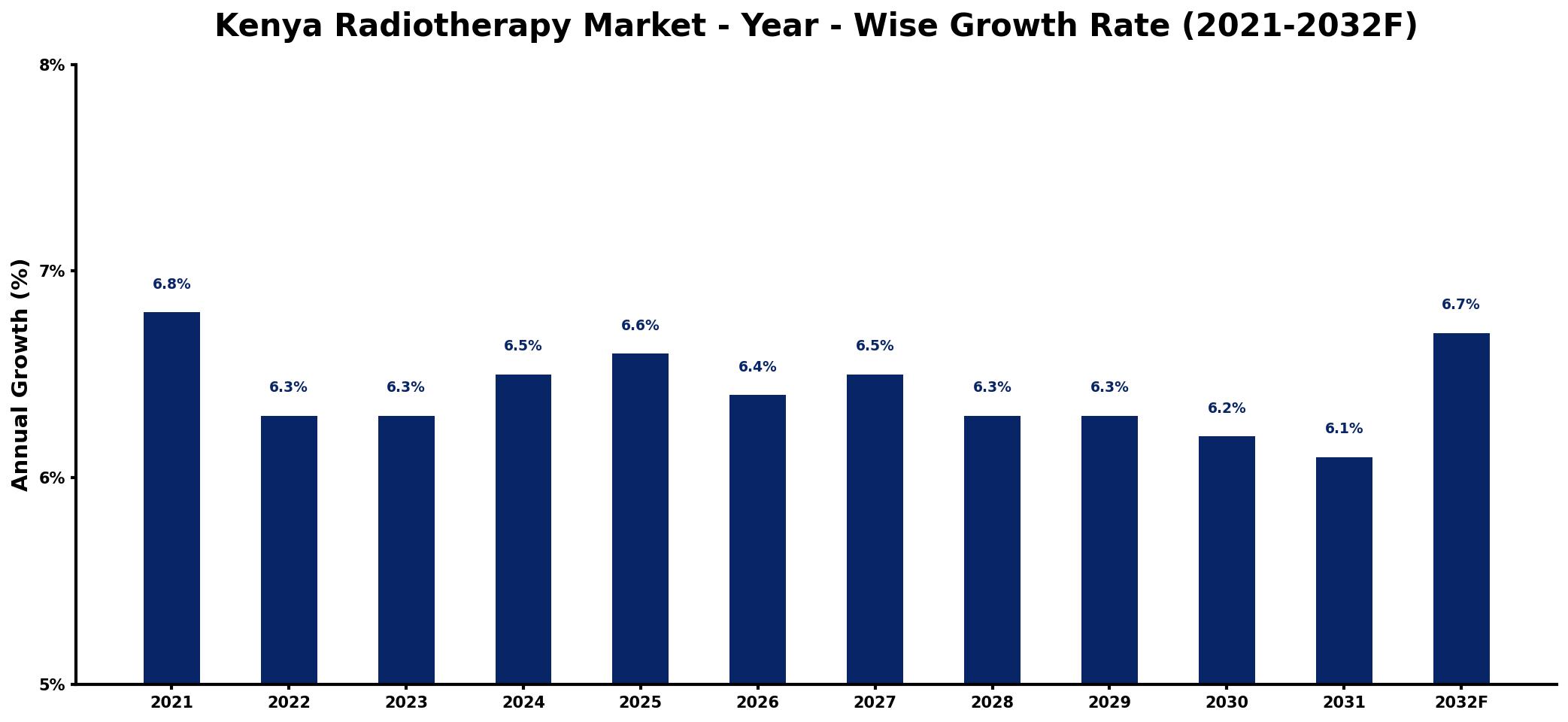
The table below presents the year‑wise growth rates along with the key drivers influencing the market
| Year | Growth Rate | Major Drivers |
| 2021 | 6.8% | increased healthcare infrastructure investment |
| 2022 | 6.3% | growing prevalence of cancer cases |
| 2023 | 6.3% | rising patient awareness initiatives |
| 2024 | 6.5% | advancements in treatment technologies |
| 2025 | 6.6% | expansion of specialized training programs |
| 2026 | 6.4% | enhanced insurance coverage policies |
| 2027 | 6.5% | growing commercial sector adoption |
| 2028 | 6.3% | growing research funding allocations |
| 2029 | 6.3% | rising infrastructure development spending |
| 2030 | 6.2% | increased collaboration with NGOs |
| 2031 | 6.1% | growing international patient influx |
| 2032 | 6.7% | emerging digital health solutions |
Note: Market size estimations and growth projections presented in this report are based on 6Wresearch's proprietary forecasting methodology, utilizing the latest available industry data, government publications, and primary research inputs.
Kenya Radiotherapy Market Synopsis
Recent momentum in the Kenya Radiotherapy Market has been notable, with increased investment in cancer treatment facilities and technology. However, the path forward is complex, as the market still grapples with limited access in rural areas and a shortage of trained professionals. As the country takes proactive measures to address these gaps, the outlook for radiotherapy services continues to become increasingly optimistic.
The focus on expanding cancer treatment capabilities illustrates a shift in the healthcare landscape, moving toward more comprehensive care solutions. As more regions receive advanced radiotherapy services, patients are likely to experience significant improvements in treatment outcomes, further enhancing the sector's potential for growth.
Kenya Radiotherapy Market Key Takeaways
- The Kenya Radiotherapy Market is on a growth trajectory fueled by rising cancer incidence and government support.
- Investment in advanced technologies and training programs for healthcare professionals is essential for market expansion.
- Limited access to treatment in rural areas poses challenges that need to be addressed for equitable healthcare.
- Public awareness campaigns are crucial in driving early detection and prevention efforts among the population.
- Collaborative initiatives between government and private sector players could enhance the overall effectiveness of cancer care.
Evaluation of Restraints in Kenya Radiotherapy Market
The Kenya Radiotherapy Market faces notable restraints that hinder its expansion. One of the most pressing issues is the limited availability of advanced radiotherapy equipment, particularly in regions outside major urban centers. This geographic disparity not only delays treatment access for patients but also limits the potential for early diagnosis and effective intervention. Moreover, the high costs associated with procuring state-of-the-art radiotherapy technologies create barriers for healthcare facilities striving to offer comprehensive cancer care. Another critical factor is the shortage of skilled healthcare professionals; without proper training and accreditation programs, the effectiveness of radiotherapy services remains compromised. Addressing these issues is vital for unlocking the market's full potential.
Kenya Radiotherapy Market Trends
Several current and emerging trends are shaping the Kenya Radiotherapy Market. One significant trend is the integration of telemedicine into radiotherapy services, allowing for remote consultations and follow-ups, particularly beneficial for patients in underserved areas. Additionally, advancements in radiotherapy technologies, such as intensity-modulated radiation therapy (IMRT) and stereotactic body radiotherapy (SBRT), are becoming more prevalent, offering patients more precise and effective treatment options. The emphasis on personalized medicine is also gaining traction, as healthcare providers increasingly tailor treatment plans based on individual patient profiles and cancer types.
Kenya Radiotherapy Market Opportunities
With the rising demand for effective cancer care solutions, the Kenya Radiotherapy Market presents ample opportunities for growth and investment. Infrastructure development in rural and semi-urban areas is a critical area, as establishing more facilities will enhance access to radiotherapy services. Additionally, partnerships with international organizations can facilitate knowledge transfer and resource sharing, ultimately improving local capabilities. Investment in training programs for healthcare professionals is another vital opportunity; equipping the workforce with essential skills will enhance service delivery and patient outcomes.
Government Initiatives in the Kenya Radiotherapy Market
The Kenyan government is actively seeking to bolster cancer care services through various initiatives. These include allocating public funding toward the establishment and upgrading of cancer treatment facilities, which is essential in addressing equipment shortages. Furthermore, public health campaigns are being launched to raise awareness of cancer prevention and early detection. The government's commitment to training healthcare professionals ensures the workforce is adequately prepared to implement radiotherapy services effectively. Collaborative efforts with international health organizations also highlight a strategic approach to enhancing cancer care across the country.
Future Insights of the Kenya Radiotherapy Market
Looking ahead to the period from 2026 to 2032, the Kenya Radiotherapy Market is poised for transformative growth. With increased investment in infrastructure and technology, the potential for improved access to radiotherapy services is significant. Government initiatives aimed at enhancing healthcare accessibility combined with rising public awareness of cancer treatment options are expected to drive market expansion. Moreover, as technological innovations continue to emerge, the treatment landscape will evolve, offering new solutions that cater to diverse patient needs. The collective focus on collaboration and training will further bolster the sector's growth, ultimately improving health outcomes for Kenyan patients.
Kenya Radiotherapy Market Latest Developments (2025 - 2026)
In recent months, the Kenya Radiotherapy Market has seen significant developments aimed at enhancing treatment capabilities and patient access. Several healthcare facilities have announced plans to upgrade their existing radiotherapy equipment, incorporating the latest technology to improve treatment precision and effectiveness. Additionally, training programs for healthcare professionals have been expanded, addressing the need for a skilled workforce in the face of increasing demand. Public health initiatives promoting cancer screening and awareness have also gained traction, further emphasizing the commitment to combatting cancer in the country.
Kenya Radiotherapy Market - Key Attractiveness of the Report
- 10 Years of Market Numbers
- Historical Data Starting from 2022 to 2025
- Base Year: 2025
- Forecast Data until 2032
- Key Performance Indicators Impacting the Market
- Major Upcoming Developments and Projects
Key Highlights of the Report:
- Kenya Radiotherapy Market Outlook
- Market Size of Kenya Radiotherapy Market, 2025
- Forecast of Kenya Radiotherapy Market, 2032
- Historical Data and Forecast of Kenya Radiotherapy Revenues & Volume for the Period 2022-2032F
- Kenya Radiotherapy Market Trend Evolution
- Kenya Radiotherapy Market Drivers and Challenges
- Kenya Radiotherapy Price Trends
- Kenya Radiotherapy Porter's Five Forces
- Kenya Radiotherapy Industry Life Cycle
- Historical Data and Forecast of Kenya Radiotherapy Market Revenues & Volume By Product for the Period 2022-2032F
- Historical Data and Forecast of Kenya Radiotherapy Market Revenues & Volume By External Beam Radiotherapy for the Period 2022-2032F
- Historical Data and Forecast of Kenya Radiotherapy Market Revenues & Volume By Electron-emitting High-energy Linear Accelerators for the Period 2022-2032F
- Historical Data and Forecast of Kenya Radiotherapy Market Revenues & Volume By Conventional Linear Accelerators for the Period 2022-2032F
- Historical Data and Forecast of Kenya Radiotherapy Market Revenues & Volume By Stereotactic Advanced Electron/Cobalt-60 Linear Accelerators for the Period 2022-2032F
- Historical Data and Forecast of Kenya Radiotherapy Market Revenues & Volume By Conventional Cobalt-60 Teletherapy Units for the Period 2022-2032F
- Historical Data and Forecast of Kenya Radiotherapy Market Revenues & Volume By Particle Therapy Systems for the Period 2022-2032F
- Historical Data and Forecast of Kenya Radiotherapy Market Revenues & Volume By Internal Beam Radiotherapy/Brachytherapy for the Period 2022-2032F
- Historical Data and Forecast of Kenya External Beam Radiotherapy Radiotherapy Market Revenues & Volume By Systemic Radiotherapy for the Period 2022-2032F
- Historical Data and Forecast of Kenya Radiotherapy Market Revenues & Volume By Application for the Period 2022-2032F
- Historical Data and Forecast of Kenya Radiotherapy Market Revenues & Volume By External Beam Radiotherapy for the Period 2022-2032F
- Historical Data and Forecast of Kenya Radiotherapy Market Revenues & Volume By Internal Beam Radiotherapy/Brachytherapy for the Period 2022-2032F
- Historical Data and Forecast of Kenya Radiotherapy Market Revenues & Volume By Procedure for the Period 2022-2032F
- Historical Data and Forecast of Kenya Radiotherapy Market Revenues & Volume By External Beam Radiotherapy for the Period 2022-2032F
- Historical Data and Forecast of Kenya Radiotherapy Market Revenues & Volume By Internal Beam Radiotherapy/Brachytherapy for the Period 2022-2032F
- Historical Data and Forecast of Kenya Radiotherapy Market Revenues & Volume By Systemic Radiotherapy for the Period 2022-2032F
- Historical Data and Forecast of Kenya Radiotherapy Market Revenues & Volume By Intravenous Radiotherapy for the Period 2022-2032F
- Historical Data and Forecast of Kenya Radiotherapy Market Revenues & Volume By Oral Radiotherapy for the Period 2022-2032F
- Historical Data and Forecast of Kenya Radiotherapy Market Revenues & Volume By Instillation Radiotherapy for the Period 2022-2032F
- Historical Data and Forecast of Kenya Radiotherapy Market Revenues & Volume By End User for the Period 2022-2032F
- Historical Data and Forecast of Kenya Radiotherapy Market Revenues & Volume By Hospitals for the Period 2022-2032F
- Historical Data and Forecast of Kenya Radiotherapy Market Revenues & Volume By Independent Radiotherapy Centers for the Period 2022-2032F
- Kenya Radiotherapy Import Export Trade Statistics
- Market Opportunity Assessment By Product
- Market Opportunity Assessment By Application
- Market Opportunity Assessment By Procedure
- Market Opportunity Assessment By End User
- Kenya Radiotherapy Top Companies Market Share
- Kenya Radiotherapy Competitive Benchmarking By Technical and Operational Parameters
- Kenya Radiotherapy Company Profiles
- Kenya Radiotherapy Key Strategic Recommendations






































