Kenya RegTech Market Size & Growth Rate (2026-2032)
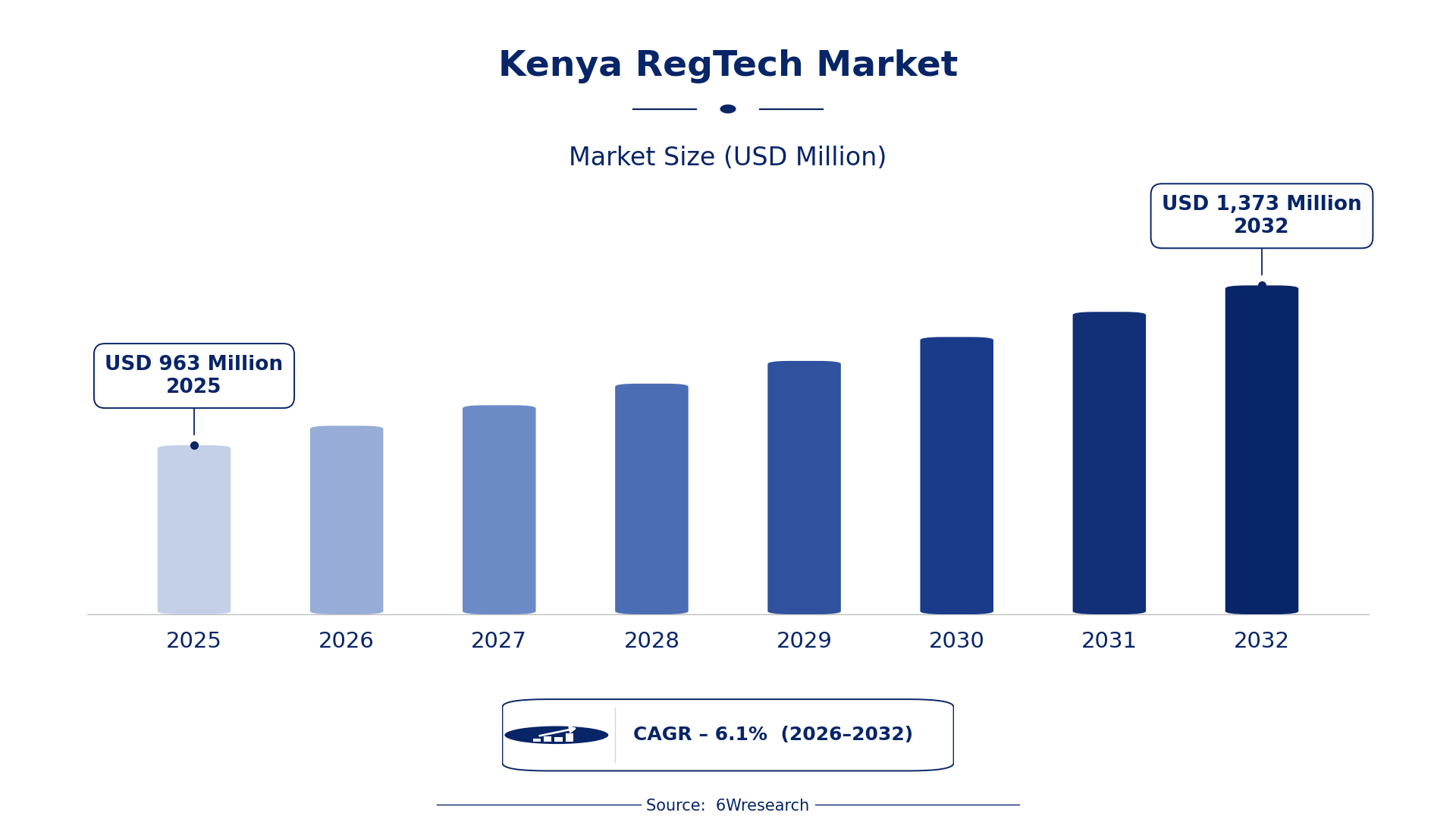
The Kenya RegTech Market was estimated at USD 963 Million in 2025 and is projected to reach USD 1373 Million by 2032, growing at a CAGR of 6.1% from 2026 to 2032.
Kenya RegTech Market Synopsis
The Kenyan RegTech market is experiencing notable momentum, driven by rising regulatory demands across sectors like finance and healthcare. Organizations are increasingly turning to RegTech solutions as they seek effective means to comply with complex regulations while managing associated risks.
As digital transformation accelerates in Kenya, the adoption of advanced technologies such as AI and blockchain is becoming more prevalent. These innovations are not just improving compliance efficiency; they are also enhancing data security and transparency, making them essential tools for businesses navigating the regulatory maze.
Kenya RegTech Market Year-wise Growth Rate and Key Drivers
This graph illustrates the annual growth rates of the Kenya RegTech Market from 2021 to 2032, highlighting a steady upward trajectory and projected expansion over the forecast period.
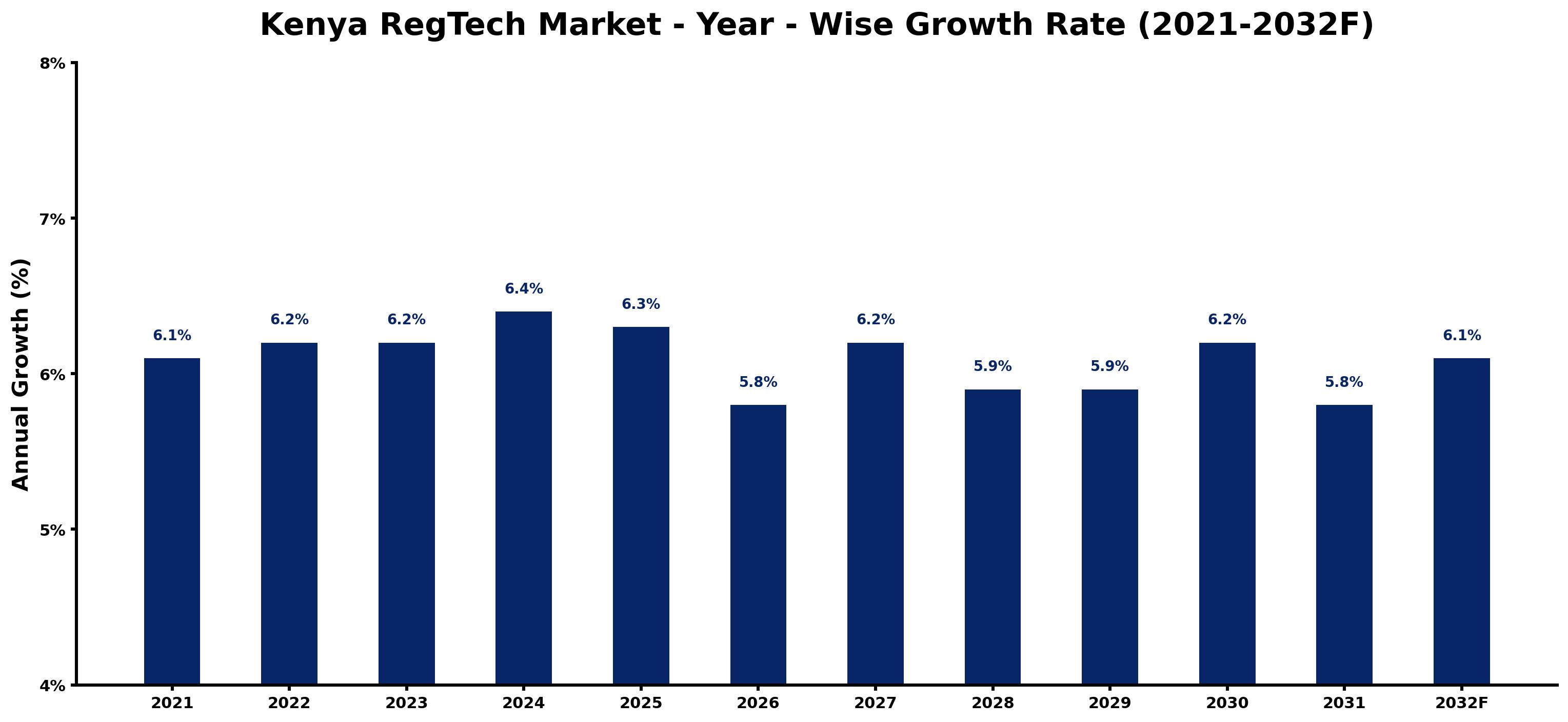
The table below presents the year‑wise growth rates along with the key drivers influencing the market
| Year | Growth Rate | Major Drivers |
| 2021 | 6.1% | Central Bank of Kenya's regulatory framework for fintech |
| 2022 | 6.2% | Increased mobile penetration fostering digital identity solutions |
| 2023 | 6.2% | National cybersecurity strategy improving KYC compliance measures |
| 2024 | 6.4% | Growth of e-commerce necessitating enhanced regulatory oversight |
| 2025 | 6.3% | Partnerships with global entities boosting local RegTech innovations |
| 2026 | 5.8% | Enhanced data protection regulations driving compliance need |
| 2027 | 6.2% | Emerging startups focusing on real-time transaction monitoring |
| 2028 | 5.9% | Rising investor interest in fintech regulatory solutions |
| 2029 | 5.9% | Public sector embracing digital regulatory frameworks |
| 2030 | 6.2% | Youth demographic pushing for secure online financial services |
| 2031 | 5.8% | Increasing fraud incidents prompting robust RegTech investments |
| 2032 | 6.1% | Government incentives for tech-driven compliance solutions |
Note: Market size estimations and growth projections presented in this report are based on 6Wresearch's proprietary forecasting methodology, utilizing the latest available industry data, government publications, and primary research inputs.
Kenya RegTech Market Key Takeaways
Below are some of the specific key takeaways from the market, including:
- The market is expanding as companies seek cost-effective compliance solutions.
- AI and machine learning are becoming integral in automating compliance tasks.
- Blockchain technology is increasingly utilized for secure data management.
- Cloud-based RegTech solutions are gaining traction for their scalability.
- Real-time data analytics capabilities are enhancing proactive compliance management.
Evaluation of Restraints in Kenya RegTech Market
Despite its growth potential, the Kenya RegTech market faces significant barriers. Regulatory complexities and inconsistent guidelines create confusion among businesses. Many organizations still lack awareness and understanding of RegTech solutions, limiting their uptake. Data privacy concerns also deter some potential users, while the high costs associated with implementation can be prohibitive, particularly for smaller enterprises. Addressing these limitations is crucial for fostering broader adoption and driving growth.
Kenya RegTech Market Trends
A few key trends are shaping the Kenya RegTech market today. The integration of AI and machine learning technologies is transforming compliance processes by automating repetitive tasks and improving accuracy. Blockchain's role in identity verification and secure transactions is also gaining prominence. on top of that, there's a significant shift towards cloud-based solutions, which offer scalability and cost savings. Finally, the focus on data analytics is intensifying, enabling businesses to monitor compliance in real time and react swiftly to regulatory changes.
Kenya RegTech Market Opportunities
The investment landscape in the Kenya RegTech market is ripe with opportunities. With regulatory frameworks tightening, there’s a pressing demand for innovative solutions that streamline compliance processes. Investors should consider developing tools focused on regulatory reporting, KYC solutions, and AML compliance software. on top of that, forming strategic partnerships with financial institutions can unlock additional avenues for growth, ensuring a strong foothold in a rapidly evolving market.
Government Initiatives in the Kenya RegTech Market
The Kenyan government is taking proactive steps to foster the RegTech sector, implementing policies designed to enhance regulatory compliance and support innovation. This regulatory backing is vital as it creates a conducive environment for both local and foreign investments in RegTech solutions.
- A recently completed initiative is the Regulatory Sandbox Policy introduced by the Capital Markets Authority, allowing startups to test their solutions in a controlled environment.
- Currently underway is the implementation of the Data Protection Act, ensuring that financial data security and privacy are prioritized.
- Planned for the future is a public-private partnership aimed at expanding digital infrastructure, enhancing access to RegTech solutions across various sectors.
- The government is also working on a national initiative to standardize compliance frameworks, expected to be rolled out by 2027.
- Ongoing efforts include workshops and training programs to raise awareness about RegTech benefits among businesses and regulatory bodies.
Future Insights of the Kenya RegTech Market
Looking ahead, the Kenya RegTech market is expected to flourish, driven by the continued complexity of regulations and the need for efficient compliance solutions. As fintech and other digital services expand, the demand for innovative regulatory technologies will intensify. The market is likely to see increased investment and adoption of RegTech solutions as businesses strive for greater operational efficiency and regulatory adherence. This momentum positions Kenya as a potential leader in RegTech innovation in the African region.
Kenya RegTech Market Latest Developments
Recent activities in the Kenya RegTech market reflect a strong trajectory towards innovation and compliance efficiency. In the past year, several key developments have emerged, illustrating the dynamic nature of this sector.
- A major technology vendor launched a new compliance management platform in early 2025, designed specifically for the financial sector.
- An ongoing initiative focuses on developing a comprehensive regulatory reporting tool, with expected completion by mid-2026.
- A partnership between a leading fintech company and a regulatory authority is currently underway, aimed at enhancing the KYC process across financial institutions.
- Plans for an upcoming pilot program to assess blockchain applications in regulatory compliance are slated to begin in Q3 2025.
- A recently announced upgrade to the national payment systems infrastructure aims to improve security and efficiency for RegTech solutions by late 2026.
Kenya RegTech Market - Key Attractiveness of the Report
- 10 Years of Market Numbers
- Historical Data Starting from 2022 to 2025
- Base Year: 2025
- Forecast Data until 2032
- Key Performance Indicators Impacting the Market
- Major Upcoming Developments and Projects
Key Highlights of the Report:
- Kenya RegTech Market Outlook
- Market Size of Kenya RegTech Market, 2025
- Forecast of Kenya RegTech Market, 2032
- Historical Data and Forecast of Kenya RegTech Revenues & Volume for the Period 2022-2032F
- Kenya RegTech Market Trend Evolution
- Kenya RegTech Market Drivers and Challenges
- Kenya RegTech Price Trends
- Kenya RegTech Porter's Five Forces
- Kenya RegTech Industry Life Cycle
- Historical Data and Forecast of Kenya RegTech Market Revenues & Volume By Component for the Period 2022-2032F
- Historical Data and Forecast of Kenya RegTech Market Revenues & Volume By Solutions for the Period 2022-2032F
- Historical Data and Forecast of Kenya RegTech Market Revenues & Volume By Services for the Period 2022-2032F
- Historical Data and Forecast of Kenya RegTech Market Revenues & Volume By Application for the Period 2022-2032F
- Historical Data and Forecast of Kenya RegTech Market Revenues & Volume By Risk & Compliance Management for the Period 2022-2032F
- Historical Data and Forecast of Kenya RegTech Market Revenues & Volume By Identity Management for the Period 2022-2032F
- Historical Data and Forecast of Kenya RegTech Market Revenues & Volume By Regulatory Reporting for the Period 2022-2032F
- Historical Data and Forecast of Kenya RegTech Market Revenues & Volume By AML and Fraud Management for the Period 2022-2032F
- Historical Data and Forecast of Kenya RegTech Market Revenues & Volume By Regulatory Intelligence for the Period 2022-2032F
- Historical Data and Forecast of Kenya RegTech Market Revenues & Volume By Organization Size for the Period 2022-2032F
- Historical Data and Forecast of Kenya RegTech Market Revenues & Volume By SMEs for the Period 2022-2032F
- Historical Data and Forecast of Kenya RegTech Market Revenues & Volume By Large Enterprises for the Period 2022-2032F
- Historical Data and Forecast of Kenya RegTech Market Revenues & Volume By Deployment Mode for the Period 2022-2032F
- Historical Data and Forecast of Kenya RegTech Market Revenues & Volume By On-Premises for the Period 2022-2032F
- Historical Data and Forecast of Kenya RegTech Market Revenues & Volume By Cloud for the Period 2022-2032F
- Historical Data and Forecast of Kenya RegTech Market Revenues & Volume By Vertical for the Period 2022-2032F
- Historical Data and Forecast of Kenya RegTech Market Revenues & Volume By Banking for the Period 2022-2032F
- Historical Data and Forecast of Kenya RegTech Market Revenues & Volume By Insurance for the Period 2022-2032F
- Historical Data and Forecast of Kenya RegTech Market Revenues & Volume By Non-Financial for the Period 2022-2032F
- Kenya RegTech Import Export Trade Statistics
- Market Opportunity Assessment By Component
- Market Opportunity Assessment By Application
- Market Opportunity Assessment By Organization Size
- Market Opportunity Assessment By Deployment Mode
- Market Opportunity Assessment By Vertical
- Kenya RegTech Top Companies Market Share
- Kenya RegTech Competitive Benchmarking By Technical and Operational Parameters
- Kenya RegTech Company Profiles
- Kenya RegTech Key Strategic Recommendations






































