Kenya Synthetic Diamond Market Size, Share & Growth Rate
The Kenya Synthetic Diamond Market was estimated at USD 333 Million in 2025 and is projected to reach USD 449 Million by 2032, growing at a CAGR of 4.4% from 2026 to 2032. This anticipated growth is fueled by an increased consumer awareness regarding the benefits of lab-grown diamonds, as well as their cost-effectiveness and ethical production. As industries such as electronics, construction, and jewelry embrace synthetic diamonds, the market is positioned to flourish in the coming years.
Kenya Synthetic Diamond Market Year-wise Growth Rate and Key Drivers
This graph highlights how the Kenya Synthetic Diamond Market has steadily grown over the years, supported by major growth factors.
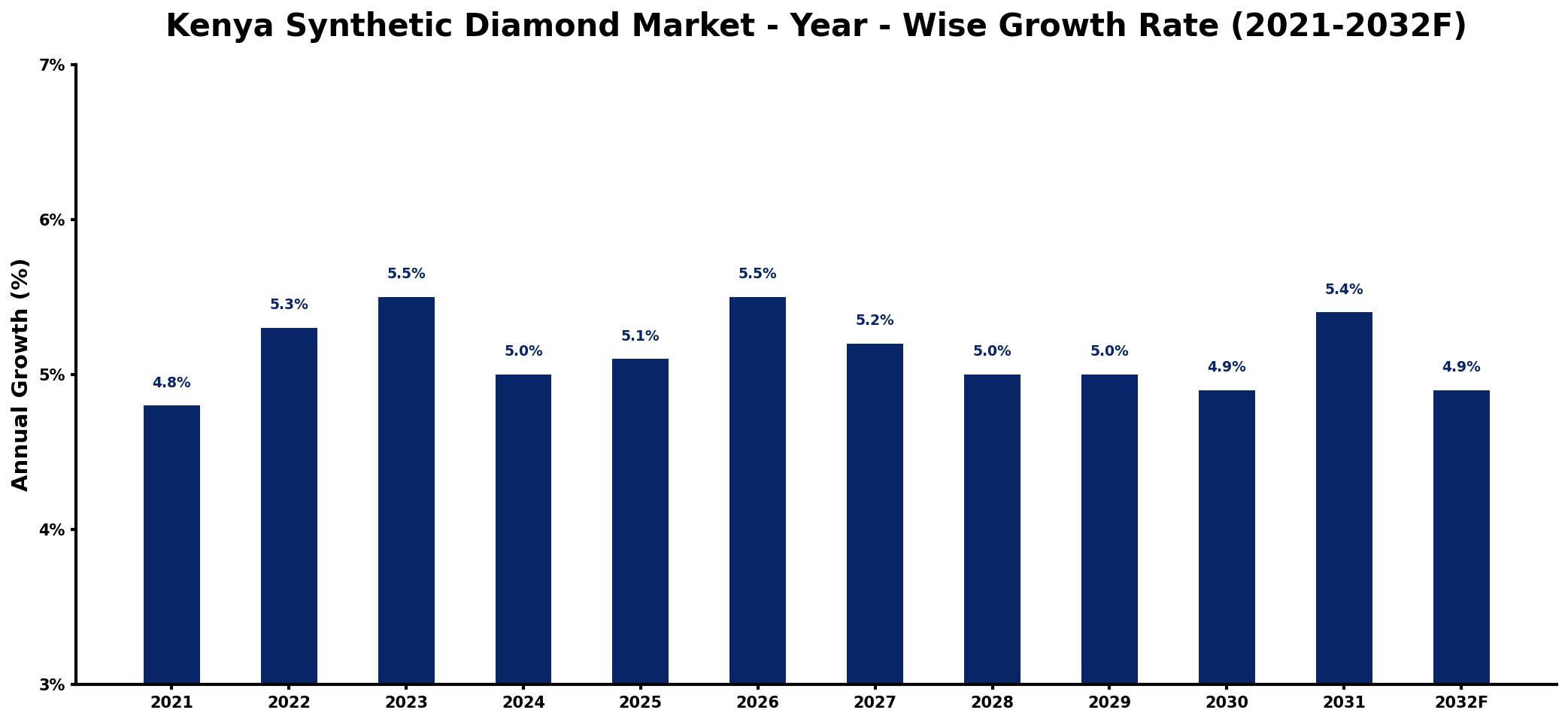
The table below presents the year‑wise growth rates along with the key drivers influencing the market
| Year | Growth Rate | Major Drivers |
| 2021 | 4.8% | Increased consumer awareness campaigns |
| 2022 | 5.3% | Rising luxury market investments |
| 2023 | 5.5% | Growing e-commerce sales platforms |
| 2024 | 5.0% | Expansion of retail distribution channels |
| 2025 | 5.1% | Innovations in manufacturing technologies |
| 2026 | 5.5% | Surge in ethical sourcing preferences |
| 2027 | 5.2% | Strengthened partnerships with retailers |
| 2028 | 5.0% | Heightened interest in customization options |
| 2029 | 5.0% | Improved marketing strategies implemented |
| 2030 | 4.9% | Development of new application sectors |
| 2031 | 5.4% | Increased collaboration with designers |
| 2032 | 4.9% | Emerging trends in sustainable practices |
Note: Market size estimations and growth projections presented in this report are based on 6Wresearch's proprietary forecasting methodology, utilizing the latest available industry data, government publications, and primary research inputs.
Kenya Synthetic Diamond Market Synopsis
The recent momentum in the Kenya Synthetic Diamond Market is indicative of a broader shift towards sustainable and ethically sourced products. Consumers are becoming more discerning about their purchases, favoring lab-grown diamonds that align with their values. As awareness continues to expand, the market is likely to see a surge in both demand and innovation.
Looking ahead, the Kenya Synthetic Diamond Market is on a trajectory for substantial growth driven by ongoing technological advancements. These innovations not only enhance the quality and affordability of synthetic diamonds but also pave the way for exciting customization opportunities. This trend is expected to further entice consumers seeking unique jewelry options.
Kenya Synthetic Diamond Market Key Takeaways
- The market is driven by increasing consumer demand for sustainable and ethically produced diamonds.
- Technological advancements are improving the quality and affordability of synthetic diamonds.
- Customization trends are allowing consumers to create unique jewelry pieces.
- Awareness campaigns are essential to educate consumers about the benefits of synthetic diamonds.
- Investment opportunities are expanding due to growing demand in multiple industries.
Evaluation of Restraints in Kenya Synthetic Diamond Market
Despite the promising growth trajectory, several restraints hinder the Kenya Synthetic Diamond Market. A significant challenge lies in the lack of consumer awareness regarding the advantages of synthetic diamonds compared to their natural counterparts. This knowledge gap often leads to a preference for traditional mined diamonds. Furthermore, the high initial investment required for setting up production facilities poses a substantial barrier to entry for potential market entrants. Additionally, concerns regarding counterfeit synthetic diamonds can undermine consumer trust, affecting overall market credibility.
Kenya Synthetic Diamond Market Trends
Current trends indicate a growing preference for lab-grown diamonds as they provide a more sustainable and ethical choice for consumers. The market is witnessing increased demand for high-quality, affordable diamonds across various applications, including electronics and automotive sectors. Additionally, the customization of synthetic diamonds is emerging as a significant trend, enabling consumers to design personalized jewelry that resonates with their individual style.
Kenya Synthetic Diamond Market Opportunities
The Kenya Synthetic Diamond Market offers exciting investment opportunities due to rising demand across diverse industries. Investors can capitalize on the shift towards sustainable practices in the diamond sector, particularly as technological innovations lead to enhanced production processes and product quality. Moreover, Kenya's favorable geographic location and existing mining infrastructure present a competitive edge for investors looking to tap into the burgeoning synthetic diamond market.
Government Initiatives in the Kenya Synthetic Diamond Market
The Kenyan government has introduced various policies aimed at fostering the growth of the synthetic diamond market. Regulatory frameworks, such as the Mining (Value Addition and Beneficiation) Regulations implemented in 2019, mandate that mining companies establish local facilities for cutting and polishing diamonds. Such initiatives aim to enhance local job creation and promote value addition within the country. Additionally, efforts to attract foreign investments through tax incentives and simplified regulatory processes illustrate the governments commitment to developing this sector and positioning Kenya as a key player in the global market.
Future Insights of the Kenya Synthetic Diamond Market
The outlook for the Kenya Synthetic Diamond Market is exceptionally optimistic as it heads into 2026-2032. With the increasing shift towards ethical consumerism and the advantages of lab-grown diamonds gaining recognition, market demand is expected to surge. Enhanced production techniques will likely result in higher quality synthetic diamonds, making them even more appealing. Additionally, as more industries adopt synthetic diamonds for their versatility, the market is poised for significant growth.
Kenya Synthetic Diamond Market Latest Developments (2025 - 2026)
Recent developments in the Kenya Synthetic Diamond Market have highlighted a clear industry direction towards sustainability and ethical sourcing. Initiatives aimed at improving consumer education about synthetic diamonds are gaining traction, effectively addressing misconceptions and promoting their benefits. Furthermore, ongoing investments in technology are driving advancements that not only enhance production capabilities but also improve the overall quality of synthetic diamonds available in the market.
Kenya Synthetic Diamond Market - Key Attractiveness of the Report
- 10 Years of Market Numbers
- Historical Data Starting from 2022 to 2025
- Base Year: 2025
- Forecast Data until 2032
- Key Performance Indicators Impacting the Market
- Major Upcoming Developments and Projects
Key Highlights of the Report:
- Kenya Synthetic Diamond Market Outlook
- Market Size of Kenya Synthetic Diamond Market, 2025
- Forecast of Kenya Synthetic Diamond Market, 2032
- Historical Data and Forecast of Kenya Synthetic Diamond Revenues & Volume for the Period 2022-2032F
- Kenya Synthetic Diamond Market Trend Evolution
- Kenya Synthetic Diamond Market Drivers and Challenges
- Kenya Synthetic Diamond Price Trends
- Kenya Synthetic Diamond Porter's Five Forces
- Kenya Synthetic Diamond Industry Life Cycle
- Historical Data and Forecast of Kenya Synthetic Diamond Market Revenues & Volume By Product for the Period 2022-2032F
- Historical Data and Forecast of Kenya Synthetic Diamond Market Revenues & Volume By Bort for the Period 2022-2032F
- Historical Data and Forecast of Kenya Synthetic Diamond Market Revenues & Volume By Dust for the Period 2022-2032F
- Historical Data and Forecast of Kenya Synthetic Diamond Market Revenues & Volume By Grit for the Period 2022-2032F
- Historical Data and Forecast of Kenya Synthetic Diamond Market Revenues & Volume By Powder for the Period 2022-2032F
- Historical Data and Forecast of Kenya Synthetic Diamond Market Revenues & Volume By Stone for the Period 2022-2032F
- Historical Data and Forecast of Kenya Synthetic Diamond Market Revenues & Volume By Type for the Period 2022-2032F
- Historical Data and Forecast of Kenya Synthetic Diamond Market Revenues & Volume By Polished for the Period 2022-2032F
- Historical Data and Forecast of Kenya Synthetic Diamond Market Revenues & Volume By Rough for the Period 2022-2032F
- Historical Data and Forecast of Kenya Synthetic Diamond Market Revenues & Volume By Grit for the Period 2022-2032F
- Historical Data and Forecast of Kenya Synthetic Diamond Market Revenues & Volume By Powder for the Period 2022-2032F
- Historical Data and Forecast of Kenya Synthetic Diamond Market Revenues & Volume By Stone for the Period 2022-2032F
- Historical Data and Forecast of Kenya Synthetic Diamond Market Revenues & Volume By Manufacturing Process for the Period 2022-2032F
- Historical Data and Forecast of Kenya Synthetic Diamond Market Revenues & Volume By High Pressure High Temperature (HPHT) for the Period 2022-2032F
- Historical Data and Forecast of Kenya Synthetic Diamond Market Revenues & Volume By Chemical Vapor Deposition (CVD) for the Period 2022-2032F
- Historical Data and Forecast of Kenya Synthetic Diamond Market Revenues & Volume By Application for the Period 2022-2032F
- Historical Data and Forecast of Kenya Synthetic Diamond Market Revenues & Volume By Gem for the Period 2022-2032F
- Historical Data and Forecast of Kenya Synthetic Diamond Market Revenues & Volume By Heat Sinks/Exchangers for the Period 2022-2032F
- Historical Data and Forecast of Kenya Synthetic Diamond Market Revenues & Volume By High-end Electronics for the Period 2022-2032F
- Historical Data and Forecast of Kenya Synthetic Diamond Market Revenues & Volume By Laser & X-ray for the Period 2022-2032F
- Historical Data and Forecast of Kenya Synthetic Diamond Market Revenues & Volume By Machining and Cutting Tools for the Period 2022-2032F
- Historical Data and Forecast of Kenya Synthetic Diamond Market Revenues & Volume By Surgical Machinery for the Period 2022-2032F
- Historical Data and Forecast of Kenya Synthetic Diamond Market Revenues & Volume By Water Treatment for the Period 2022-2032F
- Historical Data and Forecast of Kenya Synthetic Diamond Market Revenues & Volume By Quantum Computing for the Period 2022-2032F
- Kenya Synthetic Diamond Import Export Trade Statistics
- Market Opportunity Assessment By Product
- Market Opportunity Assessment By Type
- Market Opportunity Assessment By Manufacturing Process
- Market Opportunity Assessment By Application
- Kenya Synthetic Diamond Top Companies Market Share
- Kenya Synthetic Diamond Competitive Benchmarking By Technical and Operational Parameters
- Kenya Synthetic Diamond Company Profiles
- Kenya Synthetic Diamond Key Strategic Recommendations






































