Kenya Underground Mining Equipment Market Size, Share & Growth Rate
The Kenya Underground Mining Equipment Market was estimated at USD 269 Million in 2025 and is projected to reach USD 355 Million by 2032, growing at a CAGR of 4.0% from 2026 to 2032. This robust growth trajectory reflects the expanding mining sector, driven by increased exploration activities and the need for advanced technology to improve operational efficiency and safety standards. As Kenya invests in modernizing its mining infrastructure, the demand for specialized underground mining machinery is expected to rise significantly.
Kenya Underground Mining Equipment Market Year-wise Growth Rate and Key Drivers
This graph highlights how the Kenya Underground Mining Equipment Market has steadily grown over the years, supported by major growth factors.
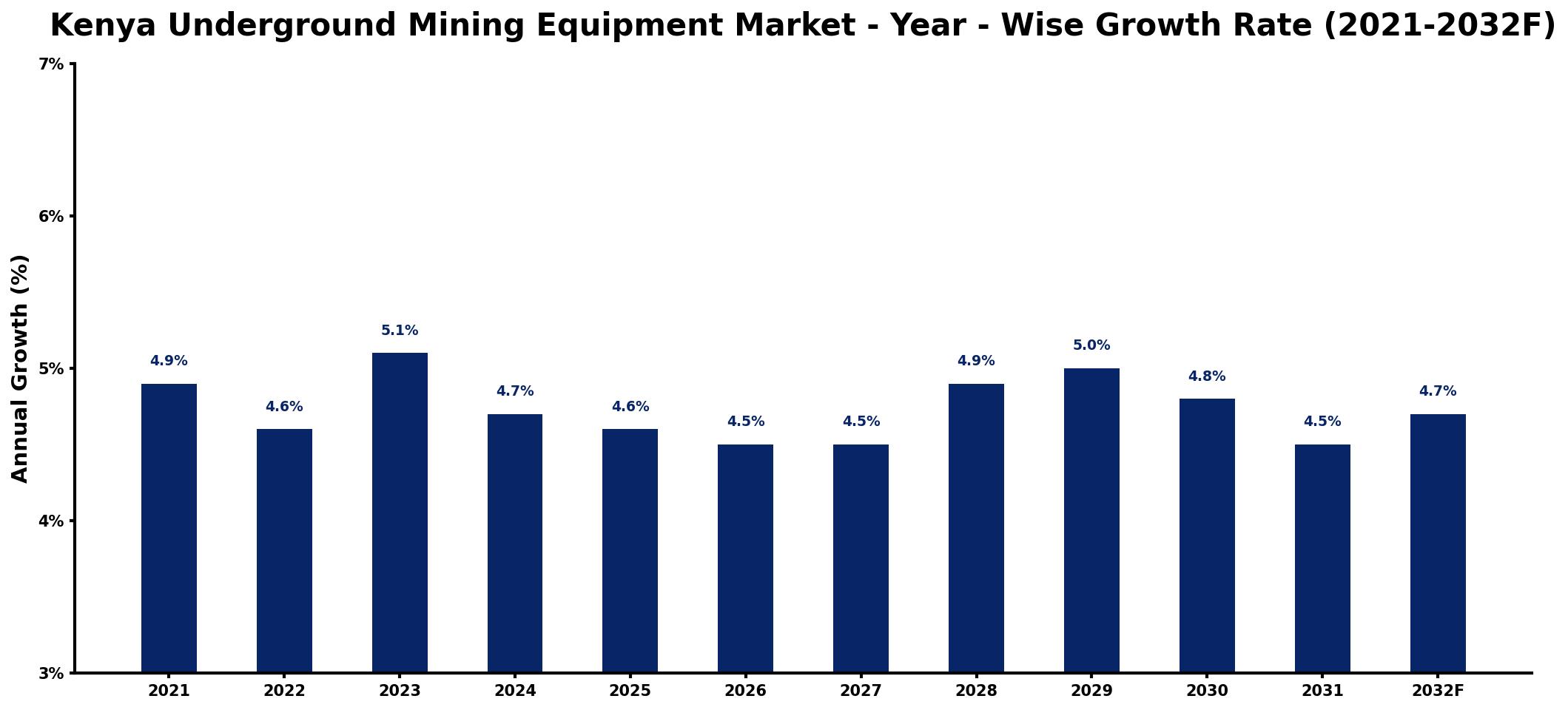
The table below presents the year‑wise growth rates along with the key drivers influencing the market
| Year | Growth Rate | Major Drivers |
| 2021 | 4.9% | Rising demand for natural resources |
| 2022 | 4.6% | Increased investment in infrastructure projects |
| 2023 | 5.1% | Growing interest in renewable energy |
| 2024 | 4.7% | growing regional consumption patterns |
| 2025 | 4.6% | Higher global commodity prices observed |
| 2026 | 4.5% | Technological advancements in extraction methods |
| 2027 | 4.5% | Emerging markets seeking resource security |
| 2028 | 4.9% | Government incentives for resource exploration |
| 2029 | 5.0% | Strengthened supply chain partnerships formed |
| 2030 | 4.8% | Increased foreign direct investment influx |
| 2031 | 4.5% | Growing demand for sustainable practices |
| 2032 | 4.7% | Enhanced regulatory support for exploration |
Note: Market size estimations and growth projections presented in this report are based on 6Wresearch's proprietary forecasting methodology, utilizing the latest available industry data, government publications, and primary research inputs.
Kenya Underground Mining Equipment Market Synopsis
In Kenya, the exploration of mineral resources, particularly in regions such as Western and Eastern Kenya, is creating a distinct demand for advanced underground mining equipment. The recent surge in investment aimed at improving local mining operations is also pivotal, showcasing a commitment to enhancing both productivity and worker safety.
Moreover, with a growing global emphasis on environmental sustainability, mining companies in Kenya are increasingly adopting innovative solutions that minimize ecological impacts while maximizing output. This trend is reflected in the government's supportive stance towards the adoption of technology that promotes sustainable mining practices.
Kenya Underground Mining Equipment Market Key Takeaways
- The market is fueled by significant investments in mining infrastructure and technology.
- Safety regulations and the need for advanced equipment are central to market growth.
- Emerging trends in sustainability are influencing equipment design and utilization.
- The fluctuating nature of commodity prices presents financial challenges for mining firms.
- Government incentives are aimed at promoting safer and more efficient mining practices.
Evaluation of Restraints in Kenya Underground Mining Equipment Market
Despite its growth, the Kenya Underground Mining Equipment Market faces significant constraints. High operational costs associated with procuring and maintaining advanced equipment can deter investment. Additionally, inherent safety risks in underground mining necessitate specialized machinery, which can further inflate costs. Fluctuating commodity prices also create uncertainties that impact financial viability and long-term planning for mining companies, potentially hindering the acquisition of necessary equipment.
Kenya Underground Mining Equipment Market Trends
Currently, the market is experiencing a shift toward automation and smart technology, which aims to increase both productivity and safety. Innovations such as remote-operated vehicles and advanced monitoring systems are gaining traction as companies strive to enhance operational efficiency. Additionally, the focus on environmentally-friendly practices is prompting manufacturers to develop equipment that reduces energy consumption and lowers carbon emissions, aligning with global sustainability goals.
Kenya Underground Mining Equipment Market Opportunities
There are considerable growth opportunities within the Kenya Underground Mining Equipment Market, particularly in regions rich in untapped mineral resources. Companies focusing on sustainable practices can capitalize on government incentives aimed at promoting eco-friendly mining methods. Moreover, the increasing availability of financing options for technology upgrades presents a unique opportunity for mining operators to enhance their operational capabilities and overall safety.
Government Initiatives in the Kenya Underground Mining Equipment Market
The Kenyan government has implemented various initiatives to bolster the underground mining equipment market, focusing on safety and efficiency. Regulatory frameworks enforce rigorous safety standards, ensuring that mining operations adhere to best practices. Financial incentives are provided to companies willing to invest in advanced technology, supporting the transition towards sustainable mining practices. Additionally, policies aimed at the rehabilitation of mining sites underline the government's commitment to minimizing environmental impacts.
Future Insights of the Kenya Underground Mining Equipment Market
Looking ahead to 2026-2032, the Kenya Underground Mining Equipment Market is expected to evolve significantly as technology continues to advance. The integration of digital solutions, such as AI and machine learning, into mining operations will likely reshape how extraction is conducted, enhancing both safety and efficiency. Furthermore, as global demand for minerals rises, particularly for those crucial in green technologies, Kenya's mining sector is poised for substantial growth, creating a fertile environment for investment and innovation.
Kenya Underground Mining Equipment Market Latest Developments (2025 - 2026)
In recent months, the Kenya Underground Mining Equipment Market has seen notable developments focused on technological advancements. Companies are increasingly investing in automation technologies, aiming to reduce labor costs and improve safety. Additionally, discussions surrounding new regulations to further enhance safety protocols in underground mining are underway, reflecting the government's commitment to maintaining high operational standards. The push for sustainability remains strong, with a growing interest in eco-friendly equipment options among mining operators.
Kenya Underground Mining Equipment Market - Key Attractiveness of the Report
- 10 Years of Market Numbers
- Historical Data Starting from 2022 to 2025
- Base Year: 2025
- Forecast Data until 2032
- Key Performance Indicators Impacting the Market
- Major Upcoming Developments and Projects
Key Highlights of the Report:
- Kenya Underground Mining Equipment Market Outlook
- Market Size of Kenya Underground Mining Equipment Market, 2025
- Forecast of Kenya Underground Mining Equipment Market, 2032
- Historical Data and Forecast of Kenya Underground Mining Equipment Revenues & Volume for the Period 2022-2032F
- Kenya Underground Mining Equipment Market Trend Evolution
- Kenya Underground Mining Equipment Market Drivers and Challenges
- Kenya Underground Mining Equipment Price Trends
- Kenya Underground Mining Equipment Porter's Five Forces
- Kenya Underground Mining Equipment Industry Life Cycle
- Historical Data and Forecast of Kenya Underground Mining Equipment Market Revenues & Volume By Product Type for the Period 2022-2032F
- Historical Data and Forecast of Kenya Underground Mining Equipment Market Revenues & Volume By Mining Loaders for the Period 2022-2032F
- Historical Data and Forecast of Kenya Underground Mining Equipment Market Revenues & Volume By Mining Trucks for the Period 2022-2032F
- Historical Data and Forecast of Kenya Underground Mining Equipment Market Revenues & Volume By Mining Drills for the Period 2022-2032F
- Historical Data and Forecast of Kenya Underground Mining Equipment Market Revenues & Volume By Mining Bolters for the Period 2022-2032F
- Historical Data and Forecast of Kenya Underground Mining Equipment Market Revenues & Volume By Mining Shearer for the Period 2022-2032F
- Historical Data and Forecast of Kenya Underground Mining Equipment Market Revenues & Volume By Continuous Miners for the Period 2022-2032F
- Historical Data and Forecast of Kenya Underground Mining Equipment Market Revenues & Volume By Mining Excavators & Shovels for the Period 2022-2032F
- Historical Data and Forecast of Kenya Mining Loaders Underground Mining Equipment Market Revenues & Volume By Mining Scalers for the Period 2022-2032F
- Historical Data and Forecast of Kenya Underground Mining Equipment Market Revenues & Volume By Mining Technique for the Period 2022-2032F
- Historical Data and Forecast of Kenya Underground Mining Equipment Market Revenues & Volume By Soft Rock Mining for the Period 2022-2032F
- Historical Data and Forecast of Kenya Underground Mining Equipment Market Revenues & Volume By Hard Rock Mining for the Period 2022-2032F
- Historical Data and Forecast of Kenya Underground Mining Equipment Market Revenues & Volume By End Users for the Period 2022-2032F
- Historical Data and Forecast of Kenya Underground Mining Equipment Market Revenues & Volume By Mining Operators for the Period 2022-2032F
- Historical Data and Forecast of Kenya Underground Mining Equipment Market Revenues & Volume By Rental Service Provider for the Period 2022-2032F
- Kenya Underground Mining Equipment Import Export Trade Statistics
- Market Opportunity Assessment By Product Type
- Market Opportunity Assessment By Mining Technique
- Market Opportunity Assessment By End Users
- Kenya Underground Mining Equipment Top Companies Market Share
- Kenya Underground Mining Equipment Competitive Benchmarking By Technical and Operational Parameters
- Kenya Underground Mining Equipment Company Profiles
- Kenya Underground Mining Equipment Key Strategic Recommendations






































