Kenya Wallet Market Summary
The kenya wallet market was estimated at USD 376 Million in 2025 and is projected to reach USD 519 Million by 2032, growing at a CAGR of 5.5% from 2026 to 2032.
Kenya Wallet Market Year-wise Growth Rate and Key Drivers
This graph highlights how the Kenya Wallet Market has steadily grown over the past five years, supported by major growth factors.
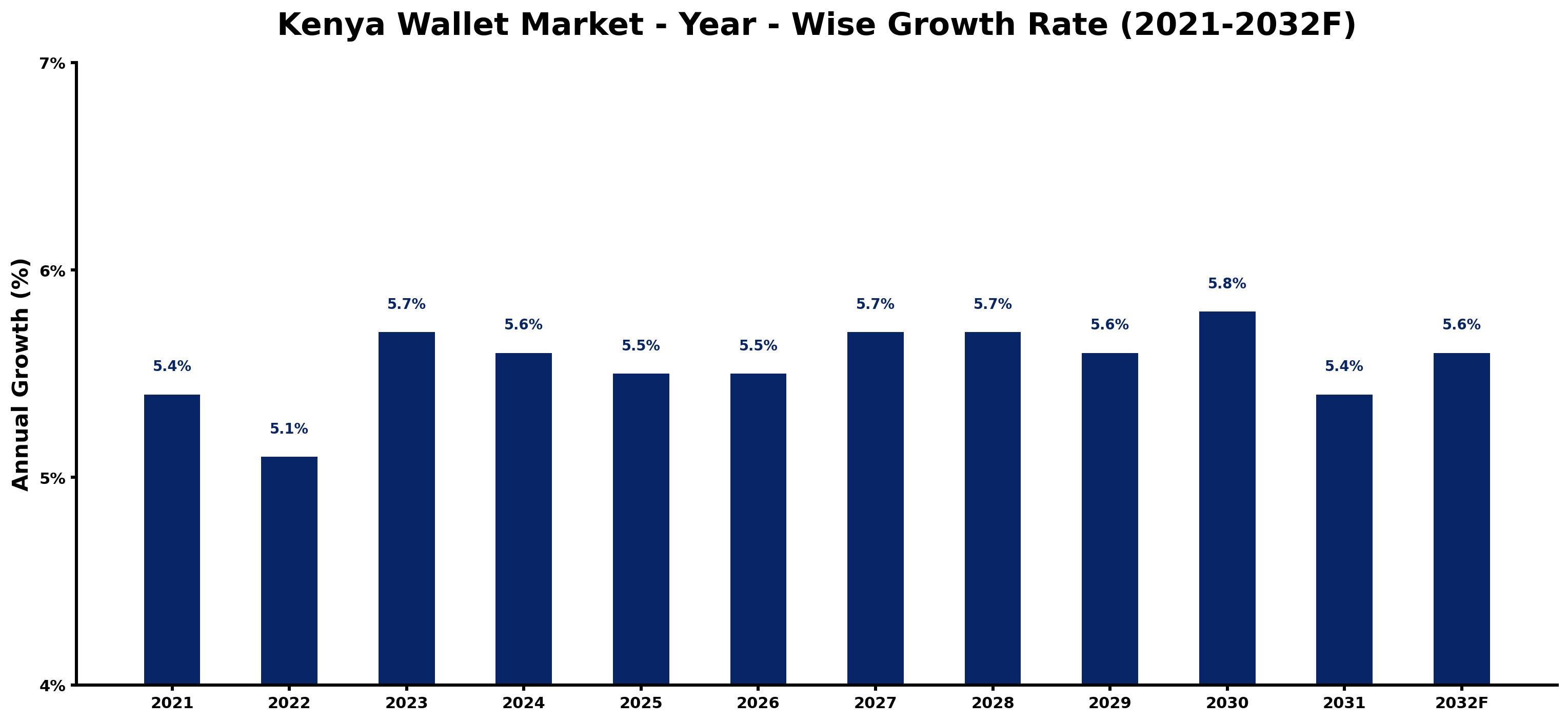
The table below presents the year wise growth rates along with the key drivers influencing the market
| Year | Growth Rate | Major Drivers |
| 2021 | 5.4% | Mobile money platforms expanded, enhancing financial accessibility across urban and rural areas. |
| 2022 | 5.1% | Increased smartphone penetration fostered digital payment adoption in diverse demographics. |
| 2023 | 5.7% | Consumer trust in electronic transactions grew, driven by improved cybersecurity measures. |
| 2024 | 5.6% | Innovations in fintech solutions attracted investment, boosting market competition significantly. |
| 2025 | 5.5% | Collaboration between banks and tech firms enhanced service offerings for consumers. |
| 2026 | 5.5% | Industries adopted cashless transactions, promoting efficient payment processing at scale. |
| 2027 | 5.7% | Emergence of social media commerce integrated with wallet services reshaped purchasing behaviors. |
| 2028 | 5.7% | Increase in cross-border transactions stimulated wallet functionalities for international payments. |
| 2029 | 5.6% | Loyalty programs linked to wallets incentivized consumer spending, strengthening user engagement. |
| 2030 | 5.8% | Rural electrification projects enabled better internet access, facilitating mobile wallet usage. |
| 2031 | 5.4% | Investment in blockchain technology improved transaction transparency and reduced fraud rates. |
| 2032 | 5.6% | Consumer preferences shifted towards seamless experiences, pushing for innovative wallet features. |
Note - Market size estimations and growth projections presented in this report are based on 6Wresearch's advanced forecasting approach, validated with industry datasets as of June 2026.
Kenya Wallet Market Synopsis
The Kenya Wallet Market is projected to reach 5.5% and witness significant growth during the forecast period (2026-2032). This growth is largely fueled by the increasing adoption of digital payment solutions and the transformative impact of mobile technology. As urbanization accelerates and mobile phone penetration rises, the demand for efficient and secure payment systems is expected to drive the evolution of digital wallets in both urban and rural settings.
Kenya Wallet Market Growth Drivers
Several key factors are propelling the growth of the Kenya wallet market. The foremost is the rapid surge in digital payments, which is reshaping consumer behavior and preferences. Concurrently, the extensive adoption of mobile money services has established a robust ecosystem for digital wallets. The following elements are critical to this development:
- The expansion of mobile phone usage among the Kenyan population is a major driver, facilitating easier access to digital wallet services.
- Government initiatives aimed at enhancing financial inclusion are fostering an environment where digital wallets can thrive, particularly among unbanked populations.
- The increased emphasis on cashless transactions, accelerated by socio-economic factors, is creating a growing appetite for digital wallet solutions.
- Strategic partnerships between telecommunication companies and financial institutions are innovating service delivery and expanding the reach of digital payment solutions.
- Technological advancements in cybersecurity are gradually building consumer trust and confidence in digital payment platforms, encouraging more users to transition to digital wallets.
Kenya Wallet Market Challenges and Restraints
Despite its promising growth trajectory, the Kenya wallet market faces several challenges that could hinder its progress. One of the primary concerns is related to security. The rise in cyber threats and fraud incidents poses substantial risks to user data and financial assets. Key challenges include:
- Security concerns surrounding digital wallets can deter users, as incidents of fraud and cyberattacks erode consumer confidence.
- The market's fragmentation, due to numerous providers offering similar services, results in intense competition and difficulties in differentiating products.
- Regulatory compliance continues to be a hurdle, as providers must navigate complex requirements while ensuring consumer protection.
- The lack of interoperability between various digital wallet platforms can complicate user experiences and limit market growth.
- The digital divide between urban and rural areas means that while urban consumers rapidly adopt digital wallets, rural areas may lag behind due to infrastructural and technological constraints.
Kenya Wallet Market Government Investment and Initiatives
In recognition of the potential of the digital economy, the Kenyan government has implemented various policies designed to promote and regulate the use of digital wallets. These initiatives are focused on enhancing the overall digital payment landscape in Kenya:
- The introduction of frameworks aimed at improving cybersecurity measures is crucial to safeguarding consumer data and enhancing trust in digital transactions.
- Financial inclusion initiatives are being prioritized to ensure that underserved populations gain access to digital wallet services, facilitating broader economic participation.
- Regulatory bodies are working to establish standards that digital wallet providers must adhere to, ensuring a level playing field and consumer protection.
- Government investments in technological infrastructure aim to boost internet access, which is vital for supporting the increasing use of digital payment solutions.
- Collaboration with private sector stakeholders is fostering innovation, with the government encouraging new technology deployments that enhance the digital wallet user experience.
Kenya Wallet Market Latest Developments (May 2025 - June 2026)
Between May 2025 and June 2026, the Kenya wallet market has observed notable developments indicative of its dynamic nature. These developments include the implementation of new regulatory policies aimed at strengthening security protocols for digital wallets. Furthermore, public awareness campaigns have been launched to educate users about the benefits and security measures associated with digital wallets. Additionally, advancements in mobile technology have led to enhanced features in wallet applications, driving user engagement and satisfaction. Investments in infrastructure have also improved internet accessibility in previously underserved areas, which is expected to further broaden the user base. Overall, the competitive landscape remains vibrant, with ongoing innovations shaping the future of digital wallets in Kenya.
Kenya Wallet Market - Key Attractiveness of the Report
- 10 Years of Market Numbers
- Historical Data Starting from 2022 to 2025
- Base Year: 2025
- Forecast Data until 2032
- Key Performance Indicators Impacting the Market
- Major Upcoming Developments and Projects
Key Highlights of the Report:
- Kenya Wallet Market Outlook
- Market Size of Kenya Wallet Market, 2025
- Forecast of Kenya Wallet Market, 2032F
- Historical Data and Forecast of Kenya Wallet Revenues & Volume for the Period 2022-2032F
- Kenya Wallet Market Trend Evolution
- Kenya Wallet Market Drivers and Challenges
- Kenya Wallet Price Trends
- Kenya Wallet Porter's Five Forces
- Kenya Wallet Industry Life Cycle
- Historical Data and Forecast of Kenya Wallet Market Revenues & Volume By Product Type for the Period 2022-2032F
- Historical Data and Forecast of Kenya Wallet Market Revenues & Volume By Short Wallet for the Period 2022-2032F
- Historical Data and Forecast of Kenya Wallet Market Revenues & Volume By Long Wallet for the Period 2022-2032F
- Historical Data and Forecast of Kenya Wallet Market Revenues & Volume By Material for the Period 2022-2032F
- Historical Data and Forecast of Kenya Wallet Market Revenues & Volume By Leather for the Period 2022-2032F
- Historical Data and Forecast of Kenya Wallet Market Revenues & Volume By Fabric for the Period 2022-2032F
- Historical Data and Forecast of Kenya Wallet Market Revenues & Volume By Gender for the Period 2022-2032F
- Historical Data and Forecast of Kenya Wallet Market Revenues & Volume By Men for the Period 2022-2032F
- Historical Data and Forecast of Kenya Wallet Market Revenues & Volume By Women for the Period 2022-2032F
- Historical Data and Forecast of Kenya Wallet Market Revenues & Volume By Kids for the Period 2022-2032F
- Historical Data and Forecast of Kenya Wallet Market Revenues & Volume By Distribution Channel for the Period 2022-2032F
- Historical Data and Forecast of Kenya Wallet Market Revenues & Volume By Online for the Period 2022-2032F
- Historical Data and Forecast of Kenya Wallet Market Revenues & Volume By Offline for the Period 2022-2032F
- Kenya Wallet Import Export Trade Statistics
- Market Opportunity Assessment By Product Type
- Market Opportunity Assessment By Material
- Market Opportunity Assessment By Gender
- Market Opportunity Assessment By Distribution Channel
- Kenya Wallet Top Companies Market Share
- Kenya Wallet Competitive Benchmarking By Technical and Operational Parameters
- Kenya Wallet Company Profiles
- Kenya Wallet Key Strategic Recommendations






































