Kenya Whey Protein Market Size, Share & Growth Rate
The Kenya Whey Protein Market was estimated at USD 1062 Million in 2025 and is projected to reach USD 1560 Million by 2032, growing at a CAGR of 5.6% from 2026 to 2032. This significant growth trajectory reflects the rising health consciousness among Kenyan consumers and an increasing inclination towards fitness and sports nutrition. As more individuals embrace active lifestyles, the demand for high-protein dietary supplements is expected to drive market expansion.
Kenya Whey Protein Market Growth Rate Analysis (2021-2032)
The Kenya whey protein market has shown stable growth, with yearly increases of 6.8% in 2021, slightly decreasing to 6.6% in 2022, and maintaining a solid 6.7% in 2023 and 2024. This steady performance can be attributed to rising health consciousness among Kenyan consumers and the increasing popularity of fitness regimes. The demand for high-quality protein sources, especially among athletes and health enthusiasts, has driven investments in production and distribution infrastructure. While the growth rate dipped to 6.2% in 2026, subsequent years saw a recovery, reaffirming market resilience influenced by technological advancements in food processing and an expanding retail landscape, allowing whey protein products to reach a broader audience.
Kenya Whey Protein Market Year-wise Growth Rate and Key Drivers
This graph highlights how the Kenya Whey Protein Market has steadily grown over the past five years, supported by major growth factors.
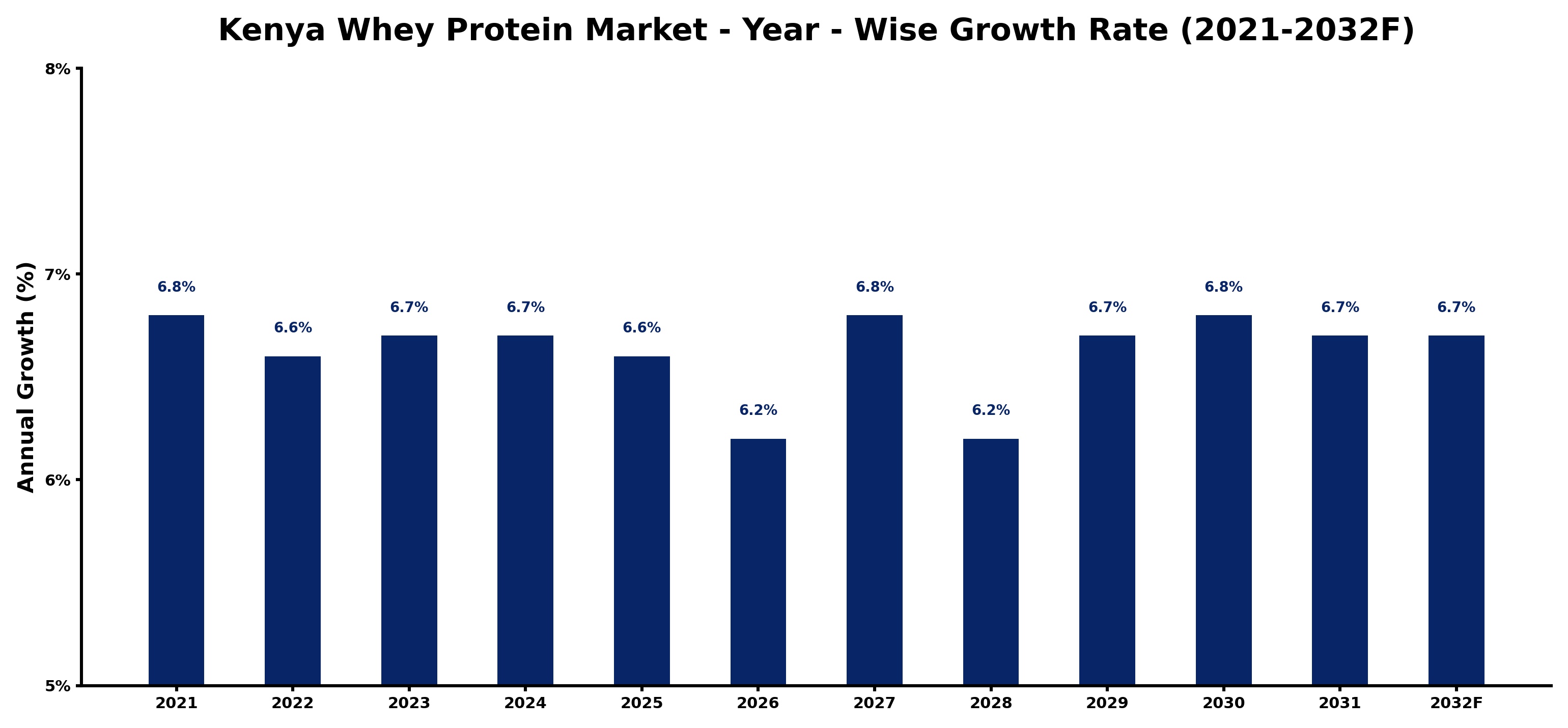
The table below presents the year‑wise growth rates along with the key drivers influencing the market
| Year | Growth Rate | Major Drivers |
| 2021 | 6.8% | Health consciousness among consumers |
| 2022 | 6.6% | Fitness trends drove product demand |
| 2023 | 6.7% | Increased awareness of nutrition |
| 2024 | 6.7% | Growth in sports nutrition market |
| 2025 | 6.6% | Rising popularity of protein diets |
| 2026 | 6.2% | Expansion of fitness facilities nationwide |
| 2027 | 6.8% | Emergence of new brands |
| 2028 | 6.2% | Innovative product formulations launched |
| 2029 | 6.7% | Increased online shopping convenience |
| 2030 | 6.8% | Collaborations with fitness influencers |
| 2031 | 6.7% | Whey protein education programs expanded |
| 2032 | 6.7% | Diverse flavor options attracted consumers |
Note - Market size estimations and growth projections presented in this report are based on 6Wresearch's advanced forecasting approach, validated with industry datasets as of June 2026.
Kenya Whey Protein Market Synopsis
The rising popularity of functional foods and dietary supplements in Kenya has heightened the demand for whey protein products, particularly among fitness enthusiasts and athletes. Local distributors are increasingly introducing a range of whey protein options, which include concentrates, isolates, and hydrolysates, catering to diverse consumer needs.
However, the industry faces supply chain challenges stemming from inconsistent whey production as a byproduct of dairy processing. This limitation restricts manufacturers' ability to scale operations and meet the burgeoning demand for whey protein supplements across the market.
Kenya Whey Protein Market Key Takeaways
- The market is poised for steady growth driven by an increase in health and fitness awareness among consumers.
- Whey protein's high nutritional value is instrumental in its rising adoption for muscle growth and weight management.
- Local and international brands compete by providing high-quality whey protein products that comply with global standards.
- Awareness campaigns are needed to educate consumers on the nutritional benefits of whey protein and increase market penetration.
- Government initiatives play a crucial role in supporting the dairy sector and fostering local manufacturing capabilities.
Evaluation of Restraints in Kenya Whey Protein Market
The Kenya Whey Protein Market encounters several obstacles that hinder its potential growth. A key limitation is the inconsistent supply of whey, which varies with dairy production levels. This inconsistency creates challenges for manufacturers in maintaining a steady output of protein supplements. Furthermore, the costs associated with processing whey into consumable products can be high, which impacts the pricing strategies of local manufacturers. As a result, imported products may offer competitive prices that threaten the viability of homegrown brands.
Kenya Whey Protein Market Trends
Emerging trends in the Kenya Whey Protein Market reveal a growing interest in plant-based and hybrid protein supplements, influenced by global shifts toward sustainable and health-conscious eating. Additionally, online sales channels are gaining traction, facilitating easier access to whey protein products for consumers. There is also an uptick in personalized nutrition, with more consumers seeking supplements that cater to their specific health goals.
Kenya Whey Protein Market Opportunities
The market offers genuine growth opportunities, particularly in expanding distribution networks and enhancing consumer awareness. Investments in local processing facilities could mitigate supply chain challenges, ensuring consistent product availability. Moreover, educational campaigns can cultivate a broader understanding of the benefits of whey protein, ultimately driving higher adoption rates among the general public.
Government Initiatives in the Kenya Whey Protein Market
Government policies in Kenya focus on promoting the dairy industry, which directly impacts the whey protein sector. The Ministry of Agriculture, Livestock, and Fisheries encourages local manufacturers through various incentives aimed at improving quality standards and increasing dairy production. These initiatives are designed to bolster the competitiveness of local whey protein products in both domestic and international markets.
Future Insights of the Kenya Whey Protein Market
Looking ahead to 2026-2032, the Kenya Whey Protein Market is expected to witness substantial growth fueled by the continuous evolution of consumer preferences towards health and fitness. As awareness around nutrition expands, coupled with government support for local manufacturers, the market is likely to develop a more robust framework for sustainable production. This environment will foster innovation in whey protein products, aligning them with consumer expectations and further propelling market growth.
Kenya Whey Protein Market Latest Developments (May 2025 - June 2026)
Recent industry developments indicate a shift towards innovative product formulations, as manufacturers explore new flavors and blends to cater to evolving consumer tastes. Additionally, collaborative partnerships between local dairy farmers and whey protein manufacturers are emerging, aiming to enhance the supply chain efficiency. Moreover, increased participation in trade fairs and health expos is being observed, enabling local brands to showcase their products and engage directly with consumers.
Kenya Whey Protein Market - Key Attractiveness of the Report
- 10 Years of Market Numbers
- Historical Data Starting from 2022 to 2025
- Base Year: 2025
- Forecast Data until 2032
- Key Performance Indicators Impacting the Market
- Major Upcoming Developments and Projects
Key Highlights of the Report:
- Kenya Whey Protein Market Outlook
- Market Size of Kenya Whey Protein Market, 2025
- Forecast of Kenya Whey Protein Market, 2032
- Historical Data and Forecast of Kenya Whey Protein Revenues & Volume for the Period 2022-2032F
- Kenya Whey Protein Market Trend Evolution
- Kenya Whey Protein Market Drivers and Challenges
- Kenya Whey Protein Price Trends
- Kenya Whey Protein Porter's Five Forces
- Kenya Whey Protein Industry Life Cycle
- Historical Data and Forecast of Kenya Whey Protein Market Revenues & Volume By Type for the Period 2022-2032F
- Historical Data and Forecast of Kenya Whey Protein Market Revenues & Volume By Whey Protein Isolates for the Period 2022-2032F
- Historical Data and Forecast of Kenya Whey Protein Market Revenues & Volume By Whey Protein Concentrates for the Period 2022-2032F
- Historical Data and Forecast of Kenya Whey Protein Market Revenues & Volume By Whey Protein Hydrolysates for the Period 2022-2032F
- Historical Data and Forecast of Kenya Whey Protein Market Revenues & Volume By Application for the Period 2022-2032F
- Historical Data and Forecast of Kenya Whey Protein Market Revenues & Volume By Nutritional Supplements for the Period 2022-2032F
- Historical Data and Forecast of Kenya Whey Protein Market Revenues & Volume By Personal Care for the Period 2022-2032F
- Historical Data and Forecast of Kenya Whey Protein Market Revenues & Volume By Food & Beverages for the Period 2022-2032F
- Historical Data and Forecast of Kenya Whey Protein Market Revenues & Volume By Animal Feed & Pet Food for the Period 2022-2032F
- Kenya Whey Protein Import Export Trade Statistics
- Market Opportunity Assessment By Type
- Market Opportunity Assessment By Application
- Kenya Whey Protein Top Companies Market Share
- Kenya Whey Protein Competitive Benchmarking By Technical and Operational Parameters
- Kenya Whey Protein Company Profiles
- Kenya Whey Protein Key Strategic Recommendations






































