Kenya Windows Market Summary
The kenya windows market was estimated at USD 478 Million in 2025 and is projected to reach USD 630 Million by 2032, growing at a CAGR of 4.9% from 2026 to 2032.
Kenya Windows Market Year-wise Growth Rate and Key Drivers
This graph highlights how the Kenya Windows Market has steadily grown over the past five years, supported by major growth factors.
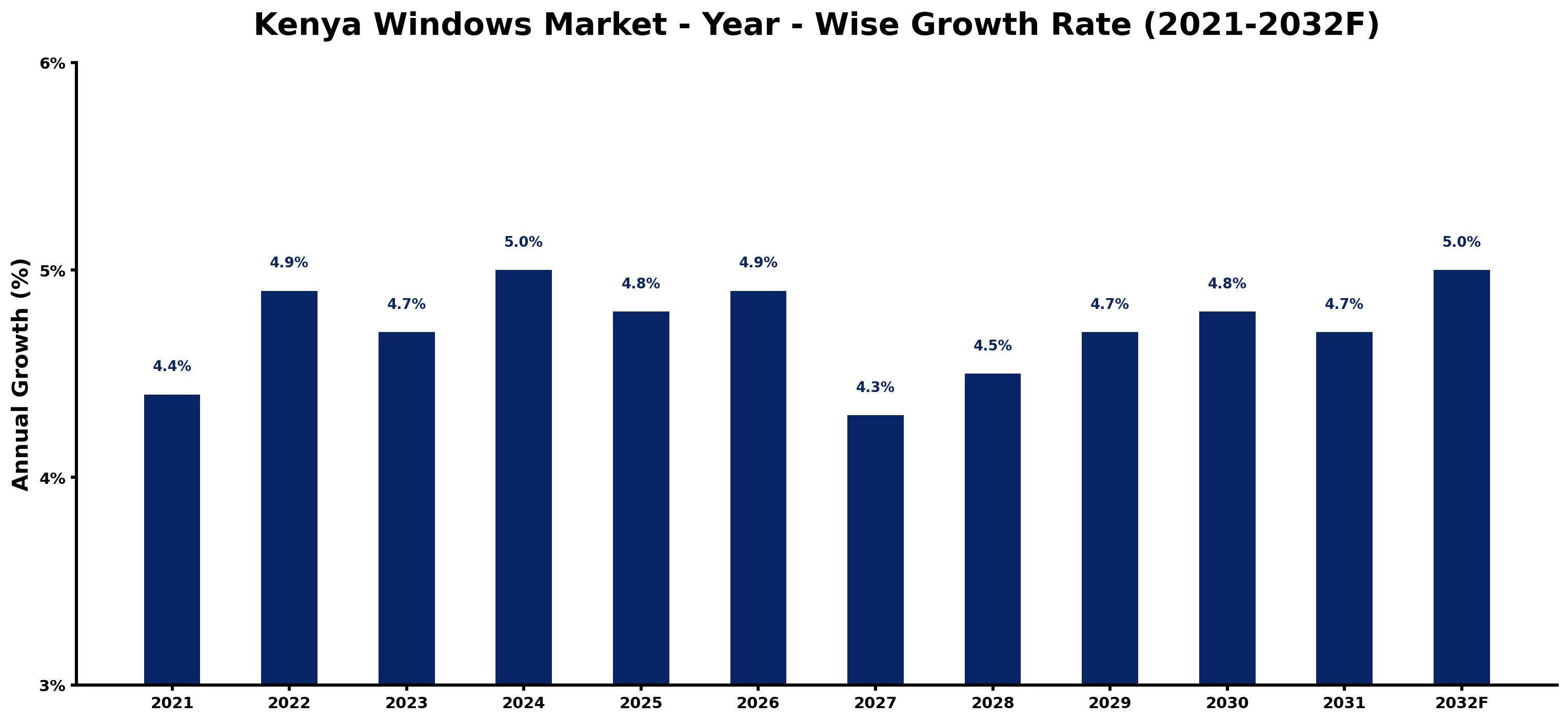
The table below presents the year wise growth rates along with the key drivers influencing the market
| Year | Growth Rate | Major Drivers |
| 2021 | 4.4% | Post-pandemic recovery has stimulated housing projects across urban Kenya, boosting construction activities. |
| 2022 | 4.9% | The influx of foreign investment has enhanced the quality of building materials available locally. |
| 2023 | 4.7% | Increased urban migration leads to higher demand for affordable housing solutions in Nairobi. |
| 2024 | 5.0% | Technological advancements in window manufacturing have improved energy efficiency and designs. |
| 2025 | 4.8% | Infrastructure developments in major cities create a favorable environment for new residential projects. |
| 2026 | 4.9% | Growing awareness of sustainable building practices encourages the use of eco-friendly windows. |
| 2027 | 4.3% | Market diversification strategies by local manufacturers are paving the way for innovative designs. |
| 2028 | 4.5% | Rising disposable incomes among middle-class households expand access to premium window options. |
| 2029 | 4.7% | Digitalization within the construction sector enhances procurement processes for window manufacturers. |
| 2030 | 4.8% | Increased competition leads to improved pricing strategies, benefiting consumers in urban areas. |
| 2031 | 4.7% | Partnerships between local firms and international brands enhance product offerings in the market. |
| 2032 | 5.0% | Emerging smart home trends inspire demand for advanced window technology, boosting sales. |
Note - Market size estimations and growth projections presented in this report are based on 6Wresearch's advanced forecasting approach, validated with industry datasets as of June 2026.
Kenya Windows Market Synopsis
The Kenya Windows Market is projected to reach 4.9% and witness significant growth during the forecast period (2026-2032). The market is currently bolstered by escalating construction activities and an increasing demand for energy-efficient building materials. Windows are integral to providing ventilation, natural lighting, and thermal comfort in buildings, making them a key component in both residential and commercial architecture.
Kenya Windows Market Growth Drivers
Several factors are contributing to the expansion of the Kenya windows market, reflecting broader construction trends and shifts in consumer preferences.
- The rapid urbanization in Kenya is driving the demand for new housing and commercial buildings, which in turn stimulates the windows market as integral components of construction.
- Technological advancements in window design and materials are enhancing the performance of windows, making them more appealing due to improved energy efficiency and sound insulation.
- The rising consumer awareness regarding sustainability is prompting builders and homeowners to prioritize energy-efficient windows, thereby increasing their adoption.
- Government initiatives aimed at promoting energy efficiency and sustainable construction practices are bolstering the market context, as they often lead to increased investment in new projects.
- Increased focus on aesthetics and lifestyle improvements has led to innovations in window designs that cater to both functionality and visual appeal, appealing to a wider range of consumers.
Kenya Windows Market Challenges and Restraints
Despite the promising growth trajectory of the Kenya windows market, several impediments hinder its potential.
- The prevalence of low-cost alternative materials can deter consumers from investing in higher-quality, energy-efficient windows, affecting overall market value.
- Limited consumer awareness about the long-term benefits of energy-efficient windows continues to pose a challenge for market players aiming to promote their products.
- Regulatory challenges and inconsistent enforcement of standards can lead to quality discrepancies in the market, undermining consumer confidence.
- Economic fluctuations and inflation may impact consumer spending power, resulting in prioritization of immediate costs over long-term savings associated with energy-efficient windows.
- The need for skilled labor to install advanced window technologies can also act as a constraint, as the market may face shortages in qualified installation professionals.
Kenya Windows Market Government Investment and Initiatives
The Kenyan government actively fosters the growth of the windows market through various policies and initiatives aimed at advancing sustainable construction practices.
- Tax incentives for manufacturers engaging in local window production are designed to stimulate domestic manufacturing and reduce dependency on imports.
- Subsidies are offered for research and development efforts focused on innovative construction materials, including energy-efficient windows.
- Government-mandated standards ensure product quality and safety, fostering trust among consumers and encouraging investments in higher-quality products.
- Promotion of locally sourced materials is part of broader efforts to enhance local supply chains and boost employment opportunities within the construction sector.
- Integration of sustainability principles in government projects serves as a model for private sector initiatives, driving demand for energy-efficient windows.
Kenya Windows Market Latest Developments (May 2025 - June 2026)
Throughout the period from May 2025 to June 2026, the Kenya windows market has experienced several notable developments, reflecting the sector's response to evolving consumer and regulatory dynamics.
- There has been a marked increase in collaborations between industry stakeholders and research institutions aimed at developing innovative window technologies that enhance energy efficiency.
- A growing number of construction projects have begun prioritizing sustainable materials, leading to increased demand for energy-efficient windows that meet international standards.
- The government has continued to roll out initiatives designed to improve public awareness about the benefits of energy-efficient windows, which have led to gradual shifts in consumer purchasing behaviors.
- Regulatory changes have been introduced to streamline the approval process for new building projects, indirectly boosting the windows market as a consequence of increased construction activities.
- Consumer demand for customized window solutions has risen, prompting manufacturers to diversify their product offerings to meet unique architectural requirements.
Kenya Windows Market - Key Attractiveness of the Report
- 10 Years of Market Numbers
- Historical Data Starting from 2022 to 2025
- Base Year: 2025
- Forecast Data until 2032
- Key Performance Indicators Impacting the Market
- Major Upcoming Developments and Projects
Key Highlights of the Report:
- Kenya Windows Market Outlook
- Market Size of Kenya Windows Market, 2025
- Forecast of Kenya Windows Market, 2032
- Historical Data and Forecast of Kenya Windows Revenues & Volume for the Period 2022-2032F
- Kenya Windows Market Trend Evolution
- Kenya Windows Market Drivers and Challenges
- Kenya Windows Price Trends
- Kenya Windows Porter's Five Forces
- Kenya Windows Industry Life Cycle
- Historical Data and Forecast of Kenya Windows Market Revenues & Volume By Material for the Period 2022-2032F
- Historical Data and Forecast of Kenya Windows Market Revenues & Volume By uPVC for the Period 2022-2032F
- Historical Data and Forecast of Kenya Windows Market Revenues & Volume By Wood for the Period 2022-2032F
- Historical Data and Forecast of Kenya Windows Market Revenues & Volume By Metal for the Period 2022-2032F
- Historical Data and Forecast of Kenya Windows Market Revenues & Volume By Others for the Period 2022-2032F
- Historical Data and Forecast of Kenya Windows Market Revenues & Volume By Application for the Period 2022-2032F
- Historical Data and Forecast of Kenya Windows Market Revenues & Volume By Residential for the Period 2022-2032F
- Historical Data and Forecast of Kenya Windows Market Revenues & Volume By Commercial for the Period 2022-2032F
- Kenya Windows Import Export Trade Statistics
- Market Opportunity Assessment By Material
- Market Opportunity Assessment By Application
- Kenya Windows Top Companies Market Share
- Kenya Windows Competitive Benchmarking By Technical and Operational Parameters
- Kenya Windows Company Profiles
- Kenya Windows Key Strategic Recommendations






































