Kenya Wood Preservatives Market Size, Share & Growth Rate
The Kenya Wood Preservatives Market was estimated at USD 381 Million in 2025 and is projected to reach USD 514 Million by 2032, growing at a CAGR of 4.4% from 2026 to 2032. This upward trajectory is propelled by the growing construction sector, alongside an increasing demand for durable wood products in furniture manufacturing. Additionally, stringent environmental regulations are fostering a shift towards eco-friendly preservatives, thereby shaping the market landscape.
Kenya Wood Preservatives Market Year-wise Growth Rate and Key Drivers
This graph highlights how the Kenya Wood Preservatives Market has steadily grown over the years, supported by major growth factors.
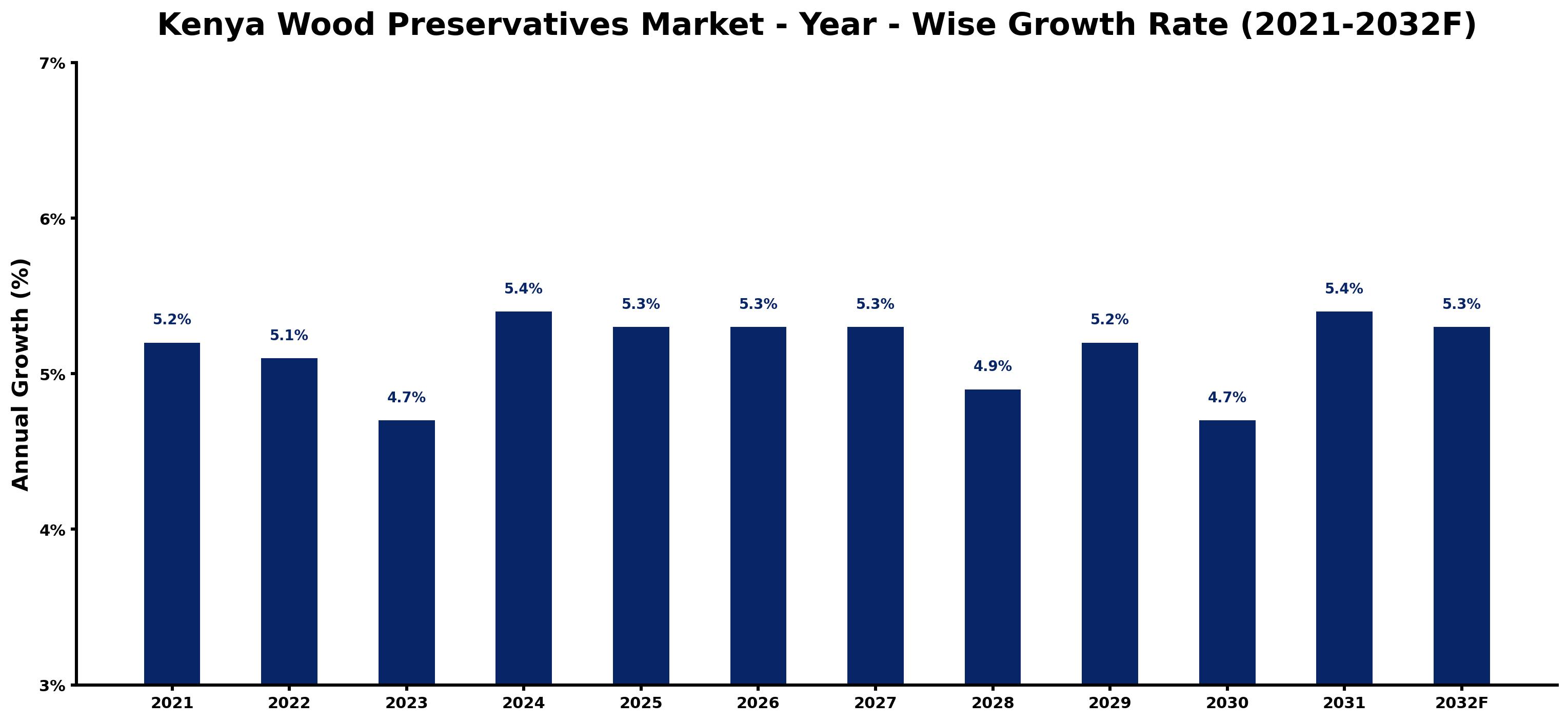
The table below presents the year‑wise growth rates along with the key drivers influencing the market
| Year | Growth Rate | Major Drivers |
| 2021 | 5.2% | Government infrastructure modernization initiatives |
| 2022 | 5.1% | Expansion of transportation and logistics networks |
| 2023 | 4.7% | Increasing smart city development projects |
| 2024 | 5.4% | Expansion of transportation and logistics networks |
| 2025 | 5.3% | Rapid growth in telecom and data center sectors |
| 2026 | 5.3% | Expansion of commercial construction activities |
| 2027 | 5.3% | Increasing industrial infrastructure investments |
| 2028 | 4.9% | Increasing adoption of advanced technologies |
| 2029 | 5.2% | Increasing industrial automation investments |
| 2030 | 4.7% | Growing urbanization and commercial development |
| 2031 | 5.4% | Increasing adoption of advanced technologies |
| 2032 | 5.3% | Expansion of commercial construction activities |
Note - Market size estimations and growth projections presented in this report are based on 6Wresearch’s advanced forecasting approach, validated with industry datasets as of June 2026.
Kenya Wood Preservatives Market Synopsis
Currently, the wood preservatives market in Kenya is critical for both residential and commercial sectors. As urbanization accelerates and building standards evolve, there is a heightened necessity for protective solutions that extend the lifespan of wooden structures and furnishings.
The market thrives on its capacity to combat the detrimental effects of environmental factors, pests, and decay. With growing awareness surrounding sustainable practices, there is a distinct pivot towards innovative preservative solutions that not only serve functional purposes but also align with eco-conscious consumer preferences.
Kenya Wood Preservatives Market Key Takeaways
- The market is set for steady growth, driven by construction and furniture industry expansions.
- Environmental regulations are reshaping product formulations and application methodologies.
- There is a notable trend towards the development of sustainable and alternative wood preservatives.
- Concerns over health and safety are influencing consumer choices in the wood preservatives sector.
- Government initiatives are fostering innovation and compliance within the industry.
Evaluation of Restraints in Kenya Wood Preservatives Market
The Kenya Wood Preservatives Market faces significant constraints primarily due to environmental regulations that restrict the use of certain chemicals. These regulations, while crucial for public health, limit product availability and innovation in the market. Moreover, limited local production capabilities result in dependence on imports, which are often subject to high tariffs. This not only influences pricing but also creates potential disruptions in the supply chain, affecting market dynamics. Additionally, there is increasing scrutiny regarding the health implications of traditional preservatives, which may deter consumers from opting for certain products.
Kenya Wood Preservatives Market Trends
Emerging trends in the Kenya Wood Preservatives Market illustrate a clear shift towards sustainable practices. More manufacturers are developing eco-friendly products in response to consumer demand for environmentally safe options. Moreover, technological advancements are enhancing the effectiveness of preservatives, making them more reliable against fungi and insects. As sustainability becomes a core value for businesses and consumers alike, this trend is likely to reshape the product offerings significantly.
Kenya Wood Preservatives Market Opportunities
Significant growth and investment opportunities exist within the Kenya Wood Preservatives Market, particularly in the development of bio-based and non-toxic preservatives. Companies can capitalize on the rising demand for sustainable products by investing in research and development to innovate safer alternatives. Additionally, the growing construction and furniture industries present lucrative avenues for targeted marketing and supply chain enhancements to meet escalating demands.
Government Initiatives in the Kenya Wood Preservatives Market
The Kenyan government is actively involved in regulating the wood preservatives market to ensure product safety and efficacy. Policies are in place that restricts the use of harmful chemicals while promoting research into alternative preservatives. Furthermore, initiatives aimed at enhancing the application methods of wood treatments are being encouraged, emphasizing safety for both humans and the environment. The government's commitment to sustainable practices plays a vital role in shaping the future landscape of this market.
Future Insights of the Kenya Wood Preservatives Market
Looking ahead to the years 2026-2032, the Kenya Wood Preservatives Market is expected to witness robust growth fueled by continued urbanization and infrastructural development. As consumers become more aware of environmental issues, the demand for innovative and eco-friendly preservatives is set to rise. Additionally, as the regulatory landscape evolves, companies will need to adapt quickly to meet new standards while leveraging technological advancements to enhance product performance.
Kenya Wood Preservatives Market Latest Developments (May 2025 - June 2026)
In recent months, the Kenyan wood preservatives market has seen a notable push towards sustainability, with various companies announcing initiatives focused on developing environmentally friendly preservative solutions. Additionally, research institutions are increasingly collaborating with industry players to explore innovative treatments that comply with stringent regulations. These developments signal a proactive approach in addressing market challenges while aligning with global sustainability trends.
Kenya Wood Preservatives Market - Key Attractiveness of the Report
- 10 Years of Market Numbers
- Historical Data Starting from 2022 to 2025
- Base Year: 2025
- Forecast Data until 2032
- Key Performance Indicators Impacting the Market
- Major Upcoming Developments and Projects
Key Highlights of the Report:
- Kenya Wood Preservatives Market Outlook
- Market Size of Kenya Wood Preservatives Market, 2025
- Forecast of Kenya Wood Preservatives Market, 2032
- Historical Data and Forecast of Kenya Wood Preservatives Revenues & Volume for the Period 2022-2032F
- Kenya Wood Preservatives Market Trend Evolution
- Kenya Wood Preservatives Market Drivers and Challenges
- Kenya Wood Preservatives Price Trends
- Kenya Wood Preservatives Porter's Five Forces
- Kenya Wood Preservatives Industry Life Cycle
- Historical Data and Forecast of Kenya Wood Preservatives Market Revenues & Volume By Formulation for the Period 2022-2032F
- Historical Data and Forecast of Kenya Wood Preservatives Market Revenues & Volume By Water-Based Wood Preservatives for the Period 2022-2032F
- Historical Data and Forecast of Kenya Wood Preservatives Market Revenues & Volume By Solvent-Based Wood Preservatives for the Period 2022-2032F
- Historical Data and Forecast of Kenya Wood Preservatives Market Revenues & Volume By Oil-Based Wood Preservatives for the Period 2022-2032F
- Historical Data and Forecast of Kenya Wood Preservatives Market Revenues & Volume By Application for the Period 2022-2032F
- Historical Data and Forecast of Kenya Wood Preservatives Market Revenues & Volume By Residential for the Period 2022-2032F
- Historical Data and Forecast of Kenya Wood Preservatives Market Revenues & Volume By Commercial for the Period 2022-2032F
- Historical Data and Forecast of Kenya Wood Preservatives Market Revenues & Volume By Industrial for the Period 2022-2032F
- Kenya Wood Preservatives Import Export Trade Statistics
- Market Opportunity Assessment By Formulation
- Market Opportunity Assessment By Application
- Kenya Wood Preservatives Top Companies Market Share
- Kenya Wood Preservatives Competitive Benchmarking By Technical and Operational Parameters
- Kenya Wood Preservatives Company Profiles
- Kenya Wood Preservatives Key Strategic Recommendations






































