Kenya Wooden Toys Market Size, Share & Growth Rate
The Kenya Wooden Toys Market was estimated at USD 387 Million in 2025 and is projected to reach USD 547 Million by 2032, growing at a CAGR of 5.1% from 2026 to 2032. This growth trajectory is being propelled by an increasing consumer awareness of the environmental and developmental advantages of wooden toys. Parents are increasingly opting for eco-friendly products, shifting their preferences towards sustainable toys that promote educational play and child engagement.
Kenya Wooden Toys Market Year-wise Growth Rate and Key Drivers
This graph highlights how the Kenya Wooden Toys Market has steadily grown over the years, supported by major growth factors.
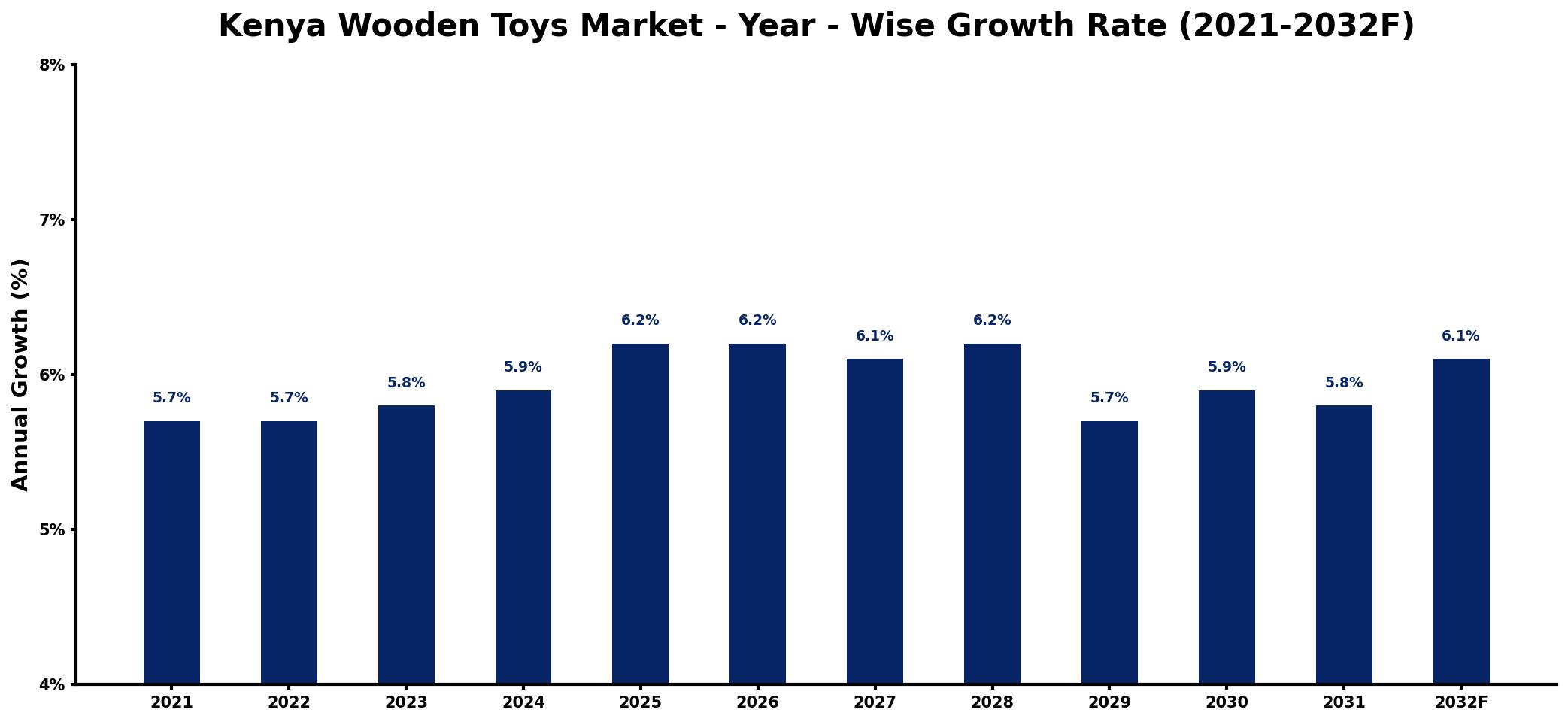
The table below presents the year‑wise growth rates along with the key drivers influencing the market
| Year | Growth Rate | Major Drivers |
| 2021 | 5.7% | Rising consumer preference for sustainability |
| 2022 | 5.7% | Increased investment in eco-friendly materials |
| 2023 | 5.8% | Growing awareness of child development |
| 2024 | 5.9% | Expansion of local manufacturing capabilities |
| 2025 | 6.2% | Surge in online retail channels |
| 2026 | 6.2% | Strengthened distribution network efficiency |
| 2027 | 6.1% | Enhanced marketing strategies effectiveness |
| 2028 | 6.2% | Diversification of product offerings available |
| 2029 | 5.7% | Improved collaborations with educational institutions |
| 2030 | 5.9% | Heightened demand for artisanal craftsmanship |
| 2031 | 5.8% | Strengthened community support initiatives |
| 2032 | 6.1% | strengthening underlying market demand |
Note: Market size estimations and growth projections presented in this report are based on 6Wresearch's proprietary forecasting methodology, utilizing the latest available industry data, government publications, and primary research inputs.
Kenya Wooden Toys Market Synopsis
The wooden toys market in Kenya has experienced recent momentum, driven by a burgeoning demand for non-toxic and environmentally friendly play options. As parents become more discerning about the safety and educational value of toys, the market is on an upward trajectory, though challenges remain in penetration and consumer awareness.
Looking ahead, the market is poised for significant growth, underpinned by government initiatives promoting local artisanship and child safety. This evolving landscape presents an opportunity for stakeholders to capture market share by aligning their offerings with consumer preferences for natural and sustainable toys.
Kenya Wooden Toys Market Key Takeaways
- The market is set to grow steadily, with a projected CAGR of 5.1% between 2026 and 2032.
- Handcrafted wooden toys are gaining traction due to rising environmental consciousness among consumers.
- Government policies are actively promoting child safety and supporting local artisans in the wooden toys sector.
- Concerns regarding the safety of plastic toys are significantly influencing consumer choices.
- Market penetration is challenged by limited awareness of the benefits of wooden toys.
Evaluation of Restraints in Kenya Wooden Toys Market
Despite the promising growth potential, the Kenya Wooden Toys Market faces several constraints that can hinder its expansion. A primary limitation stems from fierce competition posed by low-cost plastic alternatives, which dominate the toy market. Additionally, there exists a noticeable gap in consumer awareness regarding the unique benefits of wooden toys, including their educational potential and eco-friendly nature. This lack of understanding affects overall market acceptance and can deter new entrants. Furthermore, concerns surrounding product quality and inconsistent safety standards continue to challenge consumer trust, thereby complicating regulatory compliance and inhibiting broader market growth.
Kenya Wooden Toys Market Trends
Current trends in the Kenya Wooden Toys Market include a notable shift towards educational and developmental toys that foster creativity and learning. As more parents recognize the importance of play in cognitive development, there is an uptick in demand for toys that not only entertain but also educate. Another significant trend is the rise of eco-conscious consumerism, leading to a preference for products that are crafted from sustainably sourced materials. As a result, local artisans and manufacturers are increasingly focusing on using traditional craftsmanship techniques that resonate with cultural heritage while also addressing sustainability concerns.
Kenya Wooden Toys Market Opportunities
The Kenya Wooden Toys Market presents numerous growth and investment opportunities for stakeholders. There is a significant demand for innovative and educational toy designs that align with the developmental needs of children. Furthermore, investment in marketing strategies that elevate consumer awareness around the safety and educational benefits of wooden toys can drive acceptance and sales. Collaborations with local artisans to create unique, culturally inspired products also offer a pathway to differentiate from mass-produced plastic toys, tapping into the growing market of ethically sourced and sustainable goods.
Government Initiatives in the Kenya Wooden Toys Market
Government policy plays a critical role in shaping the Kenya Wooden Toys Market by promoting child safety and supporting local craftsmanship. Regulatory frameworks are in place to ensure that wooden toys meet specific safety standards, protecting children from hazards such as choking and toxic materials. Furthermore, initiatives aimed at encouraging the use of environmentally friendly materials highlight the governments commitment to fostering a sustainable market. These policies not only enhance consumer trust but also support the preservation of cultural heritage through traditional craftsmanship.
Future Insights of the Kenya Wooden Toys Market
Looking towards 2026-2032, the Kenya Wooden Toys Market is anticipated to continue on its growth trajectory, driven by a combination of heightened consumer awareness, supportive government initiatives, and an evolving toy landscape. As parents increasingly prioritize eco-friendly products, the market is expected to benefit from this shift, leading to the proliferation of innovative, sustainable toys. Additionally, the ongoing challenges posed by plastic alternatives may prompt further advocacy for wooden toys as safer and more beneficial options for child development, thus solidifying their position in the marketplace.
Kenya Wooden Toys Market Latest Developments (2025 - 2026)
Recent developments in the Kenya Wooden Toys Market indicate a growing emphasis on enhancing product quality and safety standards. Manufacturers are increasingly adopting stringent quality control measures to meet regulatory requirements while also addressing consumer concerns regarding safety. Furthermore, new partnerships between local artisans and design studios are emerging, aiming to create unique, culturally relevant toy designs that cater to the evolving demands of the market. This trend reflects a broader shift towards integrating traditional craftsmanship with contemporary design aesthetics to appeal to modern consumers.
Kenya Wooden Toys Market - Key Attractiveness of the Report
- 10 Years of Market Numbers
- Historical Data Starting from 2022 to 2025
- Base Year: 2025
- Forecast Data until 2032
- Key Performance Indicators Impacting the Market
- Major Upcoming Developments and Projects
Key Highlights of the Report:
- Kenya Wooden Toys Market Outlook
- Market Size of Kenya Wooden Toys Market, 2025
- Forecast of Kenya Wooden Toys Market, 2032
- Historical Data and Forecast of Kenya Wooden Toys Revenues & Volume for the Period 2022-2032F
- Kenya Wooden Toys Market Trend Evolution
- Kenya Wooden Toys Market Drivers and Challenges
- Kenya Wooden Toys Price Trends
- Kenya Wooden Toys Porter's Five Forces
- Kenya Wooden Toys Industry Life Cycle
- Historical Data and Forecast of Kenya Wooden Toys Market Revenues & Volume By Product Type for the Period 2022-2032F
- Historical Data and Forecast of Kenya Wooden Toys Market Revenues & Volume By Educational Toys for the Period 2022-2032F
- Historical Data and Forecast of Kenya Wooden Toys Market Revenues & Volume By Construction Toys for the Period 2022-2032F
- Historical Data and Forecast of Kenya Wooden Toys Market Revenues & Volume By Musical Toys for the Period 2022-2032F
- Historical Data and Forecast of Kenya Wooden Toys Market Revenues & Volume By Game Toys for the Period 2022-2032F
- Historical Data and Forecast of Kenya Wooden Toys Market Revenues & Volume By Dolls & Miniatures for the Period 2022-2032F
- Historical Data and Forecast of Kenya Wooden Toys Market Revenues & Volume By Automotive Toys for the Period 2022-2032F
- Historical Data and Forecast of Kenya Wooden Toys Market Revenues & Volume By Pretend Play Toys for the Period 2022-2032F
- Historical Data and Forecast of Kenya Wooden Toys Market Revenues & Volume By Wood Type for the Period 2022-2032F
- Historical Data and Forecast of Kenya Wooden Toys Market Revenues & Volume By Softwood for the Period 2022-2032F
- Historical Data and Forecast of Kenya Wooden Toys Market Revenues & Volume By Hardwood for the Period 2022-2032F
- Historical Data and Forecast of Kenya Wooden Toys Market Revenues & Volume By Age Group for the Period 2022-2032F
- Historical Data and Forecast of Kenya Wooden Toys Market Revenues & Volume By Below 1 Year for the Period 2022-2032F
- Historical Data and Forecast of Kenya Wooden Toys Market Revenues & Volume By Age 1-3 for the Period 2022-2032F
- Historical Data and Forecast of Kenya Wooden Toys Market Revenues & Volume By Age 3-5 for the Period 2022-2032F
- Historical Data and Forecast of Kenya Wooden Toys Market Revenues & Volume By Age 5-12 for the Period 2022-2032F
- Historical Data and Forecast of Kenya Wooden Toys Market Revenues & Volume By Age 12+ for the Period 2022-2032F
- Historical Data and Forecast of Kenya Wooden Toys Market Revenues & Volume By Distribution Channel for the Period 2022-2032F
- Historical Data and Forecast of Kenya Wooden Toys Market Revenues & Volume By Online for the Period 2022-2032F
- Historical Data and Forecast of Kenya Wooden Toys Market Revenues & Volume By Offline for the Period 2022-2032F
- Kenya Wooden Toys Import Export Trade Statistics
- Market Opportunity Assessment By Product Type
- Market Opportunity Assessment By Wood Type
- Market Opportunity Assessment By Age Group
- Market Opportunity Assessment By Distribution Channel
- Kenya Wooden Toys Top Companies Market Share
- Kenya Wooden Toys Competitive Benchmarking By Technical and Operational Parameters
- Kenya Wooden Toys Company Profiles
- Kenya Wooden Toys Key Strategic Recommendations






































