Algeria Wooden Toys Market Size, Share & Growth Rate
The Algeria Wooden Toys Market was estimated at USD 402 Million in 2025 and is projected to reach USD 541 Million by 2032, growing at a CAGR of 4.3% from 2026 to 2032. This growth trajectory is being driven by a notable shift in consumer preferences towards sustainable and environmentally friendly toy options. The increasing awareness among parents regarding the benefits of wooden toys, combined with a cultural resurgence of traditional playthings, is set to further enhance market expansion.
Algeria Wooden Toys Market Year-wise Growth Rate and Key Drivers
This graph highlights how the Algeria Wooden Toys Market has steadily grown over the years, supported by major growth factors.
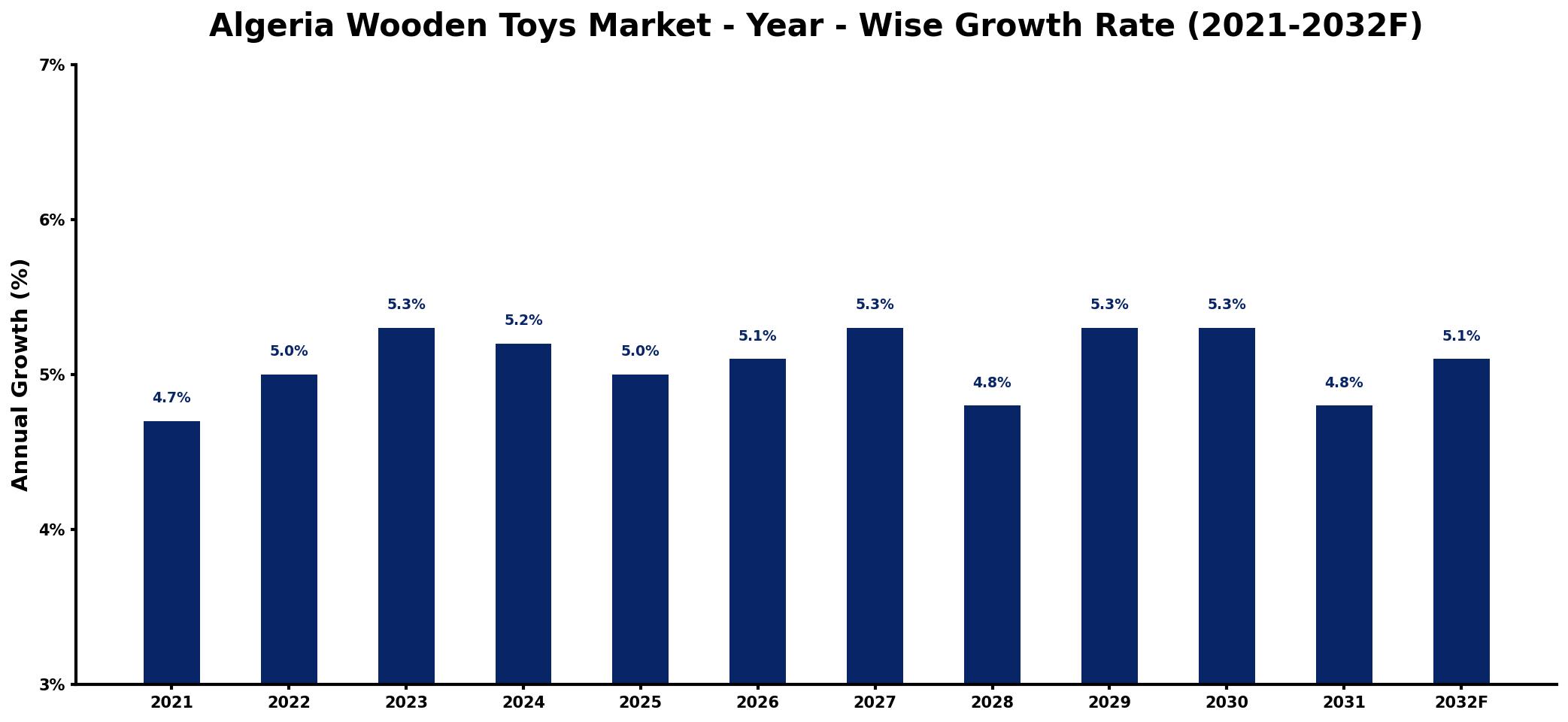
The table below presents the year‑wise growth rates along with the key drivers influencing the market
| Year | Growth Rate | Major Drivers |
| 2021 | 4.7% | Rising consumer interest in sustainability |
| 2022 | 5.0% | Increased disposable income levels |
| 2023 | 5.3% | Growing awareness of eco-friendly products |
| 2024 | 5.2% | Expansion of local manufacturing capabilities |
| 2025 | 5.0% | Higher demand for artisanal craftsmanship |
| 2026 | 5.1% | Strengthening distribution networks and logistics |
| 2027 | 5.3% | Surge in family-oriented recreational activities |
| 2028 | 4.8% | Increase in educational institutions adopting |
| 2029 | 5.3% | Growth in online retail platforms |
| 2030 | 5.3% | Enhanced marketing strategies targeting families |
| 2031 | 4.8% | Emergence of innovative design trends |
| 2032 | 5.1% | Rising popularity of experiential learning |
Note: Market size estimations and growth projections presented in this report are based on 6Wresearch's proprietary forecasting methodology, utilizing the latest available industry data, government publications, and primary research inputs.
Algeria Wooden Toys Market Synopsis
In Algeria, the wooden toys market has experienced a significant upturn, fueled by a societal shift towards eco-friendly products. The growing recognition of the durability and safety of wooden toys resonates strongly with environmentally-conscious parents seeking to minimize plastic consumption.
Additionally, the handcrafted nature of many wooden toys produced by local artisans appeals to consumers looking for unique and culturally significant products. This blend of tradition with modern values is contributing to the vibrant landscape of the Algeria Wooden Toys Market.
Algeria Wooden Toys Market Key Takeaways
- The market is primarily driven by increasing consumer awareness of the benefits of wooden toys.
- Government initiatives support local artisans and promote the sustainability of the wooden toys sector.
- Growing nostalgia for traditional toys is enhancing consumer engagement and sales.
- Logistical challenges and infrastructure limitations are significant hurdles for market players.
- Innovative designs and quality craftsmanship are becoming essential to compete in this evolving market.
Evaluation of Restraints in Algeria Wooden Toys Market
Despite its potential, the Algeria Wooden Toys Market is constrained by various factors that impede its growth. Inadequate infrastructure poses significant challenges, impacting distribution channels and hindering market penetration. Moreover, many consumers still lack awareness of the advantages of wooden toys over their plastic counterparts, which limits overall demand. Additionally, stringent regulations and compliance standards create barriers for small-scale manufacturers, making it difficult for them to innovate and compete effectively in this burgeoning sector.
Algeria Wooden Toys Market Trends
Current trends indicate a rising demand for personalized and handcrafted wooden toys as consumers seek unique items that reflect their values and experiences. Sustainability has taken center stage, with many parents opting for toys that not only entertain but also educate their children about environmental stewardship. Moreover, the integration of technology in wooden toys is becoming an emerging trend, bridging traditional play with modern learning methods.
Algeria Wooden Toys Market Opportunities
The Algeria Wooden Toys Market presents several exciting opportunities for growth and investment. The increasing demand for eco-friendly products opens avenues for businesses to innovate in sustainable manufacturing practices. Additionally, tapping into the e-commerce sector can significantly enhance market reach, allowing local artisans to connect with a broader audience. Emphasizing collaborations with educational institutions can also be fruitful, as parents seek toys that promote developmental skills.
Government Initiatives in the Algeria Wooden Toys Market
The Algerian government has recognized the significance of the wooden toys sector in promoting economic growth and preserving cultural heritage. To support this market, various initiatives have been launched, including funding programs for local artisans and training workshops focused on enhancing craftsmanship and innovation. These efforts aim to bolster the overall quality of wooden toys while fostering a competitive marketplace that benefits both manufacturers and consumers.
Future Insights of the Algeria Wooden Toys Market
Looking ahead to 2026-2032, the Algeria Wooden Toys Market is poised for steady growth driven by an increasing preference for sustainable products. As consumer awareness rises and nostalgia for traditional toys continues to grow, the market is expected to attract more investments and innovation. The alignment of government policies with market needs will further enhance the competitiveness of local artisans, ensuring that they can thrive in an evolving landscape that emphasizes quality and sustainability.
Algeria Wooden Toys Market Latest Developments (2025 - 2026)
In recent months, the wooden toys sector in Algeria has begun to see a surge in artisanal collaborations, with local craftsmen joining forces to enhance their offerings. Workshops and community events aimed at promoting the benefits of wooden toys have gained traction, engaging consumers in meaningful discussions about sustainability. Furthermore, social media campaigns highlighting the charm of handcrafted toys are fostering a new appreciation among young parents.
Algeria Wooden Toys Market - Key Attractiveness of the Report
- 10 Years of Market Numbers
- Historical Data Starting from 2022 to 2025
- Base Year: 2025
- Forecast Data until 2032
- Key Performance Indicators Impacting the Market
- Major Upcoming Developments and Projects
Key Highlights of the Report:
- Algeria Wooden Toys Market Outlook
- Market Size of Algeria Wooden Toys Market, 2025
- Forecast of Algeria Wooden Toys Market, 2032
- Historical Data and Forecast of Algeria Wooden Toys Revenues & Volume for the Period 2022-2032F
- Algeria Wooden Toys Market Trend Evolution
- Algeria Wooden Toys Market Drivers and Challenges
- Algeria Wooden Toys Price Trends
- Algeria Wooden Toys Porter's Five Forces
- Algeria Wooden Toys Industry Life Cycle
- Historical Data and Forecast of Algeria Wooden Toys Market Revenues & Volume By Product Type for the Period 2022-2032F
- Historical Data and Forecast of Algeria Wooden Toys Market Revenues & Volume By Educational Toys for the Period 2022-2032F
- Historical Data and Forecast of Algeria Wooden Toys Market Revenues & Volume By Construction Toys for the Period 2022-2032F
- Historical Data and Forecast of Algeria Wooden Toys Market Revenues & Volume By Musical Toys for the Period 2022-2032F
- Historical Data and Forecast of Algeria Wooden Toys Market Revenues & Volume By Game Toys for the Period 2022-2032F
- Historical Data and Forecast of Algeria Wooden Toys Market Revenues & Volume By Dolls & Miniatures for the Period 2022-2032F
- Historical Data and Forecast of Algeria Wooden Toys Market Revenues & Volume By Automotive Toys for the Period 2022-2032F
- Historical Data and Forecast of Algeria Wooden Toys Market Revenues & Volume By Pretend Play Toys for the Period 2022-2032F
- Historical Data and Forecast of Algeria Wooden Toys Market Revenues & Volume By Wood Type for the Period 2022-2032F
- Historical Data and Forecast of Algeria Wooden Toys Market Revenues & Volume By Softwood for the Period 2022-2032F
- Historical Data and Forecast of Algeria Wooden Toys Market Revenues & Volume By Hardwood for the Period 2022-2032F
- Historical Data and Forecast of Algeria Wooden Toys Market Revenues & Volume By Age Group for the Period 2022-2032F
- Historical Data and Forecast of Algeria Wooden Toys Market Revenues & Volume By Below 1 Year for the Period 2022-2032F
- Historical Data and Forecast of Algeria Wooden Toys Market Revenues & Volume By Age 1-3 for the Period 2022-2032F
- Historical Data and Forecast of Algeria Wooden Toys Market Revenues & Volume By Age 3-5 for the Period 2022-2032F
- Historical Data and Forecast of Algeria Wooden Toys Market Revenues & Volume By Age 5-12 for the Period 2022-2032F
- Historical Data and Forecast of Algeria Wooden Toys Market Revenues & Volume By Age 12+ for the Period 2022-2032F
- Historical Data and Forecast of Algeria Wooden Toys Market Revenues & Volume By Distribution Channel for the Period 2022-2032F
- Historical Data and Forecast of Algeria Wooden Toys Market Revenues & Volume By Online for the Period 2022-2032F
- Historical Data and Forecast of Algeria Wooden Toys Market Revenues & Volume By Offline for the Period 2022-2032F
- Algeria Wooden Toys Import Export Trade Statistics
- Market Opportunity Assessment By Product Type
- Market Opportunity Assessment By Wood Type
- Market Opportunity Assessment By Age Group
- Market Opportunity Assessment By Distribution Channel
- Algeria Wooden Toys Top Companies Market Share
- Algeria Wooden Toys Competitive Benchmarking By Technical and Operational Parameters
- Algeria Wooden Toys Company Profiles
- Algeria Wooden Toys Key Strategic Recommendations






































