Kenya Workspace as a Service Market Size & Growth Rate (2026-2032)
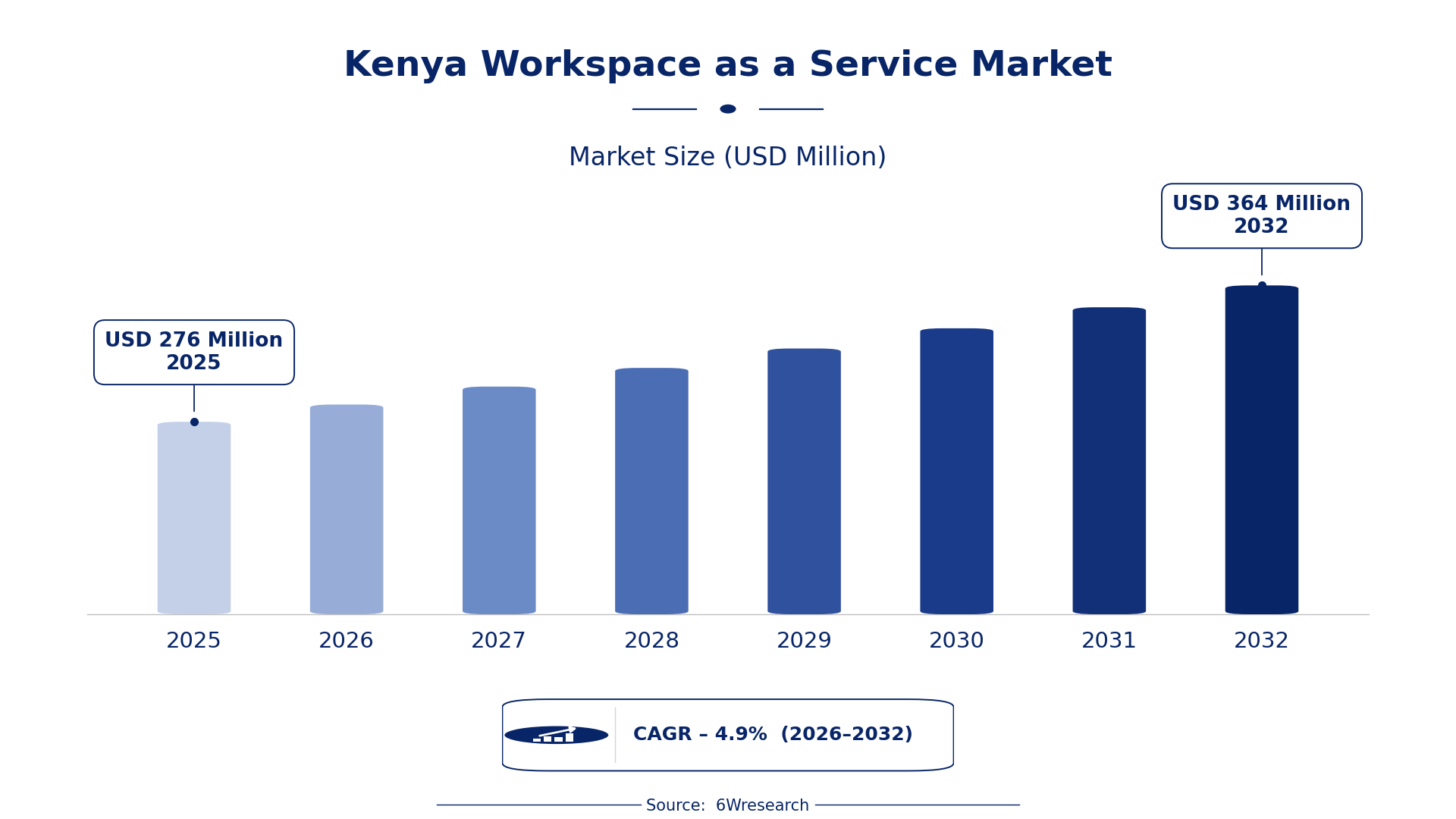
The Kenya Workspace as a Service Market was estimated at USD 276 Million in 2025 and is projected to reach USD 364 Million by 2032, growing at a CAGR of 4.9% from 2026 to 2032.
Kenya Workspace as a Service Market Synopsis
The primary driver of the Kenya Workspace as a Service market is the increasing demand for flexible work arrangements. As organizations pivot toward remote and hybrid work models, the need for reliable cloud-based solutions has surged, allowing businesses to maintain productivity and collaboration regardless of location.
This market is also shaped by technological advancements and the growth of digital infrastructure, particularly in urban areas. However, challenges related to internet bandwidth and data security still loom large, impacting adoption rates and overall market confidence.
Kenya Workspace as a Service Market Year-wise Growth Rate and Key Drivers
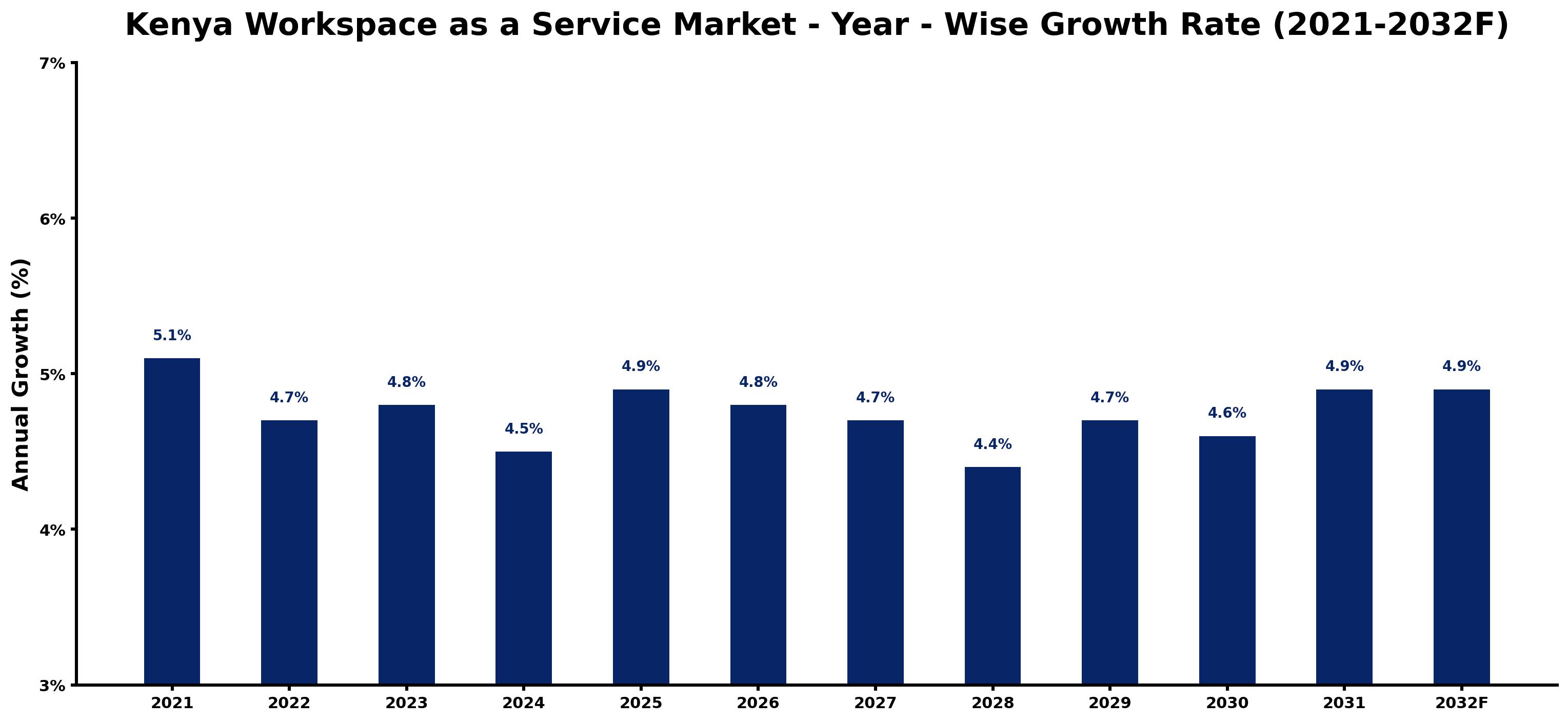
This graph illustrates the annual growth rates of the Kenya Workspace as a Service Market from 2021 to 2032, highlighting a steady upward trajectory and projected expansion over the forecast period.
The table below presents the year‑wise growth rates along with the key drivers influencing the market
| Year | Growth Rate | Major Drivers |
| 2021 | 5.1% | M-Pesa driving remote work flexibility and payment solutions. |
| 2022 | 4.7% | Increased entrepreneurial activity boosting demand for flexible office spaces. |
| 2023 | 4.8% | Government initiatives promoting digital entrepreneurship for startups. |
| 2024 | 4.5% | Youth population growth heightening interest in co-working environments. |
| 2025 | 4.9% | Post-pandemic workforce adaptation favoring flexible workspace solutions. |
| 2026 | 4.8% | Influx of foreign investments supporting technology-driven workspaces. |
| 2027 | 4.7% | Government regulations favoring shared office space licensing. |
| 2028 | 4.4% | Rise of solar-powered offices catering to sustainability trends. |
| 2029 | 4.7% | Local tech hubs encouraging networking and collaboration spaces. |
| 2030 | 4.6% | Increased demand for short-term leases by professionals. |
| 2031 | 4.9% | Evolving corporate strategies promoting outsourcing office needs. |
| 2032 | 4.9% | Government subsidies aiding startup business space acquisitions. |
Note: Market size estimations and growth projections presented in this report are based on 6Wresearch's proprietary forecasting methodology, utilizing the latest available industry data, government publications, and primary research inputs.
Kenya Workspace as a Service Market Key Takeaways
Below are some of the specific key takeaways from the market, including:
- Flexible working arrangements are becoming the norm, driving the demand for cloud-based workspace solutions.
- Urban-rural disparity in internet connectivity continues to hinder market growth.
- Data security concerns remain a significant barrier to widespread adoption.
- Government policies are increasingly supporting digital transformation and workspace solutions.
- Small and medium-sized enterprises are particularly challenged by high costs associated with cloud services.
Evaluation of Restraints in Kenya Workspace as a Service Market
The Kenya Workspace as a Service market encounters several constraints that limit its potential. Chief among these are the inadequate internet bandwidth and infrastructure, particularly in rural areas, which restricts access to essential services. on top of that, data security and privacy concerns significantly impact customer trust. Organizations are hesitant to fully embrace cloud solutions without stringent measures in place to protect sensitive information. Lastly, the financial burden of cloud services and software licenses poses a considerable challenge, especially for small and medium-sized enterprises that struggle with budget constraints.
Kenya Workspace as a Service Market Trends
A notable trend in this market is the increasing integration of artificial intelligence and machine learning technologies to enhance user experience and operational efficiency. Companies are leveraging these technologies to automate processes and provide personalized services. Additionally, there is a growing focus on hybrid work solutions that combine remote and in-office work, reflecting the evolving nature of work environments. The emphasis on sustainability and green technology in workspace solutions is also gaining traction, as organizations strive to reduce their carbon footprint while maintaining productivity.
Kenya Workspace as a Service Market Opportunities
Significant opportunities lie in the development of more affordable and scalable cloud solutions tailored for small and medium-sized enterprises. As these businesses increasingly seek to adopt digital solutions, providers that can offer cost-effective options will likely capture a substantial market share. on top of that, partnerships between technology vendors and local service providers can enhance service delivery and improve access to essential tools. Finally, with government backing for digital initiatives, companies that align their offerings with public policy goals are well-positioned for growth.
Government Initiatives in the Kenya Workspace as a Service Market
Government initiatives play a crucial role in shaping the Kenya Workspace as a Service market, promoting digital transformation and supporting businesses in adopting cloud-based solutions. Regulatory frameworks are being established to enhance data privacy and security, which are vital for fostering consumer trust. These policies also include incentives for companies investing in collaborative technologies, thus bolstering the remote work environment.
- A national digital infrastructure upgrade programme is currently in its rollout phase, aimed at improving internet connectivity across the country.
- Ongoing regulatory frameworks introduced to ensure data privacy and security are helping businesses navigate compliance challenges.
- Incentives for companies investing in cloud technologies were launched in early 2025, encouraging adoption among small and medium-sized enterprises.
- A planned public-private initiative is expected to enhance access to digital tools in rural areas by 2028.
Future Insights of the Kenya Workspace as a Service Market
Looking ahead to 2026-2032, the Kenya Workspace as a Service market is set for steady growth. As organizations increasingly embrace flexible work arrangements, the demand for cloud-based solutions will continue to rise. Emerging technologies like AI and advanced collaboration tools will further drive innovation in service offerings. However, the market must address the ongoing challenges related to internet infrastructure and data security to fully realize its potential. With the government’s continued support and a focus on affordability, the landscape will likely evolve, presenting new opportunities for investment and development.
Kenya Workspace as a Service Market Latest Developments
Recent activity in the Kenya Workspace as a Service market has showcased a shift towards more integrated and user-friendly solutions. Over the past year, businesses have increasingly adopted collaborative technologies to enhance remote work experiences. This trend reflects the growing recognition of the importance of effective digital tools in maintaining productivity and engagement.
- A leading regional operator launched a new suite of collaboration tools in Q1 2025, designed to streamline communication and project management.
- An initiative that began in mid-2025 focuses on enhancing cybersecurity measures for cloud solutions, ensuring better protection for user data.
- By late 2025, a major technology vendor is expected to roll out a platform that integrates AI capabilities into workspace solutions, boosting efficiency.
- A partnership formed in early 2025 between local tech firms aims to enhance the accessibility of cloud services in underserved regions, currently underway.
Kenya Workspace as a Service Market - Key Attractiveness of the Report
- 10 Years of Market Numbers
- Historical Data Starting from 2022 to 2025
- Base Year: 2025
- Forecast Data until 2032
- Key Performance Indicators Impacting the Market
- Major Upcoming Developments and Projects
Key Highlights of the Report:
- Kenya Workspace as a Service Market Outlook
- Market Size of Kenya Workspace as a Service Market, 2025
- Forecast of Kenya Workspace as a Service Market, 2032
- Historical Data and Forecast of Kenya Workspace as a Service Revenues & Volume for the Period 2022-2032F
- Kenya Workspace as a Service Market Trend Evolution
- Kenya Workspace as a Service Market Drivers and Challenges
- Kenya Workspace as a Service Price Trends
- Kenya Workspace as a Service Porter's Five Forces
- Kenya Workspace as a Service Industry Life Cycle
- Historical Data and Forecast of Kenya Workspace as a Service Market Revenues & Volume By Solutions for the Period 2022-2032F
- Historical Data and Forecast of Kenya Workspace as a Service Market Revenues & Volume By VDI and Applications for the Period 2022-2032F
- Historical Data and Forecast of Kenya Workspace as a Service Market Revenues & Volume By Desktop as a Service for the Period 2022-2032F
- Historical Data and Forecast of Kenya Workspace as a Service Market Revenues & Volume By Hosted Applications (Unified Communication Applications) for the Period 2022-2032F
- Historical Data and Forecast of Kenya Workspace as a Service Market Revenues & Volume By Security Solutions for the Period 2022-2032F
- Historical Data and Forecast of Kenya Workspace as a Service Market Revenues & Volume By Others (Browser-based WaaS solutions) for the Period 2022-2032F
- Historical Data and Forecast of Kenya Workspace as a Service Market Revenues & Volume By Services for the Period 2022-2032F
- Historical Data and Forecast of Kenya Workspace as a Service Market Revenues & Volume By System Integration for the Period 2022-2032F
- Historical Data and Forecast of Kenya Workspace as a Service Market Revenues & Volume By Consulting services for the Period 2022-2032F
- Historical Data and Forecast of Kenya Workspace as a Service Market Revenues & Volume By Managed services for the Period 2022-2032F
- Historical Data and Forecast of Kenya Workspace as a Service Market Revenues & Volume By Deployment Type for the Period 2022-2032F
- Historical Data and Forecast of Kenya Workspace as a Service Market Revenues & Volume By Public for the Period 2022-2032F
- Historical Data and Forecast of Kenya Workspace as a Service Market Revenues & Volume By Private for the Period 2022-2032F
- Historical Data and Forecast of Kenya Workspace as a Service Market Revenues & Volume By Hybrid for the Period 2022-2032F
- Historical Data and Forecast of Kenya Workspace as a Service Market Revenues & Volume By End-Users for the Period 2022-2032F
- Historical Data and Forecast of Kenya Workspace as a Service Market Revenues & Volume By Enterprises for the Period 2022-2032F
- Historical Data and Forecast of Kenya Workspace as a Service Market Revenues & Volume By Small and medium businesses(SMB) for the Period 2022-2032F
- Historical Data and Forecast of Kenya Workspace as a Service Market Revenues & Volume By Verticals for the Period 2022-2032F
- Historical Data and Forecast of Kenya Workspace as a Service Market Revenues & Volume By Banking, Financial Services and Insurance (BFSI) for the Period 2022-2032F
- Historical Data and Forecast of Kenya Workspace as a Service Market Revenues & Volume By Retail for the Period 2022-2032F
- Historical Data and Forecast of Kenya Workspace as a Service Market Revenues & Volume By Government for the Period 2022-2032F
- Historical Data and Forecast of Kenya Workspace as a Service Market Revenues & Volume By Healthcare for the Period 2022-2032F
- Historical Data and Forecast of Kenya Workspace as a Service Market Revenues & Volume By Manufacturing for the Period 2022-2032F
- Historical Data and Forecast of Kenya Workspace as a Service Market Revenues & Volume By Telecom and IT for the Period 2022-2032F
- Historical Data and Forecast of Kenya Workspace as a Service Market Revenues & Volume By Utilities for the Period 2022-2032F
- Historical Data and Forecast of Kenya Workspace as a Service Market Revenues & Volume By Travel and Hospitality for the Period 2022-2032F
- Kenya Workspace as a Service Import Export Trade Statistics
- Market Opportunity Assessment By Solutions
- Market Opportunity Assessment By Services
- Market Opportunity Assessment By Deployment Type
- Market Opportunity Assessment By End-Users
- Market Opportunity Assessment By Verticals
- Kenya Workspace as a Service Top Companies Market Share
- Kenya Workspace as a Service Competitive Benchmarking By Technical and Operational Parameters
- Kenya Workspace as a Service Company Profiles
- Kenya Workspace as a Service Key Strategic Recommendations






































