Kuwait Business Intelligence Market Size & Growth Rate (2026-2032)
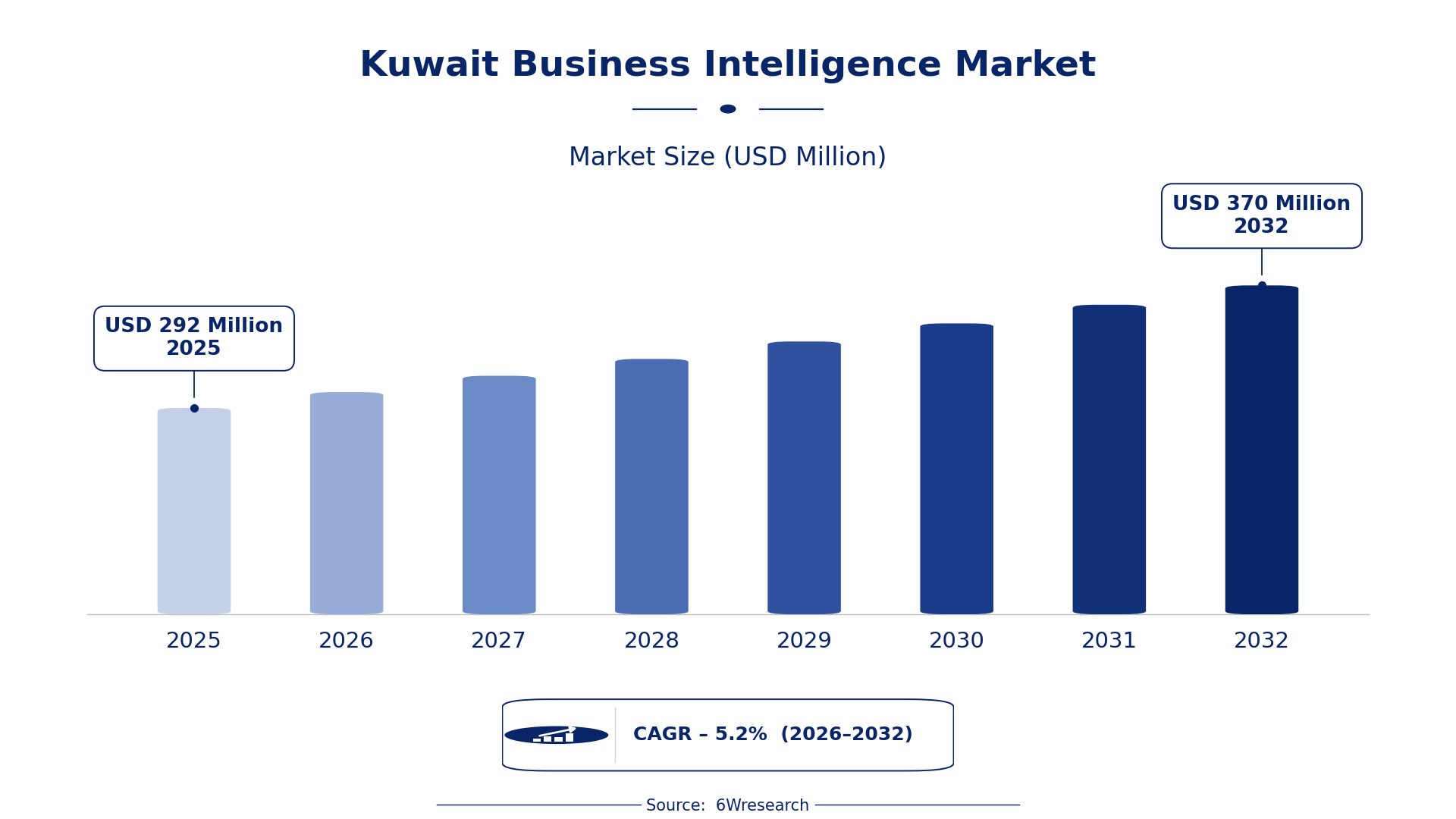
The Kuwait Business Intelligence Market was estimated at USD 292 Million in 2025 and is projected to reach USD 370 Million by 2032, growing at a CAGR of 5.2% from 2026 to 2032.
Kuwait Business Intelligence Market Synopsis
The demand for data-driven decision-making tools is the most powerful force currently shaping the Kuwait Business Intelligence Market. Organizations across sectors like oil & gas, finance, healthcare, and retail are increasingly recognizing the value of actionable insights derived from advanced BI solutions.
As businesses seek to optimize operations and enhance customer experiences, they are investing heavily in BI tools that provide real-time analytics and predictive capabilities. The Kuwaiti government's commitment to fostering digital transformation adds another layer of urgency and opportunity in this growing market.
Kuwait Business Intelligence Market Year-wise Growth Rate and Key Drivers
This graph illustrates the annual growth rates of the Kuwait Business Intelligence Market from 2021 to 2032, highlighting a steady upward trajectory and projected expansion over the forecast period.
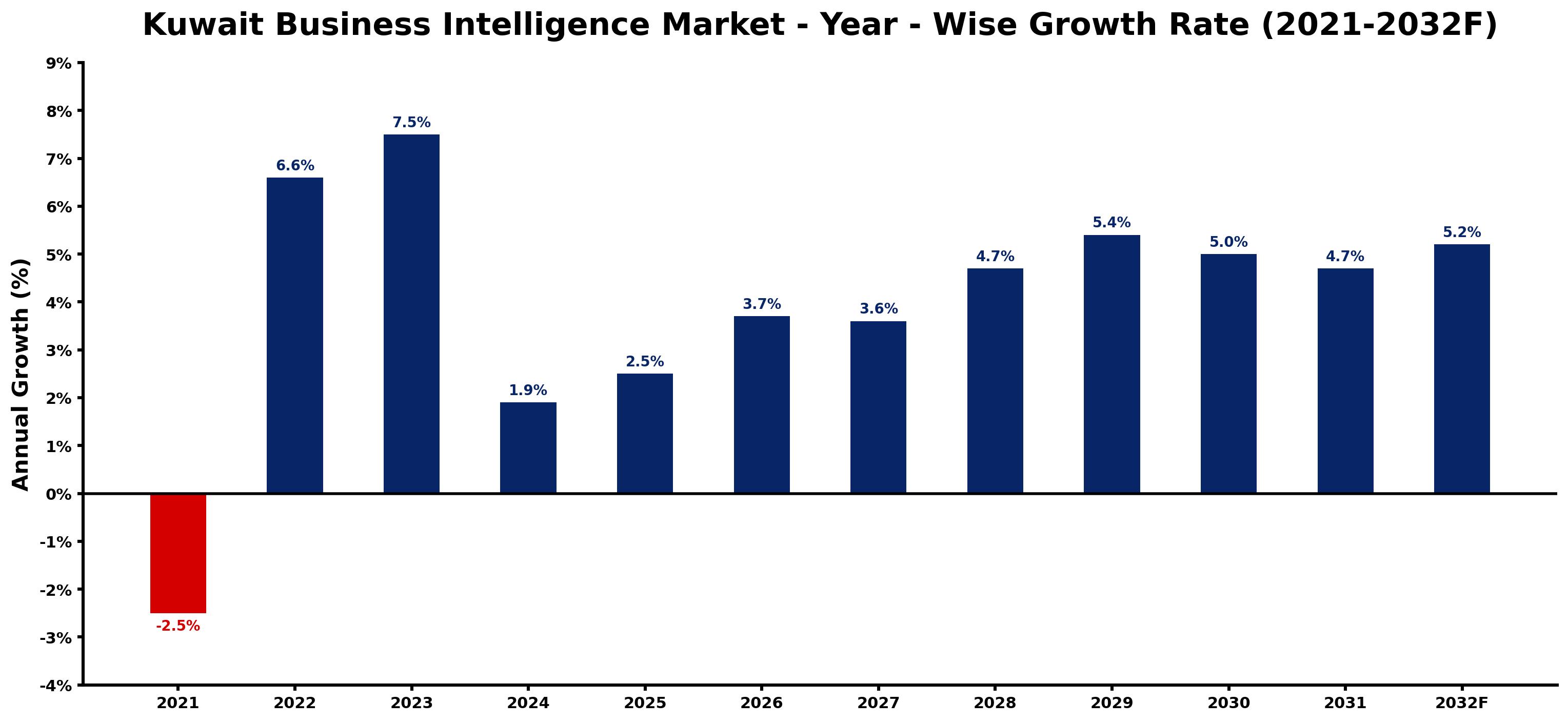
The table below presents the year‑wise growth rates along with the key drivers influencing the market
| Year | Growth Rate | Major Drivers |
| 2021 | -2.5% | Kuwaiti government budget cuts on technology investments. |
| 2022 | 6.6% | Kuwait's Vision 2035 driving digital transformation initiatives. |
| 2023 | 7.5% | Increased adoption of AI analytics in local enterprises. |
| 2024 | 1.9% | Local businesses demanding real-time analytics for efficiency. |
| 2025 | 2.5% | Corporate investments in data-driven decision-making rising. |
| 2026 | 3.7% | Growing focus on data security regulations enhancing BI adoption. |
| 2027 | 3.6% | Increased implementation of cloud-based BI solutions in SMEs. |
| 2028 | 4.7% | Demand for competitive analysis in rapidly diversifying markets. |
| 2029 | 5.4% | Local government incentivizing data analysis training programs. |
| 2030 | 5.0% | Rising consumer preference for data-informed services and products. |
| 2031 | 4.7% | Emerging fintech companies driving BI tool utilization. |
| 2032 | 5.2% | Kuwait's expanding digital economy increasing reporting demands. |
Note: Market size estimations and growth projections presented in this report are based on 6Wresearch's proprietary forecasting methodology, utilizing the latest available industry data, government publications, and primary research inputs.
Kuwait Business Intelligence Market Key Takeaways
Below are some of the specific key takeaways from the market, including:
- The increasing need for advanced analytics is driving investments in BI technologies.
- Cloud-based BI solutions are becoming the preferred choice due to their scalability and cost-effectiveness.
- There is a marked rise in the integration of AI and machine learning capabilities within BI platforms.
- Government initiatives aimed at digital transformation are creating favorable conditions for market growth.
- Training and support services are emerging as crucial offerings for organizations to maximize BI investments.
Evaluation of Restraints in Kuwait Business Intelligence Market
Despite the growth potential, the Kuwait Business Intelligence Market faces several restraints that limit its progress. Data privacy concerns loom large, given the strict regulatory environment that governs data handling and storage. on top of that, the shortage of skilled professionals in the BI field hampers the effective implementation of these technologies. Organizations also grapple with the high costs of deploying and maintaining BI solutions, which can deter investment. Additionally, cultural resistance to adopting new technologies within organizations remains a significant barrier, making it essential for stakeholders to address these challenges proactively.
Kuwait Business Intelligence Market Trends
Several trends are currently influencing the Kuwait Business Intelligence Market. Organizations are increasingly prioritizing advanced analytics solutions that offer actionable insights to drive strategic decisions. The shift towards cloud-based BI solutions is notable, as businesses seek flexible and cost-effective options. on top of that, the integration of AI and machine learning within BI platforms is on the rise, enhancing data analysis capabilities. This trend reflects a broader movement towards real-time data accessibility and predictive analytics, making organizations more competitive in their respective sectors.
Kuwait Business Intelligence Market Opportunities
The Kuwait Business Intelligence Market presents numerous opportunities for growth and investment. Vendors can focus on tailoring their BI solutions to address the specific needs of critical industries like oil & gas, finance, and healthcare. There's also a growing demand for training and support services, as organizations strive to maximize the potential of their BI tools. As businesses continue to emphasize data-driven strategies, the market is likely to see an influx of innovative solutions designed to meet these evolving needs.
Government Initiatives in the Kuwait Business Intelligence Market
Government policies are playing a crucial role in shaping the Kuwait Business Intelligence Market. The Kuwaiti government is committed to promoting economic diversification and technological innovation, which directly supports the growth of the BI sector. Key initiatives focus on fostering a business-friendly environment and enhancing digital transformation across various industries.
- A recent initiative launched in 2025 aimed at enhancing digital infrastructure to support the BI sector.
- Currently ongoing is a national program that provides incentives for foreign investment in technology-driven solutions.
- Plans for a comprehensive regulatory framework to ensure data privacy and security are expected to be introduced by 2026.
- A public-private partnership initiative aimed at boosting the adoption of advanced analytics is set to kick off in late 2025.
Future Insights of the Kuwait Business Intelligence Market
Looking ahead, the Kuwait Business Intelligence Market is likely to continue its upward trajectory through 2032. The ongoing demand for data-driven decision-making will be a central growth factor, with businesses increasingly relying on real-time analytics and cloud-based solutions. The integration of IoT devices and big data analytics will further open avenues for advanced BI tools. Organizations will prioritize enhancing operational efficiency and customer experiences, setting the stage for innovation and continued market expansion.
Kuwait Business Intelligence Market Latest Developments
In recent months, the Kuwait Business Intelligence Market has seen significant activity, reflecting a strong push towards digital transformation. Organizations are ramping up their investments in BI technologies to stay competitive and drive efficiency. This momentum is likely to lead to a more vibrant market environment as new solutions and partnerships emerge.
- A major technology vendor announced a new cloud-based BI solution in Q1 2025, aimed at enhancing data accessibility for businesses.
- An initiative focused on integrating AI capabilities into existing BI tools is currently underway, expected to roll out by mid-2026.
- A pilot project for a collaborative analytics platform was launched in late 2025, promoting shared data insights among industry stakeholders.
- Plans are in place for a comprehensive training program to upskill professionals in the BI field, expected to begin in early 2026.
Kuwait Business Intelligence Market - Key Attractiveness of the Report
- 10 Years of Market Numbers
- Historical Data Starting from 2022 to 2025
- Base Year: 2025
- Forecast Data until 2032
- Key Performance Indicators Impacting the Market
- Major Upcoming Developments and Projects
Vendors have opportunities to tailor their BI offerings for specific industries, such as oil & gas and finance, and to provide training and support services to enhance customer adoption and satisfaction.
Key Highlights of the Report:
- Kuwait Business Intelligence Market Outlook
- Market Size of Kuwait Business Intelligence Market, 2025
- Forecast of Kuwait Business Intelligence Market, 2032
- Historical Data and Forecast of Kuwait Business Intelligence Revenues & Volume for the Period 2022-2032F
- Kuwait Business Intelligence Market Trend Evolution
- Kuwait Business Intelligence Market Drivers and Challenges
- Kuwait Business Intelligence Price Trends
- Kuwait Business Intelligence Porter's Five Forces
- Kuwait Business Intelligence Industry Life Cycle
- Historical Data and Forecast of Kuwait Business Intelligence Market Revenues & Volume By Component for the Period 2022-2032F
- Historical Data and Forecast of Kuwait Business Intelligence Market Revenues & Volume By Solutions for the Period 2022-2032F
- Historical Data and Forecast of Kuwait Business Intelligence Market Revenues & Volume By Services for the Period 2022-2032F
- Historical Data and Forecast of Kuwait Business Intelligence Market Revenues & Volume By Business Function for the Period 2022-2032F
- Historical Data and Forecast of Kuwait Business Intelligence Market Revenues & Volume By Human Resource for the Period 2022-2032F
- Historical Data and Forecast of Kuwait Business Intelligence Market Revenues & Volume By Finance for the Period 2022-2032F
- Historical Data and Forecast of Kuwait Business Intelligence Market Revenues & Volume By Operations for the Period 2022-2032F
- Historical Data and Forecast of Kuwait Business Intelligence Market Revenues & Volume By Sales and Marketing for the Period 2022-2032F
- Historical Data and Forecast of Kuwait Business Intelligence Market Revenues & Volume By Deployment Mode for the Period 2022-2032F
- Historical Data and Forecast of Kuwait Business Intelligence Market Revenues & Volume By On-premises for the Period 2022-2032F
- Historical Data and Forecast of Kuwait Business Intelligence Market Revenues & Volume By Cloud for the Period 2022-2032F
- Historical Data and Forecast of Kuwait Business Intelligence Market Revenues & Volume By Organization Size for the Period 2022-2032F
- Historical Data and Forecast of Kuwait Business Intelligence Market Revenues & Volume By SMEs for the Period 2022-2032F
- Historical Data and Forecast of Kuwait Business Intelligence Market Revenues & Volume By Large Enterprises for the Period 2022-2032F
- Historical Data and Forecast of Kuwait Business Intelligence Market Revenues & Volume By Vertical for the Period 2022-2032F
- Historical Data and Forecast of Kuwait Business Intelligence Market Revenues & Volume By Retail for the Period 2022-2032F
- Historical Data and Forecast of Kuwait Business Intelligence Market Revenues & Volume By Manufacturing for the Period 2022-2032F
- Historical Data and Forecast of Kuwait Business Intelligence Market Revenues & Volume By Government and Public Services for the Period 2022-2032F
- Historical Data and Forecast of Kuwait Business Intelligence Market Revenues & Volume By Media and Entertainment for the Period 2022-2032F
- Historical Data and Forecast of Kuwait Business Intelligence Market Revenues & Volume By Transportation and Logistics for the Period 2022-2032F
- Historical Data and Forecast of Kuwait Business Intelligence Market Revenues & Volume By BFSI for the Period 2022-2032F
- Historical Data and Forecast of Kuwait Business Intelligence Market Revenues & Volume By Telecom and IT for the Period 2022-2032F
- Historical Data and Forecast of Kuwait Business Intelligence Market Revenues & Volume By Healthcare and Life Sciences for the Period 2022-2032F
- Kuwait Business Intelligence Import Export Trade Statistics
- Market Opportunity Assessment By Component
- Market Opportunity Assessment By Business Function
- Market Opportunity Assessment By Deployment Mode
- Market Opportunity Assessment By Organization Size
- Market Opportunity Assessment By Vertical
- Kuwait Business Intelligence Top Companies Market Share
- Kuwait Business Intelligence Competitive Benchmarking By Technical and Operational Parameters
- Kuwait Business Intelligence Company Profiles
- Kuwait Business Intelligence Key Strategic Recommendations






































