Kuwait Carbon Credit Market Size, Share & Growth Rate
The Kuwait Carbon Credit Market was estimated at USD 690 Million in 2025 and is projected to reach USD 1189 Million by 2032, growing at a CAGR of 8.1% from 2026 to 2032. This growth trajectory is driven by the government's commitment to diversifying its energy sources and increasing investments in renewable energy initiatives. As the local economy gradually shifts away from its heavy reliance on oil, the market for carbon credits is poised to expand, attracting both domestic and international stakeholders eager to participate in sustainability efforts.
Kuwait Carbon Credit Market Year-wise Growth Rate and Key Drivers
This graph highlights how the Kuwait Carbon Credit Market has steadily grown over the years, supported by major growth factors.
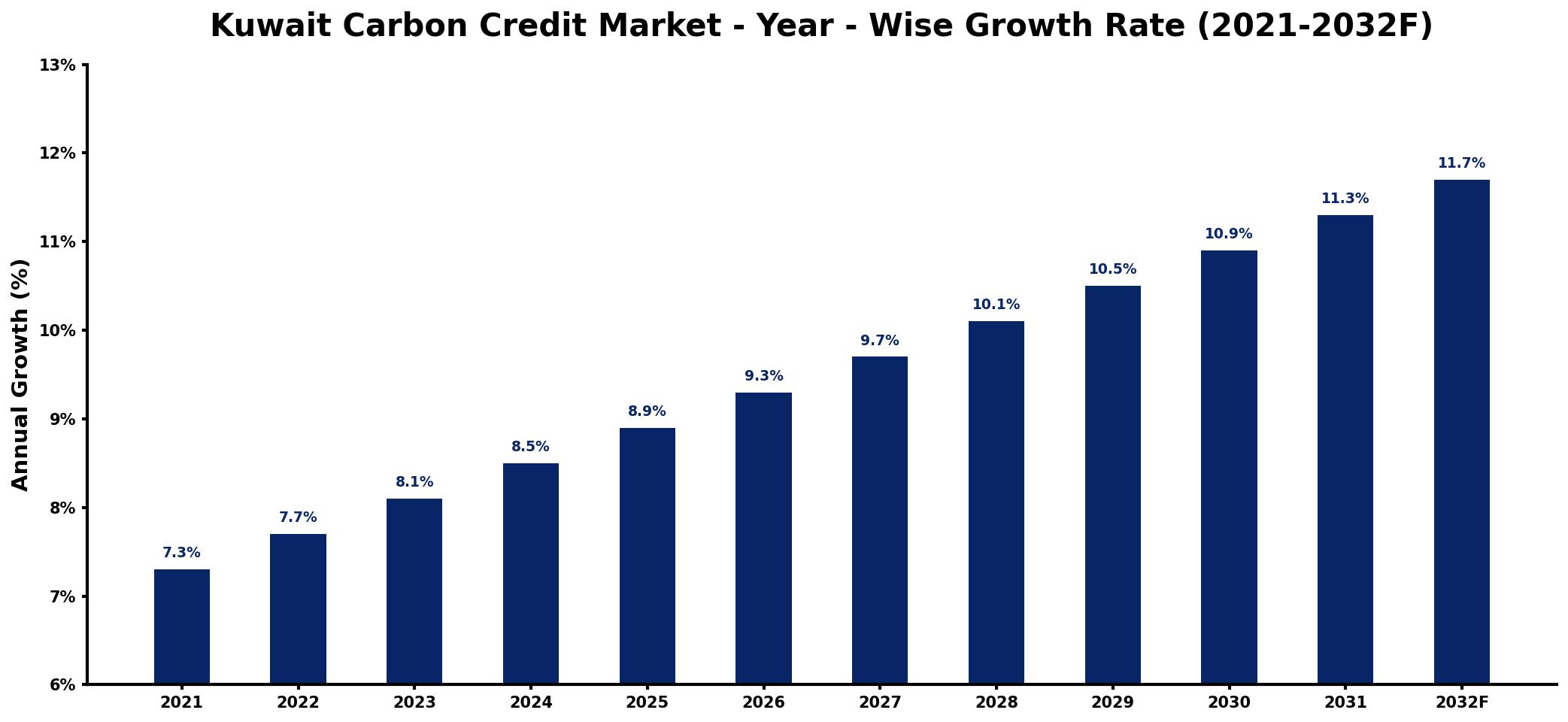
The table below presents the year‑wise growth rates along with the key drivers influencing the market
| Year | Growth Rate | Major Drivers |
| 2021 | 7.3% | Increased renewable energy investments |
| 2022 | 7.7% | Growing corporate sustainability initiatives |
| 2023 | 8.1% | Rising public environmental awareness |
| 2024 | 8.5% | Expansion of green technologies |
| 2025 | 8.9% | Strengthened international climate agreements |
| 2026 | 9.3% | Higher regulatory support frameworks |
| 2027 | 9.7% | Surge in eco-friendly projects |
| 2028 | 10.1% | Increased corporate responsibility commitments |
| 2029 | 10.5% | Growing interest in sustainable finance |
| 2030 | 10.9% | increased production capacity utilization |
| 2031 | 11.3% | Development of innovative technologies |
| 2032 | 11.7% | Rising demand for climate solutions |
Note: Market size estimations and growth projections presented in this report are based on 6Wresearch's proprietary forecasting methodology, utilizing the latest available industry data, government publications, and primary research inputs.
Kuwait Carbon Credit Market Synopsis
The Kuwait Carbon Credit Market is currently at a pivotal moment, marked by increasing interest in carbon trading as the country undertakes initiatives to lower its carbon emissions. While still in its early stages, the momentum is undeniable as both local and international entities explore opportunities in this emerging market.
As Kuwait navigates its role as a significant oil producer, challenges remain. However, recent governmental policies promoting renewable energy have created a favorable environment for carbon credit trading. This newfound emphasis on sustainability heralds a period of growth and investment that aligns with global climate initiatives.
Kuwait Carbon Credit Market Key Takeaways
- The market is on a growth path, projected to reach USD 1189 Million by 2032.
- Government initiatives aim to diversify energy sources, fostering opportunities for carbon credit projects.
- There is rising interest from international investors in Kuwait's carbon credit potential.
- Transparency and accountability in carbon trading are becoming increasingly prioritized.
- Partnerships between government and businesses are crucial for advancing sustainability goals.
Evaluation of Restraints in Kuwait Carbon Credit Market
Several key restraints are limiting the full potential of the Kuwait Carbon Credit Market. A major challenge is the absence of a cohesive regulatory framework, which creates uncertainty for potential investors and developers seeking to engage in carbon credit projects. Additionally, Kuwait's economic dependency on oil complicates the transition toward a low-carbon economy, making it essential for stakeholders to navigate shifting dynamics effectively. Limited awareness among local businesses about carbon credit mechanisms further impedes growth. Therefore, strong government commitment and the establishment of clear policies are necessary to enhance investor confidence and promote broader participation in the market.
Kuwait Carbon Credit Market Trends
Emerging trends in the Kuwait Carbon Credit Market reflect a growing commitment to sustainability and environmental stewardship. There is an increasing adoption of carbon offset projects, particularly in renewable energy and reforestation, aligning with global climate goals. Another notable trend is the enhancement of transparency and accountability measures within carbon credit trading, which is essential for ensuring the credibility of offset projects. Additionally, collaborative efforts are rising, with partnerships among government entities, private businesses, and international carbon credit providers, highlighting a unified approach to achieving carbon neutrality.
Kuwait Carbon Credit Market Opportunities
Investment opportunities in the Kuwait Carbon Credit Market are expanding, particularly in initiatives that focus on greenhouse gas emission reductions. Projects in renewable energy generation, energy efficiency improvements, and carbon capture and storage are attracting attention from investors. As Kuwait is committed to fulfilling its obligations under the Paris Agreement, the increasing demand for carbon credits represents a lucrative avenue for investors. The government's support for diversifying the economy not only enhances market viability but also incentivizes active participation in carbon credit trading.
Government Initiatives in the Kuwait Carbon Credit Market
The Kuwaiti government has been proactive in addressing climate change through various policies aimed at fostering a robust Carbon Credit Market. Kuwait's commitment to the Paris Agreement, combined with the implementation of the Kuwait National Energy Efficiency and Renewable Energy Action Plan, underscores its dedication to enhancing renewable energy capacities and energy efficiency measures. Furthermore, the establishment of a National Voluntary Carbon Market aims to encourage businesses and industries to offset emissions through carbon credits, signaling a positive direction towards a more sustainable economic framework.
Future Insights of the Kuwait Carbon Credit Market
Looking ahead to 2026-2032, the future of the Kuwait Carbon Credit Market appears bright, bolstered by a strategic government focus on reducing greenhouse gas emissions and shifting towards sustainable energy sources. The expanding appetite for carbon credits will likely be fueled by international climate agreements and growing investor interest in sustainability initiatives. As global demand for carbon neutrality rises, Kuwait is well-positioned to capitalize on its market potential, paving the way for innovative projects and increased participation in carbon trading.
Kuwait Carbon Credit Market Latest Developments (2025 - 2026)
Recent developments in the Kuwait Carbon Credit Market reflect a significant shift towards sustainability, with various initiatives being launched by the government to enhance carbon trading. New partnerships are being formed between private enterprises and state entities to promote renewable energy projects. Additionally, discussions around establishing more robust regulations to support carbon credit trading are gaining traction, indicating a move towards a more structured and transparent market environment. These efforts collectively illustrate a growing commitment to environmental sustainability within the region.
Kuwait Carbon Credit Market - Key Attractiveness of the Report
- 10 Years of Market Numbers
- Historical Data Starting from 2022 to 2025
- Base Year: 2025
- Forecast Data until 2032
- Key Performance Indicators Impacting the Market
- Major Upcoming Developments and Projects
Key Highlights of the Report:
- Kuwait Carbon Credit Market Outlook
- Market Size of Kuwait Carbon Credit Market, 2025
- Forecast of Kuwait Carbon Credit Market, 2032
- Historical Data and Forecast of Kuwait Carbon Credit Revenues & Volume for the Period 2022-2032F
- Kuwait Carbon Credit Market Trend Evolution
- Kuwait Carbon Credit Market Drivers and Challenges
- Kuwait Carbon Credit Price Trends
- Kuwait Carbon Credit Porter's Five Forces
- Kuwait Carbon Credit Industry Life Cycle
- Historical Data and Forecast of Kuwait Carbon Credit Market Revenues & Volume By Sector for the Period 2022-2032F
- Historical Data and Forecast of Kuwait Carbon Credit Market Revenues & Volume By Energy for the Period 2022-2032F
- Historical Data and Forecast of Kuwait Carbon Credit Market Revenues & Volume By Transportation for the Period 2022-2032F
- Historical Data and Forecast of Kuwait Carbon Credit Market Revenues & Volume By Residential And Commercial Buildings for the Period 2022-2032F
- Historical Data and Forecast of Kuwait Carbon Credit Market Revenues & Volume By Industry for the Period 2022-2032F
- Historical Data and Forecast of Kuwait Carbon Credit Market Revenues & Volume By Agriculture for the Period 2022-2032F
- Historical Data and Forecast of Kuwait Carbon Credit Market Revenues & Volume By Forestry for the Period 2022-2032F
- Historical Data and Forecast of Kuwait Carbon Credit Market Revenues & Volume By Water And Wastewater for the Period 2022-2032F
- Kuwait Carbon Credit Import Export Trade Statistics
- Market Opportunity Assessment By Sector
- Kuwait Carbon Credit Top Companies Market Share
- Kuwait Carbon Credit Competitive Benchmarking By Technical and Operational Parameters
- Kuwait Carbon Credit Company Profiles
- Kuwait Carbon Credit Key Strategic Recommendations






































