Kuwait Endpoint Security Market Size & Growth Rate (2026-2032)
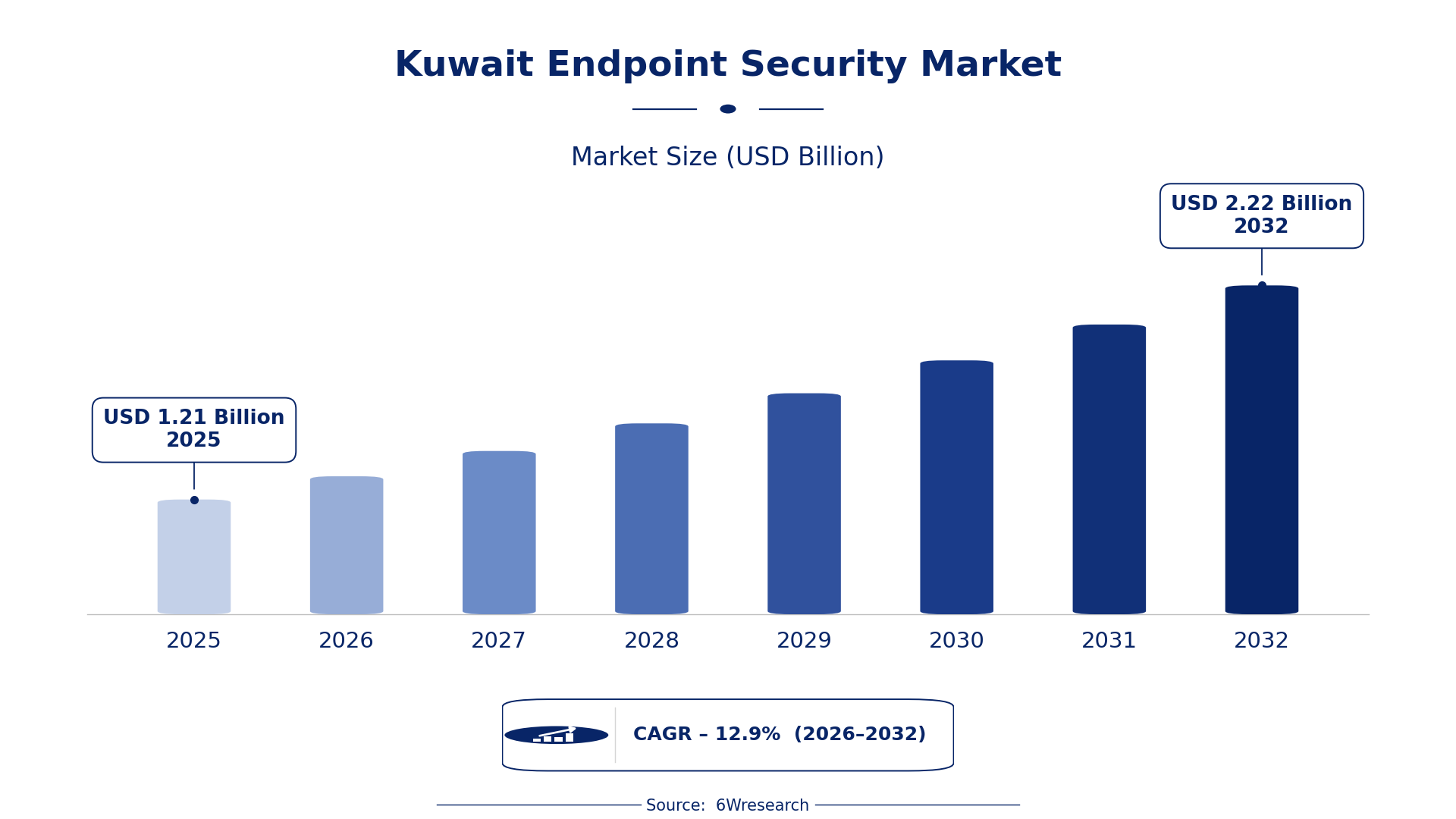
The Kuwait Endpoint Security Market was estimated at USD 1209 Million in 2025 and is projected to reach USD 2224 Million by 2032, growing at a CAGR of 12.9% from 2026 to 2032.
Kuwait Endpoint Security Market Synopsis
Cybersecurity is no longer a secondary concern for businesses in Kuwait; it's a necessity. With increasing digital transformation efforts across sectors, organizations are urgently seeking comprehensive endpoint security solutions to protect against escalating cyber threats, including malware and ransomware.
The market is evolving rapidly, characterized by growing investments from both local and international vendors offering tailored solutions. The focus is sharply on integrating advanced technologies such as artificial intelligence and machine learning, reflecting a proactive stance against sophisticated attacks that target vulnerable endpoints.
Kuwait Endpoint Security Market Year-wise Growth Rate and Key Drivers
This graph illustrates the annual growth rates of the Kuwait Endpoint Security Market from 2021 to 2032, highlighting a steady upward trajectory and projected expansion over the forecast period.
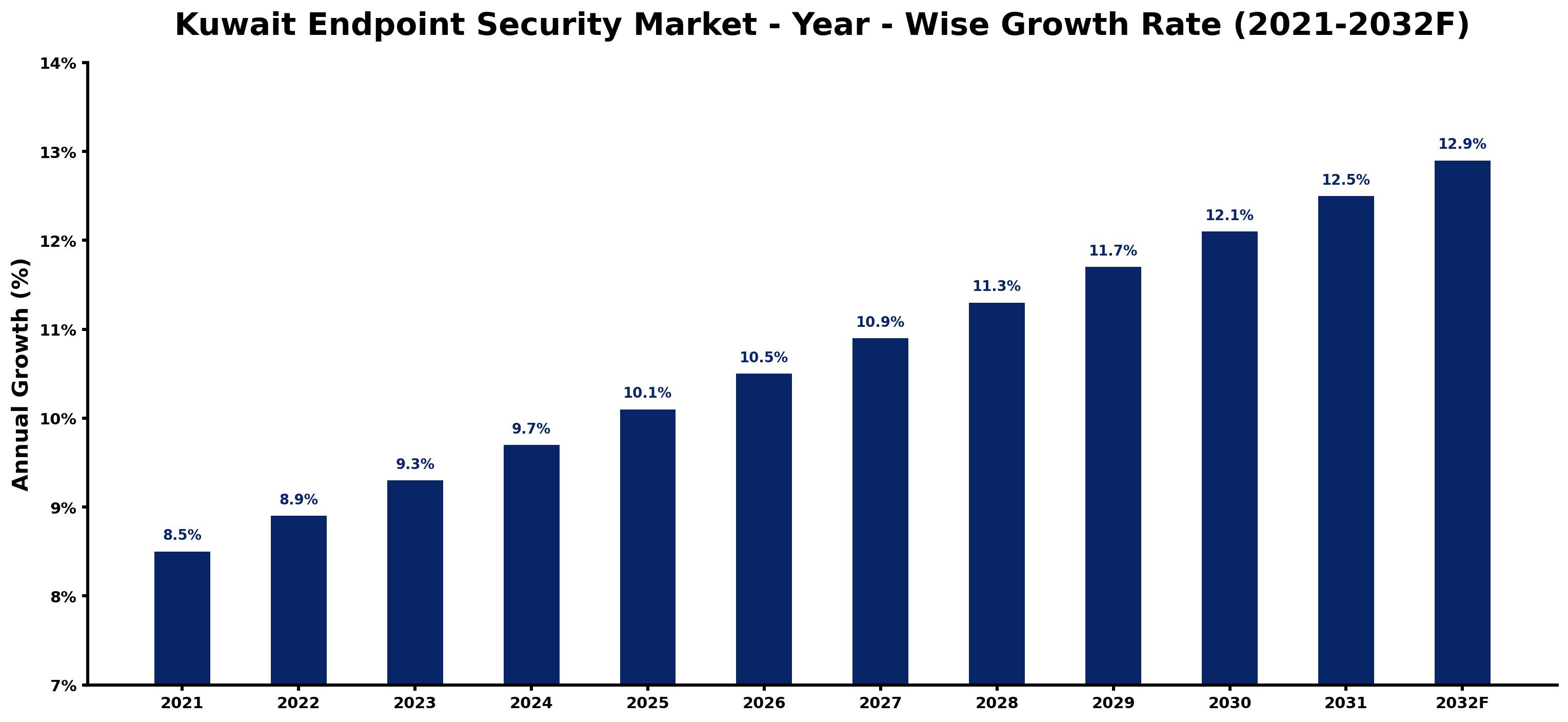
The table below presents the year‑wise growth rates along with the key drivers influencing the market
| Year | Growth Rate | Major Drivers |
| 2021 | 8.5% | Cybersecurity regulations by Kuwait's Central Bank. |
| 2022 | 8.9% | Increased remote work demands for secure access solutions. |
| 2023 | 9.3% | Rising digital transformations in government services. |
| 2024 | 9.7% | Enhanced focus on data protection and compliance standards. |
| 2025 | 10.1% | Growing incidence of cyber threats in local enterprises. |
| 2026 | 10.5% | Kuwait Vision 2035 promoting digital security initiatives. |
| 2027 | 10.9% | Emergence of local cybersecurity startups bolstering innovations. |
| 2028 | 11.3% | Local businesses investing more in IT security solutions. |
| 2029 | 11.7% | Mandatory cybersecurity assessments for critical infrastructure. |
| 2030 | 12.1% | Government funding for national cybersecurity capabilities. |
| 2031 | 12.5% | Increasing cyber attack awareness among corporate sectors. |
| 2032 | 12.9% | Enhanced partnerships between public and private cybersecurity sectors. |
Note: Market size estimations and growth projections presented in this report are based on 6Wresearch's proprietary forecasting methodology, utilizing the latest available industry data, government publications, and primary research inputs.
Kuwait Endpoint Security Market Key Takeaways
Below are some of the specific key takeaways from the market, including:
- Organizations increasingly prioritize cloud-based endpoint security solutions to enhance flexibility and scalability.
- Artificial intelligence and machine learning capabilities are becoming integral to threat detection and response strategies.
- Compliance with local and international data protection regulations is driving demand for advanced security solutions.
- End-user awareness and training programs are being emphasized to strengthen cybersecurity practices.
- The integration of diverse endpoint security features is a growing trend among vendors in the market.
Evaluation of Restraints in Kuwait Endpoint Security Market
Despite its growth potential, the Kuwait Endpoint Security Market faces notable restraints. A significant challenge is the increasing sophistication of cyber threats, which demands continuous innovation and investment in advanced security solutions. Many organizations still lack awareness regarding the critical nature of endpoint security, leading to complacency in their protective measures. on top of that, the shortage of skilled cybersecurity professionals hampers effective implementation and management of endpoint security strategies. Compliance with evolving regulations also adds to the complexity and financial burden for businesses.
Kuwait Endpoint Security Market Trends
The market is witnessing a marked shift toward integrated endpoint security platforms that provide comprehensive protection across multiple device types. As remote work scenarios proliferate, organizations are focusing on solutions that ensure seamless security for laptops, mobile devices, and servers. Enhanced threat detection and endpoint detection and response (EDR) capabilities are quickly becoming essential features. on top of that, businesses are investing in user training programs to elevate the overall cybersecurity posture, recognizing that technology alone cannot safeguard against human error.
Kuwait Endpoint Security Market Opportunities
The increasing digital adoption across various sectors presents lucrative opportunities for stakeholders in the Kuwait Endpoint Security Market. Investors can tap into the growing demand for tailored endpoint security solutions that address the unique needs of Kuwaiti organizations. Collaborations with local cybersecurity firms can further enhance market reach and adaptability to local challenges. As threats evolve, the need for innovative solutions that combine software and services will only grow, paving the way for substantial investment opportunities.
Government Initiatives in the Kuwait Endpoint Security Market
The Kuwaiti government is actively shaping the endpoint security environment through a series of strategic policies aimed at enhancing overall cybersecurity. These policies reflect a commitment to safeguarding sensitive data and critical infrastructure, recognizing the importance of proactive measures in the face of rising cyber threats.
- A recent regulatory framework was introduced mandating regular security audits for organizations to evaluate and improve their endpoint security measures.
- Currently, the government is promoting cybersecurity awareness programs targeting businesses and educational institutions to foster a culture of security.
- A national data protection regulation was enacted to ensure compliance with international standards for safeguarding sensitive information.
- In the near future, a public-private initiative is planned to bolster local cybersecurity capabilities, enhancing partnerships with technology firms.
- Ongoing investment in national cybersecurity infrastructure aims to establish stronger defenses against emerging cyber threats.
Future Insights of the Kuwait Endpoint Security Market
Looking ahead, the Kuwait Endpoint Security Market is on a clear upward trajectory fueled by the relentless rise in cyber threats and the necessity for businesses to secure their digital assets. As remote work and BYOD practices become commonplace, the need for sophisticated endpoint protection will only intensify. Organizations will increasingly seek solutions that offer not only compliance with regulations but also advanced threat detection capabilities. This dynamic environment promises to attract ongoing investments and innovations, ensuring the market remains vibrant and responsive to evolving challenges.
Kuwait Endpoint Security Market Latest Developments
In the past year, the Kuwait Endpoint Security Market has seen a surge in activity as organizations bolster their cybersecurity defenses. The focus has been on integrating advanced technologies and expanding awareness efforts among businesses and individuals alike.
- A major technology vendor launched a cloud-based endpoint security solution in Q2 2025, aiming to improve security for remote and hybrid work environments.
- A regional cybersecurity firm is currently executing a training initiative that began in early 2025, aimed at enhancing user awareness across various organizations.
- Plans are underway for a national cybersecurity conference expected to take place in late 2026, focusing on sharing best practices and innovations in endpoint security.
- A pilot program for endpoint detection and response (EDR) features was launched by a leading regional operator in early 2025, with positive feedback from initial users.
- A collaborative project between the government and cybersecurity firms is in the planning stages, aimed at developing new compliance frameworks by early 2027.
Kuwait Endpoint Security Market - Key Attractiveness of the Report
- 10 Years of Market Numbers
- Historical Data Starting from 2022 to 2025
- Base Year: 2025
- Forecast Data until 2032
- Key Performance Indicators Impacting the Market
- Major Upcoming Developments and Projects
Key Highlights of the Report:
- Kuwait Endpoint Security Market Outlook
- Market Size of Kuwait Endpoint Security Market, 2025
- Forecast of Kuwait Endpoint Security Market, 2032
- Historical Data and Forecast of Kuwait Endpoint Security Revenues & Volume for the Period 2022-2032F
- Kuwait Endpoint Security Market Trend Evolution
- Kuwait Endpoint Security Market Drivers and Challenges
- Kuwait Endpoint Security Price Trends
- Kuwait Endpoint Security Porter's Five Forces
- Kuwait Endpoint Security Industry Life Cycle
- Historical Data and Forecast of Kuwait Endpoint Security Market Revenues & Volume By Solution for the Period 2022-2032F
- Historical Data and Forecast of Kuwait Endpoint Security Market Revenues & Volume By Endpoint Protection Platform for the Period 2022-2032F
- Historical Data and Forecast of Kuwait Endpoint Security Market Revenues & Volume By Endpoint Detection for the Period 2022-2032F
- Historical Data and Forecast of Kuwait Endpoint Security Market Revenues & Volume By Response for the Period 2022-2032F
- Historical Data and Forecast of Kuwait Endpoint Security Market Revenues & Volume By Vertical for the Period 2022-2032F
- Historical Data and Forecast of Kuwait Endpoint Security Market Revenues & Volume By Healthcare for the Period 2022-2032F
- Historical Data and Forecast of Kuwait Endpoint Security Market Revenues & Volume By Retail for the Period 2022-2032F
- Historical Data and Forecast of Kuwait Endpoint Security Market Revenues & Volume By eCommerce for the Period 2022-2032F
- Historical Data and Forecast of Kuwait Endpoint Security Market Revenues & Volume By Government for the Period 2022-2032F
- Historical Data and Forecast of Kuwait Endpoint Security Market Revenues & Volume By Organization Size for the Period 2022-2032F
- Historical Data and Forecast of Kuwait Endpoint Security Market Revenues & Volume By Small and Medium-Sized Enterprises (SMEs) for the Period 2022-2032F
- Historical Data and Forecast of Kuwait Endpoint Security Market Revenues & Volume By Large Enterprises for the Period 2022-2032F
- Historical Data and Forecast of Kuwait Endpoint Security Market Revenues & Volume By Deployment Mode for the Period 2022-2032F
- Historical Data and Forecast of Kuwait Endpoint Security Market Revenues & Volume By On-premises for the Period 2022-2032F
- Historical Data and Forecast of Kuwait Endpoint Security Market Revenues & Volume By Cloud for the Period 2022-2032F
- Historical Data and Forecast of Kuwait Endpoint Security Market Revenues & Volume By Service for the Period 2022-2032F
- Historical Data and Forecast of Kuwait Endpoint Security Market Revenues & Volume By Professional Services for the Period 2022-2032F
- Historical Data and Forecast of Kuwait Endpoint Security Market Revenues & Volume By Managed Services for the Period 2022-2032F
- Kuwait Endpoint Security Import Export Trade Statistics
- Market Opportunity Assessment By Solution
- Market Opportunity Assessment By Vertical
- Market Opportunity Assessment By Organization Size
- Market Opportunity Assessment By Deployment Mode
- Market Opportunity Assessment By Service
- Kuwait Endpoint Security Top Companies Market Share
- Kuwait Endpoint Security Competitive Benchmarking By Technical and Operational Parameters
- Kuwait Endpoint Security Company Profiles
- Kuwait Endpoint Security Key Strategic Recommendations






































