Kuwait Fatty Alcohol Market: Import Trend Analysis
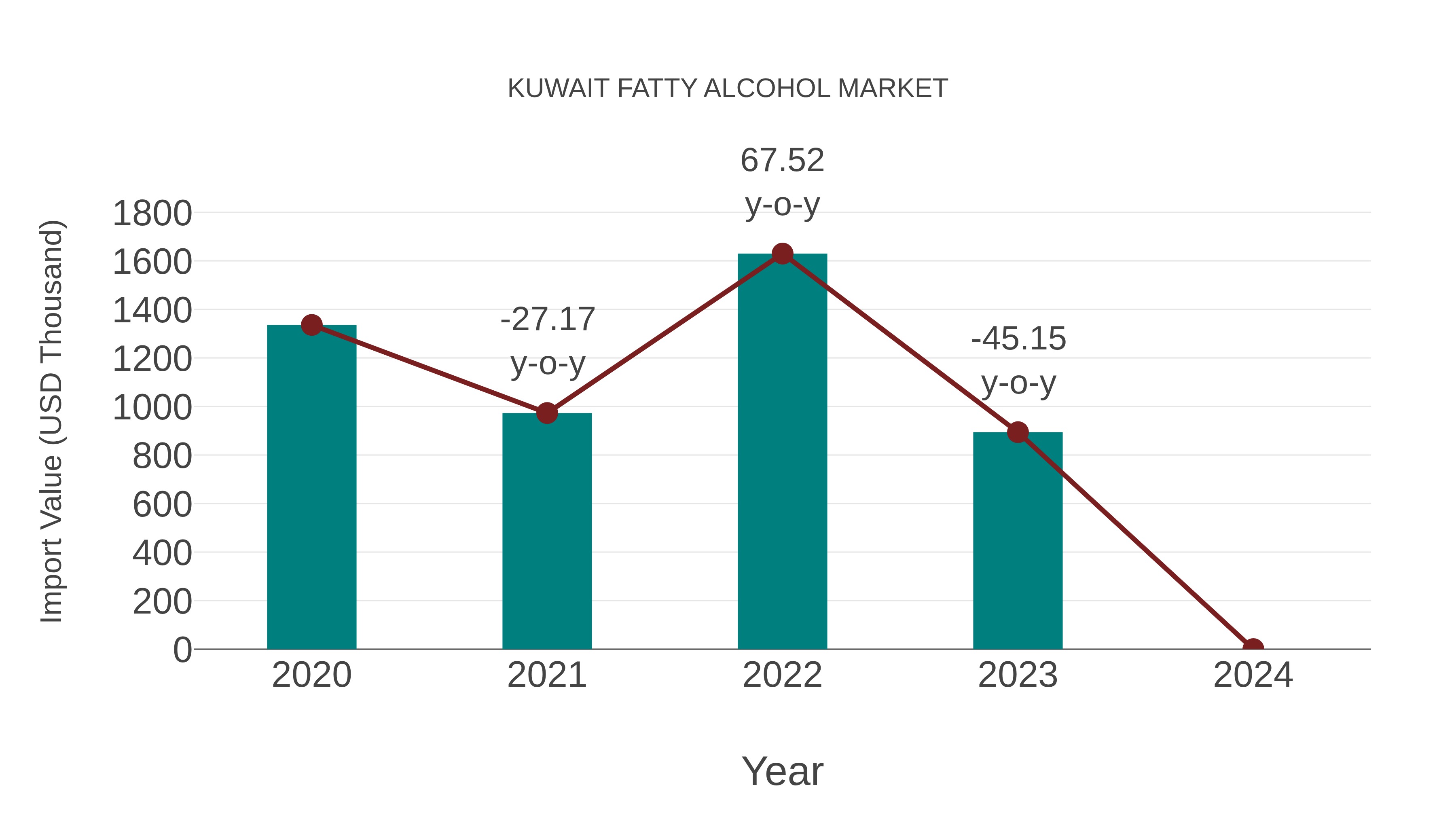
In the Kuwait fatty alcohol market, the import trend experienced a negative Compound Annual Growth Rate (CAGR) of -12.53% during 2020-2024. This decline suggests a significant decrease in import momentum, possibly indicating a shift in demand dynamics or market stability challenges impacting trade performance.
Kuwait Fatty Alcohol Market Synopsis
The Kuwait Fatty Alcohol Market is expected to witness steady growth due to increasing demand from various end-use industries such as personal care, pharmaceuticals, and industrial applications. Fatty alcohols are widely used in the production of detergents, soaps, cosmetics, and lubricants, driving the market growth. The market is also influenced by factors such as rising disposable income, changing consumer preferences towards organic and natural products, and expanding industrial activities in the region. Key players in the Kuwait Fatty Alcohol Market include global manufacturers such as BASF SE, KLK OLEO, and Sasol Limited. With a focus on product innovation, sustainability, and expanding distribution networks, these companies are poised to capitalize on the growing demand for fatty alcohols in Kuwait and the broader Middle East region.
Kuwait Fatty Alcohol Market Trends
The Kuwait fatty alcohol market is experiencing growth driven by increasing demand from various industries such as personal care, pharmaceuticals, and agrochemicals. Consumers are showing a preference for natural and sustainable products, leading to a rising interest in fatty alcohols derived from renewable sources. Manufacturers are focusing on product innovation, such as introducing eco-friendly and high-performance fatty alcohol variants. The market is also witnessing investments in research and development to enhance product quality and expand application areas. With growing awareness about the benefits of fatty alcohols in cosmetic formulations and industrial processes, the Kuwait fatty alcohol market is expected to continue its upward trajectory in the coming years.
Kuwait Fatty Alcohol Market Challenges
In the Kuwait Fatty Alcohol Market, some of the key challenges faced include intense competition from global players, fluctuating raw material prices, stringent regulatory requirements, and limited domestic production capacity. Global companies with established supply chains and economies of scale pose a threat to local manufacturers in Kuwait. The volatility in raw material prices, such as palm oil and coconut oil, directly impacts production costs and profit margins. Additionally, complying with strict regulatory standards, particularly in terms of environmental sustainability and quality control, adds complexity to operations. The limited domestic production capacity also hinders the market`s growth potential and makes Kuwait dependent on imports to meet demand, further complicating the competitive landscape for local players.
Kuwait Fatty Alcohol Market Investment Opportunities
The Kuwait fatty alcohol market presents promising investment opportunities due to several factors. Fatty alcohols are widely used in industries such as personal care, pharmaceuticals, and industrial applications, making them a versatile and in-demand product. Kuwait`s strategic location and well-established infrastructure make it an attractive hub for production and distribution within the region. Additionally, the country`s stable political environment and supportive government policies encourage foreign investment in the sector. With increasing global demand for sustainable and eco-friendly products, investing in the Kuwait fatty alcohol market could provide long-term growth potential. Opportunities for partnerships with local producers, leveraging advanced technology, and catering to evolving consumer preferences make this market an attractive prospect for investors looking to capitalize on the growing chemical industry in the region.
Jordan Agar Market Government Policies
The Kuwait government imposes strict regulations and policies on the fatty alcohol market to ensure quality control and maintain environmental sustainability. The government closely monitors the production, import, and distribution of fatty alcohols to safeguard consumer health and prevent any adverse effects on the environment. Additionally, there are regulations in place to promote the use of sustainable practices in the production of fatty alcohols, such as encouraging the use of renewable resources and energy-efficient technologies. Compliance with these policies is mandatory for all companies operating in the Kuwait fatty alcohol market to promote responsible and sustainable growth in the industry.
Kuwait Fatty Alcohol Market Future Outlook
The Kuwait Fatty Alcohol market is expected to show steady growth in the coming years, driven by increasing demand from various industries such as personal care, pharmaceuticals, and food and beverage. The market is likely to benefit from the growing population, rising disposable income, and changing consumer preferences towards natural and sustainable products. Additionally, the increasing use of fatty alcohols in the production of surfactants, emollients, and lubricants is anticipated to further boost market growth. However, challenges such as fluctuating raw material prices and stringent regulations regarding environmental sustainability may pose some hindrances to the market expansion. Overall, the Kuwait Fatty Alcohol market is poised for growth opportunities, especially with the increasing focus on eco-friendly products and rising industrial applications.
Key Highlights of the Report:
- Kuwait Fatty Alcohol Market Outlook
- Market Size of Kuwait Fatty Alcohol Market, 2025
- Forecast of Kuwait Fatty Alcohol Market, 2032
- Historical Data and Forecast of Kuwait Fatty Alcohol Revenues & Volume for the Period 2022 - 2032F
- Kuwait Fatty Alcohol Market Trend Evolution
- Kuwait Fatty Alcohol Market Drivers and Challenges
- Kuwait Fatty Alcohol Price Trends
- Kuwait Fatty Alcohol Porter's Five Forces
- Kuwait Fatty Alcohol Industry Life Cycle
- Historical Data and Forecast of Kuwait Fatty Alcohol Market Revenues & Volume By Product for the Period 2022 - 2032F
- Historical Data and Forecast of Kuwait Fatty Alcohol Market Revenues & Volume By C6-C10 for the Period 2022 - 2032F
- Historical Data and Forecast of Kuwait Fatty Alcohol Market Revenues & Volume By C11-C14 for the Period 2022 - 2032F
- Historical Data and Forecast of Kuwait Fatty Alcohol Market Revenues & Volume By C15-C22 for the Period 2022 - 2032F
- Historical Data and Forecast of Kuwait Fatty Alcohol Market Revenues & Volume By Application for the Period 2022 - 2032F
- Historical Data and Forecast of Kuwait Fatty Alcohol Market Revenues & Volume By Soaps & Detergents for the Period 2022 - 2032F
- Historical Data and Forecast of Kuwait Fatty Alcohol Market Revenues & Volume By Personal Care for the Period 2022 - 2032F
- Historical Data and Forecast of Kuwait Fatty Alcohol Market Revenues & Volume By Lubricants for the Period 2022 - 2032F
- Historical Data and Forecast of Kuwait Fatty Alcohol Market Revenues & Volume By Amines for the Period 2022 - 2032F
- Historical Data and Forecast of Kuwait Fatty Alcohol Market Revenues & Volume By Others for the Period 2022 - 2032F
- Kuwait Fatty Alcohol Import Export Trade Statistics
- Market Opportunity Assessment By Product
- Market Opportunity Assessment By Application
- Kuwait Fatty Alcohol Top Companies Market Share
- Kuwait Fatty Alcohol Competitive Benchmarking By Technical and Operational Parameters
- Kuwait Fatty Alcohol Company Profiles
- Kuwait Fatty Alcohol Key Strategic Recommendations






































