Kuwait Food & Grocery Retail Market Size, Share & Growth Rate
The Kuwait Food & Grocery Retail Market was estimated at USD 583 Million in 2025 and is projected to reach USD 1078 Million by 2032, growing at a CAGR of 9.2% from 2026 to 2032. This impressive growth trajectory is underpinned by a burgeoning expatriate population and rising disposable incomes that fuel consumer demand for diverse food options. As lifestyles evolve and health consciousness rises, there is an increasing preference for premium and organic products, driving retailers to adapt and enhance their offerings.
Kuwait Food & Grocery Retail Market Year-wise Growth Rate and Key Drivers
This graph highlights how the Kuwait Food & Grocery Retail Market has steadily grown over the years, supported by major growth factors.
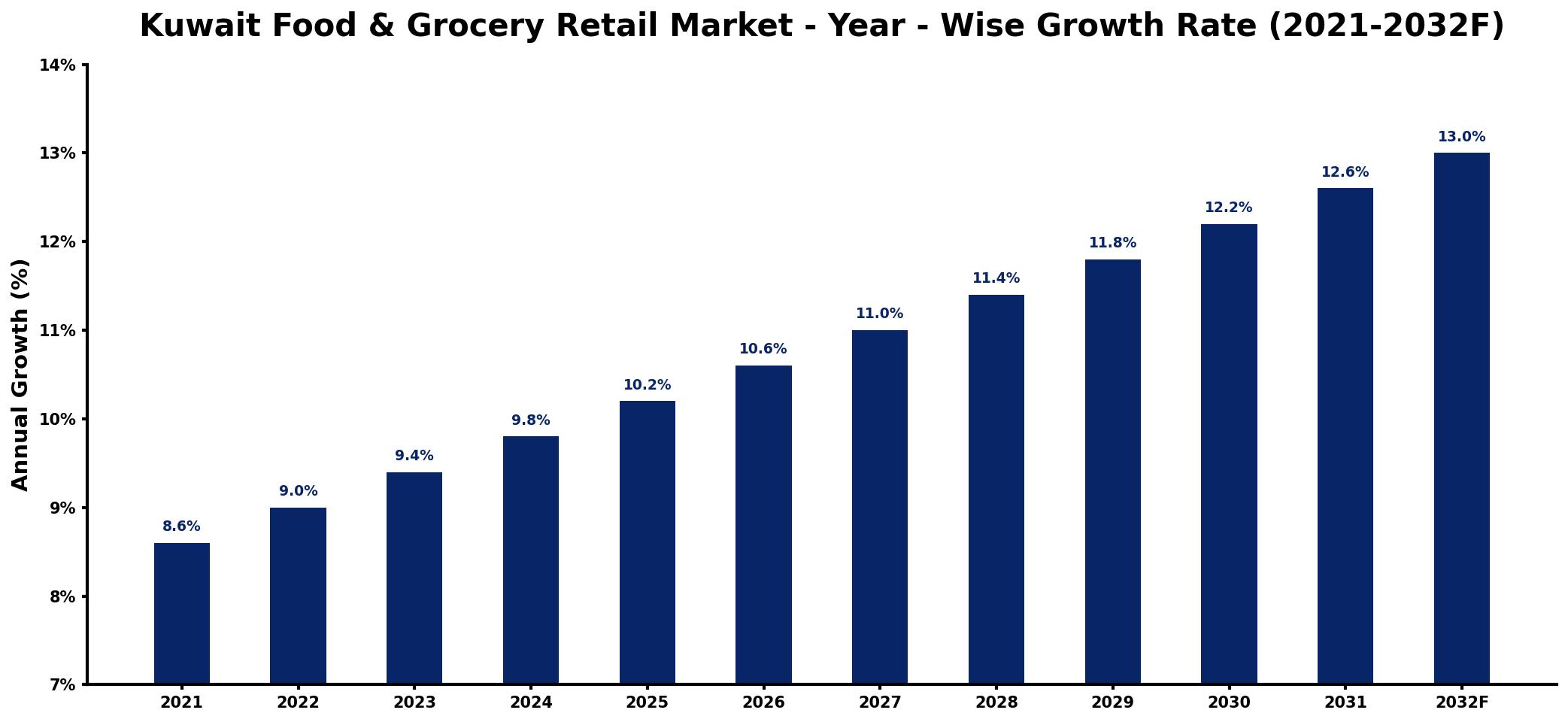
The table below presents the year‑wise growth rates along with the key drivers influencing the market
| Year | Growth Rate | Major Drivers |
| 2021 | 8.6% | Increased consumer spending habits |
| 2022 | 9.0% | Expansion of online shopping platforms |
| 2023 | 9.4% | Rising health consciousness among consumers |
| 2024 | 9.8% | Growth in delivery service options |
| 2025 | 10.2% | Investment in modern supply chains |
| 2026 | 10.6% | Emergence of sustainable sourcing practices |
| 2027 | 11.0% | Increase in urban population density |
| 2028 | 11.4% | Development of loyalty programs |
| 2029 | 11.8% | Enhancement of customer experience initiatives |
| 2030 | 12.2% | Diversification of product offerings |
| 2031 | 12.6% | Adoption of technology in operations |
| 2032 | 13.0% | Strengthening of local partnerships |
Note: Market size estimations and growth projections presented in this report are based on 6Wresearch's proprietary forecasting methodology, utilizing the latest available industry data, government publications, and primary research inputs.
Kuwait Food & Grocery Retail Market Synopsis
One of the defining characteristics of the Kuwait Food & Grocery Retail Market is its commitment to quality and safety, reflecting consumer priorities. Retailers are not only focusing on the variety of products but also on sourcing fresh and organic items that cater to the health-oriented segment of the population.
Moreover, the market is increasingly embracing technology. Online grocery shopping has gained traction, particularly among younger consumers who prioritize convenience. This shift is accompanied by a growing interest in mobile applications that streamline the shopping experience.
- The market is poised for robust growth, driven by changing consumer lifestyles and preferences.
- Innovations in technology are reshaping the retail landscape, enhancing customer engagement.
- There is a notable trend toward healthier, organic food products that meet rising health consciousness.
- Sustainability and eco-friendly practices are becoming essential for retailers to align with consumer values.
- The regulatory environment presents both challenges and opportunities for new entrants and existing players.
Despite the promising outlook, the Kuwait Food & Grocery Retail Market encounters significant challenges. Intense competition from both traditional outlets and modern retail formats has led to price pressures, complicating profit margins for businesses. Moreover, stringent regulations around foreign ownership can inhibit the entry of new players, thereby stifling innovation. The market is also vulnerable to economic fluctuations and geopolitical tensions, which may disrupt consumer spending patterns and overall growth.
Emerging trends in the Kuwait Food & Grocery Retail Market are strongly influenced by consumer demand for convenience and health. As lifestyles become busier, the appetite for ready-to-eat meals and on-the-go snack options continues to rise. Simultaneously, the popularity of online grocery shopping is reshaping traditional retail norms. Retailers are leveraging technology to offer personalized recommendations and improve the overall shopping experience. Additionally, there is an increasing emphasis on sustainable practices, pushing retailers to reduce food waste and adopt eco-friendly packaging solutions.
The Kuwait Food & Grocery Retail Market holds considerable investment potential. The expansion of modern retail formats such as supermarkets and hypermarkets presents opportunities for growth, particularly in urban areas. Moreover, as consumers increasingly seek health-focused options, there is potential for developing organic and specialty food stores. The digital transformation of the retail space suggests robust opportunities for investors interested in technology-driven solutions for supply chain optimization and customer engagement. In summary, the market landscape is ripe for innovative approaches that align with consumer preferences.
The Kuwaiti government plays a crucial role in regulating the Food & Grocery Retail Market, ensuring compliance with health and safety standards. Regulations regarding food imports are in place to maintain quality and safety for consumers. Additionally, the government promotes local agriculture through various subsidies and incentives designed to encourage domestic food production. In response to market fluctuations, measures such as price controls on essential food items have been implemented to safeguard consumer access and affordability.
Looking ahead to 2026-2032, the Kuwait Food & Grocery Retail Market is positioned for steady expansion. This growth will be driven by urbanization trends, an increasing population, and rising disposable incomes. Retailers are likely to focus on modernizing their offerings, particularly in response to growing demand for convenience and quality. With consumer preferences continuing to shift toward health-conscious and organic products, businesses must adapt swiftly to meet these evolving needs. Overall, the market's future appears promising, offering avenues for both local and international players to thrive.
In recent months, there has been a noticeable shift in Kuwait's retail landscape towards integrating technology with traditional grocery shopping. Retailers are increasingly adopting e-commerce platforms to facilitate online grocery orders, which is becoming a staple service. Additionally, the emphasis on sustainability has led to initiatives aimed at reducing plastic usage and promoting eco-friendly packaging. The response to consumer health consciousness has also encouraged retailers to expand their selections of organic and natural food items, responding to a growing demand.
- 10 Years of Market Numbers
- Historical Data Starting from 2022 to 2025
- Base Year: 2025
- Forecast Data until 2032
- Key Performance Indicators Impacting the Market
- Major Upcoming Developments and Projects
Key Highlights of the Report:
- Kuwait Food & Grocery Retail Market Outlook
- Market Size of Kuwait Food & Grocery Retail Market, 2025
- Forecast of Kuwait Food & Grocery Retail Market, 2032
- Historical Data and Forecast of Kuwait Food & Grocery Retail Revenues & Volume for the Period 2022-2032F
- Kuwait Food & Grocery Retail Market Trend Evolution
- Kuwait Food & Grocery Retail Market Drivers and Challenges
- Kuwait Food & Grocery Retail Price Trends
- Kuwait Food & Grocery Retail Porter's Five Forces
- Kuwait Food & Grocery Retail Industry Life Cycle
- Historical Data and Forecast of Kuwait Food & Grocery Retail Market Revenues & Volume By Product for the Period 2022-2032F
- Historical Data and Forecast of Kuwait Food & Grocery Retail Market Revenues & Volume By Fresh Food for the Period 2022-2032F
- Historical Data and Forecast of Kuwait Food & Grocery Retail Market Revenues & Volume By Frozen Food for the Period 2022-2032F
- Historical Data and Forecast of Kuwait Food & Grocery Retail Market Revenues & Volume By Food Cupboard for the Period 2022-2032F
- Historical Data and Forecast of Kuwait Food & Grocery Retail Market Revenues & Volume By Beverages for the Period 2022-2032F
- Historical Data and Forecast of Kuwait Food & Grocery Retail Market Revenues & Volume By Cleaning & Household for the Period 2022-2032F
- Historical Data and Forecast of Kuwait Food & Grocery Retail Market Revenues & Volume By Others for the Period 2022-2032F
- Historical Data and Forecast of Kuwait Food & Grocery Retail Market Revenues & Volume By Distribution Channel for the Period 2022-2032F
- Historical Data and Forecast of Kuwait Food & Grocery Retail Market Revenues & Volume By Supermarkets & Hypermarkets for the Period 2022-2032F
- Historical Data and Forecast of Kuwait Food & Grocery Retail Market Revenues & Volume By Convenience Stores for the Period 2022-2032F
- Historical Data and Forecast of Kuwait Food & Grocery Retail Market Revenues & Volume By Departmental Stores & Clubs for the Period 2022-2032F
- Historical Data and Forecast of Kuwait Food & Grocery Retail Market Revenues & Volume By Online for the Period 2022-2032F
- Kuwait Food & Grocery Retail Import Export Trade Statistics
- Market Opportunity Assessment By Product
- Market Opportunity Assessment By Distribution Channel
- Kuwait Food & Grocery Retail Top Companies Market Share
- Kuwait Food & Grocery Retail Competitive Benchmarking By Technical and Operational Parameters
- Kuwait Food & Grocery Retail Company Profiles
- Kuwait Food & Grocery Retail Key Strategic Recommendations






































