Peru Food & Grocery Retail Market Size, Share & Growth Rate
The Peru Food & Grocery Retail Market was estimated at USD 832 Million in 2025 and is projected to reach USD 1490 Million by 2032, growing at a CAGR of 8.7% from 2026 to 2032. This growth trajectory is largely attributed to rising disposable incomes, which empower consumers to spend more on a diverse array of food and grocery products. Additionally, the ongoing urbanization trends and evolving consumer preferences towards healthier options further catalyze the market's expansion.
Peru Food & Grocery Retail Market Year-wise Growth Rate and Key Drivers
This graph highlights how the Peru Food & Grocery Retail Market has steadily grown over the years, supported by major growth factors.
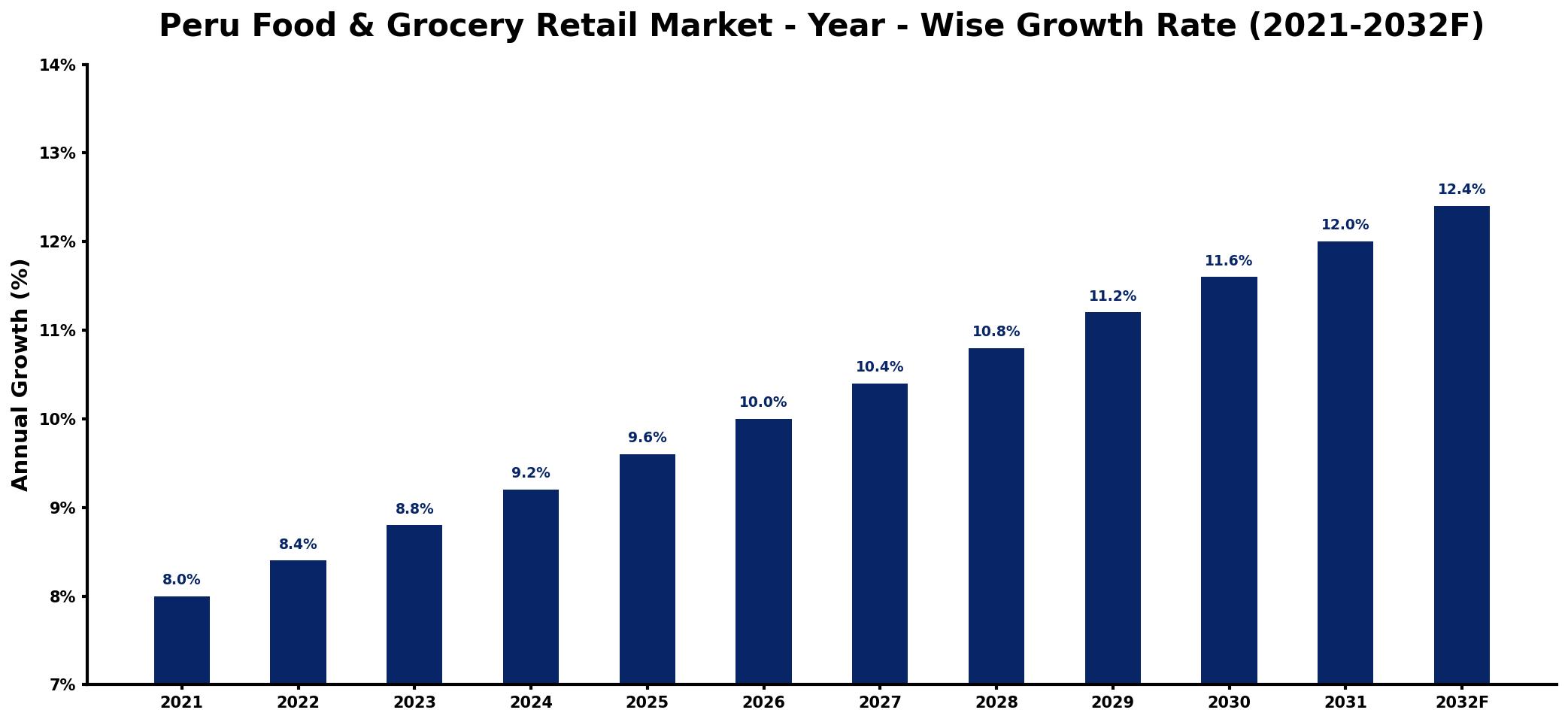
The table below presents the year‑wise growth rates along with the key drivers influencing the market
| Year | Growth Rate | Major Drivers |
| 2021 | 8.0% | Rising consumer purchasing power |
| 2022 | 8.4% | Increased urban population density |
| 2023 | 8.8% | Growing e-commerce adoption trends |
| 2024 | 9.2% | Expansion of modern trade formats |
| 2025 | 9.6% | Enhanced supply chain efficiencies |
| 2026 | 10.0% | Diverse product offerings increase |
| 2027 | 10.4% | Strengthening local production capabilities |
| 2028 | 10.8% | Investment in technology advancements |
| 2029 | 11.2% | Growing health-conscious consumer base |
| 2030 | 11.6% | Rising interest in organic options |
| 2031 | 12.0% | Emergence of convenience shopping trends |
| 2032 | 12.4% | Adoption of sustainable practices |
Note: Market size estimations and growth projections presented in this report are based on 6Wresearch's proprietary forecasting methodology, utilizing the latest available industry data, government publications, and primary research inputs.
Peru Food & Grocery Retail Market Synopsis
The increasing preference for modern retail formats is reshaping the shopping landscape in Peru. Consumers are gravitating towards supermarkets and online platforms, seeking convenience and variety, while traditional markets still hold a significant share of consumer spend.
Moreover, there is a notable uptick in the demand for organic and health-oriented products. This trend reflects a shift in consumer consciousness towards wellness, driving grocery retailers to adapt and offer a wider selection of such items to meet this burgeoning demand.
- The market is witnessing significant growth driven by urbanization and rising disposable incomes.
- Health-conscious consumer trends are shaping product offerings in the grocery sector.
- Modern retail formats are gaining market share, diversifying the shopping experience.
- E-commerce is becoming an increasingly vital channel for grocery sales.
- Investment opportunities abound, particularly in organic and specialty food segments.
The Peru Food & Grocery Retail Market faces multiple restraints that may hinder growth. Intense competition among both domestic and international retailers often leads to aggressive pricing strategies, which can squeeze profit margins. Furthermore, logistical inefficiencies, stemming from underdeveloped infrastructure in certain areas, can affect product availability and quality. Compliance with regulatory frameworks presents additional challenges, particularly regarding food safety and labeling, complicating market entry for new participants. Such factors compel existing players to continuously innovate and adjust their strategies to thrive in this competitive environment.
A major trend in the Peru Food & Grocery Retail Market is the increasing consumer shift towards healthy and sustainable products. This is evident in the rising popularity of organic and plant-based offerings as well as ethically sourced goods. Concurrently, the impact of the COVID-19 pandemic has accelerated the adoption of online grocery shopping, with consumers increasingly favoring the convenience of home delivery services. Additionally, retailers are placing greater emphasis on environmental sustainability, adopting practices that resonate with the values of socially conscious consumers.
The Peru Food & Grocery Retail Market presents robust opportunities for investment. With a burgeoning middle class and rapid urbanization, there is significant demand for modern retail formats like supermarkets and convenience stores. Investors have the potential to capitalize on this trend by establishing new retail locations or upgrading existing stores. Furthermore, the growing interest in health-focused and specialty products suggests opportunities for brands that can cater to these specific consumer needs. Collaboration with local producers can also yield competitive advantages, tapping into Peru's rich agricultural landscape.
The Peruvian government is actively implementing various policies aimed at enhancing the Food & Grocery Retail Market. Initiatives to promote food safety standards and support local agricultural development are pivotal in ensuring a stable supply chain. Additionally, there are efforts to foster fair competition within the sector, alongside programs designed to empower small and medium-sized enterprises. These measures not only boost local production but also strive to reduce reliance on imports, thereby fortifying the domestic market.
Looking ahead to the 2026-2032 period, the Peru Food & Grocery Retail Market is poised for substantial expansion. As economic conditions improve, consumer spending is expected to rise, particularly in the modern retail and e-commerce sectors. The inclination towards healthier lifestyles will continue to drive demand for premium and organic products. Moreover, government initiatives supporting local agriculture could further bolster market growth. However, stakeholders must remain vigilant about competitive pressures and adapt to the ever-evolving landscape of consumer preferences.
In recent months, the Peru Food & Grocery Retail Market has witnessed a surge in the establishment of online grocery platforms, as retailers adapt to changing consumer behaviors post-pandemic. Enhanced delivery services and partnerships with local producers are becoming more common, improving product accessibility. Additionally, many retailers are introducing loyalty programs aimed at retaining customers in an increasingly competitive environment. These developments indicate a strategic shift towards customer engagement and convenience in the grocery shopping experience.
- 10 Years of Market Numbers
- Historical Data Starting from 2022 to 2025
- Base Year: 2025
- Forecast Data until 2032
- Key Performance Indicators Impacting the Market
- Major Upcoming Developments and Projects
Key Highlights of the Report:
- Peru Food & Grocery Retail Market Outlook
- Market Size of Peru Food & Grocery Retail Market, 2025
- Forecast of Peru Food & Grocery Retail Market, 2032
- Historical Data and Forecast of Peru Food & Grocery Retail Revenues & Volume for the Period 2022-2032F
- Peru Food & Grocery Retail Market Trend Evolution
- Peru Food & Grocery Retail Market Drivers and Challenges
- Peru Food & Grocery Retail Price Trends
- Peru Food & Grocery Retail Porter's Five Forces
- Peru Food & Grocery Retail Industry Life Cycle
- Historical Data and Forecast of Peru Food & Grocery Retail Market Revenues & Volume By Product for the Period 2022-2032F
- Historical Data and Forecast of Peru Food & Grocery Retail Market Revenues & Volume By Fresh Food for the Period 2022-2032F
- Historical Data and Forecast of Peru Food & Grocery Retail Market Revenues & Volume By Frozen Food for the Period 2022-2032F
- Historical Data and Forecast of Peru Food & Grocery Retail Market Revenues & Volume By Food Cupboard for the Period 2022-2032F
- Historical Data and Forecast of Peru Food & Grocery Retail Market Revenues & Volume By Beverages for the Period 2022-2032F
- Historical Data and Forecast of Peru Food & Grocery Retail Market Revenues & Volume By Cleaning & Household for the Period 2022-2032F
- Historical Data and Forecast of Peru Food & Grocery Retail Market Revenues & Volume By Others for the Period 2022-2032F
- Historical Data and Forecast of Peru Food & Grocery Retail Market Revenues & Volume By Distribution Channel for the Period 2022-2032F
- Historical Data and Forecast of Peru Food & Grocery Retail Market Revenues & Volume By Supermarkets & Hypermarkets for the Period 2022-2032F
- Historical Data and Forecast of Peru Food & Grocery Retail Market Revenues & Volume By Convenience Stores for the Period 2022-2032F
- Historical Data and Forecast of Peru Food & Grocery Retail Market Revenues & Volume By Departmental Stores & Clubs for the Period 2022-2032F
- Historical Data and Forecast of Peru Food & Grocery Retail Market Revenues & Volume By Online for the Period 2022-2032F
- Peru Food & Grocery Retail Import Export Trade Statistics
- Market Opportunity Assessment By Product
- Market Opportunity Assessment By Distribution Channel
- Peru Food & Grocery Retail Top Companies Market Share
- Peru Food & Grocery Retail Competitive Benchmarking By Technical and Operational Parameters
- Peru Food & Grocery Retail Company Profiles
- Peru Food & Grocery Retail Key Strategic Recommendations






































