Kuwait Fruit and Vegetable Processing Market Size, Share & Growth Rate
The Kuwait Fruit and Vegetable Processing Market was estimated at USD 1185 Million in 2025 and is projected to reach USD 2157 Million by 2032, growing at a CAGR of 8.9% from 2026 to 2032. This growth trajectory is underpinned by rising consumer demands for convenient, healthy food options, alongside government initiatives aimed at enhancing domestic food production capabilities. Additionally, increasing urbanization and shifts towards healthier eating habits further fuel market expansion.
Kuwait Fruit and Vegetable Processing Market Year-wise Growth Rate and Key Drivers
This graph highlights how the Kuwait Fruit and Vegetable Processing Market has steadily grown over the years, supported by major growth factors.
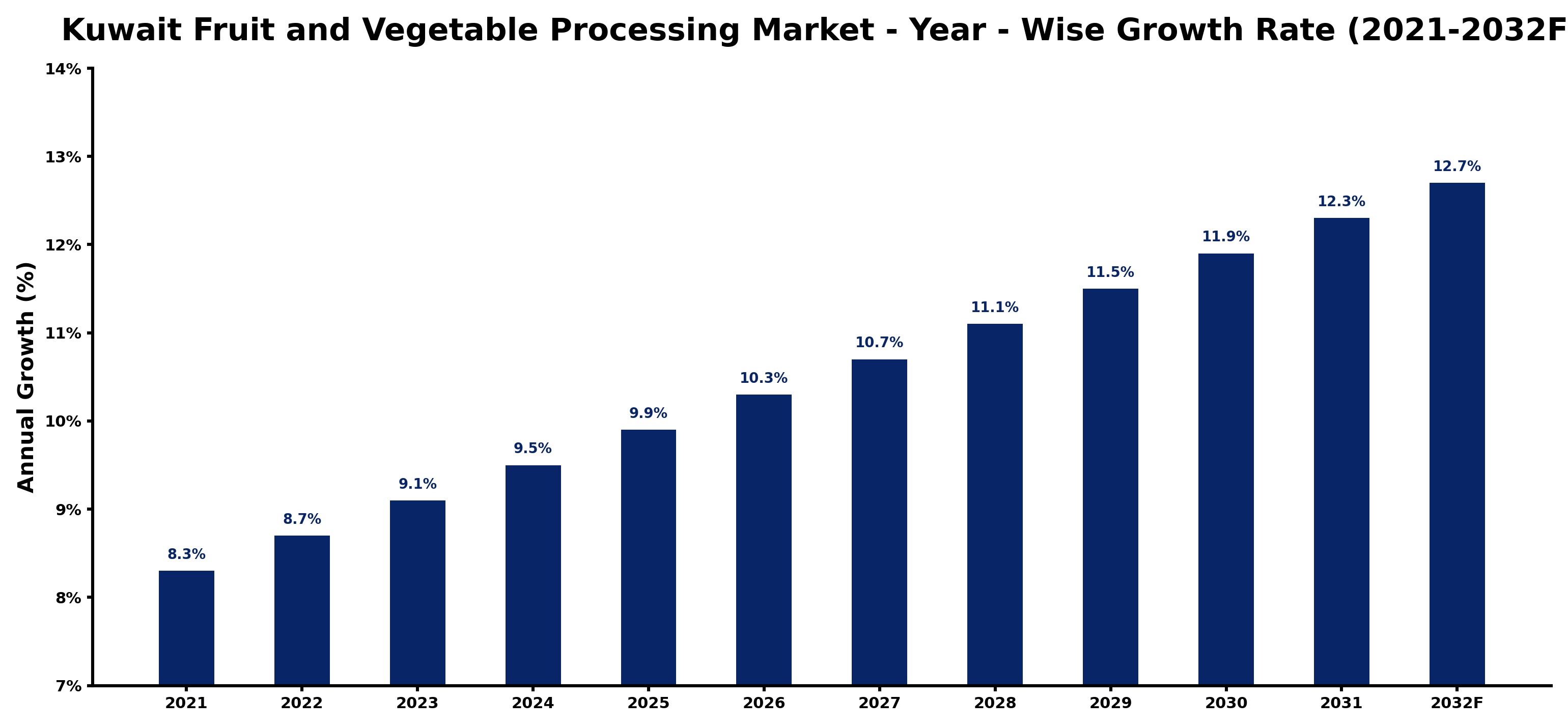
The table below presents the year‑wise growth rates along with the key drivers influencing the market
| Year | Growth Rate | Major Drivers |
| 2021 | 8.3% | Rising health consciousness among consumers |
| 2022 | 8.7% | Increased demand for organic products |
| 2023 | 9.1% | Technological advancements in processing |
| 2024 | 9.5% | Growing export opportunities for products |
| 2025 | 9.9% | Sustainability trends driving innovation |
| 2026 | 10.3% | Enhanced distribution networks expanded reach |
| 2027 | 10.7% | Consumer preference for convenience foods |
| 2028 | 11.1% | Investment in local agriculture increased |
| 2029 | 11.5% | Emerging food trends influenced offerings |
| 2030 | 11.9% | Government support for food processing |
| 2031 | 12.3% | Collaborations with international brands expanded |
| 2032 | 12.7% | Focus on product quality improvement |
Note - Market size estimations and growth projections presented in this report are based on 6Wresearch's advanced forecasting approach, validated with industry datasets as of June 2026.
Kuwait Fruit and Vegetable Processing Market Synopsis
The Kuwaiti market for processed fruits and vegetables is characterized by a burgeoning consumer interest in organic and minimally processed products. As more people become health-conscious, the demand for items devoid of artificial additives or preservatives continues to rise, presenting an exciting opportunity for local processors.
Supply chain dynamics are also critical, as the region grapples with limited local agricultural output due to its arid climate. Consequently, the market heavily relies on imports to meet the growing consumer demand for fresh produce and innovative processed options.
Kuwait Fruit and Vegetable Processing Market Key Takeaways
- Strong growth momentum is driven by a shift towards health-conscious consumption patterns.
- Innovations in product offerings focus on organic, clean label, and convenience-oriented options.
- The market faces challenges due to limited local agricultural output and dependency on imports.
- Government policies aim to bolster domestic food production and enhance processing standards.
- Investment opportunities abound in modern processing facilities and collaboration with local farmers.
Evaluation of Restraints in Kuwait Fruit and Vegetable Processing Market
The Kuwait Fruit and Vegetable Processing Market is currently constrained by several significant factors. The country's challenging agricultural landscape leads to a reliance on imported raw materials, which exposes local processors to volatile global prices and supply disruptions. Additionally, high operational costs related to energy and water, crucial for processing, further complicate profitability. These elements necessitate strategic investments in infrastructure and technology to overcome barriers and ensure sustainable growth in the sector.
Kuwait Fruit and Vegetable Processing Market Trends
Currently, there is a marked trend towards the consumption of organic and health-oriented processed products within the Kuwaiti market. Consumers are increasingly gravitating toward products that feature minimal processing, positioning convenience alongside health and wellness. Companies are responding by innovating their product lines to include organic juices, freeze-dried fruits, and ready-to-eat vegetable packs that appeal to busy lifestyles, reflecting a deeper understanding of consumer preferences.
Kuwait Fruit and Vegetable Processing Market Opportunities
The Kuwaiti market is ripe for investment, particularly in the establishment of modern processing facilities that leverage advanced technologies for efficiency and quality assurance. Collaborating with local agricultural producers can secure a stable supply of fresh produce, fostering sustainability within the industry. Furthermore, R&D efforts focused on developing innovative products tailored to shifting consumer demands present a strategic avenue for growth and competitive advantage.
Government Initiatives in the Kuwait Fruit and Vegetable Processing Market
Government initiatives play a pivotal role in shaping the Kuwait Fruit and Vegetable Processing Market. Policies focused on promoting food security emphasize domestic production while minimizing import dependency. Various programs are designed to support local farmers and processors through subsidies, technical assistance, and loans aimed at enhancing production efficiency. These efforts are critical in raising the quality and safety standards of processed fruits and vegetables in the country.
Future Insights of the Kuwait Fruit and Vegetable Processing Market
Looking ahead to 2026-2032, the Kuwait Fruit and Vegetable Processing Market is set to experience consistent growth bolstered by increasing consumer demand for convenient and health-focused options. Innovations in processing techniques, along with government-driven food security initiatives, will further stimulate market development. The landscape appears promising for both local and international players seeking to capitalize on the opportunities presented by evolving consumer behaviors and preferences.
Kuwait Fruit and Vegetable Processing Market Latest Developments (May 2025 - June 2026)
Recent developments within the Kuwait Fruit and Vegetable Processing Market indicate a shift toward more sustainable practices. Many companies are investing in energy-efficient processing technologies to reduce operational costs and minimize environmental impacts. Additionally, collaborations between local processors and agricultural producers are being forged to ensure better quality control and supply chain stability, addressing the ongoing challenges of raw material sourcing.
Kuwait Fruit and Vegetable Processing Market - Key Attractiveness of the Report
- 10 Years of Market Numbers
- Historical Data Starting from 2022 to 2025
- Base Year: 2025
- Forecast Data until 2032
- Key Performance Indicators Impacting the Market
- Major Upcoming Developments and Projects
Key Highlights of the Report:
- Kuwait Fruit and Vegetable Processing Market Outlook
- Market Size of Kuwait Fruit and Vegetable Processing Market, 2025
- Forecast of Kuwait Fruit and Vegetable Processing Market, 2032
- Historical Data and Forecast of Kuwait Fruit and Vegetable Processing Revenues & Volume for the Period 2022-2032F
- Kuwait Fruit and Vegetable Processing Market Trend Evolution
- Kuwait Fruit and Vegetable Processing Market Drivers and Challenges
- Kuwait Fruit and Vegetable Processing Price Trends
- Kuwait Fruit and Vegetable Processing Porter's Five Forces
- Kuwait Fruit and Vegetable Processing Industry Life Cycle
- Historical Data and Forecast of Kuwait Fruit and Vegetable Processing Market Revenues & Volume By Type for the Period 2022-2032F
- Historical Data and Forecast of Kuwait Fruit and Vegetable Processing Market Revenues & Volume By Fruits for the Period 2022-2032F
- Historical Data and Forecast of Kuwait Fruit and Vegetable Processing Market Revenues & Volume By Vegetables for the Period 2022-2032F
- Historical Data and Forecast of Kuwait Fruit and Vegetable Processing Market Revenues & Volume By Product for the Period 2022-2032F
- Historical Data and Forecast of Kuwait Fruit and Vegetable Processing Market Revenues & Volume By Fresh for the Period 2022-2032F
- Historical Data and Forecast of Kuwait Fruit and Vegetable Processing Market Revenues & Volume By Fresh-cut for the Period 2022-2032F
- Historical Data and Forecast of Kuwait Fruit and Vegetable Processing Market Revenues & Volume By Canned for the Period 2022-2032F
- Historical Data and Forecast of Kuwait Fruit and Vegetable Processing Market Revenues & Volume By Frozen for the Period 2022-2032F
- Historical Data and Forecast of Kuwait Fruit and Vegetable Processing Market Revenues & Volume By Dried for the Period 2022-2032F
- Historical Data and Forecast of Kuwait Fruit and Vegetable Processing Market Revenues & Volume By Processing Equipment for the Period 2022-2032F
- Historical Data and Forecast of Kuwait Fruit and Vegetable Processing Market Revenues & Volume By Pre-processing for the Period 2022-2032F
- Historical Data and Forecast of Kuwait Fruit and Vegetable Processing Market Revenues & Volume By Processing for the Period 2022-2032F
- Historical Data and Forecast of Kuwait Fruit and Vegetable Processing Market Revenues & Volume By Washing for the Period 2022-2032F
- Historical Data and Forecast of Kuwait Fruit and Vegetable Processing Market Revenues & Volume By Filling for the Period 2022-2032F
- Historical Data and Forecast of Kuwait Fruit and Vegetable Processing Market Revenues & Volume By Seasoning for the Period 2022-2032F
- Historical Data and Forecast of Kuwait Fruit and Vegetable Processing Market Revenues & Volume By Packaging for the Period 2022-2032F
- Kuwait Fruit and Vegetable Processing Import Export Trade Statistics
- Market Opportunity Assessment By Type
- Market Opportunity Assessment By Product
- Market Opportunity Assessment By Processing Equipment
- Kuwait Fruit and Vegetable Processing Top Companies Market Share
- Kuwait Fruit and Vegetable Processing Competitive Benchmarking By Technical and Operational Parameters
- Kuwait Fruit and Vegetable Processing Company Profiles
- Kuwait Fruit and Vegetable Processing Key Strategic Recommendations






































