Spain Fruit and Vegetable Processing Market Size, Share & Growth Rate
The Spain Fruit and Vegetable Processing Market was estimated at USD 194 Million in 2025 and is projected to reach USD 231 Million by 2032, growing at a CAGR of 2.5% from 2026 to 2032. This steady trajectory is bolstered by increasing consumer preferences for healthy, ready-to-eat options and significant investments in innovative processing technologies. As disposable incomes rise and awareness of health and sustainability grows, the demand for high-quality processed fruits and vegetables continues to strengthen.
Spain Fruit and Vegetable Processing Market Year-wise Growth Rate and Key Drivers
This graph highlights how the Spain Fruit and Vegetable Processing Market has steadily grown over the years, supported by major growth factors.
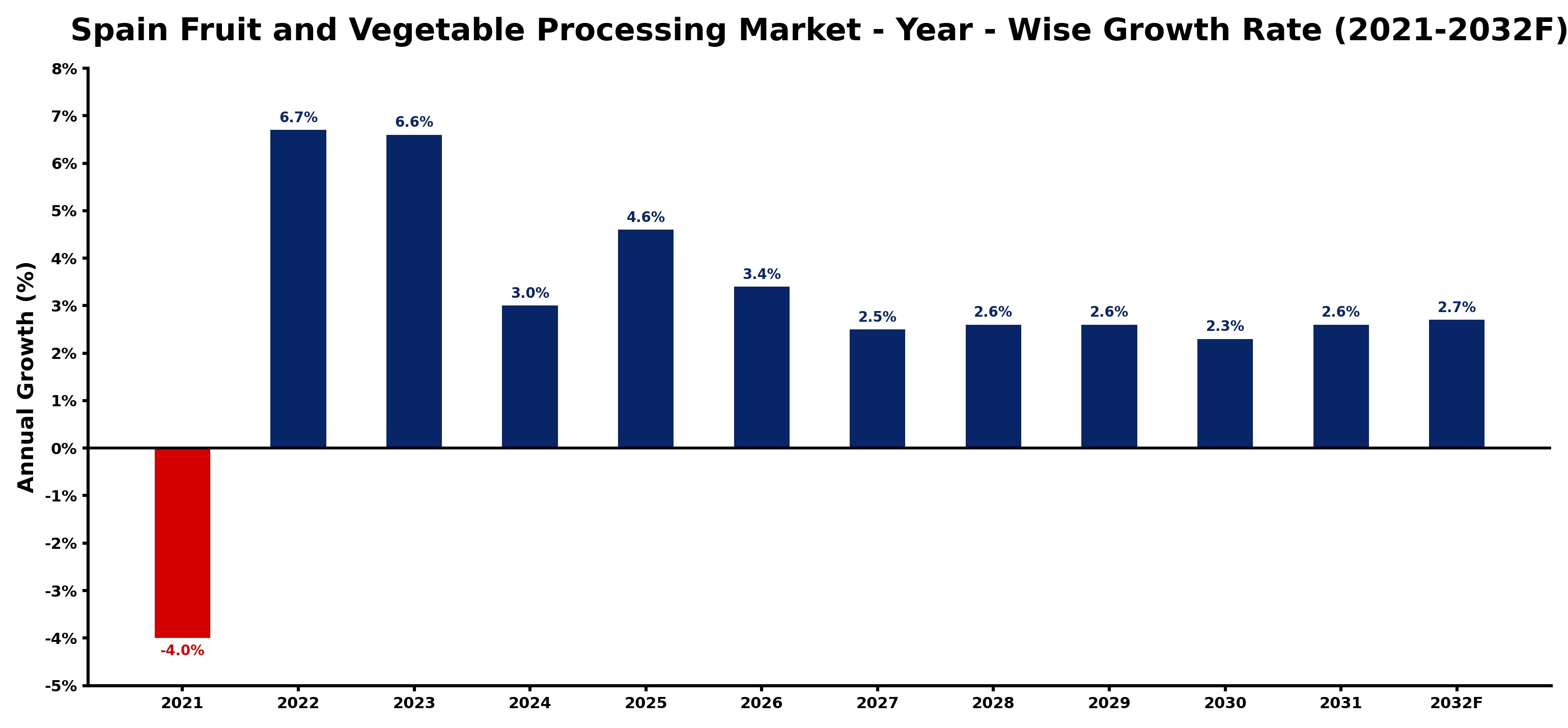
The table below presents the year‑wise growth rates along with the key drivers influencing the market
| Year | Growth Rate | Major Drivers |
| 2021 | -4.0% | Supply chain disruptions limited production |
| 2022 | 6.7% | Organic product demand increased significantly |
| 2023 | 6.6% | Sustainable packaging adoption gained momentum |
| 2024 | 3.0% | Export opportunities expanded market reach |
| 2025 | 4.6% | Technological advancements improved efficiency |
| 2026 | 3.4% | Consumer health trends influenced choices |
| 2027 | 2.5% | Local sourcing practices enhanced freshness |
| 2028 | 2.6% | Plant-based options attracted new customers |
| 2029 | 2.6% | E-commerce growth enhanced accessibility |
| 2030 | 2.3% | Food safety standards promoted confidence |
| 2031 | 2.6% | Innovative processing techniques optimized output |
| 2032 | 2.7% | Seasonal product offerings diversified selection |
Note - Market size estimations and growth projections presented in this report are based on 6Wresearch's advanced forecasting approach, validated with industry datasets as of June 2026.
Spain Fruit and Vegetable Processing Market Synopsis
In recent years, the Spain Fruit and Vegetable Processing Market has gained momentum, driven by a shift in consumer habits towards convenience and health-oriented food products. However, as the market moves forward, the focus will increasingly shift towards organic and sustainable options, reflecting the evolving preferences of consumers.
This evolution is matched by technological advancements that enhance product quality and nutritional value, suggesting a dynamic landscape ahead. While the current growth is encouraging, the future will likely see heightened competition and innovation as manufacturers adapt to consumer demands for unique, healthy products.
Spain Fruit and Vegetable Processing Market Key Takeaways
- Steady market growth is supported by rising disposable incomes and changing consumer preferences.
- Technological innovations are critical for enhancing product quality and expanding offerings.
- The trend towards organic and natural products is increasingly influencing market strategies.
- Sustainable practices and collaboration with local producers are essential for competitive advantage.
- Government policies provide a supportive framework for growth and innovation in the sector.
Evaluation of Restraints in Spain Fruit and Vegetable Processing Market
Despite its growth potential, the Spain Fruit and Vegetable Processing Market faces several restraints. Fluctuating raw material prices present significant challenges, affecting profit margins and operational stability for processors. Additionally, the increasing influx of imports intensifies competition, placing further strain on local producers. Stringent food safety regulations necessitate continual investments in quality control, complicating operations for smaller companies. To thrive in this landscape, businesses must develop strategic plans that encompass cost management, quality assurance, and market differentiation.
Spain Fruit and Vegetable Processing Market Trends
Current trends within the Spain Fruit and Vegetable Processing Market reveal a pronounced shift toward organic and clean-label products, as consumers increasingly prioritize health and environmental sustainability. Convenience continues to reign, with ready-to-eat options gaining traction among busy consumers. Innovation in processing technologies, including cold-pressed and freeze-drying methods, is becoming more common as manufacturers strive to meet the demands for higher quality, flavor, and nutritional content. This ongoing evolution signals a vibrant and responsive market.
Spain Fruit and Vegetable Processing Market Opportunities
The landscape of the Spain Fruit and Vegetable Processing Market is rich with investment opportunities. With consumers gravitating towards health-conscious food choices, there is a growing demand for innovative and high-quality processed products. Entrepreneurs can capitalize on this trend by developing novel processing technologies or enhancing product offerings. Moreover, there is significant potential for international expansion, leveraging Spain's strong reputation for quality produce. Engaging in sustainable practices and ensuring a stable supply chain through partnerships with local farmers can further distinguish businesses in this competitive market.
Government Initiatives in the Spain Fruit and Vegetable Processing Market
Government policies play a vital role in supporting the Spain Fruit and Vegetable Processing Market. The European Union's Common Agricultural Policy (CAP) offers essential subsidies and assistance to both farmers and processors, ensuring stable economic conditions. Furthermore, Spain's Ministry of Agriculture, Fisheries, and Food enforces regulations that uphold food safety, quality standards, and traceability, promoting a higher standard within the industry. Through various funding programs and incentives, the government encourages research and innovation, fostering a robust environment for growth and sustainability.
Future Insights of the Spain Fruit and Vegetable Processing Market
Looking ahead to 2026-2032, the Spain Fruit and Vegetable Processing Market is poised for continued expansion. The burgeoning consumer demand for convenience and healthy options will drive growth, coupled with ongoing technological advancements that enhance processing methods and product quality. The increasing emphasis on organic and natural products is expected to create further opportunities, as companies innovate to meet the preferences of health-conscious consumers. Overall, the market is set to flourish, offering a vibrant landscape for businesses that align with these evolving trends.
Spain Fruit and Vegetable Processing Market Latest Developments (May 2025 - June 2026)
Recent developments within the Spain Fruit and Vegetable Processing Market highlight a trend towards enhancing supply chain transparency and sustainability. Companies are increasingly focusing on adopting innovative processing techniques to improve product offerings. Additionally, there have been notable initiatives aimed at reducing food waste within the processing sector, signaling a commitment to both quality and environmental responsibility. These efforts are expected to shape the competitive dynamics of the market in the near future.
Spain Fruit and Vegetable Processing Market - Key Attractiveness of the Report
- 10 Years of Market Numbers
- Historical Data Starting from 2022 to 2025
- Base Year: 2025
- Forecast Data until 2032
- Key Performance Indicators Impacting the Market
- Major Upcoming Developments and Projects
Key Highlights of the Report:
- Spain Fruit and Vegetable Processing Market Outlook
- Market Size of Spain Fruit and Vegetable Processing Market, 2025
- Forecast of Spain Fruit and Vegetable Processing Market, 2032
- Historical Data and Forecast of Spain Fruit and Vegetable Processing Revenues & Volume for the Period 2022-2032F
- Spain Fruit and Vegetable Processing Market Trend Evolution
- Spain Fruit and Vegetable Processing Market Drivers and Challenges
- Spain Fruit and Vegetable Processing Price Trends
- Spain Fruit and Vegetable Processing Porter's Five Forces
- Spain Fruit and Vegetable Processing Industry Life Cycle
- Historical Data and Forecast of Spain Fruit and Vegetable Processing Market Revenues & Volume By Type for the Period 2022-2032F
- Historical Data and Forecast of Spain Fruit and Vegetable Processing Market Revenues & Volume By Fruits for the Period 2022-2032F
- Historical Data and Forecast of Spain Fruit and Vegetable Processing Market Revenues & Volume By Vegetables for the Period 2022-2032F
- Historical Data and Forecast of Spain Fruit and Vegetable Processing Market Revenues & Volume By Product for the Period 2022-2032F
- Historical Data and Forecast of Spain Fruit and Vegetable Processing Market Revenues & Volume By Fresh for the Period 2022-2032F
- Historical Data and Forecast of Spain Fruit and Vegetable Processing Market Revenues & Volume By Fresh-cut for the Period 2022-2032F
- Historical Data and Forecast of Spain Fruit and Vegetable Processing Market Revenues & Volume By Canned for the Period 2022-2032F
- Historical Data and Forecast of Spain Fruit and Vegetable Processing Market Revenues & Volume By Frozen for the Period 2022-2032F
- Historical Data and Forecast of Spain Fruit and Vegetable Processing Market Revenues & Volume By Dried for the Period 2022-2032F
- Historical Data and Forecast of Spain Fruit and Vegetable Processing Market Revenues & Volume By Processing Equipment for the Period 2022-2032F
- Historical Data and Forecast of Spain Fruit and Vegetable Processing Market Revenues & Volume By Pre-processing for the Period 2022-2032F
- Historical Data and Forecast of Spain Fruit and Vegetable Processing Market Revenues & Volume By Processing for the Period 2022-2032F
- Historical Data and Forecast of Spain Fruit and Vegetable Processing Market Revenues & Volume By Washing for the Period 2022-2032F
- Historical Data and Forecast of Spain Fruit and Vegetable Processing Market Revenues & Volume By Filling for the Period 2022-2032F
- Historical Data and Forecast of Spain Fruit and Vegetable Processing Market Revenues & Volume By Seasoning for the Period 2022-2032F
- Historical Data and Forecast of Spain Fruit and Vegetable Processing Market Revenues & Volume By Packaging for the Period 2022-2032F
- Spain Fruit and Vegetable Processing Import Export Trade Statistics
- Market Opportunity Assessment By Type
- Market Opportunity Assessment By Product
- Market Opportunity Assessment By Processing Equipment
- Spain Fruit and Vegetable Processing Top Companies Market Share
- Spain Fruit and Vegetable Processing Competitive Benchmarking By Technical and Operational Parameters
- Spain Fruit and Vegetable Processing Company Profiles
- Spain Fruit and Vegetable Processing Key Strategic Recommendations






































