Kuwait Gas Chromatography Systems Market Size, Share & Growth Rate
The Kuwait Gas Chromatography Systems Market was estimated at USD 1008 Million in 2025 and is projected to reach USD 1785 Million by 2032, growing at a CAGR of 8.5% from 2026 to 2032. This growth trajectory is largely propelled by the increasing demand for analytical technologies across the oil and gas sector, as well as stringent food safety regulations and environmental monitoring needs. Enhanced capabilities of gas chromatography systems are crucial in fulfilling these demands, ensuring efficient and accurate analysis in various applications.
Kuwait Gas Chromatography Systems Market Year-wise Growth Rate and Key Drivers
This graph highlights how the Kuwait Gas Chromatography Systems Market has steadily grown over the years, supported by major growth factors.
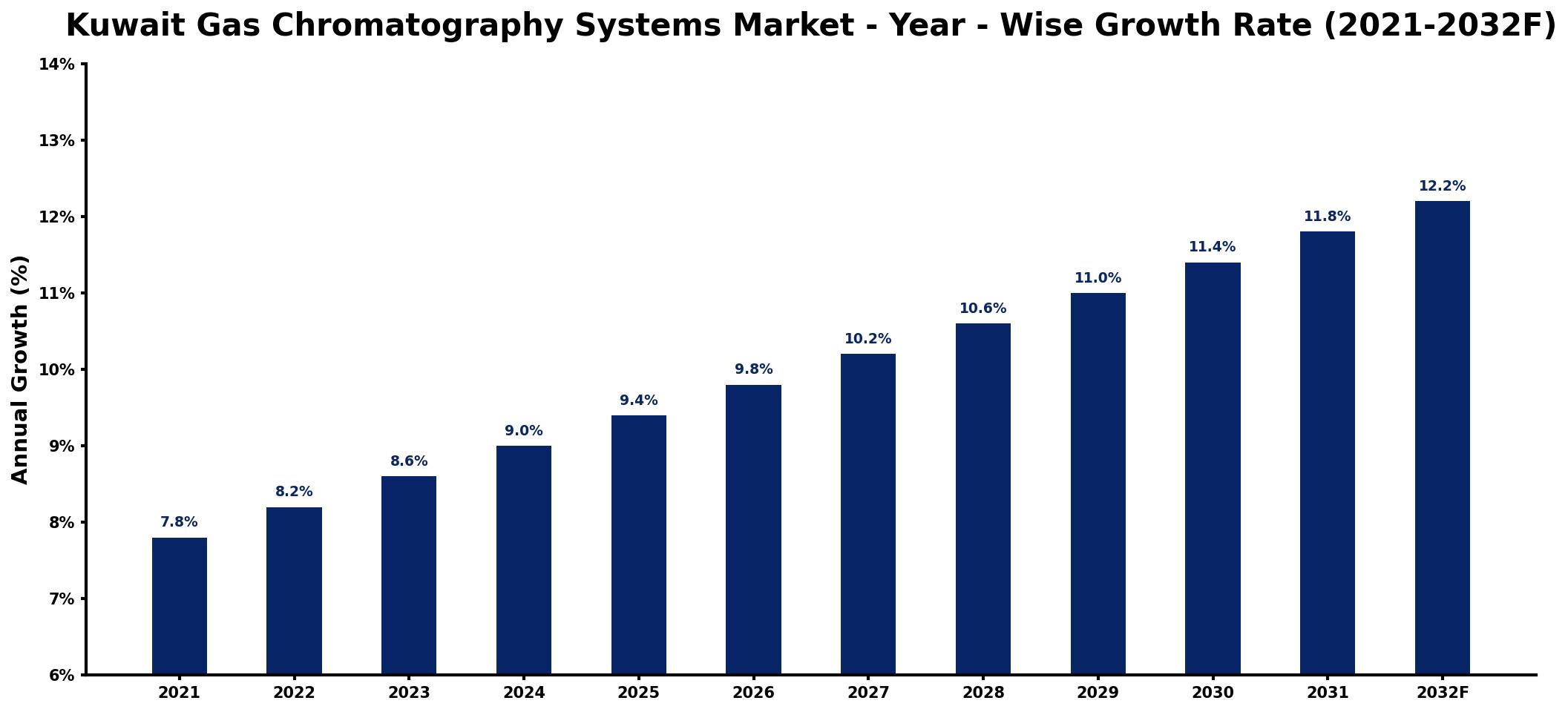
The table below presents the year‑wise growth rates along with the key drivers influencing the market
| Year | Growth Rate | Major Drivers |
| 2021 | 7.8% | Rising industrial research investments |
| 2022 | 8.2% | Increased environmental regulation compliance |
| 2023 | 8.6% | Growing pharmaceutical development activities |
| 2024 | 9.0% | Surge in food safety testing |
| 2025 | 9.4% | Expansion of academic research facilities |
| 2026 | 9.8% | Advancements in analytical technology |
| 2027 | 10.2% | Growing demand for quality assurance |
| 2028 | 10.6% | Increased focus on petrochemical analysis |
| 2029 | 11.0% | Rising need for safety monitoring |
| 2030 | 11.4% | growing automotive sector requirements |
| 2031 | 11.8% | Growing interest in renewable energy |
| 2032 | 12.2% | Increase in environmental sustainability initiatives |
Note: Market size estimations and growth projections presented in this report are based on 6Wresearch's proprietary forecasting methodology, utilizing the latest available industry data, government publications, and primary research inputs.
Kuwait Gas Chromatography Systems Market Synopsis
The strongest force currently shaping the Kuwait Gas Chromatography Systems Market is the increasing demand for advanced analytical technologies across several key industries. The petrochemical sector is a primary driver, requiring precise analysis of hydrocarbon compounds to ensure quality control and compliance.
Moreover, the growing emphasis on environmental monitoring and food safety is pushing industries to adopt sophisticated gas chromatography systems. This adoption is further supported by government initiatives aimed at enhancing research capabilities and establishing high standards for analytical instruments.
Kuwait Gas Chromatography Systems Market Key Takeaways
- The market is benefiting from increasing investments in advanced analytical technologies.
- Regulatory compliance across various sectors is a key growth driver for gas chromatography systems.
- Innovation in system design, including portable units, enhances field application and usability.
- Government policies are facilitating research and development, boosting market expansion.
- Environmental monitoring requirements continue to create significant demand for these systems.
Evaluation of Restraints in Kuwait Gas Chromatography Systems Market
Despite the promising growth, the Kuwait Gas Chromatography Systems Market faces certain restraints that could hinder progress. A notable issue is the limited availability of skilled professionals capable of operating and maintaining these advanced systems. The high initial costs associated with purchasing gas chromatography equipment can also deter investment, particularly among smaller laboratories or research institutions. Furthermore, there is a general lack of awareness regarding the benefits and potential applications of gas chromatography systems, which can limit market penetration.
Kuwait Gas Chromatography Systems Market Trends
Several current and emerging trends are shaping the Kuwait Gas Chromatography Systems Market. Notable among these is the integration of advanced software for data analysis, facilitating improved operational efficiency. Additionally, automation is becoming increasingly common, enhancing the speed and accuracy of analytical processes. There is also a shift towards developing portable and compact systems, making them suitable for on-site testing. Finally, sustainability trends are leading to the introduction of eco-friendly solutions and renewable energy sources, positively influencing product development.
Kuwait Gas Chromatography Systems Market Opportunities
The Kuwait Gas Chromatography Systems Market presents lucrative investment opportunities, particularly due to the rising demand for analytical technologies within the oil and gas sector. As Kuwait continues to focus on refining processes and environmental compliance, investing in advanced gas chromatography systems becomes essential. Furthermore, government initiatives aimed at diversifying the economy and encouraging innovation create fertile ground for partnerships and technology upgrades. Strategic acquisitions and collaborations can be significant paths for stakeholders looking to penetrate this expanding market.
Government Initiatives in the Kuwait Gas Chromatography Systems Market
In Kuwait, the gas chromatography systems market is regulated by government entities such as the Public Authority for Industry (PAI) and the Kuwait Institute for Scientific Research (KISR). These agencies enforce policies that ensure the safety, quality, and efficiency of gas chromatography systems used across various sectors including oil and gas, petrochemicals, and environmental monitoring. Mandatory certifications and compliance with established standards are essential for upholding the reliability of these analytical instruments. Additionally, the government promotes research and development through grants and collaborative initiatives with academic institutions, thereby fostering technological advancement in this field.
Future Insights of the Kuwait Gas Chromatography Systems Market
Looking ahead to 2026-2032, the Kuwait Gas Chromatography Systems Market is positioned for steady growth, driven by continuous technological advancements and the demand for quality analytical instruments across various industries. The increasing focus on regulatory compliance and quality assurance will further fuel market expansion. As industries continue to prioritize advanced analytical capabilities, stakeholders should be poised to leverage these trends to innovate and expand their product offerings in this thriving sector.
Kuwait Gas Chromatography Systems Market Latest Developments (2025 - 2026)
Recent developments in the Kuwait Gas Chromatography Systems Market indicate a growing trend toward the adoption of smart technologies in analytical processes. Companies are beginning to incorporate artificial intelligence and machine learning into gas chromatography systems, enhancing data analysis capabilities and predictive maintenance. Furthermore, a notable increase in collaborative projects between the government and private sectors aims to foster innovation and improve the overall standards of analytical instruments available in the market. These trends suggest a dynamic shift toward more efficient and effective gas chromatography solutions in the near future.
Kuwait Gas Chromatography Systems Market - Key Attractiveness of the Report
- 10 Years of Market Numbers
- Historical Data Starting from 2022 to 2025
- Base Year: 2025
- Forecast Data until 2032
- Key Performance Indicators Impacting the Market
- Major Upcoming Developments and Projects
Key Highlights of the Report:
- Kuwait Gas Chromatography Systems Market Outlook
- Market Size of Kuwait Gas Chromatography Systems Market, 2025
- Forecast of Kuwait Gas Chromatography Systems Market, 2032
- Historical Data and Forecast of Kuwait Gas Chromatography Systems Revenues & Volume for the Period 2022-2032F
- Kuwait Gas Chromatography Systems Market Trend Evolution
- Kuwait Gas Chromatography Systems Market Drivers and Challenges
- Kuwait Gas Chromatography Systems Price Trends
- Kuwait Gas Chromatography Systems Porter's Five Forces
- Kuwait Gas Chromatography Systems Industry Life Cycle
- Historical Data and Forecast of Kuwait Gas Chromatography Systems Market Revenues & Volume By Product for the Period 2022-2032F
- Historical Data and Forecast of Kuwait Gas Chromatography Systems Market Revenues & Volume By Systems for the Period 2022-2032F
- Historical Data and Forecast of Kuwait Gas Chromatography Systems Market Revenues & Volume By Detectors for the Period 2022-2032F
- Historical Data and Forecast of Kuwait Gas Chromatography Systems Market Revenues & Volume By Auto-samplers for the Period 2022-2032F
- Historical Data and Forecast of Kuwait Gas Chromatography Systems Market Revenues & Volume By Fraction Collectors for the Period 2022-2032F
- Historical Data and Forecast of Kuwait Gas Chromatography Systems Market Revenues & Volume By Other Products for the Period 2022-2032F
- Historical Data and Forecast of Kuwait Gas Chromatography Systems Market Revenues & Volume By End User for the Period 2022-2032F
- Historical Data and Forecast of Kuwait Gas Chromatography Systems Market Revenues & Volume By Pharmaceutical and Bioindustries for the Period 2022-2032F
- Historical Data and Forecast of Kuwait Gas Chromatography Systems Market Revenues & Volume By Academic Research Institutes for the Period 2022-2032F
- Historical Data and Forecast of Kuwait Gas Chromatography Systems Market Revenues & Volume By Other End Users for the Period 2022-2032F
- Kuwait Gas Chromatography Systems Import Export Trade Statistics
- Market Opportunity Assessment By Product
- Market Opportunity Assessment By End User
- Kuwait Gas Chromatography Systems Top Companies Market Share
- Kuwait Gas Chromatography Systems Competitive Benchmarking By Technical and Operational Parameters
- Kuwait Gas Chromatography Systems Company Profiles
- Kuwait Gas Chromatography Systems Key Strategic Recommendations






































