Kuwait Interior Design Market Size, Share & Growth Rate
The Kuwait Interior Design Market was estimated at USD 1401 Million in 2025 and is projected to reach USD 2428 Million by 2032, growing at a CAGR of 8.2% from 2026 to 2032. This growth trajectory is largely fueled by an expanding construction sector and a rising demand for both luxury residential and commercial spaces. As the cultural landscape evolves, Kuwait is witnessing a blend of traditional and modern design influences, further driving the need for high-quality interior design services.
Kuwait Interior Design Market Year-wise Growth Rate and Key Drivers
This graph highlights how the Kuwait Interior Design Market has steadily grown over the years, supported by major growth factors.
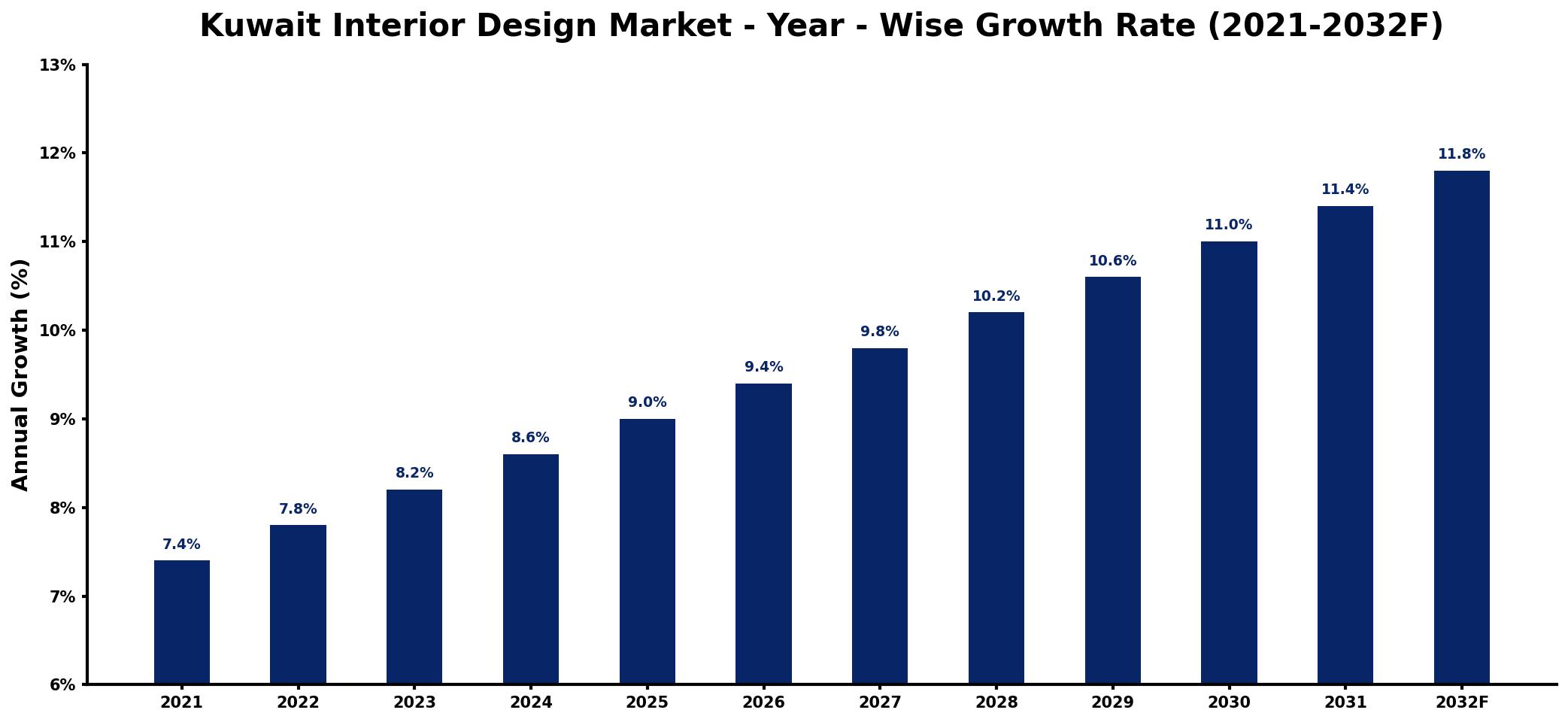
The table below presents the year‑wise growth rates along with the key drivers influencing the market
| Year | Growth Rate | Major Drivers |
| 2021 | 7.4% | Rising disposable income levels |
| 2022 | 7.8% | Increased urban population density |
| 2023 | 8.2% | Growth in tourism sector investments |
| 2024 | 8.6% | Surge in residential construction projects |
| 2025 | 9.0% | Expansion of luxury retail spaces |
| 2026 | 9.4% | Increased focus on sustainability practices |
| 2027 | 9.8% | growing automotive sector requirements |
| 2028 | 10.2% | Rising demand for commercial spaces |
| 2029 | 10.6% | Investments in cultural heritage sites |
| 2030 | 11.0% | Emergence of innovative materials usage |
| 2031 | 11.4% | Growing popularity of remote workspaces |
| 2032 | 11.8% | Enhanced governmental infrastructure projects |
Note: Market size estimations and growth projections presented in this report are based on 6Wresearch's proprietary forecasting methodology, utilizing the latest available industry data, government publications, and primary research inputs.
Kuwait Interior Design Market Synopsis
The strongest force currently shaping the Kuwait Interior Design Market is the booming construction industry. As Kuwait continues to develop its infrastructure and real estate, the demand for sophisticated and opulent interior design solutions is increasing significantly. Designers are embracing a combination of luxury and functionality, appealing to an affluent consumer base eager for customized living and working environments.
Another pivotal factor is the increasing interest in sustainable and eco-friendly designs. This trend is not merely a passing fancy; it's a reflection of a broader cultural shift towards responsible consumption and environmental awareness. Interior designers in Kuwait are increasingly tasked with innovating their projects through the integration of high-quality materials that not only meet aesthetic demands but also promote sustainability.
Kuwait Interior Design Market Key Takeaways
- Rapid growth driven by construction and high demand for luxury spaces.
- Focus on blending traditional and modern design aesthetics.
- Emerging preference for sustainable and eco-friendly materials.
- Increased integration of technology within design projects.
- Opportunities for both local and international design firms.
Evaluation of Restraints in Kuwait Interior Design Market
Despite its growth potential, the Kuwait Interior Design Market faces several restraints. Intense competition among local and international design firms creates a challenging landscape for new entrants and established players alike. Economic fluctuations can impact consumer spending patterns, and there remains a limited availability of skilled labor, which complicates project execution. Furthermore, regulatory requirements pose hurdles that demand careful navigation to ensure compliance while fostering innovation.
Kuwait Interior Design Market Trends
Current trends in the Kuwait Interior Design Market reveal a strong move towards minimalism and contemporary aesthetics. Designers are prioritizing clean lines and functional spaces that enhance the user experience. Additionally, technology plays a significant role, with smart home systems and energy-efficient solutions becoming essential components of modern designs. The fusion of local design heritage with innovative concepts is also gaining traction, creating unique offerings that reflect both cultural richness and modern needs.
Kuwait Interior Design Market Opportunities
Investment opportunities in the Kuwait Interior Design Market are robust, especially within the realms of luxury residential and commercial sectors. With the growing affluence and urbanization, there is a pressing need for high-end interior design services. Companies that focus on sustainable solutions can effectively tap into the environmentally conscious consumer segment. Moreover, partnerships with local architects and property developers can lead to collaborative projects that enhance market presence and client engagement.
Government Initiatives in the Kuwait Interior Design Market
The Kuwaiti government is actively promoting the growth of the Interior Design Market through various policies and regulations. A licensing requirement for interior designers ensures the maintenance of professionalism and quality standards in the industry. Additionally, there are initiatives to support local design firms through grants and subsidies, fostering a competitive environment. The government also encourages sustainable practices within the industry, offering incentives to firms that adopt eco-friendly design approaches.
Future Insights of the Kuwait Interior Design Market
Looking ahead, the Kuwait Interior Design Market is well-positioned for sustained growth through 2032. As urbanization accelerates and the affluent population expands, the appetite for high-quality design services will only increase. The integration of global design trends, coupled with a strong focus on sustainability and technological advancements, will play pivotal roles in shaping the market's future. Interior design firms that can adapt and innovate will find themselves at the forefront of this dynamic landscape.
Kuwait Interior Design Market Latest Developments (2025 - 2026)
Recent developments within the Kuwait Interior Design Market indicate a heightened focus on innovative design solutions that cater to contemporary consumer needs. The market has seen a surge in projects emphasizing sustainability and technology integration, with designers increasingly collaborating with tech firms to enhance functionality. Moreover, the emphasis on local craftsmanship and cultural heritage is gaining momentum, leading to unique offerings that resonate with both residents and expatriates.
Kuwait Interior Design Market - Key Attractiveness of the Report
- 10 Years of Market Numbers
- Historical Data Starting from 2022 to 2025
- Base Year: 2025
- Forecast Data until 2032
- Key Performance Indicators Impacting the Market
- Major Upcoming Developments and Projects
Key Highlights of the Report:
- Kuwait Interior Design Market Outlook
- Market Size of Kuwait Interior Design Market, 2025
- Forecast of Kuwait Interior Design Market, 2032
- Historical Data and Forecast of Kuwait Interior Design Revenues & Volume for the Period 2022-2032F
- Kuwait Interior Design Market Trend Evolution
- Kuwait Interior Design Market Drivers and Challenges
- Kuwait Interior Design Price Trends
- Kuwait Interior Design Porter's Five Forces
- Kuwait Interior Design Industry Life Cycle
- Historical Data and Forecast of Kuwait Interior Design Market Revenues & Volume By End Use for the Period 2022-2032F
- Historical Data and Forecast of Kuwait Interior Design Market Revenues & Volume By Commercial for the Period 2022-2032F
- Historical Data and Forecast of Kuwait Interior Design Market Revenues & Volume By Residential for the Period 2022-2032F
- Historical Data and Forecast of Kuwait Interior Design Market Revenues & Volume By Decoration Type for the Period 2022-2032F
- Historical Data and Forecast of Kuwait Interior Design Market Revenues & Volume By New for the Period 2022-2032F
- Historical Data and Forecast of Kuwait Interior Design Market Revenues & Volume By Renovations for the Period 2022-2032F
- Kuwait Interior Design Import Export Trade Statistics
- Market Opportunity Assessment By End Use
- Market Opportunity Assessment By Decoration Type
- Kuwait Interior Design Top Companies Market Share
- Kuwait Interior Design Competitive Benchmarking By Technical and Operational Parameters
- Kuwait Interior Design Company Profiles
- Kuwait Interior Design Key Strategic Recommendations






































