France Interior Design Market Size, Share & Growth Rate
The France Interior Design Market was estimated at USD 84 Million in 2025 and is projected to reach USD 93 Million by 2032, growing at a CAGR of 1.5% from 2026 to 2032. This growth trajectory is largely attributed to the enduring allure of French design aesthetics, paired with a burgeoning demand for eco-friendly and sustainable solutions. As consumers increasingly seek customized luxury and innovative designs, the market is well-positioned to meet these evolving demands.
France Interior Design Market Year-wise Growth Rate and Key Drivers
This graph highlights how the France Interior Design Market has steadily grown over the years, supported by major growth factors.
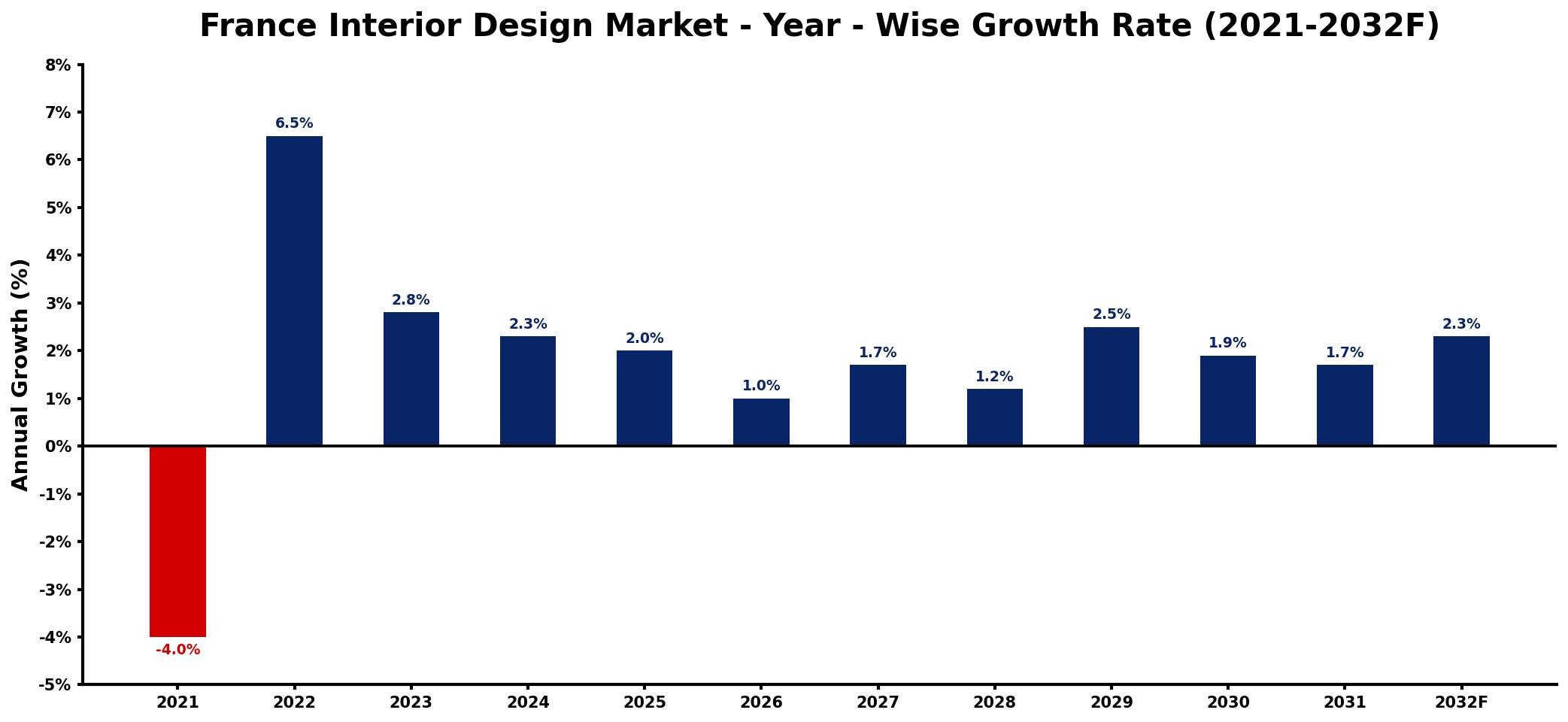
The table below presents the year‑wise growth rates along with the key drivers influencing the market
| Year | Growth Rate | Major Drivers |
| 2021 | -4.0% | reduced consumer spending on renovations |
| 2022 | 6.5% | increased demand for sustainable materials |
| 2023 | 2.8% | growth in remote workspaces demand |
| 2024 | 2.3% | expansion of smart home technology |
| 2025 | 2.0% | growing downstream application demand |
| 2026 | 1.0% | increased investment in residential projects |
| 2027 | 1.7% | growing popularity of minimalistic styles |
| 2028 | 1.2% | increased focus on wellness environments |
| 2029 | 2.5% | surge in luxury home renovations |
| 2030 | 1.9% | growing regional consumption patterns |
| 2031 | 1.7% | improved processing technologies adoption |
| 2032 | 2.3% | increased collaboration with local artisans |
Note: Market size estimations and growth projections presented in this report are based on 6Wresearch's proprietary forecasting methodology, utilizing the latest available industry data, government publications, and primary research inputs.
France Interior Design Market Synopsis
In France, the interior design market is witnessing a remarkable evolution, where traditional elegance intersects with contemporary innovation. This unique blend not only appeals to local consumers but also attracts international clients eager for that quintessential French flair in their spaces.
Sustainability is fast becoming a cornerstone of design philosophy, with designers increasingly opting for eco-friendly materials and methods. The resurgence of classic French styles, thoughtfully reimagined for modern sensibilities, complements this trend, showcasing the depth and versatility of the market.
France Interior Design Market Key Takeaways
- High-end residential and commercial spaces are driving the demand for sophisticated interior designs in France.
- There is a growing preference for sustainable and eco-friendly materials among consumers and designers alike.
- Digital technologies and online platforms are becoming essential tools for design inspiration and product sourcing.
- The integration of smart home technology is transforming the way consumers experience their living spaces.
- Investment opportunities abound, particularly in sustainable design solutions and collaborations with local artisans.
Evaluation of Restraints in France Interior Design Market
Despite its vibrancy, the French interior design market faces several constraints that could impact its growth. The increasing competition from both established firms and emerging designers complicates the landscape, making differentiation vital. Moreover, fluctuating economic conditions can affect consumer spending patterns, particularly in the luxury segment. Additionally, stringent regulatory requirements and licensing hurdles may deter new entrants and slow innovation. The rapid pace of changing client preferences necessitates continuous adaptation by designers, which can stretch resources thin in a competitive environment.
France Interior Design Market Trends
A notable trend within the France Interior Design Market is the pivot towards sustainability, with designers integrating natural materials such as wood and stone into their projects. The minimalist approach continues to hold sway, characterized by clean lines and a subdued color palette. Simultaneously, the marriage of vintage and retro elements with contemporary styles is gaining traction, allowing for unique and personalized designs. Furthermore, the rise of smart home technology is leading to increased consumer interest in high-tech solutions that enhance both convenience and aesthetics.
France Interior Design Market Opportunities
Investment opportunities within the France Interior Design Market are abundant, particularly for entities focusing on sustainable design solutions. The shift towards smart home technologies presents a lucrative avenue for businesses willing to innovate. Additionally, collaborations with local artisans can create a distinctive market position, emphasizing quality and heritage. Targeting the luxury segment remains a profitable niche, as affluent consumers continue to seek bespoke design services that reflect their individual styles.
Government Initiatives in the France Interior Design Market
The French government is actively supporting the interior design sector through various initiatives aimed at promoting sustainability and innovation. Regulations ensure that safety standards and environmental protections are upheld, encouraging the use of eco-friendly materials. Additionally, tax incentives and grants are available to support startups and small businesses within the industry. Collaborative efforts with educational institutions aim to foster a skilled workforce capable of driving future growth and creativity.
Future Insights of the France Interior Design Market
Looking forward to the period from 2026 to 2032, the France Interior Design Market appears poised for positive growth. The demand for sustainable and eco-conscious designs is expected to continue rising, shaping the future landscape of interior design in the country. The integration of digital services and virtual consultations will likely expand market accessibility, allowing consumers to engage in design processes more readily. With the French emphasis on aesthetics and luxury, customized and innovative design solutions will remain in high demand.
France Interior Design Market Latest Developments (2025 - 2026)
In recent months, the France Interior Design Market has seen significant shifts towards adopting sustainable practices, with designers increasingly showcasing eco-friendly materials at major trade events. Virtual design consultations are becoming more mainstream, offering clients a convenient way to access expert services. Additionally, many designers are embracing technology to enhance their portfolios and client interactions, resulting in a more dynamic and engaging industry atmosphere.
France Interior Design Market - Key Attractiveness of the Report
- 10 Years of Market Numbers
- Historical Data Starting from 2022 to 2025
- Base Year: 2025
- Forecast Data until 2032
- Key Performance Indicators Impacting the Market
- Major Upcoming Developments and Projects
Key Highlights of the Report:
- France Interior Design Market Outlook
- Market Size of France Interior Design Market, 2025
- Forecast of France Interior Design Market, 2032
- Historical Data and Forecast of France Interior Design Revenues & Volume for the Period 2022-2032F
- France Interior Design Market Trend Evolution
- France Interior Design Market Drivers and Challenges
- France Interior Design Price Trends
- France Interior Design Porter's Five Forces
- France Interior Design Industry Life Cycle
- Historical Data and Forecast of France Interior Design Market Revenues & Volume By End Use for the Period 2022-2032F
- Historical Data and Forecast of France Interior Design Market Revenues & Volume By Commercial for the Period 2022-2032F
- Historical Data and Forecast of France Interior Design Market Revenues & Volume By Residential for the Period 2022-2032F
- Historical Data and Forecast of France Interior Design Market Revenues & Volume By Decoration Type for the Period 2022-2032F
- Historical Data and Forecast of France Interior Design Market Revenues & Volume By New for the Period 2022-2032F
- Historical Data and Forecast of France Interior Design Market Revenues & Volume By Renovations for the Period 2022-2032F
- France Interior Design Import Export Trade Statistics
- Market Opportunity Assessment By End Use
- Market Opportunity Assessment By Decoration Type
- France Interior Design Top Companies Market Share
- France Interior Design Competitive Benchmarking By Technical and Operational Parameters
- France Interior Design Company Profiles
- France Interior Design Key Strategic Recommendations






































