Kuwait Middleware Market Size & Growth Rate (2026-2032)
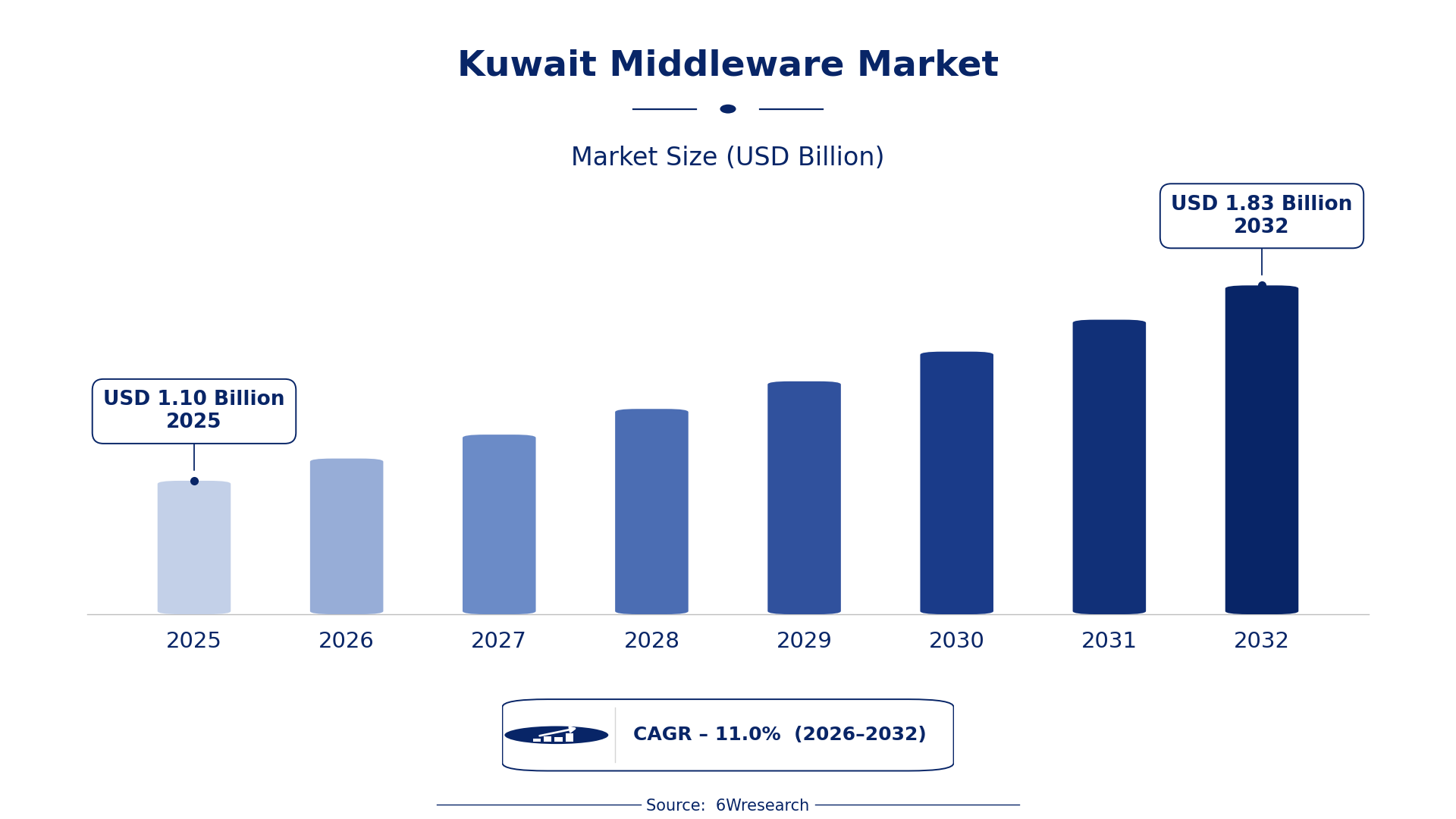
The Kuwait Middleware Market was estimated at USD 1104 Million in 2025 and is projected to reach USD 1831 Million by 2032, growing at a CAGR of 11.0% from 2026 to 2032.
Kuwait Middleware Market Synopsis
The primary driver of the Kuwait Middleware Market is the increasing demand for efficient IT infrastructure. As organizations shift towards cloud computing and seek to optimize their operations, middleware solutions are becoming essential for integrating various applications and ensuring smooth data exchange.
In Kuwait, businesses are increasingly adopting integration platforms to enhance digital capabilities. This trend is not merely a reflection of technological advancement but also a necessity for operational efficiency, particularly as companies aim to improve customer engagement and streamline their processes.
Kuwait Middleware Market Year-wise Growth Rate and Key Drivers
This graph illustrates the annual growth rates of the Kuwait Middleware Market from 2021 to 2032, highlighting a steady upward trajectory and projected expansion over the forecast period.
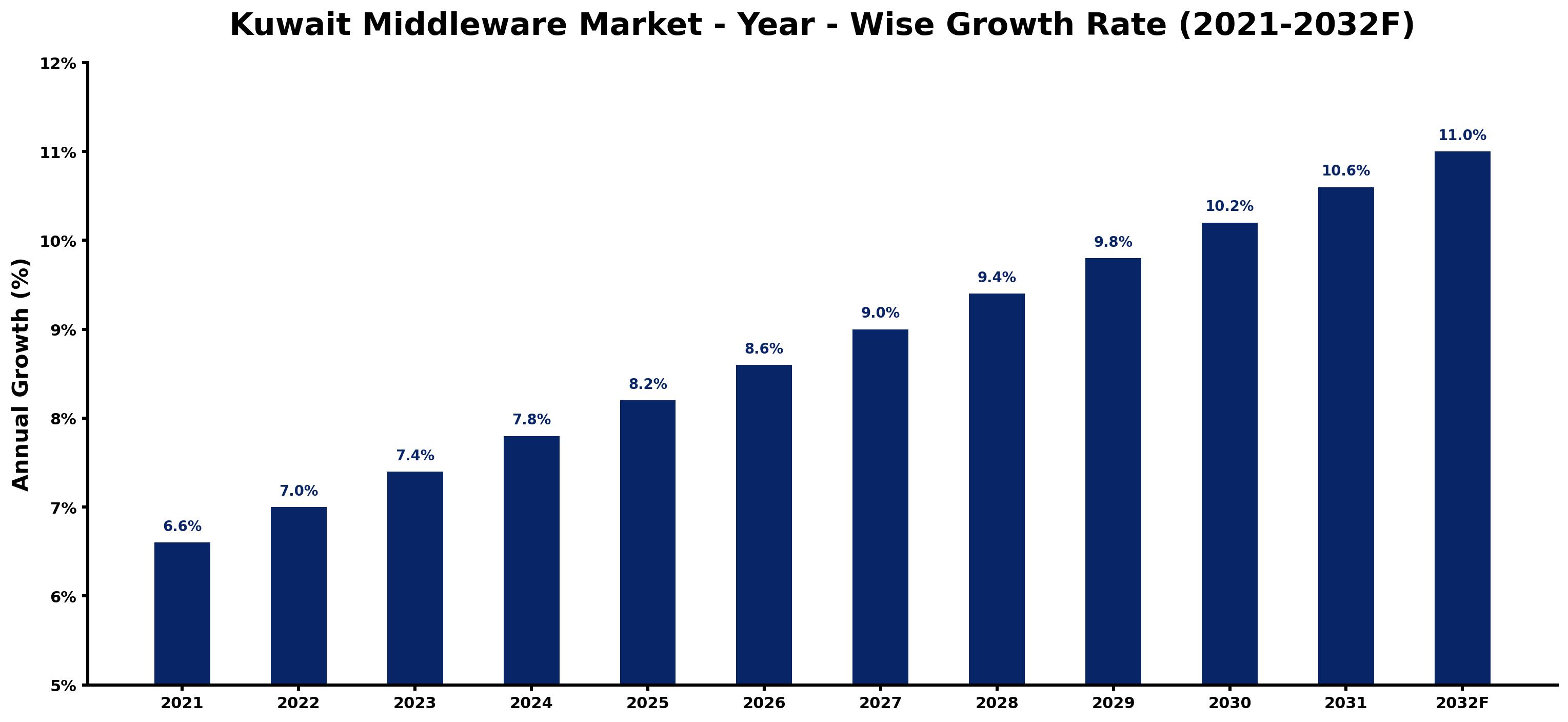
The table below presents the year‑wise growth rates along with the key drivers influencing the market
| Year | Growth Rate | Major Drivers |
| 2021 | 6.6% | Kuwaiti businesses adopting digital transformation strategies rapidly. |
| 2022 | 7.0% | Increased government initiatives for smart city developments. |
| 2023 | 7.4% | Growing interest in cybersecurity measures post major breaches. |
| 2024 | 7.8% | Enhancements in local data privacy regulations supporting middleware. |
| 2025 | 8.2% | Rise in remote work driving cloud-based middleware adoption. |
| 2026 | 8.6% | Kuwait's economic diversification plans boosting tech investments. |
| 2027 | 9.0% | Private sector funding for innovative tech solutions increasing. |
| 2028 | 9.4% | Local universities enhancing IT curriculum fostering middleware expertise. |
| 2029 | 9.8% | Kuwait's telecom advancements improving middleware accessibility. |
| 2030 | 10.2% | Government support for startups accelerating middleware innovations. |
| 2031 | 10.6% | Investment in fintech solutions demanding sophisticated middleware integration. |
| 2032 | 11.0% | Rising adoption of AI technologies requiring advanced middleware frameworks. |
Note: Market size estimations and growth projections presented in this report are based on 6Wresearch's proprietary forecasting methodology, utilizing the latest available industry data, government publications, and primary research inputs.
Kuwait Middleware Market Key Takeaways
Below are some of the specific key takeaways from the market, including:
- The Kuwait Middleware Market is projected to grow significantly, reaching USD 1831 Million by 2032.
- Integration and application development platforms are critical for businesses aiming to enhance operational efficiency.
- Middleware solutions support essential applications like ERP, CRM, and e-commerce, driving demand across sectors.
- The market faces challenges from high technology costs and competition from global providers.
- Continuous innovation is necessary to meet evolving regulatory standards and operational demands.
Evaluation of Restraints in Kuwait Middleware Market
Despite the promising growth, the Kuwait Middleware Market encounters substantial restraints. High costs associated with advanced middleware technologies pose a significant barrier for many organizations. on top of that, continuous innovation is required to keep pace with evolving integration needs and to maintain competitiveness against global players. Compliance with international regulations also adds layers of complexity and potential operational costs. Companies must also tackle the integration of new middleware solutions with existing IT infrastructure, which can be a daunting task, particularly for larger organizations.
Kuwait Middleware Market Trends
Several key trends are shaping the demand for middleware solutions in Kuwait. The rise of cloud computing is leading businesses to seek middleware that can facilitate the integration of cloud-based applications with on-premises systems. Additionally, the focus on enhancing customer experience is pushing companies to invest in more sophisticated middleware that supports real-time data exchange and analytics.
on top of that, the adoption of microservices architecture is gaining traction, necessitating flexible middleware solutions that can adapt to changing business needs. As organizations embrace digital transformation, middleware is becoming a cornerstone of their IT strategies, enabling them to optimize workflows and enhance interoperability.
Kuwait Middleware Market Opportunities
The Kuwait Middleware Market presents several opportunities for growth and investment. The ongoing digital transformation initiatives in both public and private sectors create a fertile ground for middleware solutions. Companies can capitalize on the increasing demand for integration solutions, particularly in industries such as finance, healthcare, and retail.
Additionally, the expansion of cloud services offers a significant avenue for middleware providers to enhance their offerings. As businesses seek to streamline operations, those that offer innovative, cost-effective middleware solutions are likely to capture a substantial share of the market.
Government Initiatives in the Kuwait Middleware Market
Government policy plays a crucial role in shaping the Kuwait Middleware Market. With a clear focus on digital transformation, the government is implementing initiatives that promote the development of advanced middleware solutions. By supporting software development and integration initiatives, the state is fostering an environment conducive to technological innovation.
- A national digital transformation strategy launched in early 2025 aims to enhance the integration of IT systems across government agencies.
- Current initiatives focus on funding middleware solutions that improve operational efficiency for public sector organizations.
- A regulatory framework introduced in 2025 mandates compliance with international standards, impacting middleware development and deployment.
- Planned public-private partnerships expected to emerge by 2028 will further support infrastructure upgrades, enhancing middleware capabilities.
- Ongoing training programs for IT professionals are designed to improve skills related to middleware technologies, which are essential for effective implementation.
Future Insights of the Kuwait Middleware Market
Looking ahead to 2026-2032, the Kuwait Middleware Market is set to experience notable advancements. As businesses increasingly rely on digital solutions, the demand for effective middleware will only grow. The integration of artificial intelligence and machine learning into middleware solutions is expected to enhance their functionality, making them more adaptive to user needs.
on top of that, with the government's continued investment in digital infrastructure, middleware will be crucial for enabling seamless communication between various systems. Companies that focus on innovation and adaptability will likely find themselves at the forefront of this evolving market.
Kuwait Middleware Market Latest Developments
In the last 12-14 months, the Kuwait Middleware Market has seen a surge in activity as organizations increasingly recognize the importance of integration solutions. Several initiatives and partnerships have been launched to address the growing demand for efficient middleware technologies.
- A major technology vendor unveiled a new middleware platform in Q1 2025 aimed at enhancing cloud integration capabilities for local businesses.
- An initiative that began in mid-2025 focuses on upgrading existing IT infrastructures to support advanced middleware solutions.
- A partnership between a leading regional operator and a software developer, launched in late 2025, aims to create tailored middleware solutions for the retail sector.
- Upcoming in early 2026 is a regional conference focusing on middleware technologies, which will showcase innovations and best practices.
- A local startup is expected to launch a new middleware-as-a-service offering in late 2026, targeting small and medium enterprises.
Kuwait Middleware Market - Key Attractiveness of the Report
- 10 Years of Market Numbers
- Historical Data Starting from 2022 to 2025
- Base Year: 2025
- Forecast Data until 2032
- Key Performance Indicators Impacting the Market
- Major Upcoming Developments and Projects
Key Highlights of the Report:
- Kuwait Middleware Market Outlook
- Market Size of Kuwait Middleware Market, 2025
- Forecast of Kuwait Middleware Market, 2032
- Historical Data and Forecast of Kuwait Middleware Revenues & Volume for the Period 2022-2032F
- Kuwait Middleware Market Trend Evolution
- Kuwait Middleware Market Drivers and Challenges
- Kuwait Middleware Price Trends
- Kuwait Middleware Porter's Five Forces
- Kuwait Middleware Industry Life Cycle
- Historical Data and Forecast of Kuwait Middleware Market Revenues & Volume By Product Type for the Period 2022-2032F
- Historical Data and Forecast of Kuwait Middleware Market Revenues & Volume By Communication Middleware for the Period 2022-2032F
- Historical Data and Forecast of Kuwait Middleware Market Revenues & Volume By Platform Middleware for the Period 2022-2032F
- Historical Data and Forecast of Kuwait Middleware Market Revenues & Volume By Integration Middleware for the Period 2022-2032F
- Historical Data and Forecast of Kuwait Middleware Market Revenues & Volume By Others for the Period 2022-2032F
- Historical Data and Forecast of Kuwait Middleware Market Revenues & Volume By Deployment Types for the Period 2022-2032F
- Historical Data and Forecast of Kuwait Middleware Market Revenues & Volume By On-Premise for the Period 2022-2032F
- Historical Data and Forecast of Kuwait Middleware Market Revenues & Volume By Hosted for the Period 2022-2032F
- Historical Data and Forecast of Kuwait Middleware Market Revenues & Volume By Hybrid for the Period 2022-2032F
- Historical Data and Forecast of Kuwait Middleware Market Revenues & Volume By Organization Size for the Period 2022-2032F
- Historical Data and Forecast of Kuwait Middleware Market Revenues & Volume By Small businesses for the Period 2022-2032F
- Historical Data and Forecast of Kuwait Middleware Market Revenues & Volume By Medium businesses for the Period 2022-2032F
- Historical Data and Forecast of Kuwait Middleware Market Revenues & Volume By Enterprises for the Period 2022-2032F
- Historical Data and Forecast of Kuwait Middleware Market Revenues & Volume By Large enterprises for the Period 2022-2032F
- Historical Data and Forecast of Kuwait Middleware Market Revenues & Volume By Verticals for the Period 2022-2032F
- Historical Data and Forecast of Kuwait Middleware Market Revenues & Volume By Banking, financial services and insurance (BFSI) for the Period 2022-2032F
- Historical Data and Forecast of Kuwait Middleware Market Revenues & Volume By Consumer Goods and Retail for the Period 2022-2032F
- Historical Data and Forecast of Kuwait Middleware Market Revenues & Volume By IT and telecom for the Period 2022-2032F
- Historical Data and Forecast of Kuwait Middleware Market Revenues & Volume By Manufacturing for the Period 2022-2032F
- Historical Data and Forecast of Kuwait Middleware Market Revenues & Volume By Oil and Gas for the Period 2022-2032F
- Historical Data and Forecast of Kuwait Middleware Market Revenues & Volume By Healthcare for the Period 2022-2032F
- Historical Data and Forecast of Kuwait Middleware Market Revenues & Volume By Government for the Period 2022-2032F
- Kuwait Middleware Import Export Trade Statistics
- Market Opportunity Assessment By Product Type
- Market Opportunity Assessment By Deployment Types
- Market Opportunity Assessment By Organization Size
- Market Opportunity Assessment By Verticals
- Kuwait Middleware Top Companies Market Share
- Kuwait Middleware Competitive Benchmarking By Technical and Operational Parameters
- Kuwait Middleware Company Profiles
- Kuwait Middleware Key Strategic Recommendations






































