Latin America Breakfast Food Market Size, Share & Growth Rate
The Latin America Breakfast Food Market was estimated at USD 295 Million in 2025 and is projected to reach USD 391 Million by 2032, growing at a CAGR of 4.1% from 2026 to 2032. This growth trajectory is primarily fueled by evolving food habits and the increasing influence of western culture on consumer dietary choices, leading to a rising demand for convenient meal solutions. Enhanced consumer awareness of nutritional benefits, coupled with a growing middle class and urbanization trends, further contributes to this promising market outlook.
Latin America Breakfast Food Market Year-wise Growth Rate and Key Drivers
This graph highlights how the Latin America Breakfast Food Market has steadily grown over the years, supported by major growth factors.
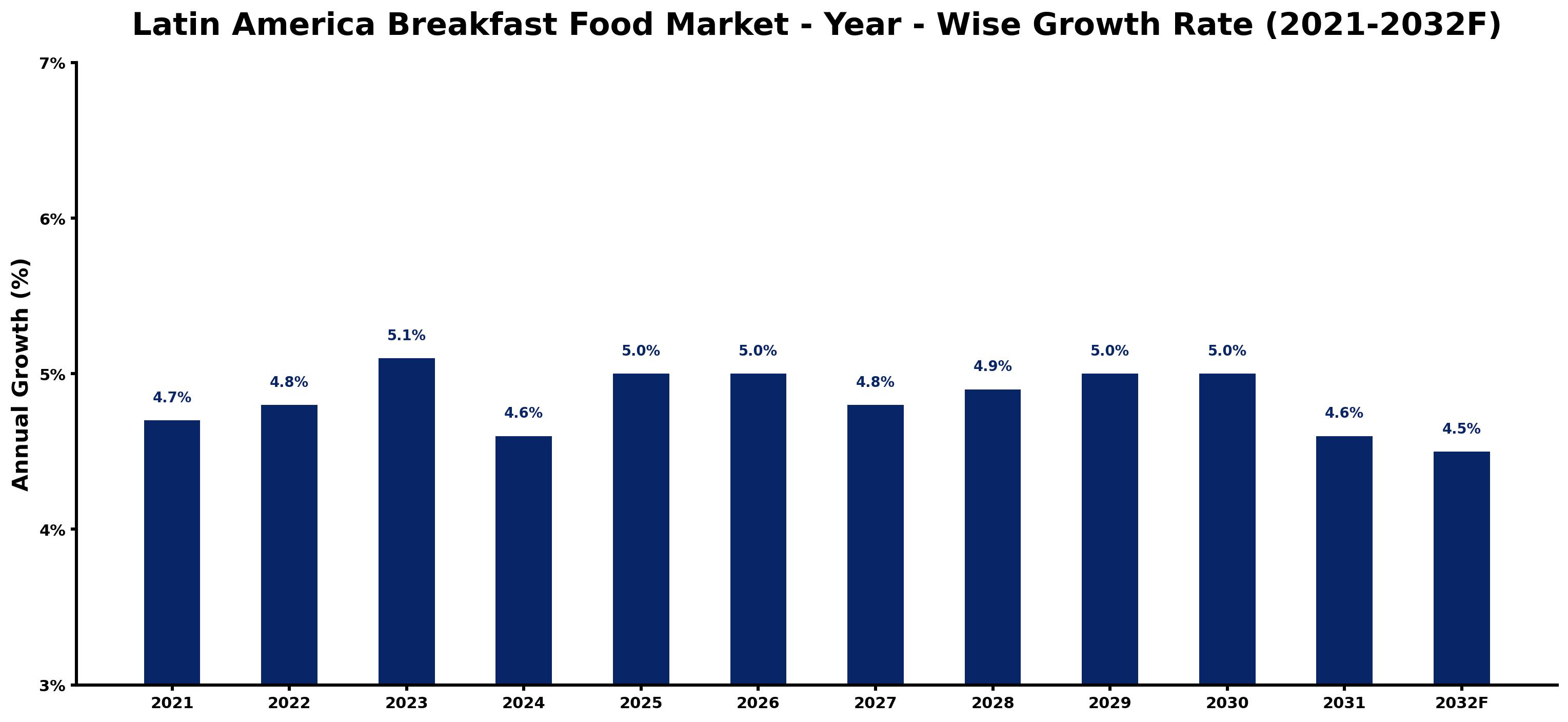
The table below presents the year‑wise growth rates along with the key drivers influencing the market
| Year | Growth Rate | Major Drivers |
| 2021 | 4.7% | Rapid growth in telecom and data center sectors |
| 2022 | 4.8% | Expansion of manufacturing activities |
| 2023 | 5.1% | Growing urbanization and commercial development |
| 2024 | 4.6% | Rapid growth in telecom and data center sectors |
| 2025 | 5.0% | Expansion of manufacturing activities |
| 2026 | 5.0% | Increasing industrial infrastructure investments |
| 2027 | 4.8% | Expansion of transportation and logistics networks |
| 2028 | 4.9% | Rapid growth in telecom and data center sectors |
| 2029 | 5.0% | Rising electricity demand across industries |
| 2030 | 5.0% | Increasing smart city development projects |
| 2031 | 4.6% | Increasing smart city development projects |
| 2032 | 4.5% | Growing urbanization and commercial development |
Note - Market size estimations and growth projections presented in this report are based on 6Wresearch’s advanced forecasting approach, validated with industry datasets as of June 2026.
Latin America Breakfast Food Market Synopsis
The most significant force currently shaping the Latin America Breakfast Food Market is the rapid shift towards convenience-oriented products. As consumers increasingly seek quick and accessible meal options, ready-to-eat products are gaining popularity, driven by busy lifestyles and time constraints.
Furthermore, the surge in home consumption during the pandemic has cemented breakfast food as a staple in households, with many brands innovating to maintain consumer engagement. The adaptability of companies in introducing healthier and organic product variants is also playing a crucial role in market dynamics.
Latin America Breakfast Food Market Key Takeaways
- The market is predominantly influenced by the convenience of ready-to-eat breakfast products, particularly among busy urban consumers.
- Brazil stands as the leading contributor to market revenue, with Argentina following closely due to shared consumer preferences and lifestyle trends.
- Awareness of the adverse effects of high sugar intake is reshaping product formulations and driving healthier alternatives across several countries.
- Distribution channels, particularly supermarkets and online retail, are evolving, emphasizing the need for brands to enhance their reach.
- Government regulations on labeling and health initiatives are impacting consumer choices and product developments in the region.
Evaluation of Restraints in Latin America Breakfast Food Market
Despite the growth potential, several key restraints limit the advancement of the Latin America Breakfast Food Market. A notable factor is the strong preference for traditional breakfast foods, which continues to compete with emerging convenience products. This inclination towards cultural norms can slow the acceptance of new offerings. Additionally, the growing concern over sugar consumption and the implementation of stringent labeling regulations in various countries, particularly Colombia and Chile, pose challenges for brands trying to reformulate products. The Covid-19 pandemic exacerbated these issues by disrupting supply chains and consumer habits, resulting in a temporary decline in sales.
Latin America Breakfast Food Market Trends
Current trends in the Latin America Breakfast Food Market highlight an increasing consumer focus on health and wellness. The demand for whole grain and organic ingredients is on the rise, as consumers look for products that offer both convenience and nutritional value. Innovations in packaging and product formats, such as on-the-go options, are gaining traction, reflecting the dynamic lifestyle of consumers in urban areas. Moreover, the shift towards online shopping has accelerated, especially post-pandemic, as consumers seek the convenience of home delivery services for their breakfast needs.
Latin America Breakfast Food Market Opportunities
The landscape of opportunities in the Latin America Breakfast Food Market is ripe for exploration, especially for brands that can seamlessly integrate health and convenience. The growing middle class, with its increasing disposable income, presents a vast consumer base ready to invest in premium breakfast products. Furthermore, regions experiencing significant urbanization are prime targets for innovative ready-to-eat solutions. Companies that successfully adapt to consumer preferences for healthier options and sustainable practices will find substantial growth potential in this evolving market.
Government Initiatives in the Latin America Breakfast Food Market
Various government initiatives aimed at improving public health and nutrition are influencing the Latin America Breakfast Food Market. Policies focused on reducing sugar consumption and promoting healthier eating habits are being adopted, which in turn impact product formulation and labeling requirements. These regulations encourage manufacturers to innovate and align their products with health standards, fostering a competitive environment that prioritizes consumer wellness. Additionally, public health campaigns aimed at increasing awareness around nutrition further support the market's evolution towards healthier breakfast options.
Future Insights of the Latin America Breakfast Food Market
Looking ahead to 2026-2032, the Latin America Breakfast Food Market is anticipated to evolve with a stronger emphasis on health-conscious products and sustainable practices. As consumers become increasingly discerning, brands that prioritize transparency, quality ingredients, and innovative solutions will stand out. The continued rise in digital commerce will reshape distribution strategies, with an expected increase in online purchasing. Overall, the market is poised for steady growth, underpinned by demographic shifts and an enduring love for breakfast, albeit with a modern twist.
Latin America Breakfast Food Market Latest Developments (May 2025 - June 2026)
Recent developments in the Latin America Breakfast Food Market indicate a shift towards embracing healthier formulations and expanding product lines to include organic options. Brands are increasingly focusing on consumer feedback to enhance taste and health profiles. Additionally, promotional campaigns targeting young consumers are gaining momentum, highlighting the importance of breakfast as a vital meal. Innovations in packaging, such as eco-friendly materials, are also being introduced as companies align with sustainability trends.
Latin America Breakfast Food Market - Key Attractiveness of the Report
- 10 Years of Market Numbers
- Historical Data Starting from 2022 to 2025
- Base Year: 2025
- Forecast Data until 2032
- Key Performance Indicators Impacting the Market
- Major Upcoming Developments and Projects
Key Highlights of the Report:
- Latin America Breakfast Food Market Outlook
- Market Size of Latin America Breakfast Food Market, 2025
- Forecast of Latin America Breakfast Food Market, 2032F
- Historical Data and Forecast of Latin America Breakfast Food Revenues & Volume for the Period 2022-2032F
- Latin America Breakfast Food Market Trend Evolution
- Latin America Breakfast Food Market Drivers and Challenges
- Latin America Breakfast Food Price Trends
- Latin America Breakfast Food Porter's Five Forces
- Latin America Breakfast Food Industry Life Cycle
- Historical Data and Forecast of Latin America Breakfast Food Market Revenues & Volume By Product Type for the Period 2022-2032F
- Historical Data and Forecast of Latin America Breakfast Food Market Revenues & Volume By Cereals for the Period 2022-2032F
- Historical Data and Forecast of Latin America Breakfast Food Market Revenues & Volume By Beverages for the Period 2022-2032F
- Historical Data and Forecast of Latin America Breakfast Food Market Revenues & Volume By Snack Bars for the Period 2022-2032F
- Historical Data and Forecast of Latin America Breakfast Food Market Revenues & Volume By Ready meals for the Period 2022-2032F
- Historical Data and Forecast of Latin America Breakfast Food Market Revenues & Volume By Others for the Period 2022-2032F
- Historical Data and Forecast of Brazil Breakfast Food Market Revenues & Volume By Product Type for the Period 2022-2032F
- Historical Data and Forecast of Brazil Breakfast Food Market Revenues & Volume By Cereals for the Period 2022-2032F
- Historical Data and Forecast of Brazil Breakfast Food Market Revenues & Volume By Beverages for the Period 2022-2032F
- Historical Data and Forecast of Brazil Breakfast Food Market Revenues & Volume By Snack Bars for the Period 2022-2032F
- Historical Data and Forecast of Brazil Breakfast Food Market Revenues & Volume By Ready meals for the Period 2022-2032F
- Historical Data and Forecast of Brazil Breakfast Food Market Revenues & Volume By Others for the Period 2022-2032F
- Historical Data and Forecast of Mexico Breakfast Food Market Revenues & Volume By Product Type for the Period 2022-2032F
- Historical Data and Forecast of Mexico Breakfast Food Market Revenues & Volume By Cereals for the Period 2022-2032F
- Historical Data and Forecast of Mexico Breakfast Food Market Revenues & Volume By Beverages for the Period 2022-2032F
- Historical Data and Forecast of Mexico Breakfast Food Market Revenues & Volume By Snack Bars for the Period 2022-2032F
- Historical Data and Forecast of Mexico Breakfast Food Market Revenues & Volume By Ready meals for the Period 2022-2032F
- Historical Data and Forecast of Mexico Breakfast Food Market Revenues & Volume By Others for the Period 2022-2032F
- Historical Data and Forecast of Argentina Breakfast Food Market Revenues & Volume By Product Type for the Period 2022-2032F
- Historical Data and Forecast of Argentina Breakfast Food Market Revenues & Volume By Cereals for the Period 2022-2032F
- Historical Data and Forecast of Argentina Breakfast Food Market Revenues & Volume By Beverages for the Period 2022-2032F
- Historical Data and Forecast of Argentina Breakfast Food Market Revenues & Volume By Snack Bars for the Period 2022-2032F
- Historical Data and Forecast of Argentina Breakfast Food Market Revenues & Volume By Ready meals for the Period 2022-2032F
- Historical Data and Forecast of Argentina Breakfast Food Market Revenues & Volume By Others for the Period 2022-2032F
- Historical Data and Forecast of Rest of Latin America Breakfast Food Market Revenues & Volume By Product Type for the Period 2022-2032F
- Historical Data and Forecast of Rest of Latin America Breakfast Food Market Revenues & Volume By Cereals for the Period 2022-2032F
- Historical Data and Forecast of Rest of Latin America Breakfast Food Market Revenues & Volume By Beverages for the Period 2022-2032F
- Historical Data and Forecast of Rest of Latin America Breakfast Food Market Revenues & Volume By Snack Bars for the Period 2022-2032F
- Historical Data and Forecast of Rest of Latin America Breakfast Food Market Revenues & Volume By Ready meals for the Period 2022-2032F
- Historical Data and Forecast of Rest of Latin America Breakfast Food Market Revenues & Volume By Others for the Period 2022-2032F
- Historical Data and Forecast of Latin America Breakfast Food Market Revenues & Volume By Distribution Channel for the Period 2022-2032F
- Historical Data and Forecast of Latin America Breakfast Food Market Revenues & Volume By Hypermarkets and Supermarkets for the Period 2022-2032F
- Historical Data and Forecast of Latin America Breakfast Food Market Revenues & Volume By Independent Retailers for the Period 2022-2032F
- Historical Data and Forecast of Latin America Breakfast Food Market Revenues & Volume By Specialist Retailers for the Period 2022-2032F
- Historical Data and Forecast of Latin America Breakfast Food Market Revenues & Volume By Convenience Stores for the Period 2022-2032F
- Historical Data and Forecast of Latin America Breakfast Food Market Revenues & Volume By Others for the Period 2022-2032F
- Historical Data and Forecast of Brazil Breakfast Food Market Revenues & Volume By Distribution Channel for the Period 2022-2032F
- Historical Data and Forecast of Brazil Breakfast Food Market Revenues & Volume By Hypermarkets and Supermarkets for the Period 2022-2032F
- Historical Data and Forecast of Brazil Breakfast Food Market Revenues & Volume By Independent Retailers for the Period 2022-2032F
- Historical Data and Forecast of Brazil Breakfast Food Market Revenues & Volume By Specialist Retailers for the Period 2022-2032F
- Historical Data and Forecast of Brazil Breakfast Food Market Revenues & Volume By Convenience Stores for the Period 2022-2032F
- Historical Data and Forecast of Brazil Breakfast Food Market Revenues & Volume By Others for the Period 2022-2032F
- Historical Data and Forecast of Mexico Breakfast Food Market Revenues & Volume By Distribution Channel for the Period 2022-2032F
- Historical Data and Forecast of Mexico Breakfast Food Market Revenues & Volume By Hypermarkets and Supermarkets for the Period 2022-2032F
- Historical Data and Forecast of Mexico Breakfast Food Market Revenues & Volume By Independent Retailers for the Period 2022-2032F
- Historical Data and Forecast of Mexico Breakfast Food Market Revenues & Volume By Specialist Retailers for the Period 2022-2032F
- Historical Data and Forecast of Mexico Breakfast Food Market Revenues & Volume By Convenience Stores for the Period 2022-2032F
- Historical Data and Forecast of Mexico Breakfast Food Market Revenues & Volume By Others for the Period 2022-2032F
- Historical Data and Forecast of Argentina Breakfast Food Market Revenues & Volume By Distribution Channel for the Period 2022-2032F
- Historical Data and Forecast of Argentina Breakfast Food Market Revenues & Volume By Hypermarkets and Supermarkets for the Period 2022-2032F
- Historical Data and Forecast of Argentina Breakfast Food Market Revenues & Volume By Independent Retailers for the Period 2022-2032F
- Historical Data and Forecast of Argentina Breakfast Food Market Revenues & Volume By Specialist Retailers for the Period 2022-2032F
- Historical Data and Forecast of Argentina Breakfast Food Market Revenues & Volume By Convenience Stores for the Period 2022-2032F
- Historical Data and Forecast of Argentina Breakfast Food Market Revenues & Volume By Others for the Period 2022-2032F
- Historical Data and Forecast of Rest of Latin America Breakfast Food Market Revenues & Volume By Distribution Channel for the Period 2022-2032F
- Historical Data and Forecast of Rest of Latin America Breakfast Food Market Revenues & Volume By Hypermarkets and Supermarkets for the Period 2022-2032F
- Historical Data and Forecast of Rest of Latin America Breakfast Food Market Revenues & Volume By Independent Retailers for the Period 2022-2032F
- Historical Data and Forecast of Rest of Latin America Breakfast Food Market Revenues & Volume By Specialist Retailers for the Period 2022-2032F
- Historical Data and Forecast of Rest of Latin America Breakfast Food Market Revenues & Volume By Convenience Stores for the Period 2022-2032F
- Historical Data and Forecast of Rest of Latin America Breakfast Food Market Revenues & Volume By Others for the Period 2022-2032F
- Latin America Breakfast Food Market - Key Performance Indicators
- Latin America Breakfast Food Market - Import Export Trade Statistics
- Latin America Breakfast Food Market - Opportunity Assessment By Countries
- Latin America Breakfast Food Market - Opportunity Assessment By Product Type
- Latin America Breakfast Food Market - Opportunity Assessment By Distribution Channel
- Latin America Breakfast Food Market - Top Companies Market Share
- Latin America Breakfast Food Market - Top Companies Profiles
- Latin America Breakfast Food Market - Comparison of Players in Technical and Operating Parameters
- Latin America Breakfast Food Market - Strategic Recommendations
Markets Covered
The Market report includes the following segments:
- By Product Type:
- Cereals
- Beverages
- Snack Bars
- Ready Meals
- Others
- By Distribution Channel:
- Hypermarkets and Supermarkets
- Independent Retailers
- Specialist Retailers
- Convenience Stores
- Others
- By Countries:
- Mexico
- Brazil
- Argentina
- Brazil
- Rest of Latin America






































