Latin America Handheld Thermal Camera Market Size, Share & Growth Rate
The Latin America Handheld Thermal Camera Market was estimated at USD 227 Million in 2025 and is projected to reach USD 320 Million by 2032, growing at a CAGR of 5.0% from 2026 to 2032. This growth trajectory is being propelled by several factors including rising COVID-19 cases prompting increased health security measures, as well as an uptick in government mandates for thermal screening solutions in public spaces. Furthermore, advancements in technology are enhancing the usability and application scope of handheld thermal cameras, making them indispensable tools across various sectors.
Latin America Handheld Thermal Camera Market Year-wise Growth Rate and Key Drivers
This graph highlights how the Latin America Handheld Thermal Camera Market has steadily grown over the years, supported by major growth factors.
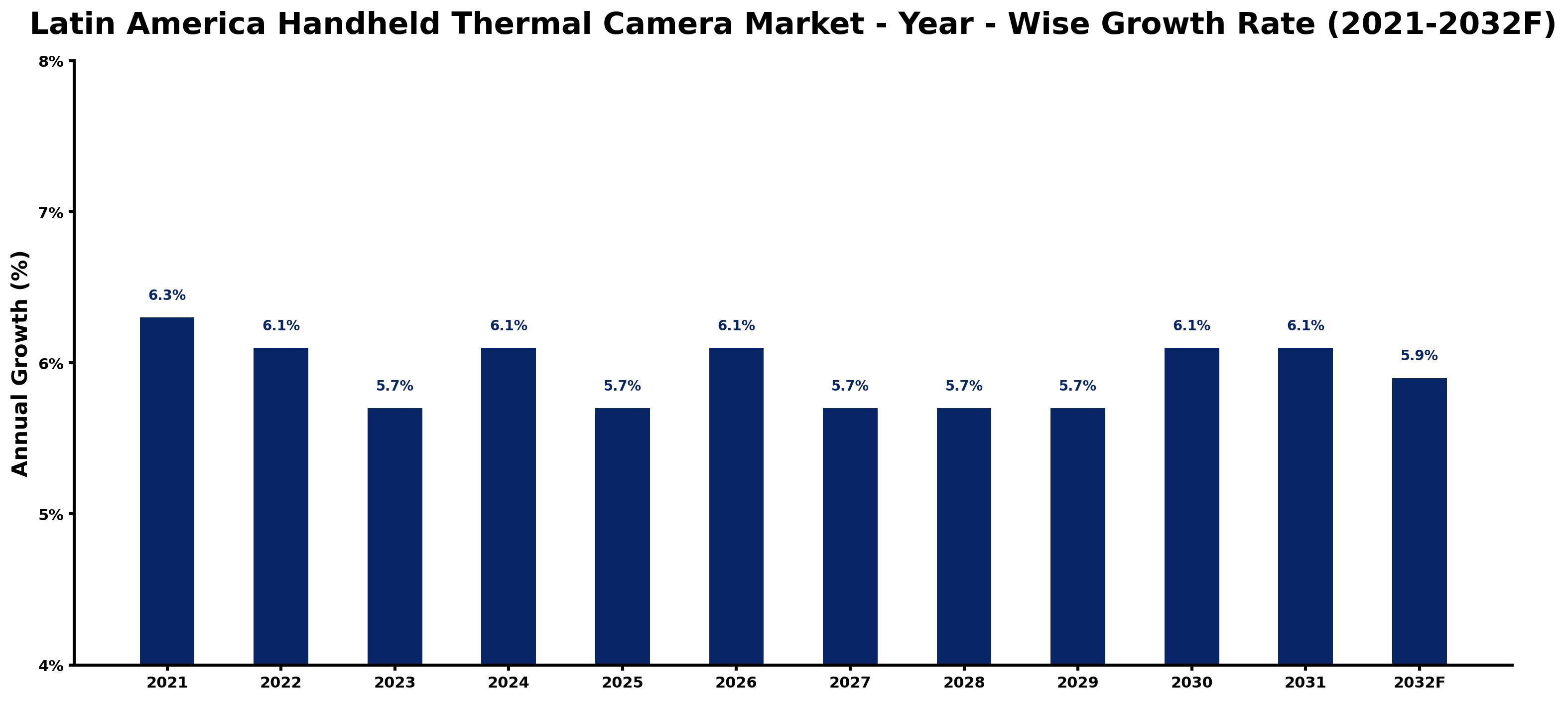
The table below presents the year‑wise growth rates along with the key drivers influencing the market
| Year | Growth Rate | Major Drivers |
| 2021 | 6.3% | Increasing industrial automation investments |
| 2022 | 6.1% | Growing renewable energy integration projects |
| 2023 | 5.7% | Expansion of transportation and logistics networks |
| 2024 | 6.1% | Growing renewable energy integration projects |
| 2025 | 5.7% | Increasing industrial automation investments |
| 2026 | 6.1% | Expansion of manufacturing activities |
| 2027 | 5.7% | Increasing smart city development projects |
| 2028 | 5.7% | Growing renewable energy integration projects |
| 2029 | 5.7% | Government infrastructure modernization initiatives |
| 2030 | 6.1% | Expansion of commercial construction activities |
| 2031 | 6.1% | Rising electricity demand across industries |
| 2032 | 5.9% | Growing urbanization and commercial development |
Note - Market size estimations and growth projections presented in this report are based on 6Wresearch’s advanced forecasting approach, validated with industry datasets as of June 2026.
Latin America Handheld Thermal Camera Market Synopsis
The most significant force currently shaping the Latin America Handheld Thermal Camera Market is the persistent vigilance required in the wake of the COVID-19 pandemic. As businesses, schools, and public venues continue to implement health screenings, the demand for efficient and reliable thermal imaging solutions has never been higher.
In addition, low infrastructure deployment for these devices provides ample opportunities for market expansion. The gradual revelation of the full applicability of handheld thermal cameras indicates that significant advancements are on the horizon, promising to diversify their use across multiple sectors, including healthcare and security.
Latin America Handheld Thermal Camera Market Key Takeaways
- The market is witnessing rapid growth driven by government initiatives and the ongoing pandemic.
- Technological advancements are expanding the functionalities and applications of handheld thermal cameras.
- Limited infrastructure deployment presents significant opportunities for market penetration.
- Growing awareness of health safety is catalyzing widespread adoption across various sectors.
- Investment in R&D is expected to lead to innovative thermal camera solutions in the near future.
Evaluation of Restraints in Latin America Handheld Thermal Camera Market
Despite the positive momentum in the Latin America Handheld Thermal Camera Market, several constraints could impact growth. Limited awareness and understanding of thermal camera technology among potential users hinder widespread adoption. Additionally, concerns regarding privacy and data protection in relation to thermal imaging may deter organizations from implementing these systems. High initial costs can also be a barrier, particularly for smaller businesses or public institutions operating under tight budgets.
Latin America Handheld Thermal Camera Market Trends
The current trend in the Latin America Handheld Thermal Camera Market is the integration of artificial intelligence (AI) capabilities to enhance diagnostic accuracy and efficiency. Manufacturers are increasingly focusing on creating compact and user-friendly models that cater to non-specialist users. The trend of dual-use cameras, which can operate in both thermal and visible spectrums, is also gaining traction. This versatility not only expands their application in various sectors but also boosts their market appeal.
Latin America Handheld Thermal Camera Market Opportunities
There are promising growth opportunities in the Latin America Handheld Thermal Camera Market, particularly in public health and safety sectors. As countries increasingly prioritize health security, demand for thermal cameras in transportation hubs, workplaces, and public events is set to rise. Additionally, industries such as construction and facility management are recognizing the value of thermal imaging for maintenance and safety inspections, which could further broaden market prospects.
Government Initiatives in the Latin America Handheld Thermal Camera Market
Governments across Latin America are actively promoting the deployment of handheld thermal cameras as part of their public health strategies. Many jurisdictions are instituting regulations that require thermal screening in high-traffic areas, especially as pandemic response efforts continue. Moreover, public sector funding for technology adoption in healthcare and security sectors underscores the commitment to enhancing safety measures and infrastructure across the region.
Future Insights of the Latin America Handheld Thermal Camera Market
Looking ahead to the 2026-2032 period, the Latin America Handheld Thermal Camera Market is poised for significant expansion driven by technological innovations and increased applications. Enhanced sensitivity and resolution in thermal cameras are expected to unlock new functionalities in areas such as predictive maintenance and security surveillance. As awareness grows regarding the importance of health monitoring in various environments, coupled with the anticipated influx of government and private sector investment, the market is set to thrive, catering to a diverse range of needs.
Latin America Handheld Thermal Camera Market Latest Developments (May 2025 - June 2026)
Recent industry developments indicate a trend toward the incorporation of smart technologies in handheld thermal cameras. Research initiatives are focusing on improving user interfaces and data analytics capabilities, enabling users to obtain actionable insights. Collaborations between public health entities and tech companies are also on the rise, aiming to foster innovation and enhance the efficiency of thermal imaging solutions.
Latin America Handheld Thermal Camera Market - Key Attractiveness of the Report
- 10 Years of Market Numbers
- Historical Data Starting from 2022 to 2025
- Base Year: 2025
- Forecast Data until 2032
- Key Performance Indicators Impacting the Market
- Major Upcoming Developments and Projects
Key Highlights of the Report:
- Latin America Handheld Thermal Camera Market Overview
- Latin America Handheld Thermal Camera Market Outlook
- Latin America Handheld Thermal Camera Market Forecast
- Market Size of Latin America Handheld thermal Camera Market, 2025
- Forecast of Latin America Handheld thermal Camera Market, Until 2032F
- Historical Data and Forecast of Latin America Handheld thermal Camera Market Revenues & Volume for the Period 2022-2032F
- Market Size and Forecast of Latin America Handheld thermal Camera Market Revenues & Volume, Until 2032F
- Historical Data and Forecast of Latin America Handheld thermal Camera Market Revenues & Volume for the period, By Product, 2022-2032F
- Market Size and Forecast of Latin America Handheld thermal Camera Market Revenues & Volume, By Product, Until 2032F
- Historical Data of Latin America Handheld thermal Camera Market Revenues & Volume for the period, By Applications, 2022-2032F
- Market Size and Forecast of Latin America Handheld thermal Camera Market Revenues & Volume, By Applications, Until 2032F
- Historical Data of Latin America Handheld thermal Camera Market Revenues & Volume for the period, By End Users, 2022-2032F
- Market Size and Forecast of Latin America Handheld thermal Camera Market Revenues & Volume, By End Users, Until 2032F
- Historical Data of Mexico Handheld Thermal Camera Market Revenues & Volume for the period 2022-2032F
- Market Size and Forecast of Mexico Handheld Thermal Camera Market Revenues & Volume, Until 2032F
- Historical Data of Brazil Handheld thermal Camera Market Revenues & Volume for the period 2022-2032F
- Market Size and Forecast of Brazil Handheld thermal Camera Market Revenues & Volume, Until 2032F
- Historical Data of Argentina Handheld thermal Camera Market Revenues & Volume for the period 2022-2032F
- Market Size and Forecast of Argentina Handheld thermal Camera Market Revenues & Volume, Until 2032F
- Historical Data of Rest of Latin America Handheld thermal Camera Market Revenues & Volume for the period 2022-2032F
- Market Size and Forecast of Rest of Latin America Handheld thermal Camera Market Revenues & Volume, Until 2032F
- Market Drivers and Restraints
- Latin America Handheld Thermal Camera Market Price Trends
- Latin America Handheld Thermal Camera Market Trends and Industry Life Cycle
- Porter’s Five Force Analysis
- Market Opportunity Assessment
- Latin America Handheld Thermal Camera Market Share, By Company
- Latin America Handheld Thermal Camera Market Share, By Regions
- Latin America Handheld Thermal Camera Market Overview on Competitive Benchmarking
- Company Profiles
- Key Strategic Recommendations
Markets Covered:
The Latin America handheld thermal camera market report provides a detailed analysis of the following market segments:
- By Product
- Monocular
- Binocular
- By Applications
- Military
- Industrial
- Household
- By End-Users
- Military and Defense
- Industrial
- Commercial
- Healthcare and Life Sciences
- Residential
- Automotive
- Oil and Gas
- By Countries
- Mexico
- Brazil
- Argentina
- Rest of Latin America






































