Latvia Auto Catalyst Market Size (2020-2030)
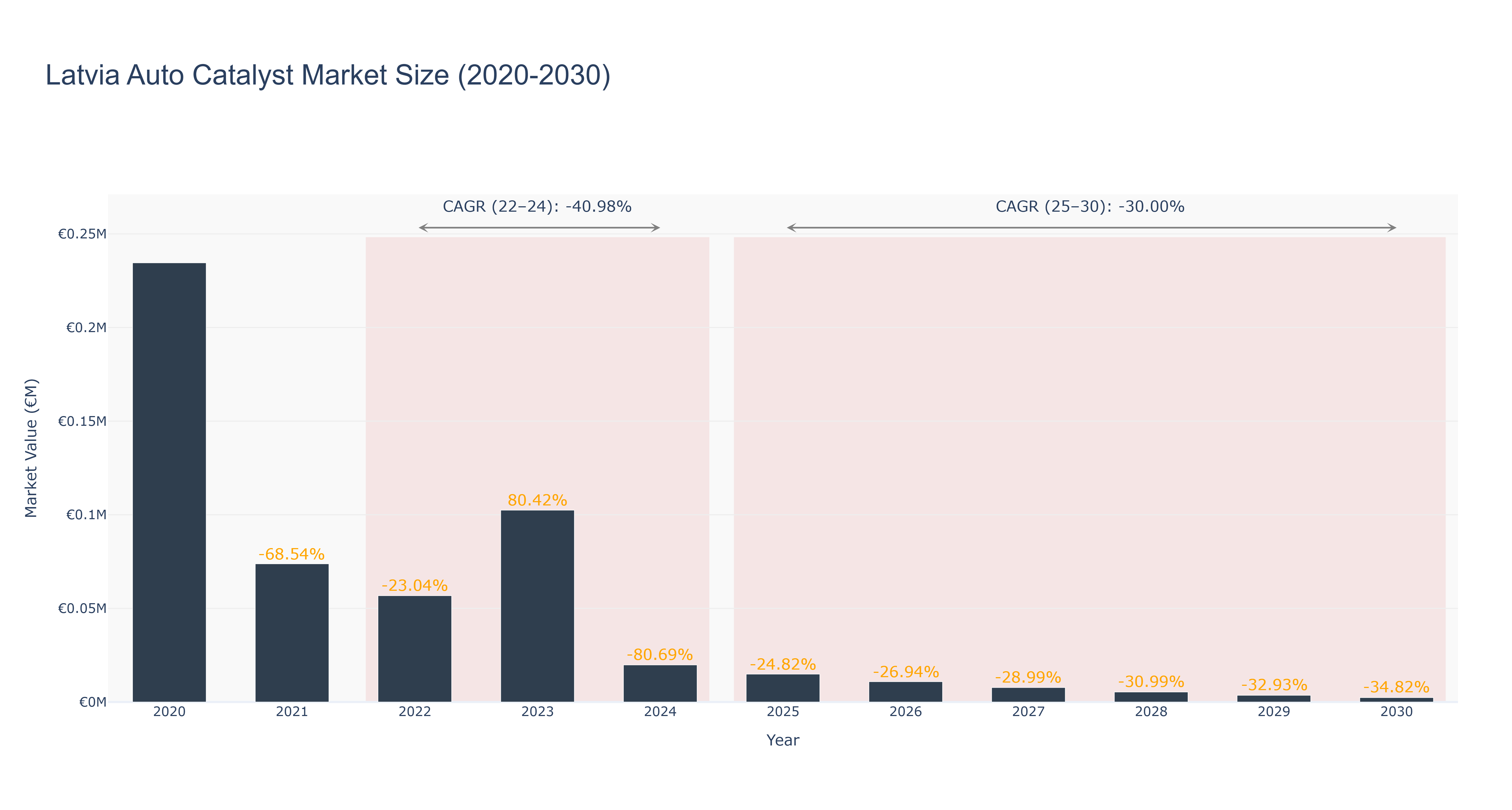
The Latvia Auto Catalyst Market has experienced significant fluctuations, with an overall declining trajectory observed from 2020 to 2030. The market peaked in 2020 at €234.54 thousand, but subsequently fell to €56.79 thousand in 2022, reflecting a substantial decline of -68.54% in 2021 and a further -23.04% in 2022. A brief recovery occurred in 2023, where the market size reached €102.46 thousand, marking an 80.42% growth. However, forecasts for 2025-2030 indicate a continued downturn, with projected market sizes decreasing from €14.87 thousand in 2025 to €2.33 thousand by 2030, resulting in a CAGR of -30.00%. This decline can be attributed to factors such as reduced vehicle sales and shifts towards electric vehicles, which diminish the demand for traditional auto catalysts. As Latvia navigates these transitions, the market may benefit from potential regulatory changes and investments in cleaner technologies, although the outlook remains challenging.
Latvia Auto Catalyst Market: Production & Trade Performance (2019-2025)
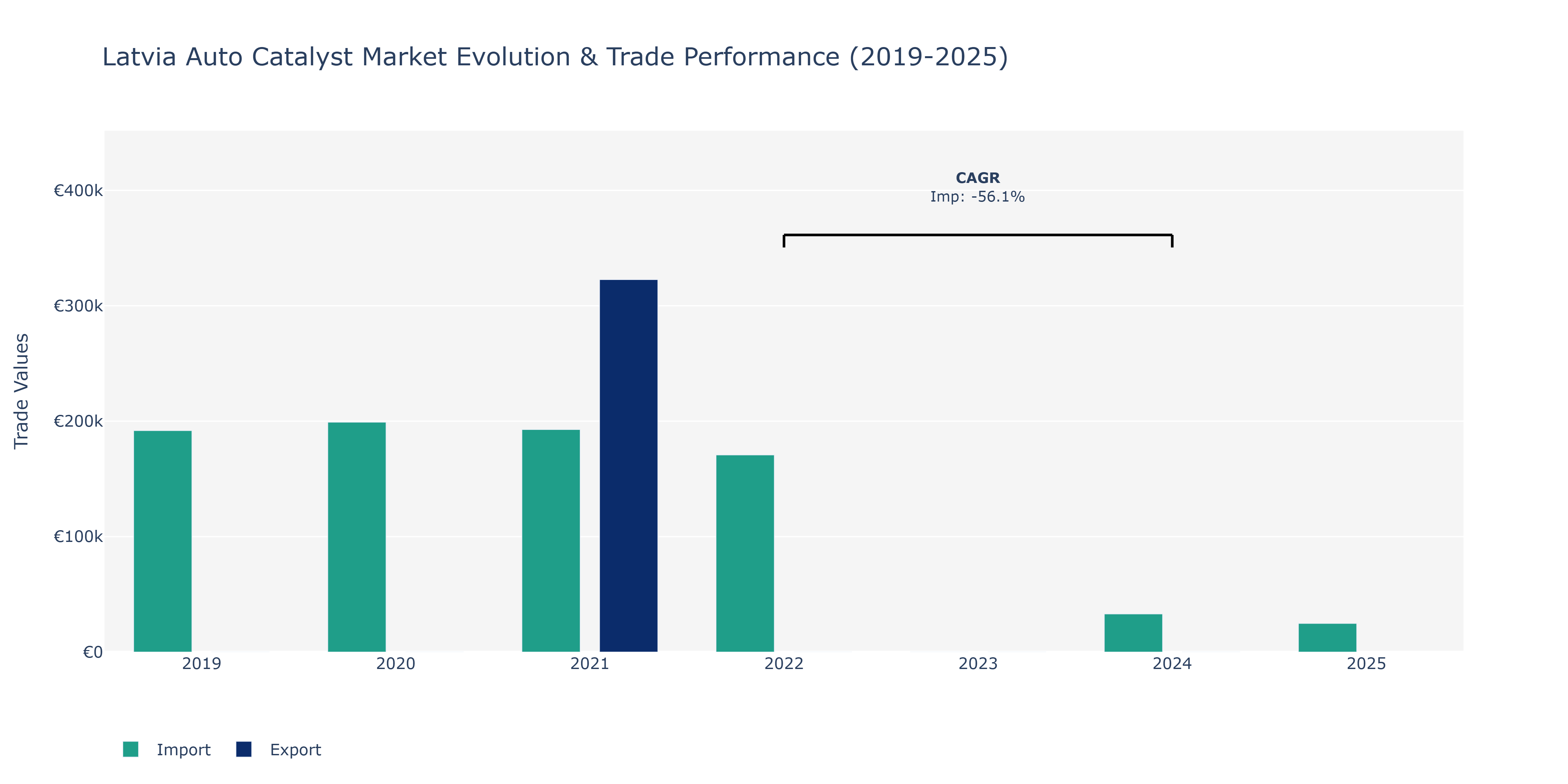
Between 2019 and 2025, Latvia's Auto Catalyst Market witnessed varying trends in both Exports and Imports. In 2019, Imports stood at €191.8 thousand, showing a slight increase to €199.1 thousand in 2020. Notably, 2021 saw a substantial surge in Exports to €322.65 thousand, exceeding Imports at €192.76 thousand. However, imports experienced a significant decline in subsequent years, dropping to €170.77 thousand in 2022, and significantly lower to €32.97 thousand in 2024, before further decreasing to €24.79 thousand in 2025. This downward trend in imports could be linked to shifts in demand, changes in production levels, or adjustments in supply chain dynamics within the auto catalyst market. Such fluctuations highlight the market's sensitivity to external factors that impact trade volumes.
Key Highlights of the Report:
- Latvia Auto catalyst Market Outlook
- Market Size of Latvia Auto catalyst Market, 2025
- Forecast of Latvia Auto catalyst Market, 2032
- Historical Data and Forecast of Latvia Auto catalyst Revenues & Volume for the Period 2022 - 2032
- Latvia Auto catalyst Market Trend Evolution
- Latvia Auto catalyst Market Drivers and Challenges
- Latvia Auto catalyst Price Trends
- Latvia Auto catalyst Porter's Five Forces
- Latvia Auto catalyst Industry Life Cycle
- Historical Data and Forecast of Latvia Auto catalyst Market Revenues & Volume By Application for the Period 2022 - 2032
- Historical Data and Forecast of Latvia Auto catalyst Market Revenues & Volume By LDV-Diesel for the Period 2022 - 2032
- Historical Data and Forecast of Latvia Auto catalyst Market Revenues & Volume By LDV-Gasoline for the Period 2022 - 2032
- Historical Data and Forecast of Latvia Auto catalyst Market Revenues & Volume By HDV for the Period 2022 - 2032
- Latvia Auto catalyst Import Export Trade Statistics
- Market Opportunity Assessment By Application
- Latvia Auto catalyst Top Companies Market Share
- Latvia Auto catalyst Competitive Benchmarking By Technical and Operational Parameters
- Latvia Auto catalyst Company Profiles
- Latvia Auto catalyst Key Strategic Recommendations






































