Latvia Ethyl Alcohol Market Top 5 Importing Countries and Market Competition (HHI) Analysis
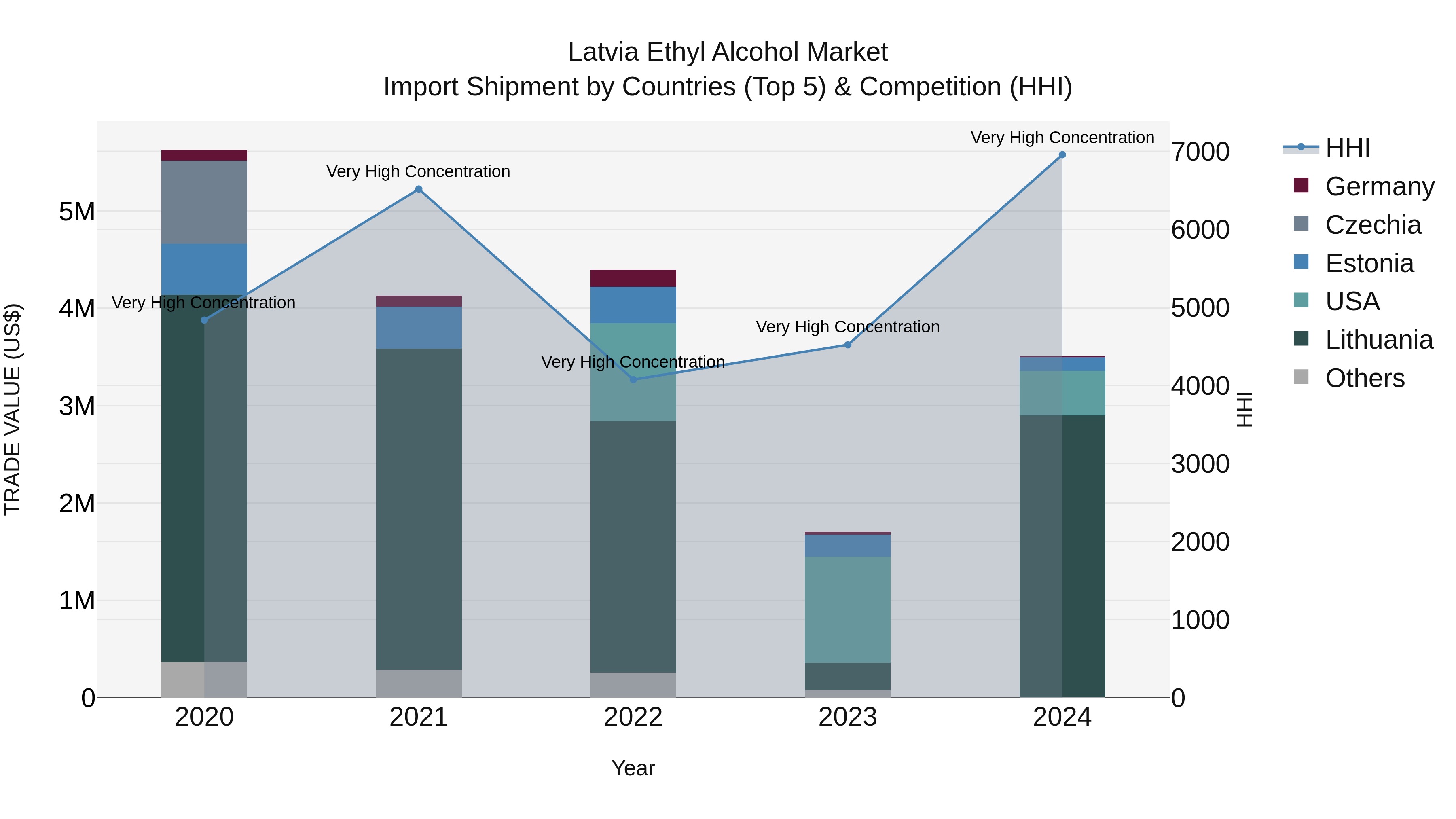
In 2024, Latvia continued to rely heavily on imports of ethyl alcohol, with Lithuania, USA, Estonia, Germany, and Netherlands being the top exporting countries. Despite a significant decrease in the compound annual growth rate (CAGR) from 2020 to 2024 at -11.11%, the growth rate between 2023 and 2024 surged impressively by 105.97%. The high concentration of the Herfindahl-Hirschman Index (HHI) indicates a competitive market with dominant players. This data suggests a dynamic and evolving landscape for ethyl alcohol imports in Latvia, with potential opportunities for market players to explore.
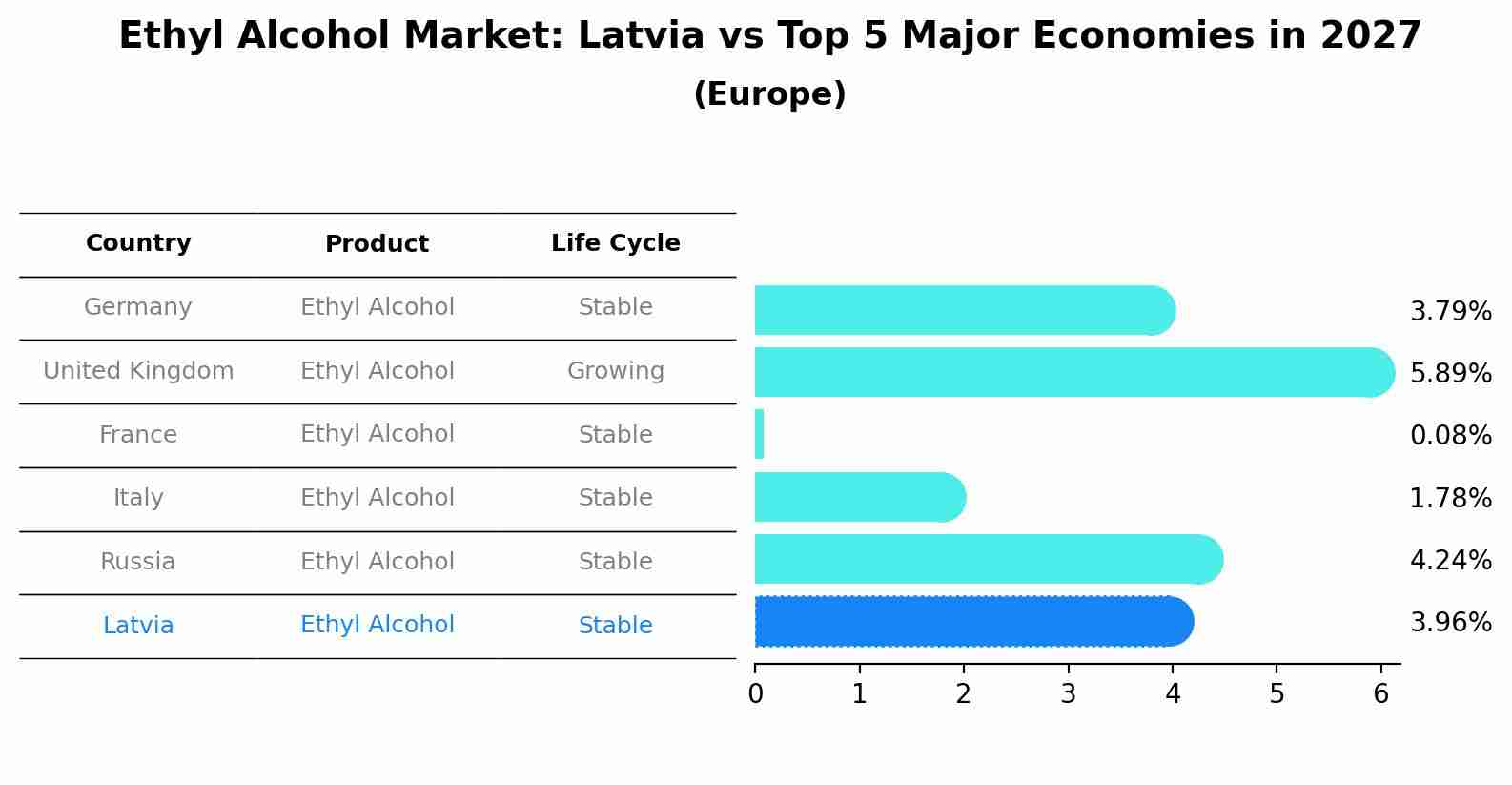
Ethyl Alcohol Market: Latvia vs Top 5 Major Economies in 2027 (Europe)
Latvia's Ethyl Alcohol market is anticipated to experience a stable growth rate of 3.96% by 2027, reflecting trends observed in the largest economy Germany, followed by United Kingdom, France, Italy and Russia.
Key Highlights of the Report:
- Latvia Ethyl Alcohol Market Outlook
- Market Size of Latvia Ethyl Alcohol Market, 2025
- Forecast of Latvia Ethyl Alcohol Market, 2032
- Historical Data and Forecast of Latvia Ethyl Alcohol Revenues & Volume for the Period 2022 - 2032F
- Latvia Ethyl Alcohol Market Trend Evolution
- Latvia Ethyl Alcohol Market Drivers and Challenges
- Latvia Ethyl Alcohol Price Trends
- Latvia Ethyl Alcohol Porter`s Five Forces
- Latvia Ethyl Alcohol Industry Life Cycle
- Historical Data and Forecast of Latvia Ethyl Alcohol Market Revenues & Volume By Grade for the Period 2022 - 2032F
- Historical Data and Forecast of Latvia Ethyl Alcohol Market Revenues & Volume By Food Grade for the Period 2022 - 2032F
- Historical Data and Forecast of Latvia Ethyl Alcohol Market Revenues & Volume By Industrial Grade for the Period 2022 - 2032F
- Historical Data and Forecast of Latvia Ethyl Alcohol Market Revenues & Volume By Pharmaceutical Grade for the Period 2022 - 2032F
- Historical Data and Forecast of Latvia Ethyl Alcohol Market Revenues & Volume By Lab Grade for the Period 2022 - 2032F
- Historical Data and Forecast of Latvia Ethyl Alcohol Market Revenues & Volume By End-user Industry for the Period 2022 - 2032F
- Historical Data and Forecast of Latvia Ethyl Alcohol Market Revenues & Volume By Automotive and Transportation for the Period 2022 - 2032F
- Historical Data and Forecast of Latvia Ethyl Alcohol Market Revenues & Volume By Food and Beverage for the Period 2022 - 2032F
- Historical Data and Forecast of Latvia Ethyl Alcohol Market Revenues & Volume By Pharmaceutical for the Period 2022 - 2032F
- Historical Data and Forecast of Latvia Ethyl Alcohol Market Revenues & Volume By Cosmetics and Personal Care (Includes hand-Sanitizer) for the Period 2022 - 2032F
- Historical Data and Forecast of Latvia Ethyl Alcohol Market Revenues & Volume By Other End-user Industries for the Period 2022 - 2032F
- Latvia Ethyl Alcohol Import Export Trade Statistics
- Market Opportunity Assessment By Grade
- Market Opportunity Assessment By End-user Industry
- Latvia Ethyl Alcohol Top Companies Market Share
- Latvia Ethyl Alcohol Competitive Benchmarking By Technical and Operational Parameters
- Latvia Ethyl Alcohol Company Profiles
- Latvia Ethyl Alcohol Key Strategic Recommendations






































