Latvia Propylene Glycol Market Size (2020-2030)
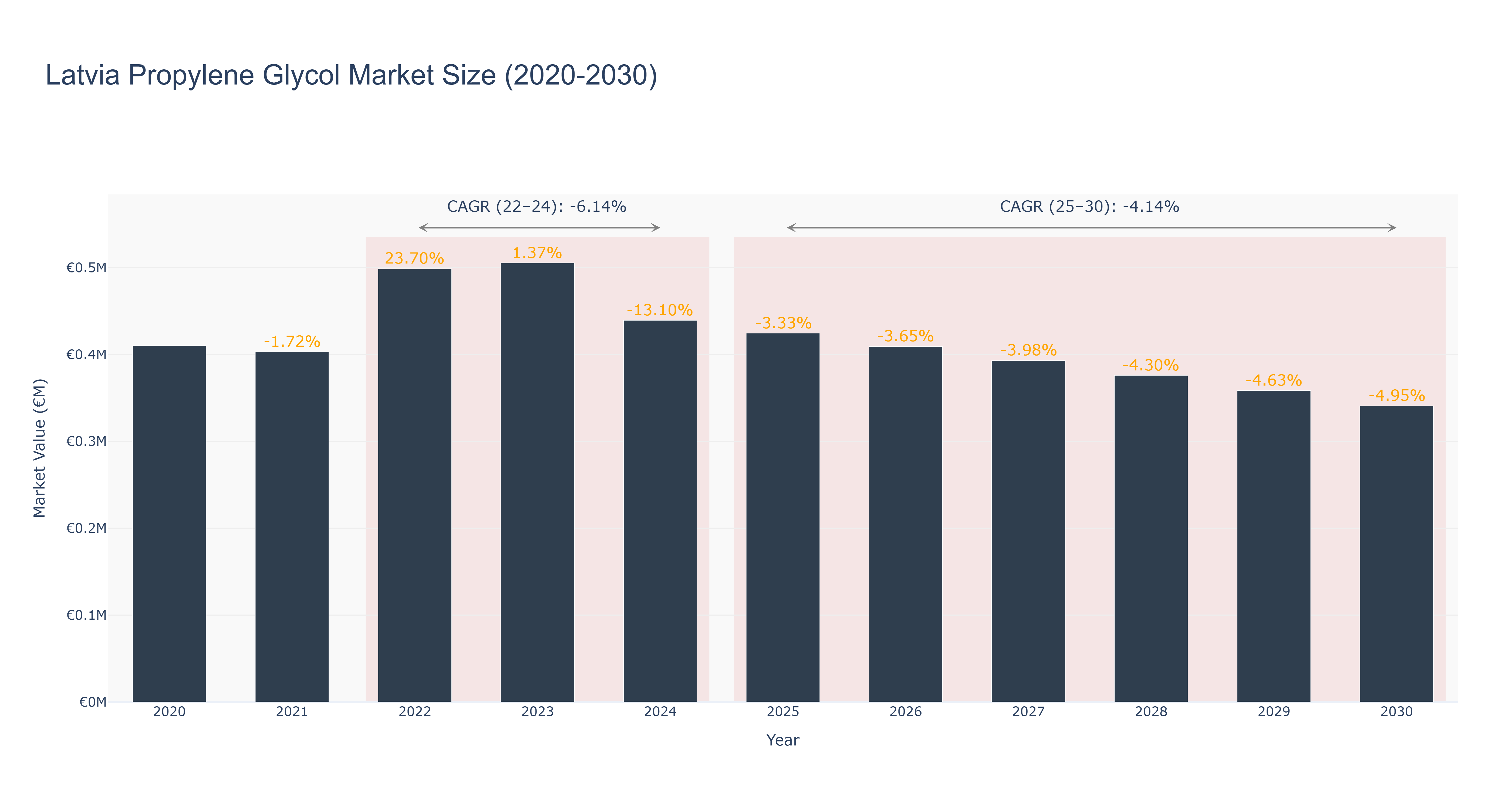
Latvia Propylene Glycol Market has experienced fluctuations in market size over the years. The peak market size of €0.51 million was reached in 2023, followed by a decline to €0.44 million in 2024. The forecasted trend indicates a further decrease to €0.34 million by 2030, with a CAGR of -4.14% from 2025 to 2030. The market saw a significant growth of 23.70% in 2022, which was likely driven by increased demand from various industries. Conversely, the decline in market size from 2024 onwards can be attributed to factors such as market saturation and economic downturns. Looking ahead, Latvia is set to witness new investments in sustainable production processes for propylene glycol, aligning with the global shift towards eco-friendly solutions in the chemicals industry.
Latvia Propylene Glycol Market: Production & Trade Performance (2019-2025)
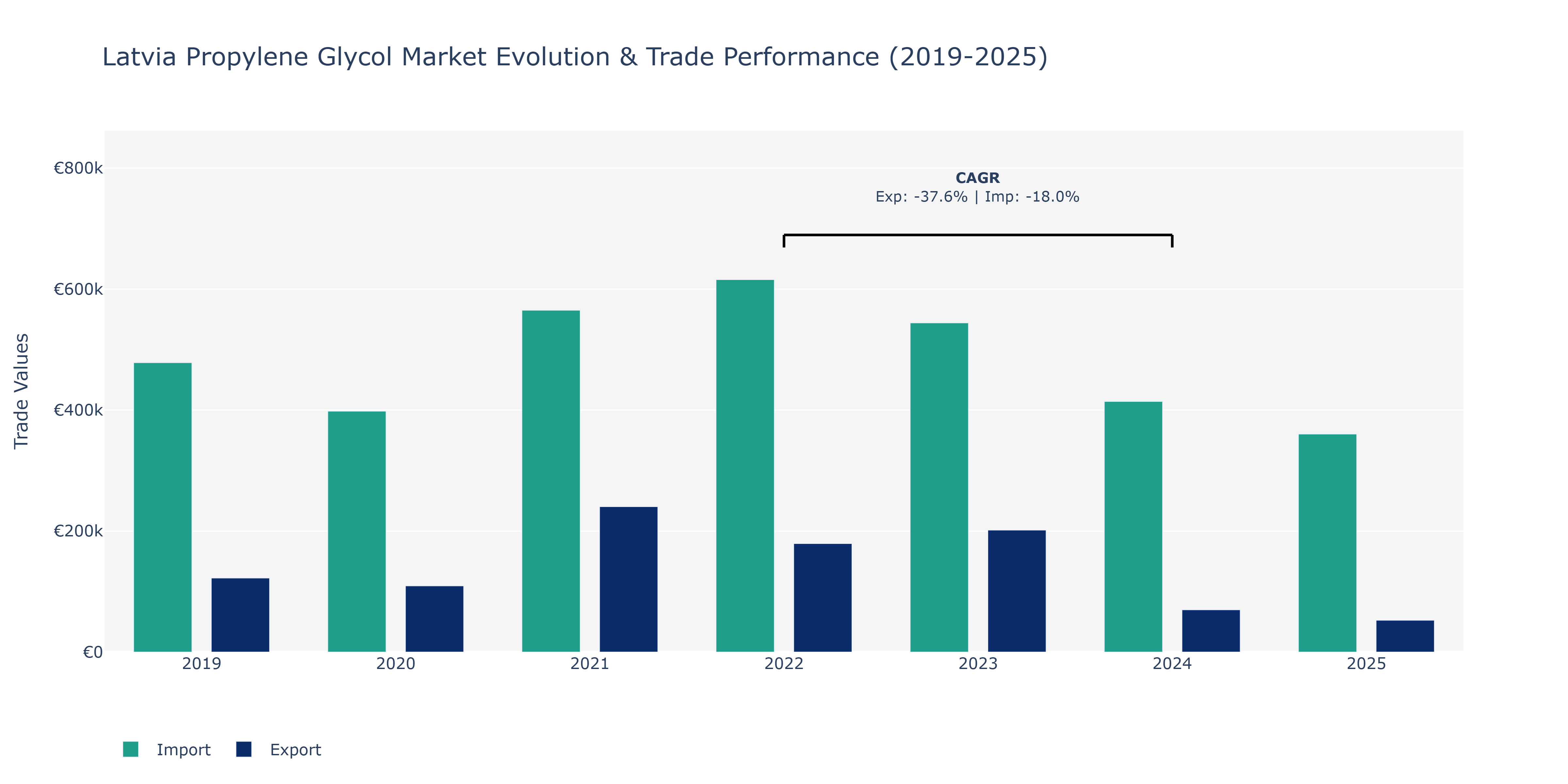
The Latvia Propylene Glycol Market witnessed fluctuations in both Exports and Imports from 2019 to 2025. In 2019, Imports were at €478.38 thousand, significantly higher than Exports at €122.28 thousand. The following year, 2020, saw a decrease in both Exports to €109.36 thousand and Imports to €398.19 thousand. The year 2021 marked a notable uptick in trade activity, with Exports surging to €240.3 thousand and Imports reaching €564.97 thousand, reflecting increased demand and market expansion. However, in 2022, Exports dropped to €179.26 thousand, while Imports peaked at €615.65 thousand, indicating shifting market dynamics. By 2024, Exports fell to €69.85 thousand, contrasting with Imports at €414.14 thousand. The year 2025 continued the downward trend for both Exports and Imports, with Exports at €52.51 thousand and Imports at €360.29 thousand. These variations could be attributed to changing consumer preferences, global economic conditions, and evolving regulatory landscapes impacting trade patterns in the propylene glycol market.
Key Highlights of the Report:
- Latvia Propylene Glycol Market Outlook
- Market Size of Latvia Propylene Glycol Market, 2025
- Forecast of Latvia Propylene Glycol Market, 2032
- Historical Data and Forecast of Latvia Propylene Glycol Revenues & Volume for the Period 2022 - 2032F
- Latvia Propylene Glycol Market Trend Evolution
- Latvia Propylene Glycol Market Drivers and Challenges
- Latvia Propylene Glycol Price Trends
- Latvia Propylene Glycol Porter`s Five Forces
- Latvia Propylene Glycol Industry Life Cycle
- Historical Data and Forecast of Latvia Propylene Glycol Market Revenues & Volume By Application for the Period 2022 - 2032F
- Historical Data and Forecast of Latvia Propylene Glycol Market Revenues & Volume By Unsaturated Polyester Resins,Functional Fluids,Food, Drug, and Cosmetics,Liquid Detergent,Paints and Coating,Others for the Period 2022 - 2032F
- Latvia Propylene Glycol Import Export Trade Statistics
- Market Opportunity Assessment By Application
- Latvia Propylene Glycol Top Companies Market Share
- Latvia Propylene Glycol Competitive Benchmarking By Technical and Operational Parameters
- Latvia Propylene Glycol Company Profiles
- Latvia Propylene Glycol Key Strategic Recommendations






































