Latvia Table Olives Market Top 5 Importing Countries and Market Competition (HHI) Analysis
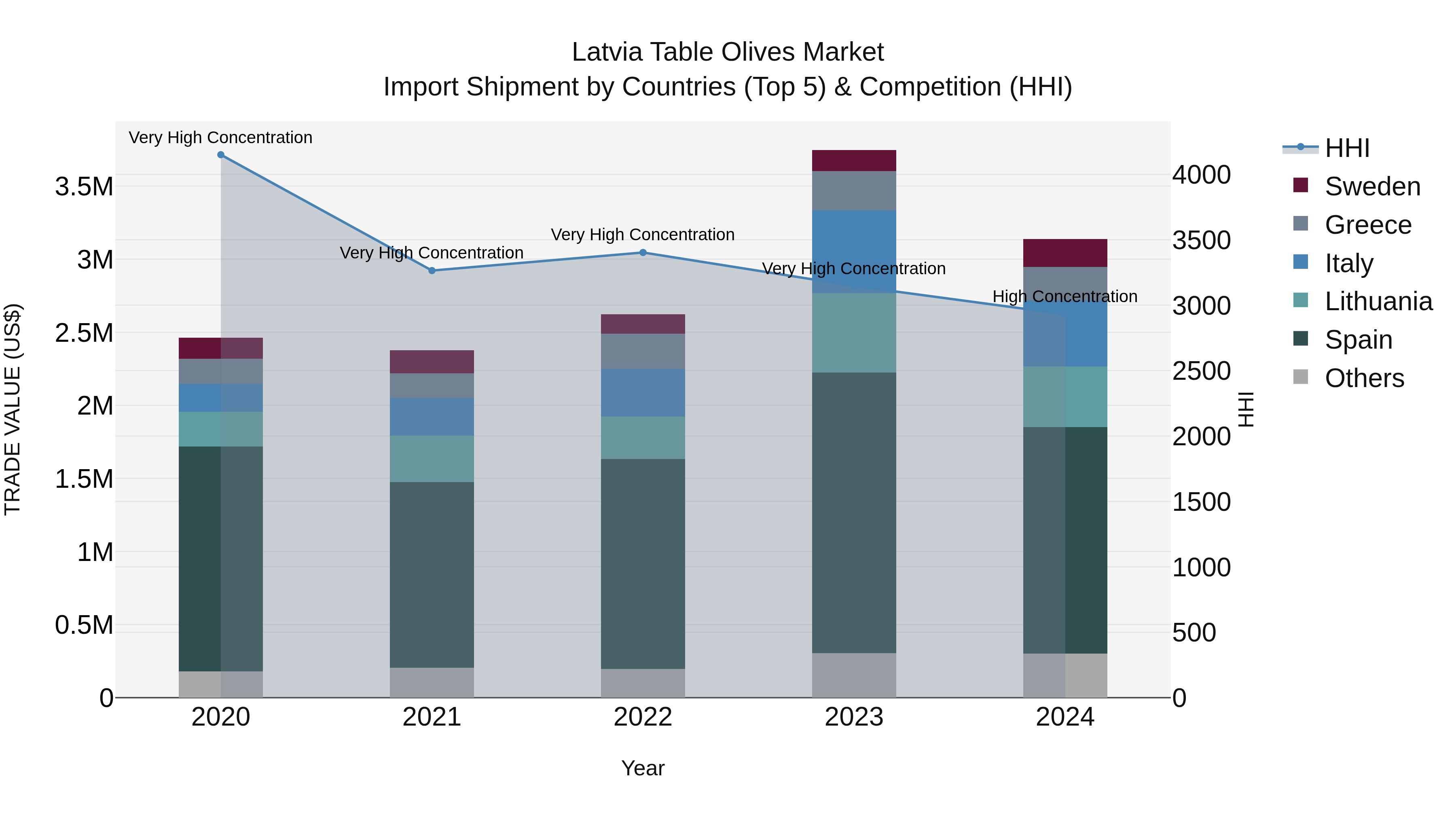
Latvia`s table olives import market in 2024 continues to be dominated by Spain, Italy, Lithuania, Greece, and Sweden. The market concentration, as measured by the Herfindahl-Hirschman Index (HHI), remained high in 2024, indicating a competitive market. Despite a notable decline in growth rate from 2023 to 2024, the compound annual growth rate (CAGR) for the period 2020-2024 stands at a healthy 6.25%. This suggests a stable and growing demand for table olives in Latvia, with potential opportunities for both domestic and international suppliers to capitalize on this market trend.
Latvia Table Olives Market Synopsis
The Latvia table olives market is experiencing steady growth driven by increasing consumer awareness of the health benefits associated with olives consumption. The market is primarily dominated by imported table olives from Mediterranean countries such as Greece, Spain, and Italy. Local production of table olives is limited due to climatic conditions not being ideal for olive cultivation. However, there is a growing trend towards organic and gourmet table olives among health-conscious consumers, providing opportunities for niche producers. Retail channels like supermarkets and specialty stores are the primary distribution channels for table olives in Latvia. The market is also influenced by factors such as changing consumer preferences, food culture, and a growing interest in Mediterranean cuisine, indicating a positive outlook for the Latvia table olives market in the coming years.
Latvia Table Olives Market Trends
The Latvia Table Olives Market is witnessing a shift towards healthier and more diverse food options, leading to an increasing demand for table olives as a nutritious snack or ingredient. Consumers are seeking out products with natural flavors and health benefits, driving the market towards premium and specialty varieties such as organic, marinated, and stuffed olives. There is also a growing interest in Mediterranean cuisine, where olives play a central role, further boosting the market growth. Opportunities exist for producers to innovate in packaging, flavors, and marketing strategies to cater to evolving consumer preferences. Additionally, expanding distribution channels and increasing export potential present avenues for market expansion and reaching a broader audience beyond Latvia.
Latvia Table Olives Market Challenges
In the Latvia Table Olives Market, some key challenges include limited consumer awareness and familiarity with table olives compared to other types of food products, such as pickles or other preserved goods. Additionally, the market may face obstacles in terms of distribution channels and accessibility to a wider range of high-quality table olive products. Competition from imported olives and other similar products from Mediterranean countries can also pose a challenge for local producers in Latvia. Furthermore, ensuring consistent quality and flavor profiles of table olives to meet consumer preferences and demands while maintaining cost-effectiveness in production processes is another hurdle that players in the market need to address to stay competitive and grow their market share.
Latvia Table Olives Market Investment Opportunities
The key drivers fueling the Latvia Table Olives Market include the growing consumer awareness about the health benefits associated with consuming table olives, such as their high antioxidant content and potential to reduce the risk of chronic diseases. Additionally, changing consumer preferences towards healthier and natural food options are driving the demand for table olives as a popular snack or ingredient in meals. The increasing popularity of Mediterranean cuisine and the rise of food tourism are also contributing to the growth of the market in Latvia. Furthermore, advancements in packaging technologies and distribution channels are making table olives more accessible to consumers, further boosting the market`s expansion.
Latvia Table Olives Market Government Polices
Government policies related to the Latvia Table Olives Market focus on ensuring food safety, quality standards, and fair trade practices. The Latvian government has implemented regulations to control the production, processing, and distribution of table olives to meet European Union standards. This includes monitoring the use of pesticides and ensuring compliance with labeling requirements to protect consumer health and promote transparency in the market. Additionally, there are support programs in place to assist local producers in improving their cultivation techniques and accessing export markets. The government`s objective is to foster a competitive and sustainable table olives industry in Latvia while safeguarding the interests of both producers and consumers.
Latvia Table Olives Market Future Outlook
The future outlook for the Latvia Table Olives Market appears promising, driven by increasing consumer awareness of the health benefits associated with olives and the rising trend of Mediterranean diet adoption. The market is expected to witness steady growth due to the growing popularity of olives as a versatile and flavorful ingredient in various cuisines. Additionally, the increasing focus on healthy eating habits and the rising demand for natural and organic food products are likely to further boost the market. As consumers become more health-conscious and seek out nutritious and convenient food options, the Latvia Table Olives Market is poised for expansion, presenting opportunities for both domestic producers and international exporters to capitalize on this growing trend.
Key Highlights of the Report:
- Latvia Table Olives Market Outlook
- Market Size of Latvia Table Olives Market, 2024
- Forecast of Latvia Table Olives Market, 2031
- Historical Data and Forecast of Latvia Table Olives Revenues & Volume for the Period 2021- 2031
- Latvia Table Olives Market Trend Evolution
- Latvia Table Olives Market Drivers and Challenges
- Latvia Table Olives Price Trends
- Latvia Table Olives Porter's Five Forces
- Latvia Table Olives Industry Life Cycle
- Historical Data and Forecast of Latvia Table Olives Market Revenues & Volume By Type for the Period 2021- 2031
- Historical Data and Forecast of Latvia Table Olives Market Revenues & Volume By Black Olive for the Period 2021- 2031
- Historical Data and Forecast of Latvia Table Olives Market Revenues & Volume By Green Olive for the Period 2021- 2031
- Historical Data and Forecast of Latvia Table Olives Market Revenues & Volume By Application for the Period 2021- 2031
- Historical Data and Forecast of Latvia Table Olives Market Revenues & Volume By Online Store for the Period 2021- 2031
- Historical Data and Forecast of Latvia Table Olives Market Revenues & Volume By Supermarket for the Period 2021- 2031
- Historical Data and Forecast of Latvia Table Olives Market Revenues & Volume By Convenience Store for the Period 2021- 2031
- Historical Data and Forecast of Latvia Table Olives Market Revenues & Volume By Other for the Period 2021- 2031
- Latvia Table Olives Import Export Trade Statistics
- Market Opportunity Assessment By Type
- Market Opportunity Assessment By Application
- Latvia Table Olives Top Companies Market Share
- Latvia Table Olives Competitive Benchmarking By Technical and Operational Parameters
- Latvia Table Olives Company Profiles
- Latvia Table Olives Key Strategic Recommendations






































