Lebanon Personal computers (PC) Market Summary
The lebanon personal computers (pc) market was estimated at USD 163 Million in 2025 and is projected to reach USD 218 Million by 2032, growing at a CAGR of 4.8% from 2026 to 2032.
Lebanon Personal computers (PC) Market Year-wise Growth Rate and Key Drivers
This graph highlights how the Lebanon Personal computers (PC) Market has steadily grown over the past five years, supported by major growth factors.
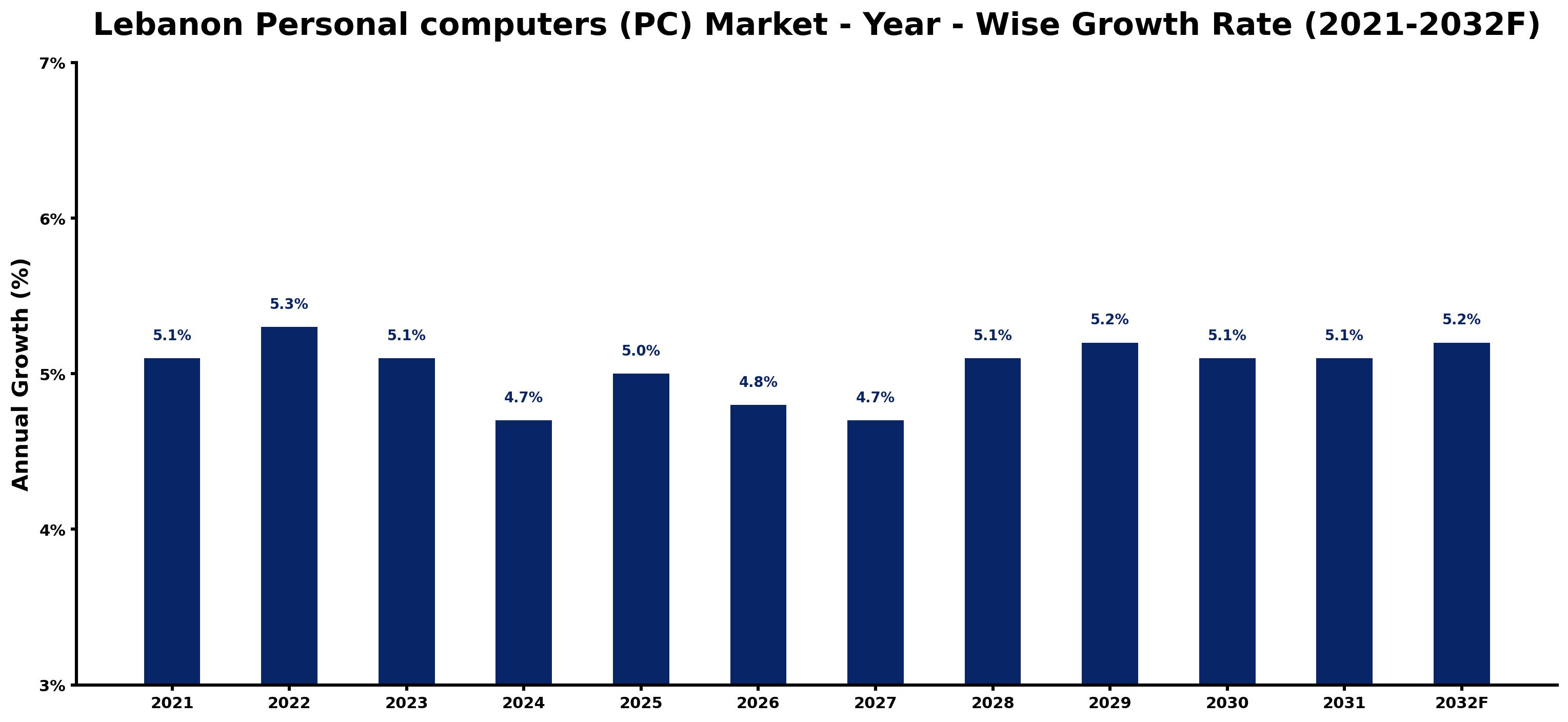
The table below presents the year wise growth rates along with the key drivers influencing the market
| Year | Growth Rate | Major Drivers |
| 2021 | 5.1% | PC manufacturers faced supply chain disruptions, hindering product availability and pricing strategies. |
| 2022 | 5.3% | Remote work trends compelled households to invest in reliable personal computing devices. |
| 2023 | 5.1% | Gaming culture expanded among youth, increasing demand for high-performance PCs and accessories. |
| 2024 | 4.7% | Local tech startups emerged, focusing on customized solutions, boosting regional market interest. |
| 2025 | 5.0% | Improvements in internet infrastructure enabled smoother online experiences for consumers and businesses. |
| 2026 | 4.8% | Shifts in education toward hybrid models encouraged schools to upgrade their computer systems. |
| 2027 | 4.7% | Emergence of smart home devices created ecosystems that integrate seamlessly with personal computers. |
| 2028 | 5.1% | Local governments began initiatives to enhance digital literacy, indirectly promoting PC ownership. |
| 2029 | 5.2% | Cybersecurity concerns pushed consumers to upgrade outdated PCs for better protection and performance. |
| 2030 | 5.1% | Sustainability trends influenced manufacturers to produce eco-friendly, energy-efficient personal computers. |
| 2031 | 5.1% | Collaboration tools gained traction, necessitating enhanced hardware for optimal performance in remote settings. |
| 2032 | 5.2% | Consumer preference shifted toward multifunctional devices, blending PCs with emerging technologies efficiently. |
Note - Market size estimations and growth projections presented in this report are based on 6Wresearch's advanced forecasting approach, validated with industry datasets as of June 2026.
Lebanon Personal computers (PC) Market Synopsis
The Lebanon Personal computers (PC) Market is projected to reach 4.8% and witness significant growth during the forecast period (2026-2032). The market, while relatively small and underdeveloped compared to its regional counterparts, has been experiencing a gradual uptick in demand driven by the introduction of more affordable personal computing devices. The landscape of personal computers in Lebanon primarily consists of imported units, with China and Europe being the dominant sources. Despite local vendors beginning to enter the market, the overwhelming preference remains for imported products.
Lebanon Personal computers (PC) Market Growth Drivers
Several key factors are propelling the Lebanon Personal computers (PC) Market forward. Firstly, the increasing accessibility of affordable PCs is facilitating consumer adoption. Many households and small businesses are now considering PCs for educational and professional use, leading to a surge in sales. Furthermore, the ongoing digital transformation in Lebanon has heightened the demand for personal computers, as more individuals shift to online platforms for both work and education.
- The implementation of remote learning initiatives has amplified the need for laptops, particularly among students and educational institutions.
- A growing emphasis on digital literacy by government and educational authorities encourages the adoption of personal computing devices.
- As internet penetration expands across the nation, the necessity for personal computers to access online content and services becomes increasingly apparent.
- The local market's gradual acceptance of laptops over desktops aligns with global trends, where portable devices are preferred for their versatility.
- Consumer preferences are shifting towards high-performance laptops, prompting an influx of specifications and features that cater to various user needs.
Lebanon Personal computers (PC) Market Trends and Opportunities
The Lebanon Personal computers (PC) Market is witnessing several notable trends that create opportunities for growth. A significant trend is the rise of portable devices, particularly laptops, which account for the majority of sales. This shift underscores consumer preferences for mobility and flexibility in computing. Additionally, the increasing adoption of cloud-based services is influencing purchasing decisions, as consumers opt for PCs that can seamlessly integrate with cloud applications.
- The focus on lightweight, durable designs in laptops is gaining traction, as consumers are more inclined towards devices that support their on-the-go lifestyles.
- There is a growing interest in eco-friendly computing solutions, prompting discussions about sustainable practices within the tech industry.
- The market is slowly seeing an increase in the availability of Linux-based operating systems, appealing to cost-conscious consumers who prioritize open-source options.
- Emerging technologies such as AI and machine learning are influencing product development, leading to smarter computing solutions that enhance user experiences.
- Collaborative software and applications are becoming essential, pushing users towards PCs that can effectively support these functionalities.
Lebanon Personal computers (PC) Market Challenges and Restraints
Despite the promising growth prospects, the Lebanon Personal computers (PC) Market faces several challenges. The primary restraint stems from the economic situation, which can limit consumer purchasing power. Fluctuations in currency value and inflation rates can impact the affordability of imported PCs, creating barriers for potential buyers. Furthermore, competition from alternative devices such as tablets and smartphones poses a challenge, as consumers may prioritize these options over traditional PCs.
- The limited local manufacturing capabilities hinder the competitive pricing of PCs, keeping the market reliant on costly imports.
- Infrastructure issues, particularly in terms of electricity and internet connectivity, can hinder the effective use of personal computers in some areas.
- Consumer awareness regarding the specifications and benefits of different PC options remains low, affecting overall sales.
- The market's dependency on foreign supply chains exposes it to global supply chain disruptions, impacting availability.
- Regulatory hurdles may arise that affect imports, further complicating the market landscape.
Lebanon Personal computers (PC) Market Government Investment and Initiatives
In recognizing the potential of the Lebanon Personal computers (PC) Market, the government has initiated various policies aimed at enhancing digital infrastructure and accessibility. These initiatives include investments in broadband infrastructure to improve internet connectivity, which is essential for personal computer usage. Additionally, educational programs are being introduced to promote digital literacy among the youth, thereby encouraging the adoption of personal computing.
- The government has announced plans to enhance public sector digital services, necessitating the use of PCs for efficiency.
- Subsidies and incentives may be introduced to support local assembly of PCs, aiming to reduce dependency on imports.
- Public spending is increasingly directed towards improving educational institutions' access to technology, reflecting a commitment to integrating PCs into learning environments.
- Collaboration with international agencies aims to provide funding and resources for technology adoption across various sectors.
- Regulations are being examined to facilitate smoother importation processes for computing devices, ensuring market stability.
Lebanon Personal computers (PC) Market Latest Developments (May 2025 - June 2026)
The period between May 2025 and June 2026 has seen notable developments in the Lebanon Personal computers (PC) Market. There has been a marked increase in promotional campaigns by local vendors focusing on accessible price points, aiming to attract segments of the population previously unable to afford personal computers. Additionally, partnerships between educational institutions and technology firms are fostering innovation in educational tools, which are heavily reliant on personal computing capabilities. Furthermore, discussions around sustainable technology practices are gaining momentum, encouraging vendors to consider eco-friendly options in their product offerings.
Lebanon Personal computers (PC) Market - Key Attractiveness of the Report
- 10 Years of Market Numbers
- Historical Data Starting from 2022 to 2025
- Base Year: 2025
- Forecast Data until 2032
- Key Performance Indicators Impacting the Market
- Major Upcoming Developments and Projects
Key Highlights of the Report:
- Lebanon Personal computers (PC) Market Outlook
- Market Size of Lebanon Personal computers (PC) Market, 2025
- Forecast of Lebanon Personal computers (PC) Market, 2032F
- Historical Data and Forecast of Lebanon Personal computers (PC) Revenues & Volume for the Period 2022-2032F
- Lebanon Personal computers (PC) Market Trend Evolution
- Lebanon Personal computers (PC) Market Drivers and Challenges
- Lebanon Personal computers (PC) Price Trends
- Lebanon Personal computers (PC) Porter's Five Forces
- Lebanon Personal computers (PC) Industry Life Cycle
- Historical Data and Forecast of Lebanon Personal computers (PC) Market Revenues & Volume By Product for the Period 2022-2032F
- Historical Data and Forecast of Lebanon Personal computers (PC) Market Revenues & Volume By Commercial Desktop for the Period 2022-2032F
- Historical Data and Forecast of Lebanon Personal computers (PC) Market Revenues & Volume By Commercial Notebook for the Period 2022-2032F
- Historical Data and Forecast of Lebanon Personal computers (PC) Market Revenues & Volume By Consumer Desktop for the Period 2022-2032F
- Historical Data and Forecast of Lebanon Personal computers (PC) Market Revenues & Volume By Consumer Notebook and Workstation for the Period 2022-2032F
- Historical Data and Forecast of Lebanon Personal computers (PC) Market Revenues & Volume By Distribution Channel for the Period 2022-2032F
- Historical Data and Forecast of Lebanon Personal computers (PC) Market Revenues & Volume By Online for the Period 2022-2032F
- Historical Data and Forecast of Lebanon Personal computers (PC) Market Revenues & Volume By Offline for the Period 2022-2032F
- Lebanon Personal computers (PC) Import Export Trade Statistics
- Market Opportunity Assessment By Product
- Market Opportunity Assessment By Distribution Channel
- Lebanon Personal computers (PC) Top Companies Market Share
- Lebanon Personal computers (PC) Competitive Benchmarking By Technical and Operational Parameters
- Lebanon Personal computers (PC) Company Profiles
- Lebanon Personal computers (PC) Key Strategic Recommendations






































