Lithuania Adipic Acid Market - Import Trends (2019-2025)
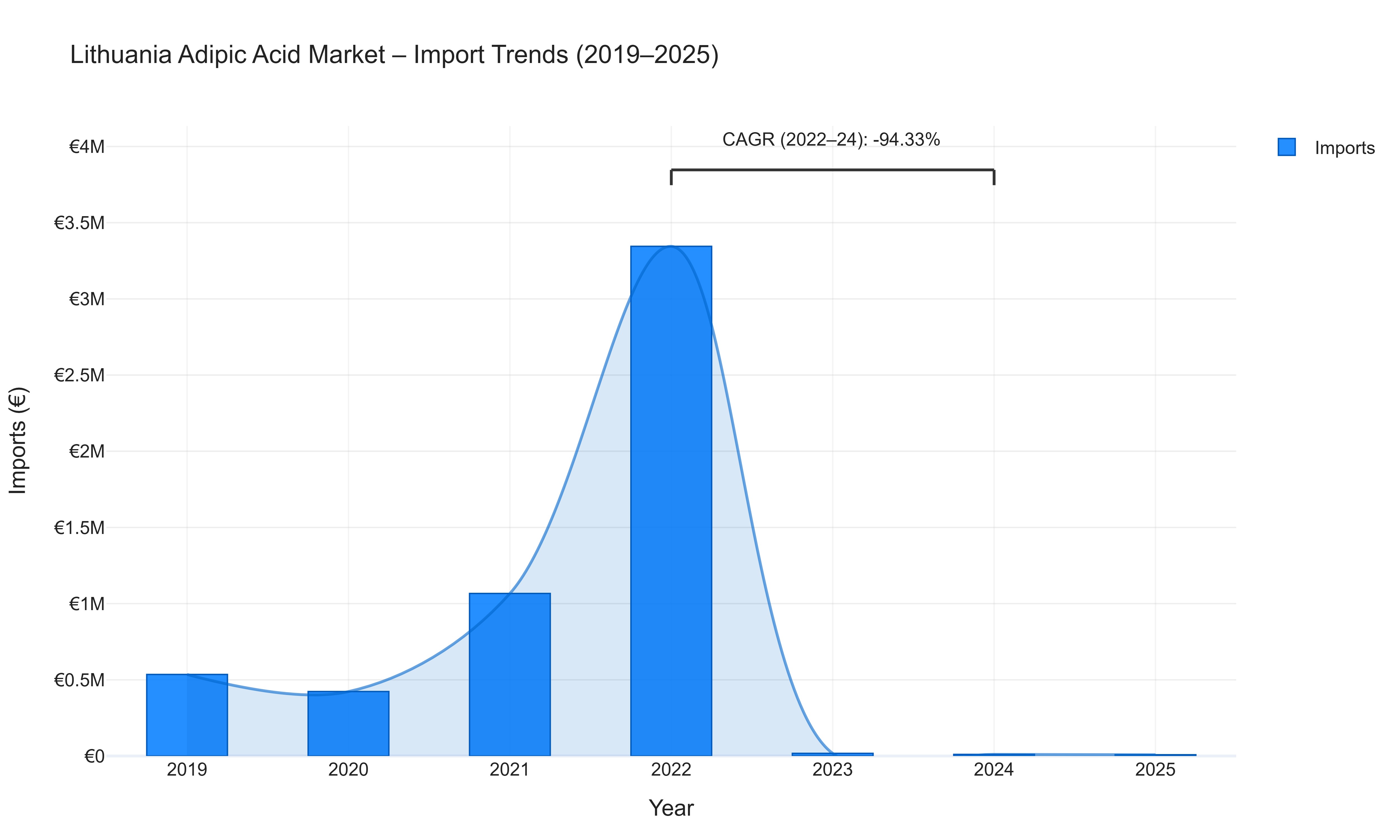
The Lithuania Adipic Acid market witnessed significant fluctuations in Import Values over the years. Import Values surged from €535.13 thousand in 2019 to a peak of €3.34 million in 2022, driven by increased demand and favorable market conditions. However, a sharp decline followed in 2023 and 2024, dropping to €17.40 thousand and €10.74 thousand, respectively, attributed to supply chain disruptions and shifting market dynamics. The negative Compound Annual Growth Rate (CAGR) of -94.33% from 2022 to 2024 reflects the drastic downturn in import activity during this period. The subsequent slight recovery in 2025 to €8.08 thousand indicates a potential stabilization in the market, albeit at a much lower level compared to previous peak years.
Adipic Acid Market: Lithuania vs Top 5 Major Economies in 2027 (Europe)
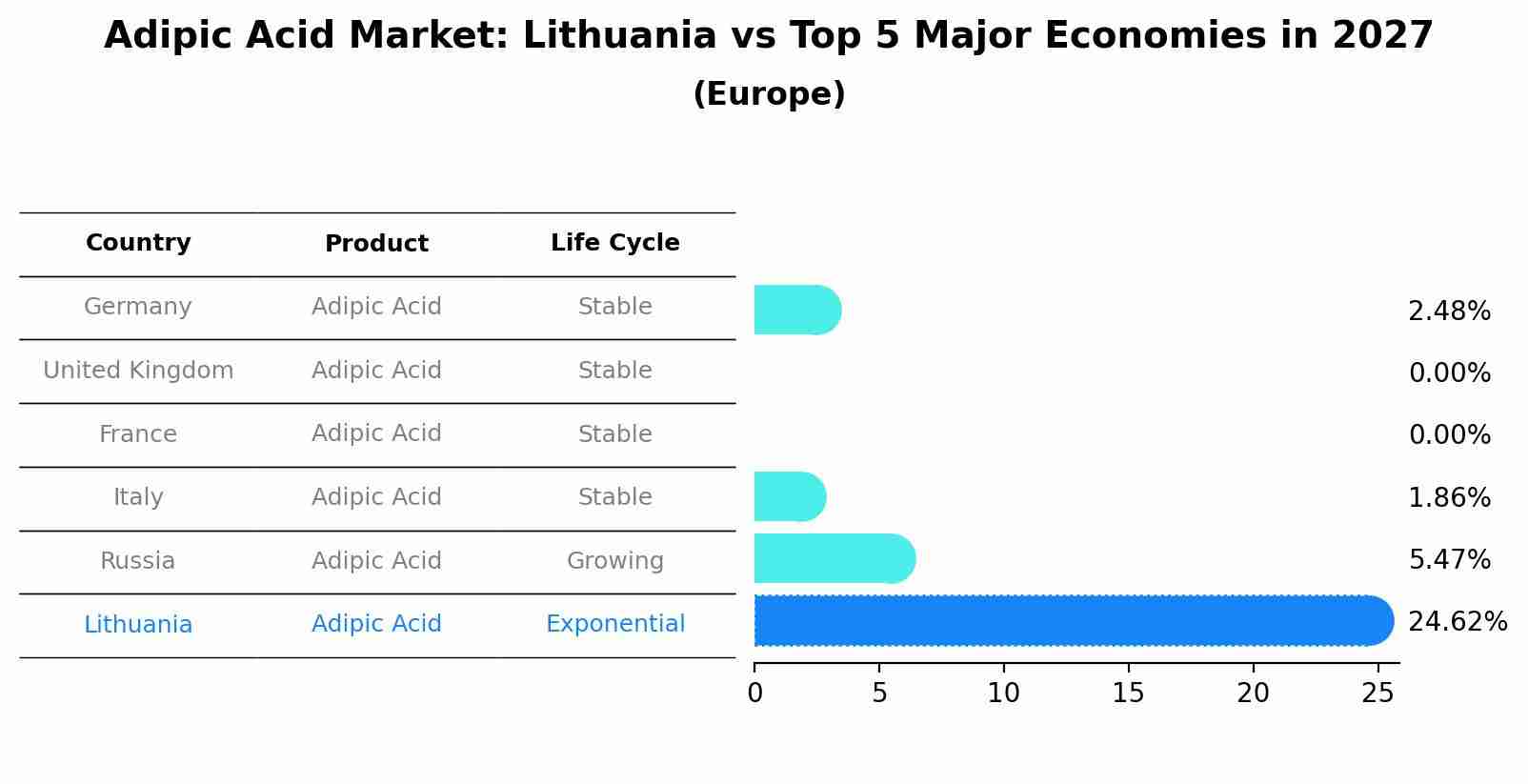
By 2027, Lithuania's Adipic Acid market is forecasted to achieve a exponential growth rate of 24.62%, with Germany leading the Europe region, followed by United Kingdom, France, Italy and Russia.
Key Highlights of the Report:
- Lithuania Adipic Acid Market Outlook
- Market Size of Lithuania Adipic Acid Market, 2024
- Forecast of Lithuania Adipic Acid Market, 2031
- Historical Data and Forecast of Lithuania Adipic Acid Revenues & Volume for the Period 2021-2031
- Lithuania Adipic Acid Market Trend Evolution
- Lithuania Adipic Acid Market Drivers and Challenges
- Lithuania Adipic Acid Price Trends
- Lithuania Adipic Acid Porter`s Five Forces
- Lithuania Adipic Acid Industry Life Cycle
- Historical Data and Forecast of Lithuania Adipic Acid Market Revenues & Volume By Applications for the Period 2021-2031
- Historical Data and Forecast of Lithuania Adipic Acid Market Revenues & Volume By Nylon 66 for the Period 2021-2031
- Historical Data and Forecast of Lithuania Adipic Acid Market Revenues & Volume By Plasticizers for the Period 2021-2031
- Historical Data and Forecast of Lithuania Adipic Acid Market Revenues & Volume By Polyurethanes for the Period 2021-2031
- Historical Data and Forecast of Lithuania Adipic Acid Market Revenues & Volume By Automotive for the Period 2021-2031
- Historical Data and Forecast of Lithuania Adipic Acid Market Revenues & Volume By Polyester Staple Fiber for the Period 2021-2031
- Lithuania Adipic Acid Import Export Trade Statistics
- Market Opportunity Assessment By Applications
- Lithuania Adipic Acid Top Companies Market Share
- Lithuania Adipic Acid Competitive Benchmarking By Technical and Operational Parameters
- Lithuania Adipic Acid Company Profiles
- Lithuania Adipic Acid Key Strategic Recommendations






































