Lithuania Non-Woven Fabric Market Size (2020-2030)
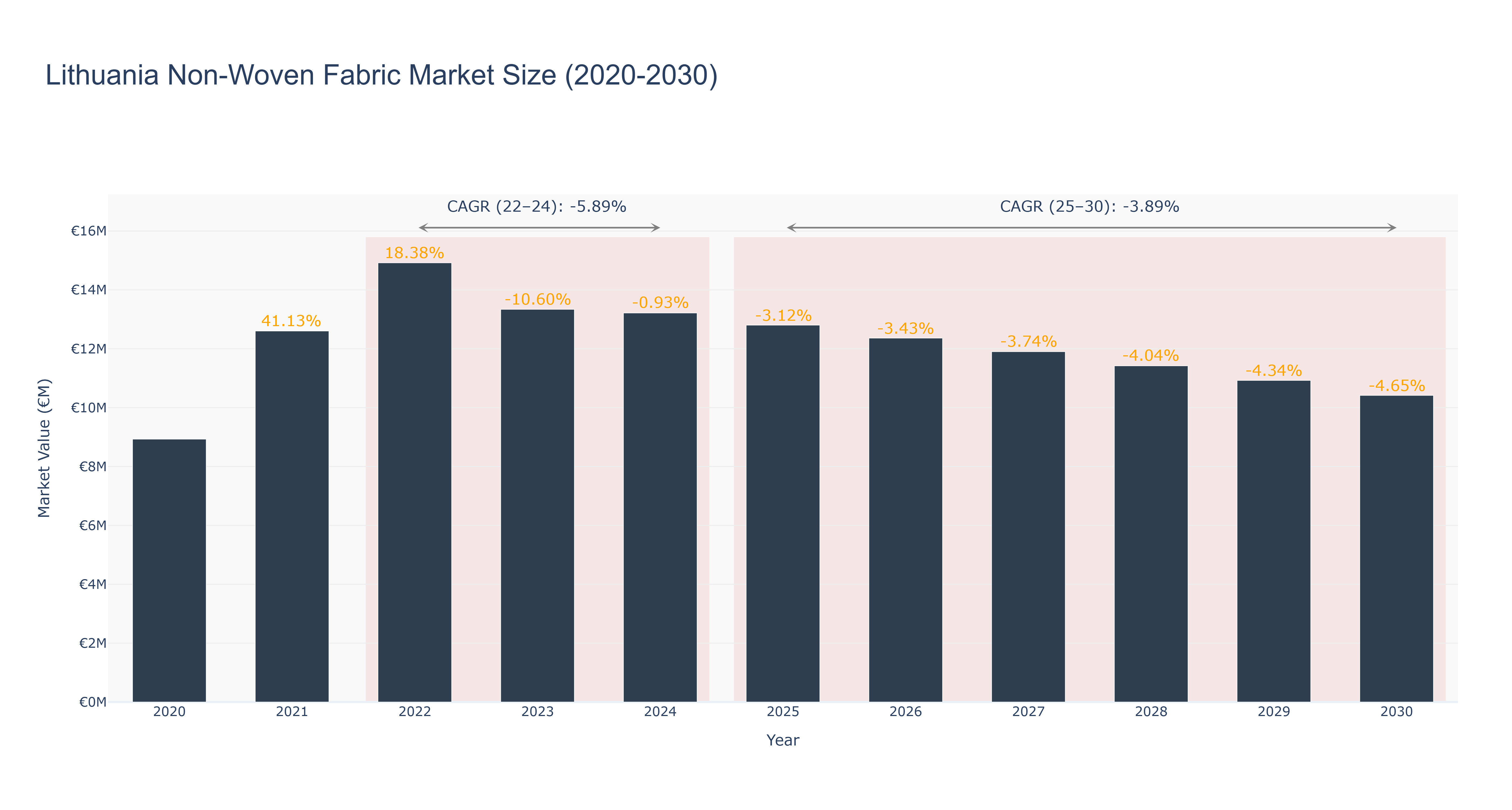
The Lithuania Non-Woven Fabric Market peaked in 2022 with a market size of €14.92 million. However, the market experienced a decline in subsequent years, reaching €12.80 million in 2025. The forecasted market size is expected to continue decreasing, reaching €10.42 million by 2030. The CAGR for the period 2022-24 was -5.89%, while for 2025-30, it is projected to be -3.89%. The downward trend in market size can be attributed to factors such as economic slowdown, changing consumer preferences, and increased competition. Despite the challenges, recent developments in sustainable non-woven fabrics and technological advancements are expected to drive future growth in the market. Future projects focusing on innovation and sustainability are likely to play a key role in revitalizing the Lithuania Non-Woven Fabric Market.
Lithuania Non-Woven Fabric Market: Production & Trade Performance (2019-2025)
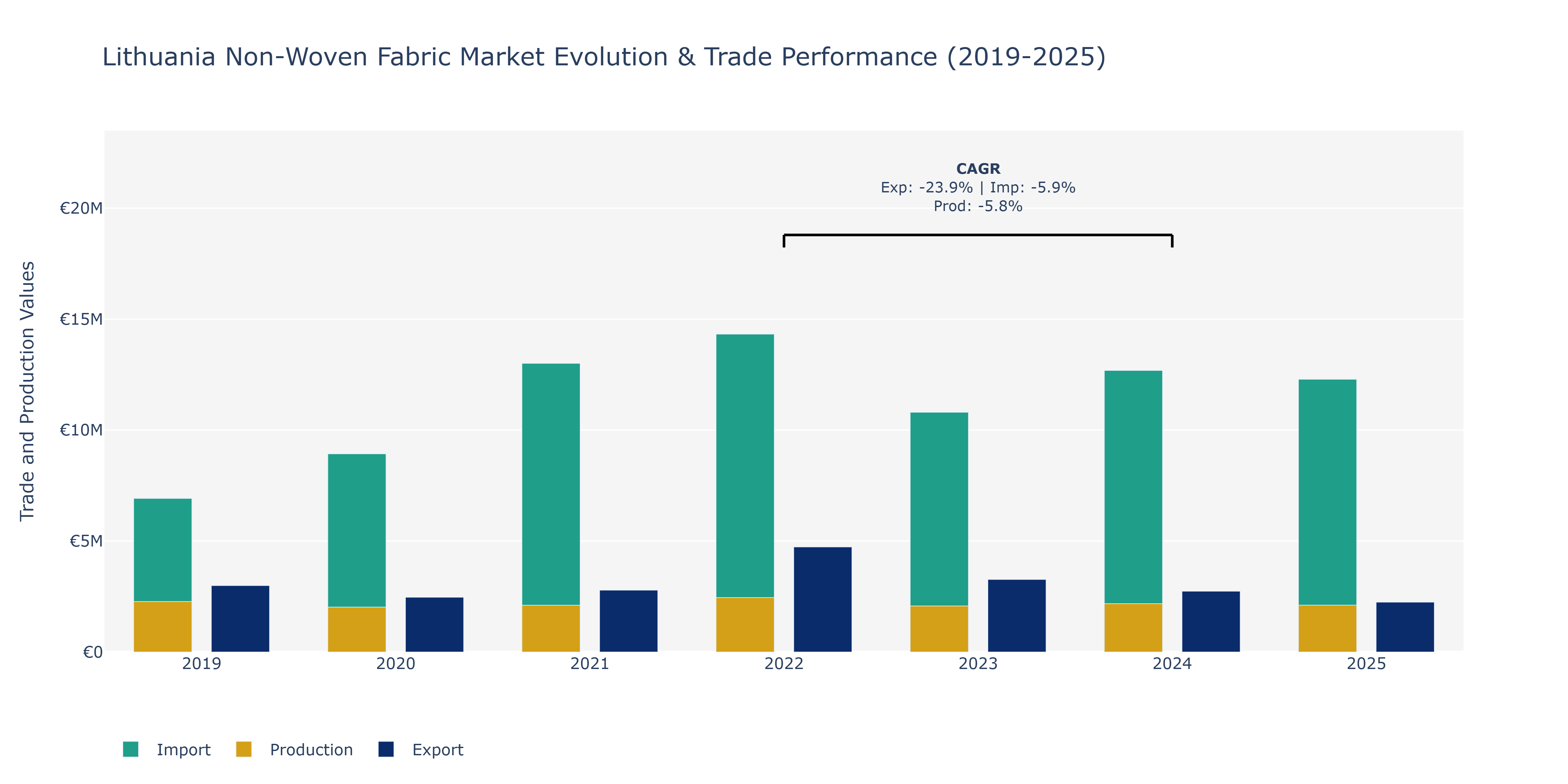
The Lithuania Non-Woven Fabric Market saw varied trends in Exports, Imports, and Production over the years. In 2019, Imports led at €6.92 million, with Exports at €2.99 million and Production at €2.27 billion. However, there was a notable decline in 2020 across all metrics, with Exports dropping to €2.47 million, Imports increasing to €8.93 million, and Production decreasing to €2.02 billion. The market showed signs of recovery in 2021, with Exports rebounding to €2.79 million, Imports rising to €13.01 million, and Production increasing to €2.11 billion. Exports peaked in 2022 at €4.74 million, while Imports continued to rise to €14.32 million, and Production also increased to €2.46 billion. The subsequent years witnessed fluctuations, with 2025 showing a decline in Exports to €2.25 million, stable Imports at €12.29 million, and a slight decrease in Production to €2.11 billion. These fluctuations can be attributed to global demand shifts, geopolitical factors affecting trade, and technological advancements enhancing production efficiency in the non-woven fabric industry.
Key Highlights of the Report:
- Lithuania Non-Woven Fabric Market Outlook
- Market Size of Lithuania Non-Woven Fabric Market, 2025
- Forecast of Lithuania Non-Woven Fabric Market, 2032
- Historical Data and Forecast of Lithuania Non-Woven Fabric Revenues & Volume for the Period 2022 - 2032
- Lithuania Non-Woven Fabric Market Trend Evolution
- Lithuania Non-Woven Fabric Market Drivers and Challenges
- Lithuania Non-Woven Fabric Price Trends
- Lithuania Non-Woven Fabric Porter's Five Forces
- Lithuania Non-Woven Fabric Industry Life Cycle
- Historical Data and Forecast of Lithuania Non-Woven Fabric Market Revenues & Volume By Technology for the Period 2022 - 2032
- Historical Data and Forecast of Lithuania Non-Woven Fabric Market Revenues & Volume By Spun-Bond for the Period 2022 - 2032
- Historical Data and Forecast of Lithuania Non-Woven Fabric Market Revenues & Volume By Wet Laid for the Period 2022 - 2032
- Historical Data and Forecast of Lithuania Non-Woven Fabric Market Revenues & Volume By Dry Laid for the Period 2022 - 2032
- Historical Data and Forecast of Lithuania Non-Woven Fabric Market Revenues & Volume By Others for the Period 2022 - 2032
- Historical Data and Forecast of Lithuania Non-Woven Fabric Market Revenues & Volume By Material for the Period 2022 - 2032
- Historical Data and Forecast of Lithuania Non-Woven Fabric Market Revenues & Volume By Polyester for the Period 2022 - 2032
- Historical Data and Forecast of Lithuania Non-Woven Fabric Market Revenues & Volume By Polypropylene for the Period 2022 - 2032
- Historical Data and Forecast of Lithuania Non-Woven Fabric Market Revenues & Volume By Polyethylene for the Period 2022 - 2032
- Historical Data and Forecast of Lithuania Non-Woven Fabric Market Revenues & Volume By Rayon for the Period 2022 - 2032
- Historical Data and Forecast of Lithuania Non-Woven Fabric Market Revenues & Volume By Others for the Period 2022 - 2032
- Historical Data and Forecast of Lithuania Non-Woven Fabric Market Revenues & Volume By End-User Industry for the Period 2022 - 2032
- Historical Data and Forecast of Lithuania Non-Woven Fabric Market Revenues & Volume By Construction for the Period 2022 - 2032
- Historical Data and Forecast of Lithuania Non-Woven Fabric Market Revenues & Volume By Textiles for the Period 2022 - 2032
- Historical Data and Forecast of Lithuania Non-Woven Fabric Market Revenues & Volume By Healthcare for the Period 2022 - 2032
- Historical Data and Forecast of Lithuania Non-Woven Fabric Market Revenues & Volume By Automotive for the Period 2022 - 2032
- Historical Data and Forecast of Lithuania Non-Woven Fabric Market Revenues & Volume By Others for the Period 2022 - 2032
- Lithuania Non-Woven Fabric Import Export Trade Statistics
- Market Opportunity Assessment By Technology
- Market Opportunity Assessment By Material
- Market Opportunity Assessment By End-User Industry
- Lithuania Non-Woven Fabric Top Companies Market Share
- Lithuania Non-Woven Fabric Competitive Benchmarking By Technical and Operational Parameters
- Lithuania Non-Woven Fabric Company Profiles
- Lithuania Non-Woven Fabric Key Strategic Recommendations






































