Lithuania Packaged Water Market Top 5 Importing Countries and Market Competition (HHI) Analysis
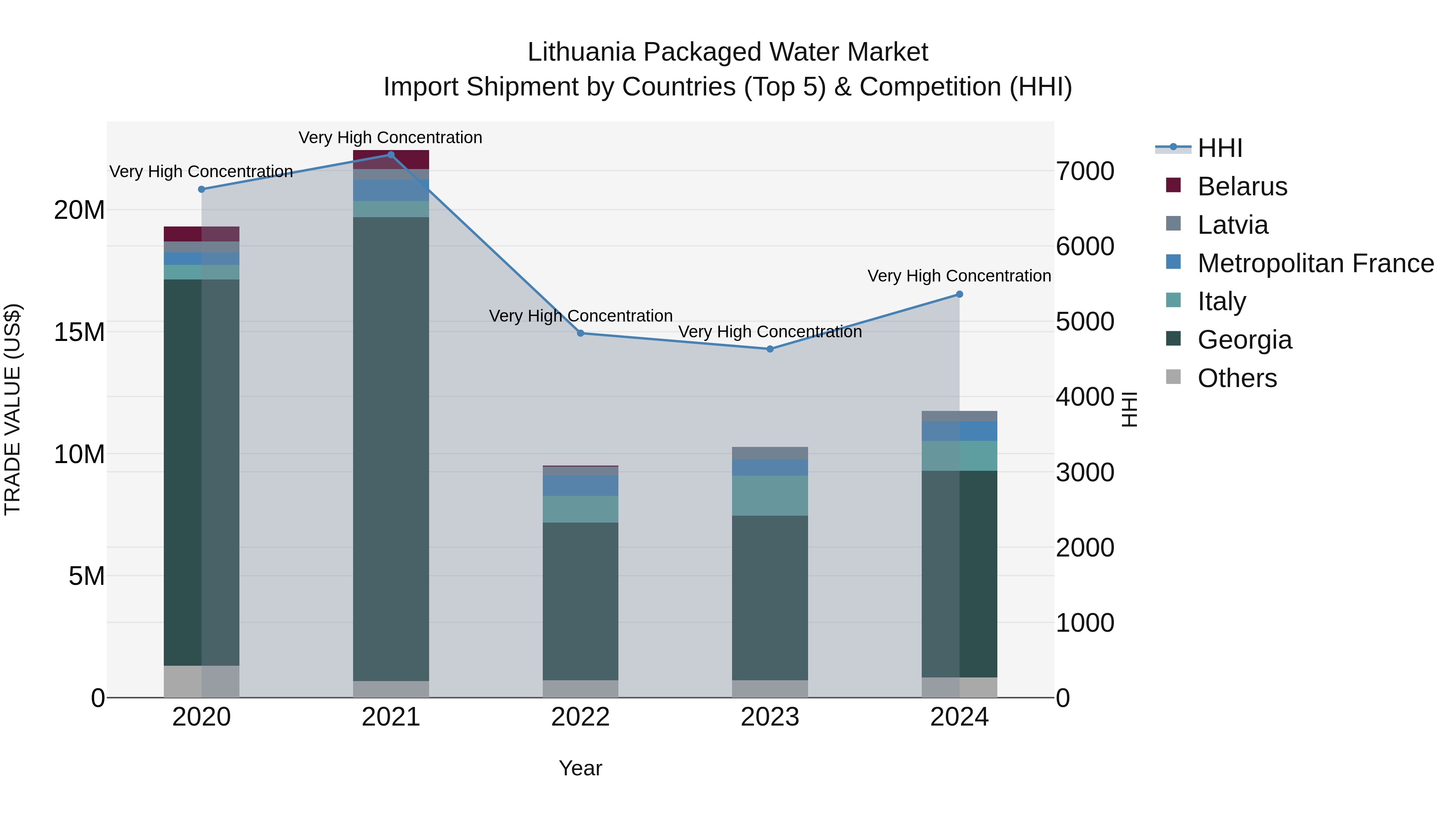
The Lithuania packaged water import market saw a significant increase in shipments in 2024, with top exporting countries being Georgia, Italy, Metropolitan France, Latvia, and Estonia. Despite the high concentration in the market, the compound annual growth rate (CAGR) from 2020 to 2024 was -11.69%, indicating a challenging period for the industry. However, there was a notable growth rate of 14.27% from 2023 to 2024, suggesting a potential turnaround in the market dynamics and opportunities for expansion in the coming years.
Lithuania Packaged water Market Overview
The Lithuania packaged water market is currently experiencing steady growth driven by factors such as increasing health consciousness among consumers, growing preference for convenience, and the rise in tourism activities. The market is characterized by intense competition among key players who are focusing on product innovation, environmentally friendly packaging, and strategic marketing initiatives to differentiate their offerings. Premiumization trends are also evident, with a shift towards higher quality and premium packaged water products. The market is expected to continue expanding, supported by rising disposable incomes, urbanization, and a shift towards healthier lifestyles. However, challenges such as environmental concerns related to plastic waste and regulatory issues regarding water quality standards may impact the market`s growth trajectory in the future.
Lithuania Packaged water Market Trends and Opportunities
The Lithuania Packaged water market is experiencing growth due to increasing health consciousness among consumers and a shift towards convenient on-the-go hydration options. The market is seeing a rise in demand for premium and functional water products such as vitamin-enhanced, flavored, and alkaline waters. Sustainability and eco-friendly packaging are also key trends, with consumers showing a preference for recyclable and biodegradable packaging materials. Opportunities exist for companies to innovate with unique flavors, functional ingredients, and sustainable packaging solutions to cater to evolving consumer preferences. Additionally, expanding distribution channels and increasing marketing efforts towards health-conscious consumers can further drive growth in the Lithuania Packaged water market.
Lithuania Packaged water Market Challenges
In the Lithuania Packaged water market, several challenges are prevalent. One key challenge is the increasing competition among various brands, leading to price wars and pressure on profit margins. Additionally, environmental concerns related to plastic packaging and the push for sustainable alternatives have prompted consumers to seek more eco-friendly options, impacting the demand for traditional packaged water products. Regulatory hurdles and stringent quality standards also pose challenges for market players, requiring compliance with strict guidelines for production and distribution. Moreover, fluctuating raw material costs and logistical issues in sourcing and distribution further complicate the operating environment for companies in the Packaged water market in Lithuania. To succeed in this highly competitive landscape, companies need to innovate, diversify product offerings, and adopt sustainable practices to meet evolving consumer preferences and regulatory requirements.
Lithuania Packaged water Market Drivers
The Lithuania Packaged water market is primarily driven by factors such as increasing health consciousness among consumers, growing awareness about the benefits of staying hydrated, and the convenience offered by packaged water products. The rising trend of on-the-go consumption, busy lifestyles, and a preference for safe and clean drinking water are also key drivers for the market. Additionally, concerns over water quality and contamination issues in tap water have led to a shift towards packaged water as a reliable and convenient alternative. Furthermore, the availability of various packaging sizes, innovative product offerings, and aggressive marketing strategies by manufacturers are driving the growth of the Packaged water market in Lithuania.
Lithuania Packaged water Market Government Policy
In Lithuania, the Packaged water market is regulated by various government policies aimed at ensuring the safety and quality of packaged water products. The Lithuanian government closely monitors and enforces regulations pertaining to water quality standards, packaging and labeling requirements, as well as hygiene and sanitation practices in production facilities. The State Food and Veterinary Service (VMVT) plays a key role in overseeing the compliance of packaged water producers with these regulations, conducting regular inspections and quality assessments. Additionally, there are specific regulations in place to address environmental concerns related to packaging waste and promote sustainable packaging practices within the industry. Overall, the government policies in Lithuania aim to safeguard consumer health, promote transparency in the market, and minimize the environmental impact of packaged water production and consumption.
Lithuania Packaged water Market Future Outlook
The future outlook for the Lithuania Packaged water market appears promising, with a growing trend towards health and wellness driving demand for convenient and safe drinking water options. Consumers are increasingly seeking low-calorie, sugar-free, and environmentally friendly beverage choices, positioning packaged water as a preferred alternative to sugary drinks. The market is expected to continue expanding as consumers become more health-conscious and prioritize hydration. Additionally, the convenience factor of packaged water makes it a popular choice for on-the-go consumption, further fueling market growth. With increasing disposable incomes and changing consumer preferences, the Lithuania Packaged water market is likely to witness steady growth in the coming years, presenting opportunities for market players to innovate and cater to evolving consumer needs.
Key Highlights of the Report:
- Lithuania Packaged water Market Outlook
- Market Size of Lithuania Packaged water Market, 2024
- Forecast of Lithuania Packaged water Market, 2031
- Historical Data and Forecast of Lithuania Packaged water Revenues & Volume for the Period 2021- 2031
- Lithuania Packaged water Market Trend Evolution
- Lithuania Packaged water Market Drivers and Challenges
- Lithuania Packaged water Price Trends
- Lithuania Packaged water Porter's Five Forces
- Lithuania Packaged water Industry Life Cycle
- Historical Data and Forecast of Lithuania Packaged water Market Revenues & Volume By Product for the Period 2021- 2031
- Historical Data and Forecast of Lithuania Packaged water Market Revenues & Volume By Still for the Period 2021- 2031
- Historical Data and Forecast of Lithuania Packaged water Market Revenues & Volume By Carbonated for the Period 2021- 2031
- Historical Data and Forecast of Lithuania Packaged water Market Revenues & Volume By Flavored for the Period 2021- 2031
- Historical Data and Forecast of Lithuania Packaged water Market Revenues & Volume By Functional for the Period 2021- 2031
- Lithuania Packaged water Import Export Trade Statistics
- Market Opportunity Assessment By Product
- Lithuania Packaged water Top Companies Market Share
- Lithuania Packaged water Competitive Benchmarking By Technical and Operational Parameters
- Lithuania Packaged water Company Profiles
- Lithuania Packaged water Key Strategic Recommendations






































