Lithuania Particle Board Market Size (2020-2030)
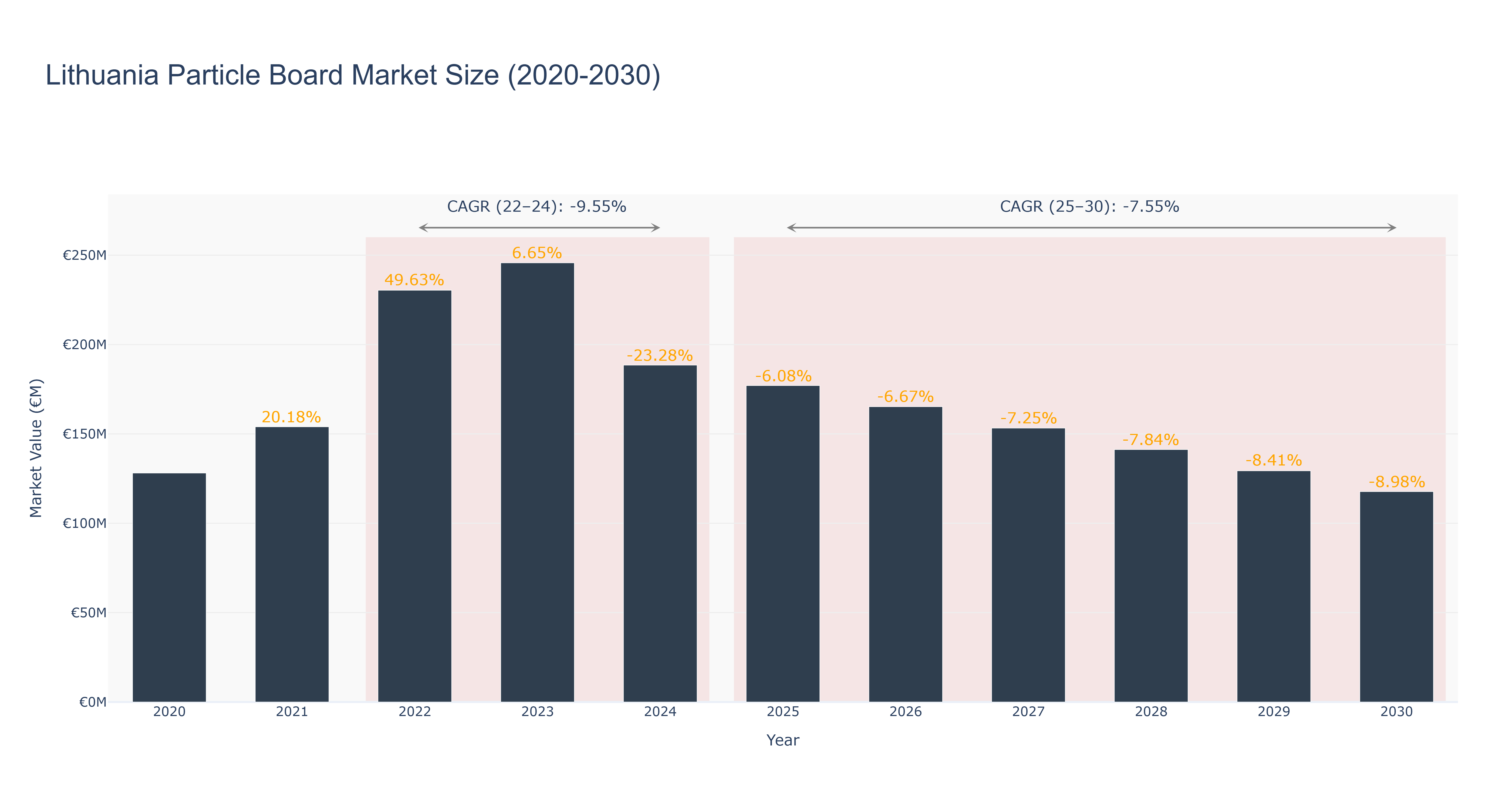
The Lithuania Particle Board Market experienced a peak size of €245.73 million in 2023, followed by a decline to €188.52 million in 2024. Forecasted market sizes show a continued decrease, with a projected value of €117.74 million in 2030. The CAGR from 2022-24 was -9.55%, while from 2025-30, it is expected to be -7.55%. The market faced a downturn due to economic factors impacting the construction industry, leading to reduced demand for particle boards. However, recent initiatives to promote sustainable building materials in Lithuania are expected to drive future growth. The upcoming introduction of stricter environmental regulations and increased focus on green construction practices are likely to boost demand for particle boards in the market.
Lithuania Particle Board Market: Production & Trade Performance (2019-2025)
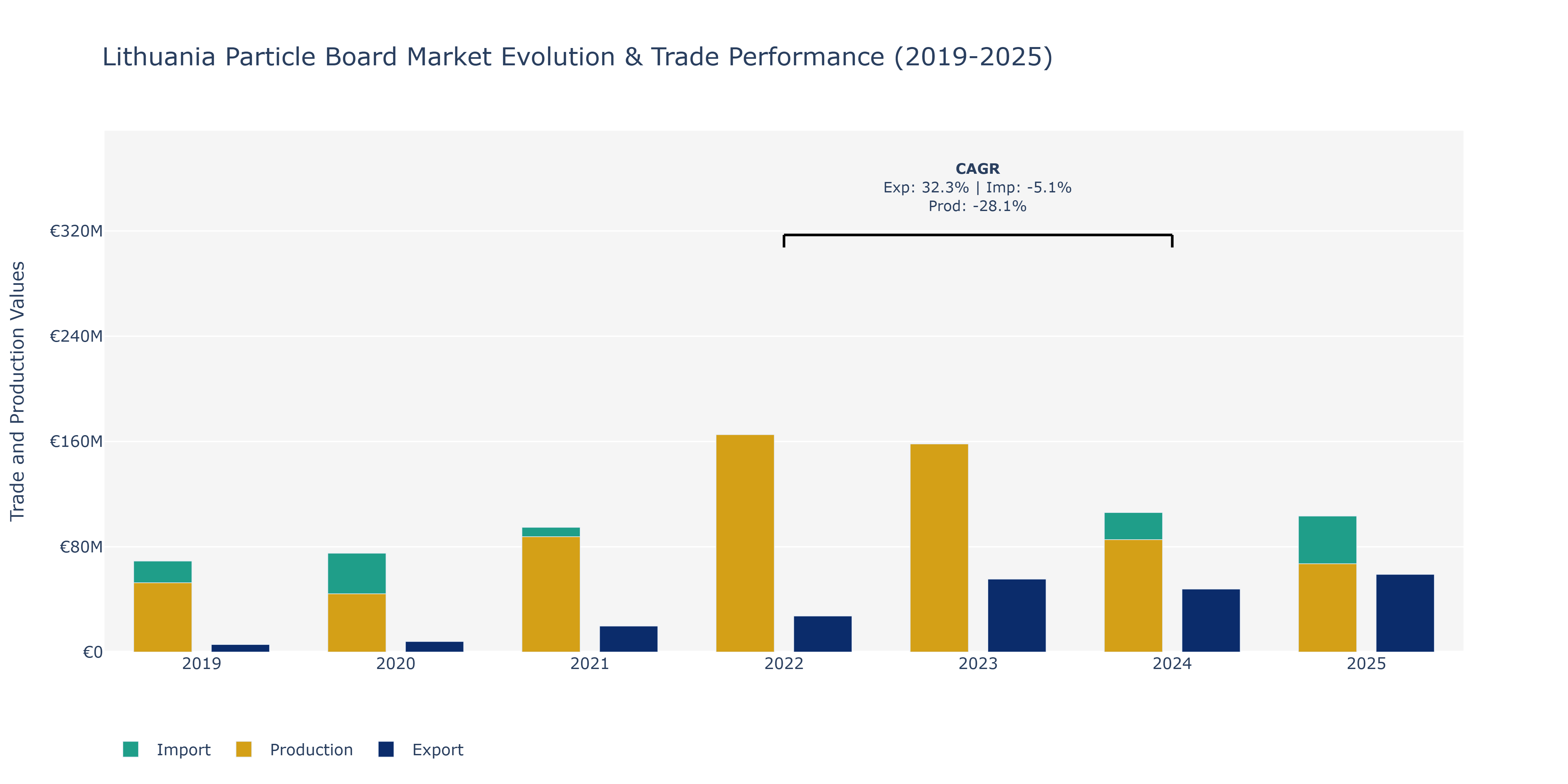
In the Lithuania Particle Board Market, from 2019 to 2025, Exports displayed a fluctuating pattern. Exports started at €5.69 million in 2019, increased to €8.04 million in 2020, peaked at €59.04 million in 2023, and then slightly declined to €59.04 million in 2025. This rise can be attributed to increasing global demand for particle board products from Lithuania due to their quality and competitive pricing. In contrast, Imports consistently rose from €69.16 million in 2019 to €103.33 million in 2025, reflecting a trend of steady growth in imported particle board products. The growth in Imports could be influenced by the need to supplement domestic production with foreign sources to meet local demand. On the other hand, Production experienced a notable decline from €52.61 million in 2019 to €67.07 million in 2025. This decline could be due to factors such as changes in market demand, fluctuations in raw material prices, or technological advancements affecting production efficiencies. To sustain and further develop the market, companies may need to focus on enhancing domestic production capabilities and optimizing supply chain strategies to compete effectively in the global particle board market.
Key Highlights of the Report:
- Lithuania Particle Board Market Outlook
- Market Size of Lithuania Particle Board Market, 2025
- Forecast of Lithuania Particle Board Market, 2032
- Historical Data and Forecast of Lithuania Particle Board Revenues & Volume for the Period 2022 - 2032F
- Lithuania Particle Board Market Trend Evolution
- Lithuania Particle Board Market Drivers and Challenges
- Lithuania Particle Board Price Trends
- Lithuania Particle Board Porter`s Five Forces
- Lithuania Particle Board Industry Life Cycle
- Historical Data and Forecast of Lithuania Particle Board Market Revenues & Volume By Type for the Period 2022 - 2032F
- Historical Data and Forecast of Lithuania Particle Board Market Revenues & Volume By Standard Chipboard for the Period 2022 - 2032F
- Historical Data and Forecast of Lithuania Particle Board Market Revenues & Volume By Melamine Veneered Chipboard for the Period 2022 - 2032F
- Historical Data and Forecast of Lithuania Particle Board Market Revenues & Volume By Flooring Grade Chipboard for the Period 2022 - 2032F
- Historical Data and Forecast of Lithuania Particle Board Market Revenues & Volume By Wood Veneered Chipboard for the Period 2022 - 2032F
- Historical Data and Forecast of Lithuania Particle Board Market Revenues & Volume By Plastic Veneered Chipboard for the Period 2022 - 2032F
- Historical Data and Forecast of Lithuania Particle Board Market Revenues & Volume By Other for the Period 2022 - 2032F
- Historical Data and Forecast of Lithuania Particle Board Market Revenues & Volume By Application for the Period 2022 - 2032F
- Historical Data and Forecast of Lithuania Particle Board Market Revenues & Volume By Construction for the Period 2022 - 2032F
- Historical Data and Forecast of Lithuania Particle Board Market Revenues & Volume By Furniture for the Period 2022 - 2032F
- Historical Data and Forecast of Lithuania Particle Board Market Revenues & Volume By Infrastructure for the Period 2022 - 2032F
- Historical Data and Forecast of Lithuania Particle Board Market Revenues & Volume By Other for the Period 2022 - 2032F
- Lithuania Particle Board Import Export Trade Statistics
- Market Opportunity Assessment By Type
- Market Opportunity Assessment By Application
- Lithuania Particle Board Top Companies Market Share
- Lithuania Particle Board Competitive Benchmarking By Technical and Operational Parameters
- Lithuania Particle Board Company Profiles
- Lithuania Particle Board Key Strategic Recommendations






































