Lithuania Rolling Mill Components And Ancillary Equipment Market Size (2020-2030)
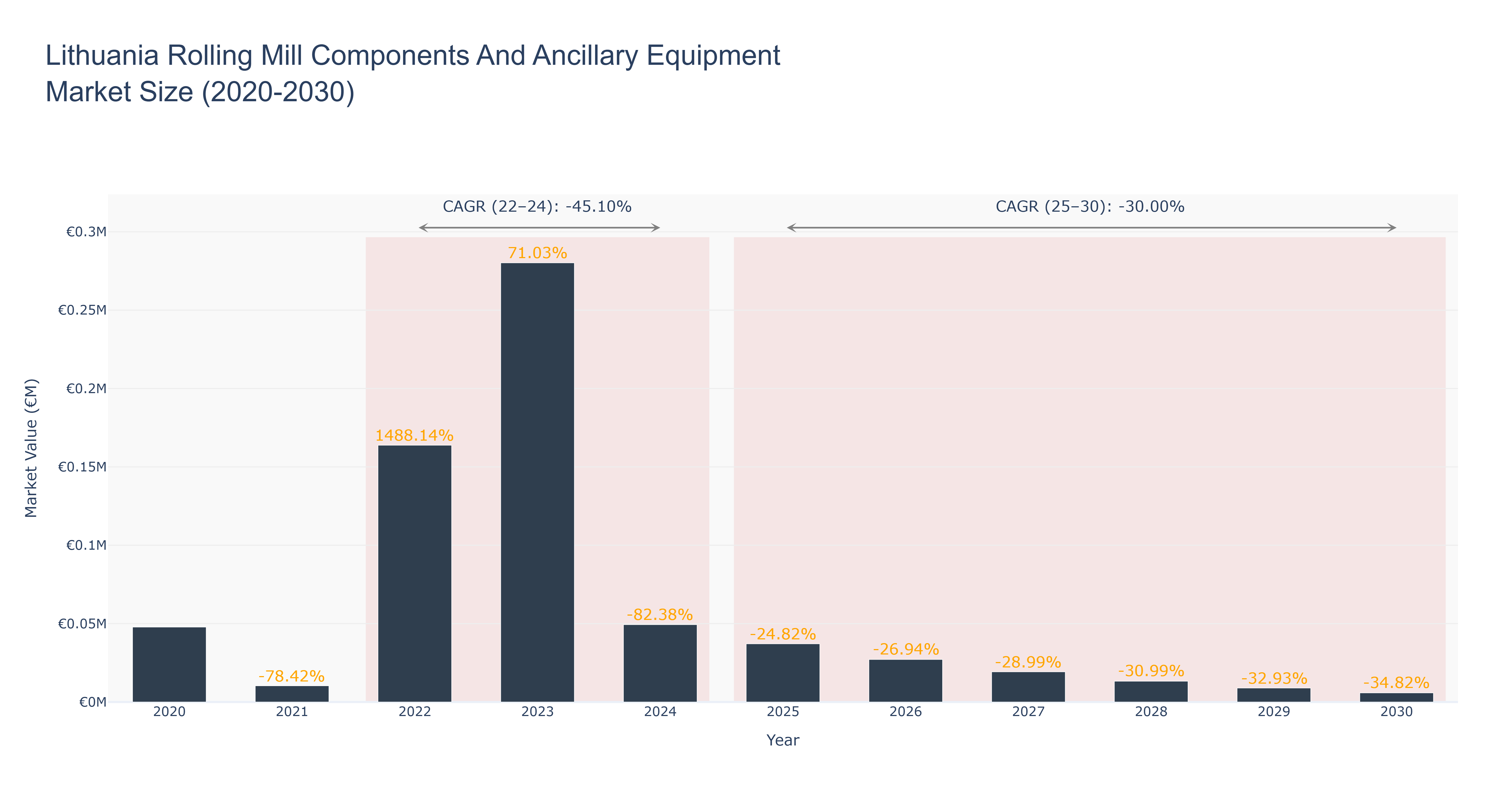
The Lithuania Rolling Mill Components And Ancillary Equipment Market experienced a peak market size of €0.28 million in 2023. From 2020 to 2024, the market size fluctuated significantly, starting at €0.05 million in 2020, dropping to €0.04 million in 2025, and then stabilizing around €0.03 million in 2026. The market is forecasted to continue its downward trend, with an expected size of €0.01 million by 2030. The CAGR for the period 2022-24 was -45.10%, reflecting a sharp decline, while the CAGR for 2025-30 is projected at -30.0%. The market's downturn can be attributed to global economic uncertainties impacting investment in ancillary equipment. Looking ahead, Lithuania aims to boost its manufacturing sector, which could potentially drive demand for rolling mill components and ancillary equipment in the near future.
Lithuania Rolling Mill Components And Ancillary Equipment Market: Production & Trade Performance (2019-2025)
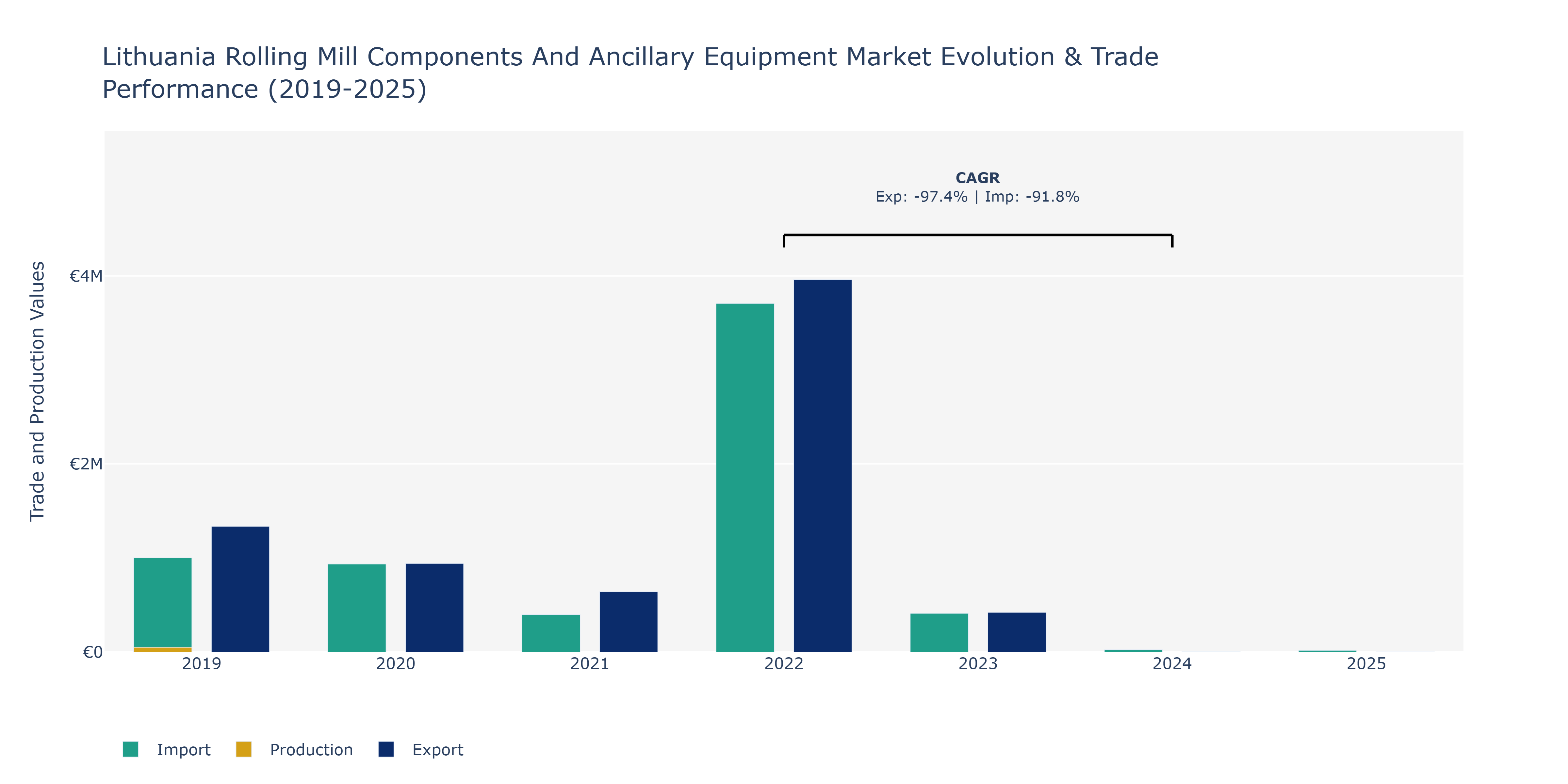
In the Lithuania Rolling Mill Components And Ancillary Equipment Market, exports saw a notable fluctuation from 2019 to 2025. Starting at €1.34 million in 2019, exports declined sharply in 2020 to €942.07 thousand, followed by a further decrease in 2021 to €640.67 thousand. However, a significant recovery was observed in 2022, reaching a peak of €3.96 million, before dropping again in the following years. Imports followed a similar trend, albeit with slightly lower figures, reaching €2.46 million in 2024. Production levels remained relatively stable over the years, hovering around €50 million. The fluctuations in exports and imports can be attributed to global economic conditions, trade agreements, and market demand for rolling mill components and ancillary equipment. The sharp declines in 2020 could be linked to the impact of the COVID-19 pandemic on international trade, while the subsequent recoveries might indicate a gradual stabilization of the market post-pandemic. Further research into evolving industry standards and technological advancements could provide deeper insights into these market dynamics.
Key Highlights of the Report:
- Lithuania Rolling Mill Components and Ancillary Equipment Market Outlook
- Market Size of Lithuania Rolling Mill Components and Ancillary Equipment Market, 2024
- Forecast of Lithuania Rolling Mill Components and Ancillary Equipment Market, 2031
- Historical Data and Forecast of Lithuania Rolling Mill Components and Ancillary Equipment Revenues & Volume for the Period 2021-2031
- Lithuania Rolling Mill Components and Ancillary Equipment Market Trend Evolution
- Lithuania Rolling Mill Components and Ancillary Equipment Market Drivers and Challenges
- Lithuania Rolling Mill Components and Ancillary Equipment Price Trends
- Lithuania Rolling Mill Components and Ancillary Equipment Porter`s Five Forces
- Lithuania Rolling Mill Components and Ancillary Equipment Industry Life Cycle
- Historical Data and Forecast of Lithuania Rolling Mill Components and Ancillary Equipment Market Revenues & Volume By Product for the Period 2021-2031
- Historical Data and Forecast of Lithuania Rolling Mill Components and Ancillary Equipment Market Revenues & Volume By Iron Rolls for the Period 2021-2031
- Historical Data and Forecast of Lithuania Rolling Mill Components and Ancillary Equipment Market Revenues & Volume By Steel Rolls for the Period 2021-2031
- Historical Data and Forecast of Lithuania Rolling Mill Components and Ancillary Equipment Market Revenues & Volume By Others for the Period 2021-2031
- Historical Data and Forecast of Lithuania Rolling Mill Components and Ancillary Equipment Market Revenues & Volume By End User for the Period 2021-2031
- Historical Data and Forecast of Lithuania Rolling Mill Components and Ancillary Equipment Market Revenues & Volume By Oil & Gas for the Period 2021-2031
- Historical Data and Forecast of Lithuania Rolling Mill Components and Ancillary Equipment Market Revenues & Volume By Industrial for the Period 2021-2031
- Historical Data and Forecast of Lithuania Rolling Mill Components and Ancillary Equipment Market Revenues & Volume By Automotive for the Period 2021-2031
- Historical Data and Forecast of Lithuania Rolling Mill Components and Ancillary Equipment Market Revenues & Volume By Mining for the Period 2021-2031
- Historical Data and Forecast of Lithuania Rolling Mill Components and Ancillary Equipment Market Revenues & Volume By Others for the Period 2021-2031
- Lithuania Rolling Mill Components and Ancillary Equipment Import Export Trade Statistics
- Market Opportunity Assessment By Product
- Market Opportunity Assessment By End User
- Lithuania Rolling Mill Components and Ancillary Equipment Top Companies Market Share
- Lithuania Rolling Mill Components and Ancillary Equipment Competitive Benchmarking By Technical and Operational Parameters
- Lithuania Rolling Mill Components and Ancillary Equipment Company Profiles
- Lithuania Rolling Mill Components and Ancillary Equipment Key Strategic Recommendations






































